
Why Farm Insurance Coverage Is Essential for Protecting Your Agricultural Investment
Farm insurance coverage is a specialized type of policy that protects your land, buildings, equipment, livestock, crops, and liability — all under one plan designed specifically for agricultural operations.
Here is a quick breakdown of what farm insurance typically covers:
| Coverage Area | What It Protects |
|---|---|
| Dwelling and structures | Your home and farm buildings |
| Farm equipment | Tractors, machinery, and tools |
| Livestock | Animals raised on the property |
| Crops and produce | Harvested and stored agricultural goods |
| Liability | Injuries or damage to others on your property |
| Additional living expenses | Temporary housing if your home is uninhabitable |
Farm insurance is not the same as homeowners insurance. Standard home policies leave out outbuildings, equipment, livestock, and the commercial risks that come with running a working farm.
Your farm is likely the largest investment you will ever make. One bad storm, one lawsuit, or one equipment fire could wipe out years of work without the right protection in place.
The Hornbuckle Agency brings nearly 18 years of experience helping rural Alabama families find the right farm insurance coverage for their operations. Whether you farm a few acres or manage a large diversified operation, this guide walks through every major coverage decision you need to make.
Core Components of Standard Farm Insurance Coverage

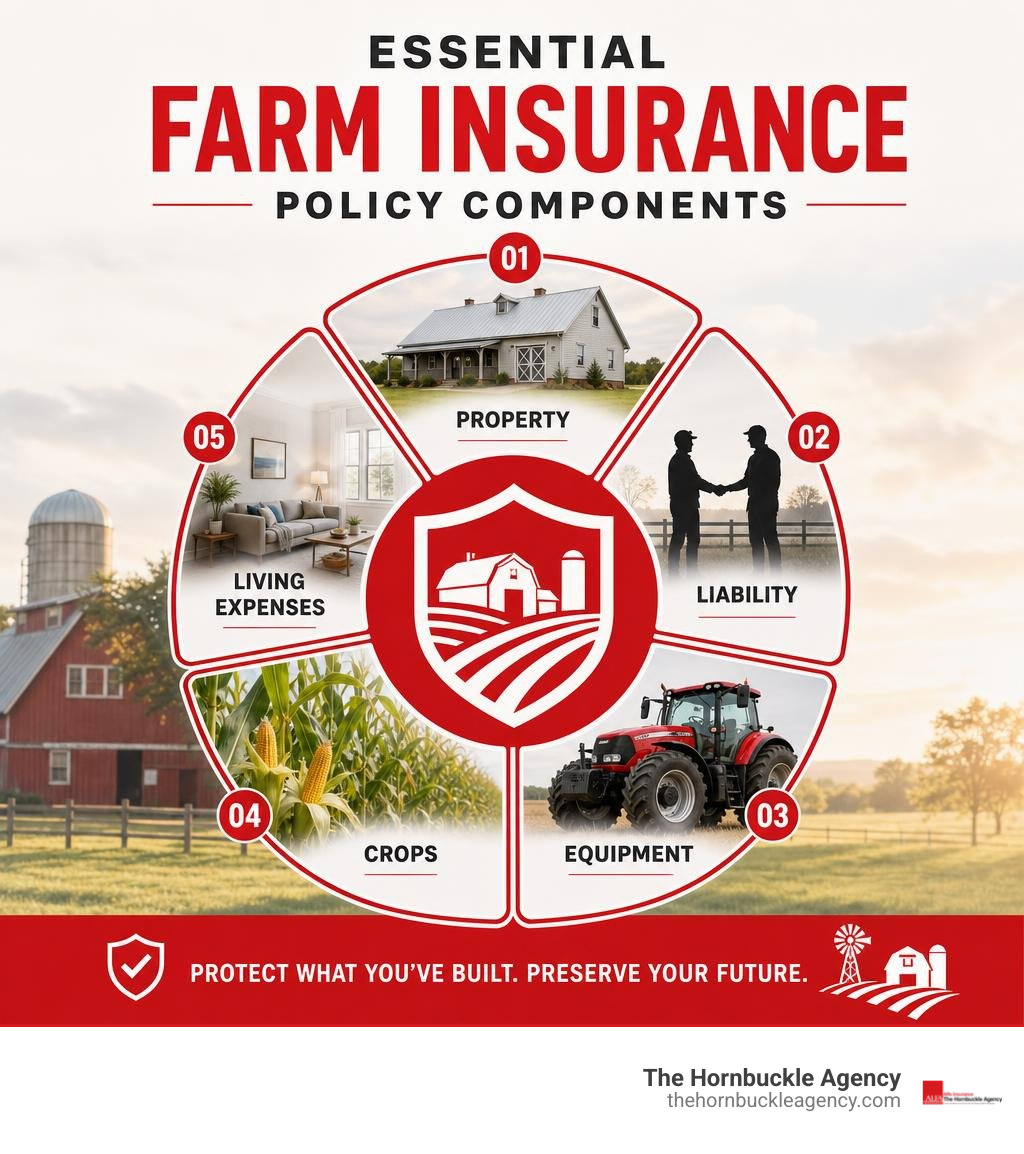
When you secure a policy, you are putting together a multi-layered shield over both your personal lifestyle and your commercial agricultural business. Standard farm policies combine residential protection with commercial property and liability protection into a single structured policy.
To explore how these pieces fit together for your specific location, taking a look at our Farm Insurance overview gives you a great starting point. Broadly speaking, a comprehensive policy breaks down into three distinct sections:
- Section I (Residential Property): Covers the primary dwelling, detached private structures (such as a personal garage), personal property, and additional living expenses.
- Section II (Farm Property): Covers dedicated farm buildings, structures, machinery, tools, livestock, and unharvested or stored produce.
- Section III (Liability): Protects against third-party bodily injury, property damage, and legal defense expenses tied to your agricultural practices.
Understanding valuation methods is vital here. Dwellings are frequently covered on a replacement cost basis, meaning the policy pays to rebuild with similar materials without deducting for depreciation. In contrast, farm outbuildings and agricultural structures often default to Actual Cash Value (ACV) unless explicitly endorsed otherwise on your declarations page. ACV takes age and depreciation into account when settling a loss.
Differentiating Farm Insurance Coverage from Homeowners Policies
A common misconception among modern property owners is believing that a standard home insurance plan provides adequate protection for a working parcel of land. While residential policies work well for traditional homes, they actively exclude commercial agricultural operations, specialized machinery, outbuildings used for business, and public liability risks. If you want to understand the exact limits of residential policies, review our guide on Home Insurance.
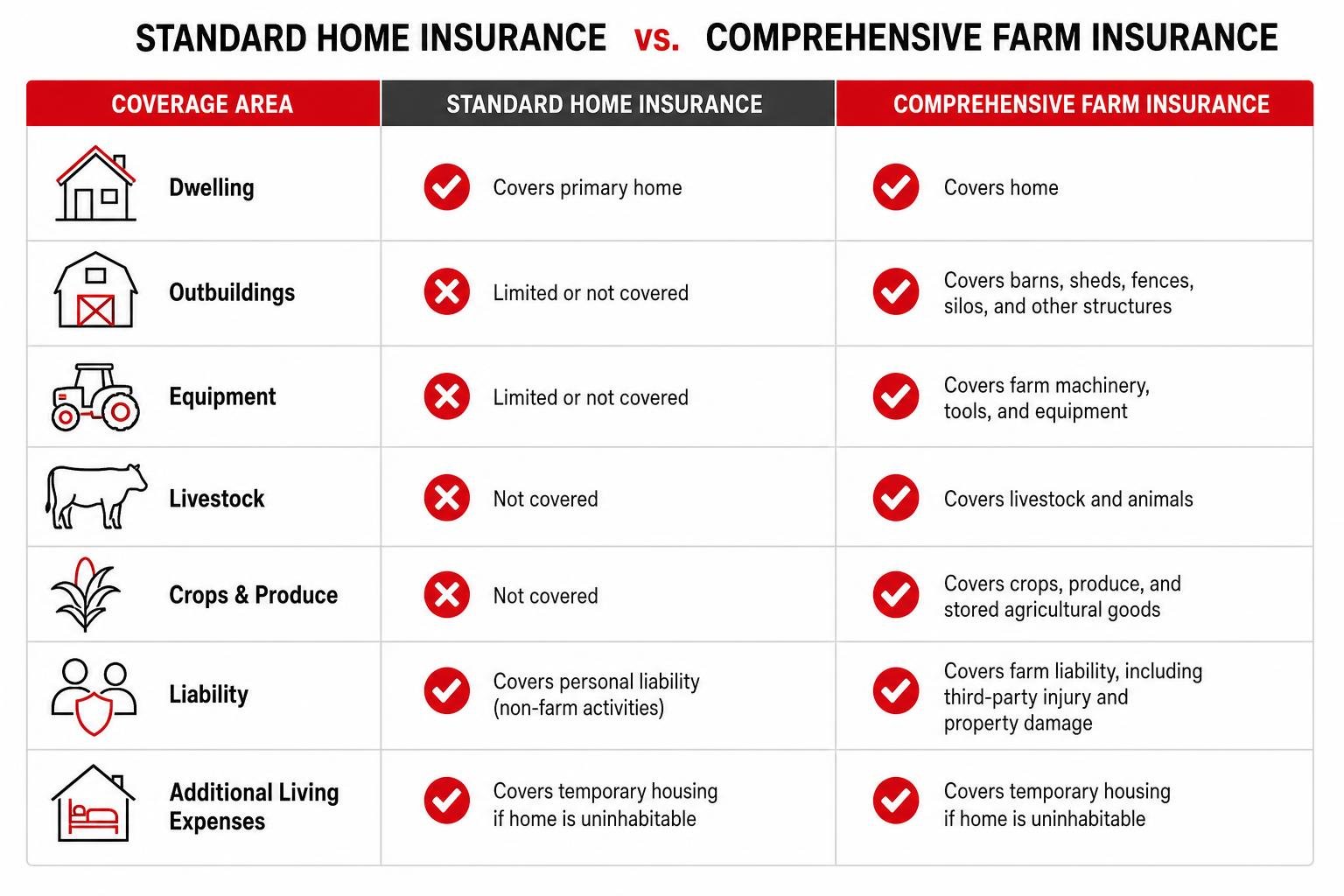
Standard home insurance plans explicitly limit or carve out agricultural risks. For instance, outbuildings, perimeter fences, and grain silos are not automatically protected under personal property limits. Furthermore, standard personal liability explicitly excludes damage or bodily injury arising from commercial farm labor or off-site equipment operation.
Another clear operational divide involves custom farming. If you take your tractor off your land to plow, plant, or harvest a neighbor’s property in exchange for payment, you enter the realm of commercial services. Standard policies exclude these commercial receipts, leaving a major protection gap if an accident happens off-site.
Essential Inclusions: Property, Liability, and Medical Expense Provisions
A well-structured agricultural policy addresses specific operational risks through essential core provisions:
- Property Damage Protection: Covers loss from specified perils such as fire, lightning, windstorm, hail, explosion, aircraft damage, vehicular damage, theft, and vandalism.
- Farm Liability: Defends you in court and pays court-ordered settlements or judgments if a visitor, contractor, or delivery driver is injured on your land or if your escaped livestock causes a motor vehicle accident on a public road.
- Voluntary Medical Payments: Pays reasonable medical bills for guests who suffer minor injuries on your property, regardless of legal fault. However, this coverage strictly excludes you and members of your immediate household.
- Additional Living Expenses (ALE): Pays for temporary housing, food, and emergency living costs if a covered fire or storm renders your primary farm dwelling uninhabitable.
Special Endorsements, Equipment, and Agri-Tourism Options

No two agricultural operations look identical. A poultry house requires completely different protection than a row-crop operation or an apple orchard. That is where policy endorsements come into play — specialized add-ons that customize your baseline policy to match your exact day-to-day operations.
For specialized operational needs, exploring tailored Commercial Insurance strategies ensures that commercial gaps are properly closed before a loss occurs.
Enhancing Farm Insurance Coverage for Tractors and Machinery
Your machinery and tractors represent significant capital investments. Standard farm property coverage may provide baseline protection, but high-value implements require scheduled equipment endorsements.
Scheduling your equipment involves listing every tractor, combine, baler, and attachment individually with its specific serial number and replacement value. This ensures full financial recovery if the item is lost to fire, rollover, or theft. Unscheduled broad machinery policies, by comparison, apply a blanket limit across all tools, which can leave expensive modern units underinsured.
When building equipment endorsements, keep these key risk protections in mind:
- Cab Glass Coverage: Pays for windshield and window replacement without requiring a full property deductible.
- Foreign Object Ingestion: Covers internal mechanical destruction if a log, rock, or metal scrap gets pulled into a combine or harvester.
- Mechanical Breakdown: Protects critical power systems and electrical components beyond normal wear and tear.
It is also important to maintain clear records for workers’ compensation and employee risk. Standard farm policies include voluntary employee compensation options or require separate statutory workers’ compensation policies depending on your payroll and state mandates.
Agri-Tourism Risk Management: Corn Mazes, Hayrides, and Public Access
Opening your land to the general public turns farm operations into a public venue. Whether you host seasonal corn mazes, operate pick-your-own pumpkin patches, offer public hayrides, or run petting zoos, inviting visitors onto your property introduces significant public liability risks.
Standard policy forms usually treat public agri-tourism as a commercial business enterprise rather than a traditional farming activity. If a visitor trips on uneven terrain, falls off a hayride, or suffers an animal bite, standard agricultural liability limits may decline the claim unless an agri-tourism or commercial endorsement is added.
Managing agri-tourism risks effectively requires a multi-tier safety plan:
- Obtain Commercial Endorsements: Formally report all public activities, ticket sales, and event schedules to your agent so commercial public liability is explicitly bound.
- Conduct Physical Safety Audits: Inspect walkways, secure perimeter fencing around active machinery, and maintain emergency access routes.
- Implement Product Liability Protection: If you sell raw honey, canned goods, baked items, or raw produce, secure product liability to protect against foodborne illness claims.
- Layer Liability with Excess Coverage: Explore expanded liability buffers through Umbrella Insurance to guard against catastrophic personal injury lawsuits.
Demystifying Federal Crop Insurance and Revenue Protection
While standard agricultural property policies protect physical structures and machinery, they do not protect growing crops from natural disasters like severe droughts, late spring freezes, hail, or falling market prices. For that, you need federal crop insurance programs administered by the USDA Risk Management Agency (RMA) and sold exclusively through private agents.
To understand how localized farm protection connects with regional risk management, take a moment to read about Protecting Your Farm and Home with ALFA Insurance in Marshall County.
Federal crop policies cover natural disasters including:
- Drought and heat stress
- Excessive moisture and flooding
- Hail, frost, and freeze
- Hurricanes, wind, and tornadoes
- Plant diseases, insect infestations, and wildlife damage
Understanding Whole-Farm Revenue Protection (WFRP) Rules
For diversified operations growing multiple crops, raising livestock, or selling direct-to-consumer goods, traditional single-crop policies can be tedious to manage. Whole-Farm Revenue Protection (WFRP) offers a single policy that secures all agricultural revenue generated under a single tax identification number. You can review official USDA standards directly in the WFRP Pilot Policy reference.
WFRP protects against overall income drops caused by natural disasters or market volatility, providing insured revenue limits up to $17 million.
Key terms to understand when building a WFRP strategy include:
- Allowable Revenue: The baseline farm income calculated directly from IRS Schedule F (Form 1040) tax records, excluding non-farm income, land sales, or timber.
- Approved Revenue: The expected revenue figure agreed upon by the insurer and producer, based on historical tax records and the annual Farm Operation Report.
- Whole-Farm History Period: The five consecutive historical tax years preceding the policy year, used to set the farm’s historical baseline revenue.
- Commodity Count: The number of distinct commodities produced on the farm that meet specific diversification thresholds, directly impacting available premium subsidies.
Special provisions also exist for Beginning Farmers or Ranchers (BFR) — defined as producers who have managed a farm or ranch for 10 policy years or fewer. BFR status grants access to extra federal premium subsidies and flexible baseline historical record requirements.
Umbrella Protection via Crop and Livestock Income Protection (CLIP)
Another modern tool for multi-commodity growers is Crop and Livestock Income Protection (CLIP). CLIP acts as an umbrella revenue protection mechanism that coordinates underlying Revenue Protection (RP) policies to offer higher overall protection across multiple commodities. Official operational rules can be referenced in the CLIP Insurance Handbook.
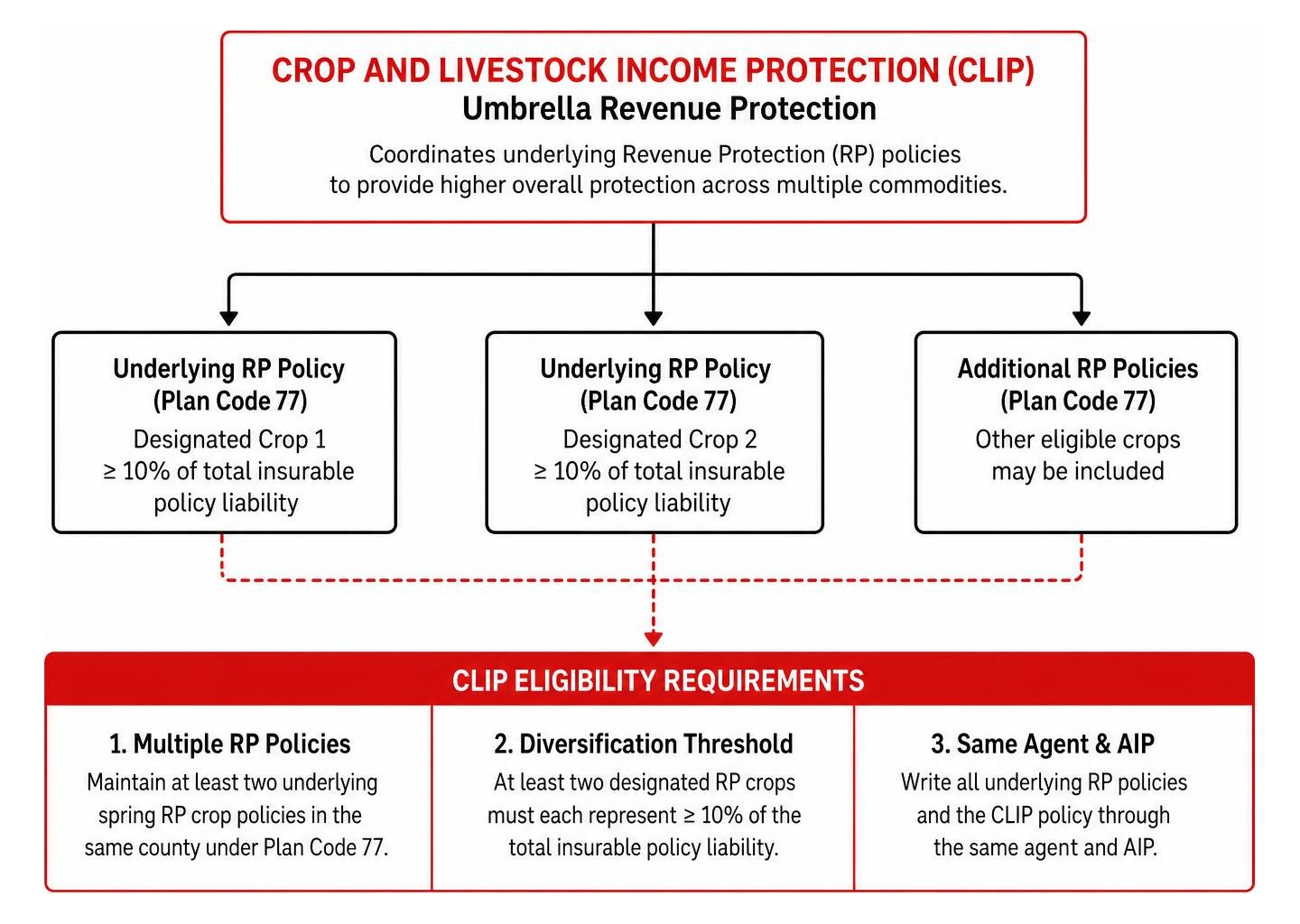
To qualify for CLIP umbrella coverage, your operation must satisfy strict criteria:
- Maintain at least two underlying spring Revenue Protection (RP) crop policies in the same county under Plan Code 77.
- Ensure that at least two designated RP crops each represent at least 10% of the total insurable policy liability.
- Write all underlying RP policies and the CLIP policy through the same agent and Approved Insurance Provider (AIP).
CLIP allows you to combine underlying coverage levels into an overarching revenue guarantee up to 85%. Subsidies cover a generous portion of the total cost: at a 70% coverage level, federal subsidies cover 80% of the premium, while at an 85% coverage level, subsidies pay 56% of the cost.
Policy Pricing, Claims Handling, and Consumer Rights
Understanding how your policy is priced — and how to navigate claims — empowers you to keep your operation fully protected without overpaying.
Factors Affecting Insurance Premiums and Deductibles
Insurers evaluate several risk factors when calculating your annual premium:
| Factor | Description & Operational Impact |
|---|---|
| Property Location | Geographic exposure to windstorms, severe weather, and local emergency response times. |
| Fire Protection Class | Distance to the nearest fire station, local water sources, and municipal hydrants. |
| Deductible Selection | Choosing higher deductibles lowers annual premiums; lower deductibles increase upfront costs. |
| Claims History | A clean claims record earns favorable rating credits and lowers overall renewal costs. |
| Safety & Security Plans | Documented safety plans, monitored fire alarms, and security gates lower risk ratings. |
Conducting an in-person, on-site walkthrough with a licensed agent is the best way to uncover hidden risks, verify replacement costs, and maximize premium discounts.
Claims Workflow, Dispute Rights, and Cancellation Rules
When property damage occurs, taking organized action speeds up loss recovery and protects your rights:
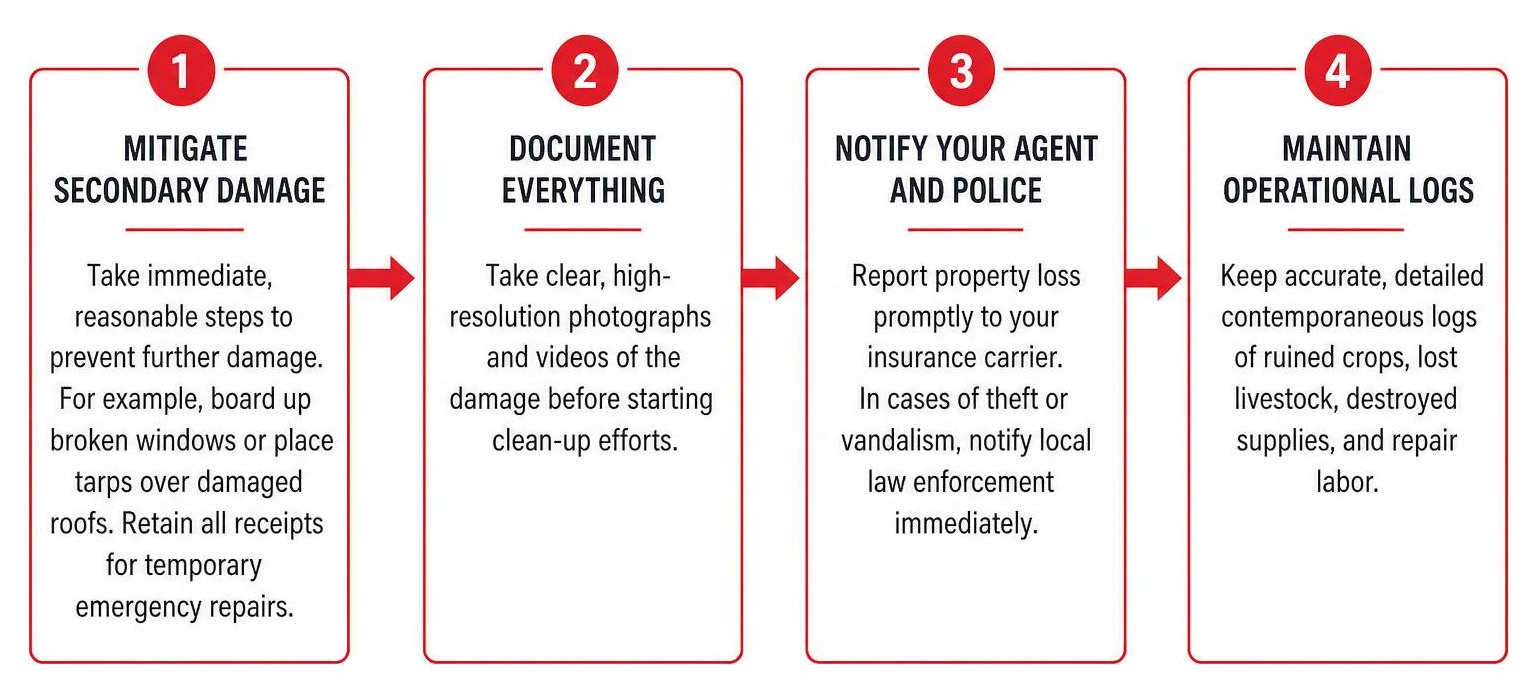
- Mitigate Secondary Damage: Take immediate, reasonable steps to prevent further damage. For example, board up broken windows or place tarps over damaged roofs. Retain all receipts for temporary emergency repairs.
- Document Everything: Take clear, high-resolution photographs and videos of the damage before starting clean-up efforts.
- Notify Your Agent and Police: Report property loss promptly to your insurance carrier. In cases of theft or vandalism, notify local law enforcement immediately.
- Maintain Operational Logs: Keep accurate, detailed contemporaneous logs of ruined crops, lost livestock, destroyed supplies, and repair labor.
Understand your regulatory rights regarding policy management. Insurers must issue formal written notice prior to canceling or non-renewing a policy — typically a 10-day advance notice for non-payment of premium. Giving intentional misrepresentations or hiding critical operational facts on an application can invalidate coverage entirely. Pay premiums via traceable checks or electronic transfers to avoid billing disputes.
Frequently Asked Questions About Farm Insurance
How does custom farming affect standard policy terms?
Custom farming refers to operating your machinery on someone else’s land for financial payment. Standard policies treat casual, non-monetary neighborly work exchanges as covered farming activities. However, once your custom farming receipts reach or exceed $10,000 in a calendar year, insurers classify it as a commercial activity. You must add a specific Custom Farming Endorsement to preserve liability and machinery coverage while working off-premises.
What steps should I take immediately after sustaining farm property damage?
First, secure the area to ensure family and employee safety. Next, take photographs of the damage from multiple angles. Perform minor emergency repairs — such as boarding up broken doors or covering open roofs with tarps — to prevent weather elements from causing secondary water damage. Keep every repair receipt and present them to your claims adjuster along with an itemized inventory of damaged property.
Can an insurance carrier cancel my policy for a late payment?
Yes. Insurance carriers are legally permitted to issue a cancellation notice if a premium payment is missed. In most jurisdictions, carriers must send a formal 10-day advance notice before policy cancellation for non-payment takes effect. To avoid lapse in coverage, set up automatic bank transfers or make payments via trackable online methods.
Conclusion
Your farm is far more than a business — it is your livelihood, your family heritage, and your home. Securing robust farm insurance coverage means protecting every piece of that legacy, from your primary dwelling and outbuildings to your machinery, livestock, crops, and public liability.
At The Hornbuckle Agency, we deliver personalized risk education and clear policy guidance so you can make confident decisions about your coverage. The Hornbuckle Agency serves multiple Alabama communities, including Albertville, Guntersville, Boaz, Arab, Geraldine, Crossville, Collinsville, Horton, and Douglas.
Reach out to our team today to schedule an on-site property walkthrough, audit your current policy, and discover how our tailored Farm Insurance policy guidance can keep your operation safe for generations to come.
