
Why Homeowners Insurance Is One of the Most Important Decisions You’ll Make
Homeowners insurance is a policy that protects your home, your belongings, and your finances when something unexpected goes wrong — like a fire, a theft, or someone getting hurt on your property.
Here’s a quick summary of what it does:
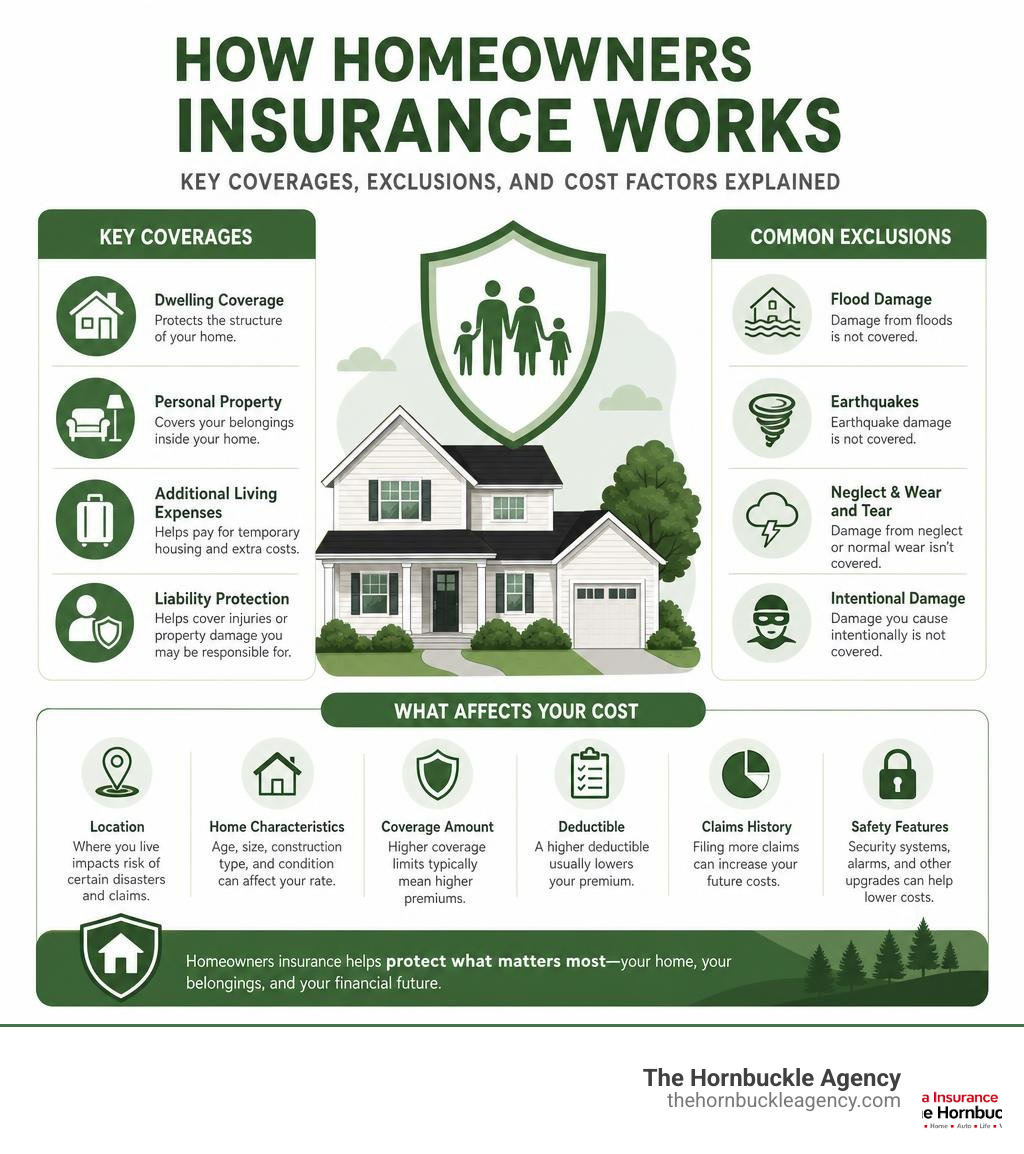
- Covers your home’s structure if it’s damaged by fire, wind, hail, or other covered events
- Protects your personal belongings like furniture, clothing, and electronics
- Pays for temporary housing if your home becomes unlivable after a covered loss
- Shields you from liability if someone is injured on your property
Most homeowners can’t afford to rebuild their home and replace everything in it out of pocket after a disaster. That’s exactly what this coverage is for.
For rural Alabama families, this protection matters more than most people realize. Your home is likely your single biggest investment — and more than half of U.S. homes are underinsured, meaning many homeowners would face serious financial gaps if they had to file a major claim today.
This guide walks you through everything you need to know — from what’s covered to how much you actually need and what it will cost.
Understanding the Basics of Homeowners Insurance

When you buy a home in Marshall County, whether it’s a historic craftsman in Guntersville or a new build in Albertville, you aren’t just buying four walls and a roof. You are buying a sanctuary for your family and a vault for your hard-earned belongings.
A standard homeowners insurance policy is actually a “package policy.” This means it bundles several different types of financial protection together so you don’t have to buy a dozen different policies just to keep your household safe. From liability protection if a visitor trips on your porch to repairing your living room after a severe storm, your policy structure is designed to keep you from starting over at square zero.
Understanding how these pieces fit together is the first step toward securing the right Home Insurance policy for your needs.
What Does a Standard Policy Cover?
A standard policy (often referred to in the industry as an HO-3 policy) is divided into several clear coverage areas. Each has its own limit, which is the maximum amount your insurance provider will pay out for a covered loss:
- Dwelling Coverage (Coverage A): This is the core of your policy. It covers the physical structure of your home—the foundation, walls, roof, and built-in appliances. If a tornado sweeps through Albertville and damages your roof, dwelling coverage pays to repair or rebuild it.
- Other Structures (Coverage B): This covers structures on your property that aren’t physically attached to your house. Think detached garages, tool sheds, fences, greenhouses, or even a boat dock on Lake Guntersville. Typically, this limit is set at 10% of your dwelling coverage.
- Personal Property (Coverage C): This covers your “stuff”—your furniture, clothes, electronics, sporting goods, and kitchen appliances. This coverage even travels with you. If your laptop is stolen from your car while you are shopping in Boaz, your home insurance usually covers it. Standard policies typically cover personal belongings at 50% to 70% of the dwelling limit. However, keep in mind there are special sub-limits for high-value items like jewelry, silverware, and cash (for example, many standard policies cap theft coverage for jewelry at $500 to $1,500 unless you add a special rider).
- Loss of Use / Additional Living Expenses (Coverage D): If a fire renders your home temporarily uninhabitable, you can’t exactly camp out in the front yard. Loss of use coverage pays for your temporary housing, restaurant meals, and other increased living expenses while your home is being rebuilt or repaired.
- Personal Liability (Coverage E): If a guest slips on pool-deck moisture or your dog accidentally bites a visitor, you could be held legally responsible. Personal liability coverage pays for legal defense fees and court-ordered judgments up to your policy limits (which typically start at $100,000, though we strongly recommend higher limits).
Common Exclusions in Homeowners Insurance
While standard policies are incredibly broad, they do not cover everything. Believing that your home insurance is an all-powerful shield against every imaginable disaster is one of the most dangerous mistakes a homeowner can make.
Standard policies specifically exclude:
- Flood Damage: Standard homeowners insurance does not cover damage caused by rising surface water, overflowing lakes, or storm surges. Even a localized flash flood in Boaz won’t be covered under your standard policy.
- Earth Movement: Earthquakes, landslides, and mudslides are excluded.
- Neglect and Maintenance Issues: If your roof leaks because it is 30 years old and missing half its shingles, or if termites chew through your floor joists, insurance will not pay for the repairs. Home insurance is for sudden, accidental occurrences—not basic home maintenance.
- Sewer Backups: Unless you add a specific water backup endorsement, damage from backed-up sewers or failed sump pumps is usually excluded.
For those looking to protect their assets from catastrophic liability claims that exceed standard policy limits, we often recommend looking into Umbrella Insurance to provide an extra layer of security.
Determining How Much Coverage You Need

One of the most common questions we hear at The Hornbuckle Agency is: “Should I insure my house for what I paid for it, or what it would sell for today?”
The short answer is: Neither.
You should insure your home for its estimated replacement cost—which is the actual dollar amount it would take to rebuild your home from scratch using local labor and materials, excluding the value of the land.
If you base your coverage on your home’s market value, you might end up dangerously underinsured. For instance, in July 2026, building material costs and labor shortages continue to fluctuate. If a widespread storm damages dozens of homes in Marshall County simultaneously, local construction costs will spike due to supply and demand. If your policy limits are too low, you could be left paying tens of thousands of dollars out of pocket.
Actual Cash Value vs. Replacement Cost
How your insurance company calculates payouts makes a massive difference in how much money you receive after a disaster. There are three main levels of coverage:
| Coverage Type | How It Works | Impact on Your Payout |
|---|---|---|
| Actual Cash Value (ACV) | Pays the cost to replace the item minus depreciation for age and wear. | If your 15-year-old roof is destroyed, you will only receive a fraction of what a new roof costs because the roof has lost value over time. |
| Replacement Cost (RC) | Pays the actual cost to repair or replace the damaged property with materials of like kind and quality, without deducting for depreciation. | You get a brand-new roof of similar quality, minus your deductible. |
| Guaranteed / Extended Replacement Cost | Pays to rebuild your home even if the cost exceeds your policy limit (usually up to an extra 20% to 25% over the limit). | Protects you against sudden post-disaster spikes in construction and labor costs. |
To protect your family’s financial future, we always advise choosing replacement cost coverage for both your dwelling and your personal property.
The 80% Rule in Homeowners Insurance
Many homeowners are unaware of the “80% rule” written into most insurance contracts. This rule states that you must maintain dwelling coverage equal to at least 80% of your home’s total replacement value at the time of a loss.
If your coverage falls below that 80% threshold, your insurance company will not pay the full cost of a partial claim. Instead, they will apply a coinsurance penalty, paying only a proportional percentage of the claim or the actual cash value of the damage—whichever is less. Keep your coverage updated, especially if you have recently remodeled your kitchen or added a deck!
Key Factors That Influence Your Premium Costs
Every home is unique, and so is every insurance premium. When underwriters calculate your rate, they are essentially trying to predict how likely you are to file a claim and how much that claim will cost.
Understanding these factors can help you find ways to save.
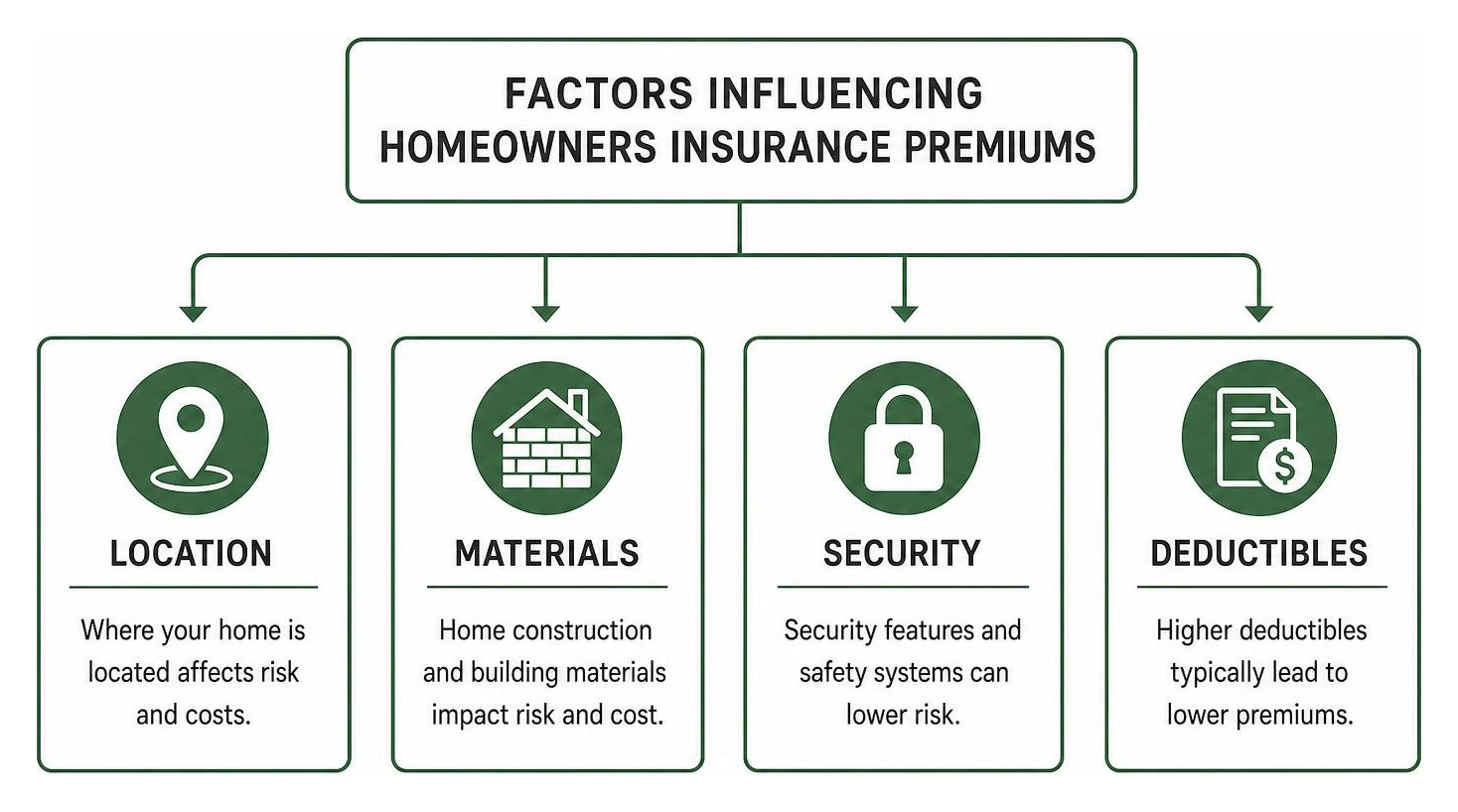
Here are the primary drivers behind your premium costs:
- Your Deductible: Your deductible is the amount you pay out of pocket before your insurance coverage kicks in. Choosing a higher deductible (like $2,500 instead of $1,000) reduces the insurer’s risk and lowers your monthly premium.
- Your Claim History: If you have filed multiple property claims in the past three to five years, insurers may view you as a higher risk, which can raise your rates.
- Safety and Security Features: Homes equipped with smoke detectors, deadbolt locks, fire extinguishers, and active security systems generally qualify for discounts.
Property Location and Local Risks
Where you live plays a massive role in your premium. Insurance companies look closely at regional weather patterns, crime rates, and proximity to emergency services.
In Marshall County, our beautiful landscape comes with unique regional risks. We are no strangers to severe spring storms, hail, and tornadoes. Because of this, homes in Albertville, Boaz, and Guntersville may have different risk profiles than homes in other parts of the country.
Furthermore, your proximity to a local fire department and hydrants is evaluated using a Public Protection Classification (PPC) score. If you live within city limits near municipal water lines, your rate will likely be lower than if you live in a highly rural pocket of the county. For local municipal resources, you can always check the official Marshall County Online portal.
While there are many corporate options out there, we at The Hornbuckle Agency pride ourselves on providing that personalized, local Alfa Insurance touch—helping you navigate these regional risks with real local expertise.
Home Age, Construction, and Safety Features
The physical characteristics of your home are just as important as its location:
- The Roof: A brand-new roof made of impact-resistant shingles is highly attractive to insurers. An old, worn roof is a claim waiting to happen, and some insurers may refuse to cover a home with a roof that is over 15 or 20 years old without a surcharge.
- Construction Materials: Brick and masonry homes generally cost less to insure against fire than wood-framed homes, though wood-framed homes may perform better in earthquake zones.
- Electrical and Plumbing Systems: Older homes with outdated wiring (like knob-and-tube or aluminum wiring) or old galvanized steel pipes are prone to fires and water leaks, which can drive premiums up. Upgrading these systems is a great way to protect your home and lower your insurance bills.
Frequently Asked Questions about Home Insurance
Navigating insurance jargon can feel like trying to read a map upside down. To help clear things up, we’ve compiled answers to the most common questions we receive from local homeowners.
Is home insurance required by law?
Technically, no. Unlike auto insurance, there is no state or federal law in Alabama that forces you to buy homeowners insurance.
However, if you have a mortgage, your lender absolutely will require it. Because the home serves as collateral for your loan, the bank wants to ensure their investment is protected. If you let your policy lapse, your lender has the right to purchase “force-placed insurance” on your behalf and bill you for it. Force-placed insurance is almost always significantly more expensive than a policy you find yourself, and it typically only protects the lender’s financial interest—not your personal belongings or liability.
Do standard policies cover flood or earthquake damage?
No. As mentioned earlier, standard policies exclude earthquakes and floods.
If you live near the water in Guntersville or in low-lying areas prone to heavy rain accumulation, you should seriously consider a separate flood insurance policy through the National Flood Insurance Program (NFIP). Similarly, if you live in a manufactured home on Sand Mountain, standard policies won’t fit your needs; you will need specialized Manufactured Home Insurance designed for your specific property type.
What should I do immediately after experiencing a property loss?
If disaster strikes, taking the right steps quickly can streamline your claims process:
- Prevent Further Damage: Take reasonable, safe steps to protect your property from worsening. This means putting a tarp over a damaged roof or shutting off the main water valve if a pipe bursts. Do not make permanent repairs until an adjuster inspects the damage.
- Document Everything: Take clear photos and videos of the damage before you clean up anything. Keep receipts for any emergency materials you purchase (like plywood or tarps).
- File a Police Report: If the damage is due to theft, vandalism, or malicious mischief, file a report with local law enforcement immediately.
- Notify Us Promptly: Contact your insurance agent as soon as possible to start the claims process. Having a local agent means you have a real neighbor to guide you through the paperwork and recovery.
Conclusion
At the end of the day, homeowners insurance isn’t just about satisfying your mortgage lender or checking off a box on your closing checklist. It is about protecting the life you’ve built and ensuring that one bad storm or unexpected accident doesn’t wipe out your hard-earned financial security.
At The Hornbuckle Agency, we don’t believe in one-size-fits-all policies. As your local Alfa Insurance provider right here in Albertville, AL, our mission is to provide personalized risk education. We want to sit down with you, look at your unique home, and build a customized protection plan that fits your family’s needs and budget. Whether you call Albertville, Guntersville, Boaz, or anywhere else in Marshall County home, we are here to guide you every step of the way.
Ready to protect your peace of mind? Explore our Home Insurance options or Contact Us today to get a personalized quote from a local agent who truly gets you.
