
Why Is Fall Football Season a High-Risk Time for Drivers?
As August 2026 brings the return of high school and college football across Alabama, Friday nights transform into a hub of excitement. Community stadiums fill with fans, student bands, and tailgaters. However, behind the stadium lights lies a significant spike in road risk. The sudden convergence of congested Friday night traffic, dark two-lane rural roads, packed parking lots, and inexperienced teen drivers creates a complex environment for drivers.
When football season arrives, families spend significantly more time behind the wheel. Parents shuttle groups of students to home and away games, while newly licensed teenagers experience their first tastes of independent nighttime driving. The combination of high traffic volumes and novice drivers elevates the statistical likelihood of accidents.
National highway safety data reinforces why fall driving requires extra caution:
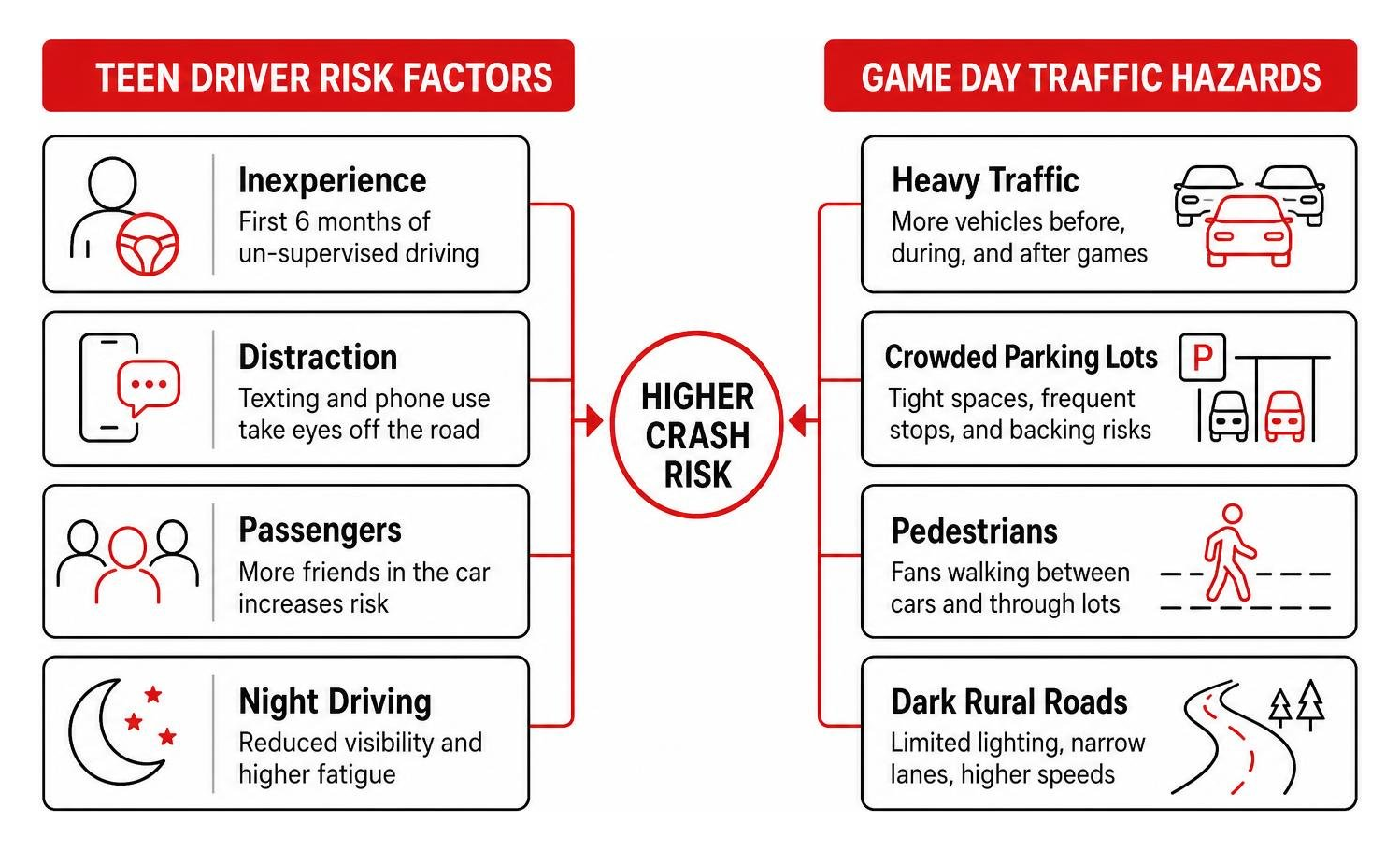
- Novice Driver Vulnerability: Motor vehicle crashes remain the single leading cause of death for teenagers. A young driver’s greatest statistical risk of crashing occurs during their first six months of holding an un-supervised license.
- Over-Representation in Collisions: In recent federal crash reporting, drivers under age 20 accounted for 12.6% of all crash-involved drivers, despite making up only 5.1% of licensed drivers overall.
- Distracted Driving Hazards: Sending or receiving a text message takes a driver’s eyes off the road for an average of 4.6 seconds. Traveling at 55 miles per hour, that brief distraction is equivalent to driving the full 100-yard length of a football field completely blindfolded. Furthermore, texting while driving makes a driver 23 times more likely to be involved in a collision, making it roughly six times more dangerous than driving intoxicated.
- The Passenger Multiplier Effect: Carrying young passengers dramatically shifts risk levels for teenage drivers. Carrying a single passenger under age 21 increases a teen driver’s crash risk by 44 percent. Carrying two young passengers doubles the crash risk, and transporting three or more passengers under 21 quadruples the crash risk when no adult is present. Conversely, having an adult passenger aged 35 or older in the vehicle cuts a teen’s risk of a fatal crash by 62 percent.
Reviewing your auto coverage and policy limits before the football season kicks off is not just a routine chore—it is a critical financial safety net. A minor parking lot bump or a major highway collision during game-day traffic can quickly lead to costly repair bills and severe medical expenses if your coverage falls short.
How Should You Update Household Drivers Before Friday Night Kickoffs?
Before your teenager takes the keys to drive to Friday night games or tailgate parties, reviewing who is officially registered on your auto policy is vital. One of the most common issues we see during high-traffic seasons is outdated household driver records, which can cause unexpected friction during a claim.
Every driver residing in your household who holds a driver’s license needs to be evaluated. It is essential to understand the structural difference between policy designations:
- Listed Drivers: Individuals who are formally named on the policy documents as members of the household or authorized operators.
- Rated Drivers: Drivers whose individual driving records, age, and risk profiles are directly calculated into the policy’s premium pricing.
In most circumstances, newly licensed teenagers residing in your home must be added as rated drivers on your primary policy.
Timing is critical when updating your coverage. While some insurance carriers require notice as soon as a young driver receives a learner’s permit, others only require rating once the teen obtains a provisional or full driver’s license. Omitting a licensed household driver—even if they only drive occasionally to stadium parking lots—can lead to severe consequences. If an unlisted teenager causes an accident, the insurance company could deny coverage for the claim, leaving your household personally responsible for property damages and legal liabilities.
Many parents mistakenly assume that “permissive use” covers their children. Permissive use is intended for occasional, out-of-household operators—such as a visiting relative borrowing your truck for an errand. It rarely applies to regular household residents who have unmonitored access to your family vehicles.
To streamline updating your policy before school and football logistics take over, organize an administrative update packet:
- Full legal name, date of birth, and driver’s license number for each household driver.
- Vehicle Identification Numbers (VINs) for all household automobiles.
- Primary driving details, including estimated annual mileage and school commuting distance.
For more administrative advice on managing vehicle policies ahead of fall routines, read this checklist guide on updating teen drivers before school starts. Ensuring every driver in your garage is accurately accounted for on your Auto Insurance keeps your family fully protected.
Which Auto Insurance Coverages and Limits Do You Need for Game-Day Traffic?

Navigating game-day traffic requires adequate liability protection. Stadium exits after a high school game often turn into bottlenecks where multi-car fender benders or unexpected pedestrian crossings happen. Carrying only state-mandated minimum liability limits can leave your personal assets vulnerable in a major collision.
In Alabama, mandatory minimum liability limits (25/50/25) provide:
- $25,000 for bodily injury per person.
- $50,000 total bodily injury per accident.
- $25,000 for property damage per accident.
Consider a practical game-night scenario: an unexpected crash in stadium traffic involves two newer vehicles, resulting in structural damage and emergency room visits for multiple passengers. Modern vehicle replacement parts, sensor calibration, and medical bills can easily exhaust a $25,000 property damage or $50,000 bodily injury ceiling. Once policy limits are maxed out, the at-fault driver—and their parents, if the driver is a minor—can be held personally liable for the remaining balances.
To protect your home, savings, and future earnings, we typically recommend higher structured limits for households with active drivers:
- Bodily Injury Liability: $100,000 per person / $300,000 per accident (or $250,000 / $500,000).
- Property Damage Liability: $100,000 per accident.
Another crucial layer of protection on busy game nights is Uninsured/Underinsured Motorist (UM/UIM) Coverage. Despite state laws, a noticeable percentage of drivers on the road carry no auto insurance or lack sufficient limits to pay for the damage they cause. If an uninsured driver strikes your vehicle in a crowded stadium line or on a dark country road while your teen is driving home, UM/UIM coverage steps in to cover medical expenses, lost wages, and pain and suffering for everyone in your car.
For families seeking complete peace of mind, an Personal Umbrella Policy provides an additional $1,000,000 or more in liability protection beyond your underlying auto insurance policy limits. Umbrella coverage is surprisingly affordable and offers essential security during high-risk seasons. To explore structured policy options, check out The Ultimate Guide to Auto Insurance Quotes.
How Do Collision and Comprehensive Coverages Protect Your Car in Crowded Parking Lots?
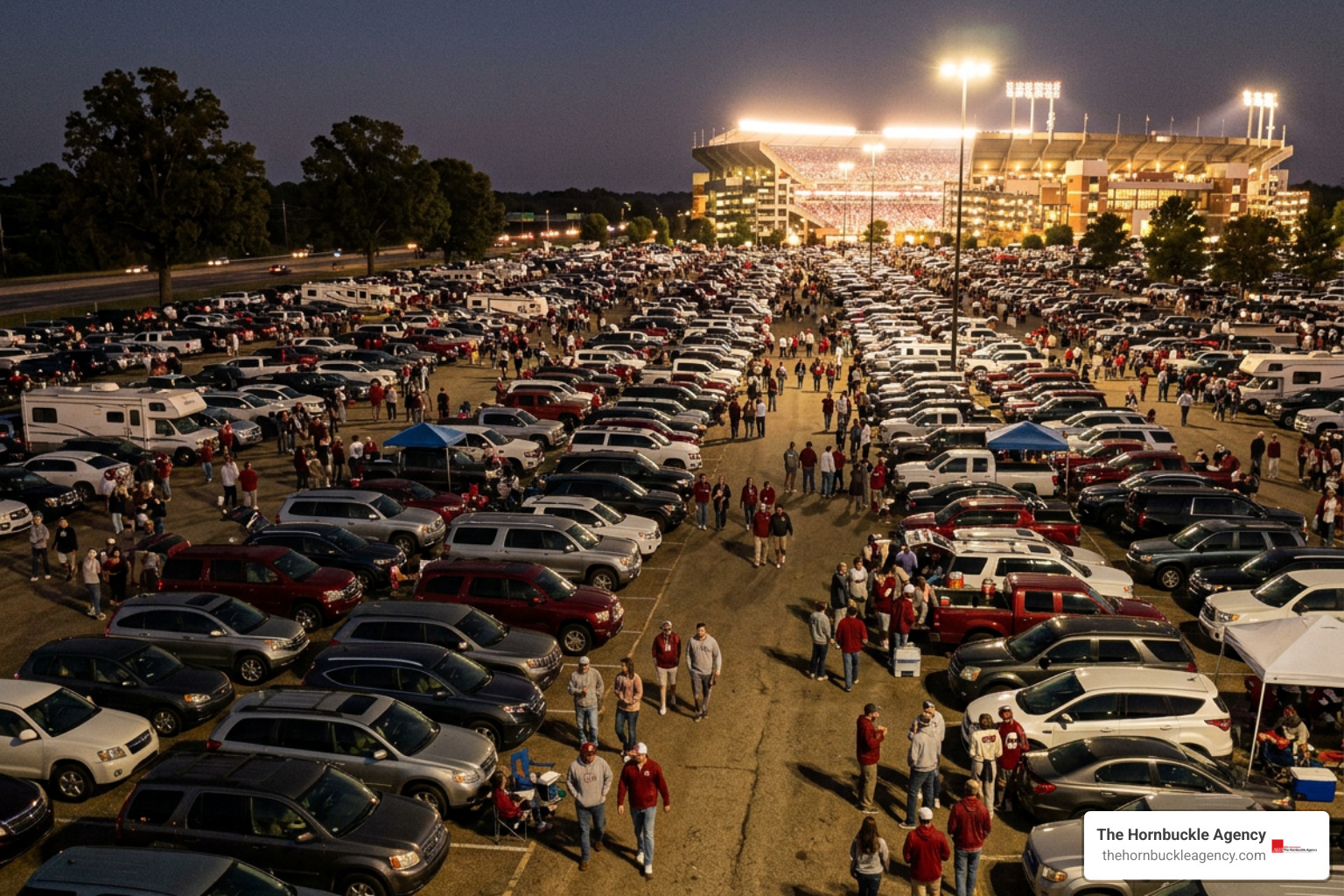
High school and college parking lots on game days present a unique mix of physical risks. Vehicles are parked bumper-to-bumper, tailgaters maneuver around tight lanes, visibility is limited by large SUVs, and athletic equipment moves around open areas. Understanding how collision and comprehensive coverages handle these parking lot risks helps prevent unexpected out-of-pocket bills.
While liability coverage pays for damage your vehicle causes to others, collision and comprehensive coverages repair or replace your vehicle.
- Collision Coverage: Covers physical damage to your vehicle resulting from an impact with another car or object. In stadium parking lots, collision coverage handles backing-out accidents, low-speed impacts while turning tight corners, striking light poles or barricades, and side-swipe scratches caused by passing cars.
- Comprehensive Coverage: Handles damage caused by non-collision events outside your control. During football season, comprehensive claims frequently include windshield cracks from flying gravel on busy highways, runaway footballs or soccer balls striking parked body panels, fallen tree limbs in unpaved parking fields, animal strikes during late-night rural drives, theft, and stadium vandalism.
| Common Game-Day Scenario | Primary Coverage Type | Applicable Deductible Applied |
|---|---|---|
| Backing into a parked truck in a dark stadium lot | Collision | Collision Deductible |
| Stray football dents car hood or breaks side mirror | Comprehensive | Comprehensive Deductible |
| Hitting a deer on a dark two-lane road driving home | Comprehensive | Comprehensive Deductible |
| Scraping a concrete stadium light pole base | Collision | Collision Deductible |
| Vandalism or broken window while parked at the game | Comprehensive | Comprehensive Deductible |
Managing deductibles is an effective way to balance monthly premiums with potential out-of-pocket costs. Choosing a $500 deductible lowers your immediate expense during a claim, whereas raising your deductible to $1,000 lowers your recurring policy premium.
For older vehicles with lower market value, families often evaluate whether maintaining physical damage coverages makes financial sense. However, for newer cars or vehicles driven by teenagers navigating chaotic parking lots every Friday night, keeping collision and comprehensive coverage intact is essential. Learn how to structure these protections effectively in Car Insurance Plans Get Covered Without Breaking the Bank.
How Can You Lower Premiums for Teen Drivers Without Sacrificing Coverage?
Adding a newly licensed teenager to your auto policy will naturally increase your premium due to the higher statistical risk. However, parents do not have to sacrifice higher coverage limits to keep insurance premiums manageable. Utilizing discounts and taking advantage of driver education resources can meaningfully offset rate increases.
Here are practical strategies families can use to lower insurance costs before football season kicks into high gear:
1. Capitalize on Academic Discounts
Most carriers offer a Good Student Discount for young drivers who maintain a “B” average (3.0 GPA) or higher. Submitting a report card or transcript to your agent can lower the teen portion of your policy premium by as much as 15% to 25%.
2. Enroll in Driver Safety Courses
Completing certified driver education or defensive driving programs teaches novice drivers critical hazard perception skills while unlocking policy discounts.
3. Utilize Telematics and Driving Apps
Usage-based insurance programs track driving behaviors through mobile apps or plug-in devices—monitoring speed, smooth braking, cornering, and late-night driving habits. Safe driving performance can earn significant ongoing discounts.
4. Implement Family Driving Rules and Coaching
Establishing clear boundaries behind the wheel builds safe habits early. Parents can set up a formal family driving agreement covering:
- Zero Cell Phone Use: Strict prohibition of texting or hand-held device use while driving.
- Passenger Restrictions: Enforcing a single-passenger rule during the first six months of driving to minimize peer distractions.
- Nighttime Curfews: Establishing clear return times after games to avoid high-risk driving hours.
What Are the Most Common Questions About Football Season Auto Insurance?
Do I need to list my teenager on my policy if they only drive to Friday night games?
Yes. Insurance companies require all household residents who hold a active driver’s license to be formally declared on your auto policy, regardless of how frequently they drive. Even if your teen only drives a family vehicle once a week to attend local high school football games, they must be listed. Failing to declare a licensed household driver can result in a denied claim or policy cancellation if they are involved in a game-day collision.
What happens if another parent carpools my teen to an away game and has an accident?
In standard auto insurance policies, insurance primary coverage follows the vehicle, not the driver. If another parent drives their own vehicle carrying your teen to an away game and gets into an accident, that parent’s auto policy serves as the primary coverage for property damage and bodily injury liabilities. Your personal policy would only come into play as secondary coverage under specific or catastrophic loss circumstances. The driver’s policy permissive use terms generally cover occasional group carpooling arrangements.
How can families in North Alabama ensure their auto coverage fits their local driving needs?
Driving conditions in North Alabama during the fall involve unique factors—from navigating busy high school athletic grounds in town to traveling unlit, two-lane rural roads across county lines. Working directly with an independent local agent allows you to tailor coverage to these regional driving risks.
For comprehensive insights on selecting local coverage, read The Ultimate Auto Insurance Roundup Finding the Best Coverage for Your Ride.
At The Hornbuckle Agency, we offer personalized policy reviews and risk education tailored specifically to the families we serve across our region. We serve multiple Alabama communities, including Albertville, Guntersville, Boaz, Arab, Geraldine, Crossville, Collinsville, Horton, and Douglas. We help parents review policy limits, list teen drivers accurately, and capture all available discounts so their households remain properly protected all season long.
Is Your Auto Policy Ready for the Upcoming Football Season?
As Friday night lights illuminate fields across Alabama this fall, taking a proactive approach to your auto insurance gives you peace of mind while your family travels to and from games.
Before the season kicks into full gear, run through this quick kickoff checklist:
- Audit Household Drivers: Confirm all licensed teenagers and young adults in your home are correctly named on your auto policy.
- Review Liability Limits: Ensure your bodily injury and property damage limits ($100k/$300k/$100k minimum recommended) can protect your financial assets against high-density traffic accidents.
- Verify Physical Damage Coverages: Check that your collision and comprehensive deductibles make financial sense for parking lot risks and fall driving conditions.
- Secure Teen Discounts: Submit transcripts for Good Student Discounts and explore telematics programs to lower monthly premiums.
- Set Driving Boundaries: Revisit family rules regarding seatbelt compliance, night curfews, zero phone use, and passenger limits.
Don’t wait until a parking lot bump or highway incident occurs to find out if your policy has gaps. Reach out to The Hornbuckle Agency today to schedule a comprehensive auto policy review. Our team is dedicated to providing personalized protection guidance so you can focus on enjoying every touchdown this season.
