
Why Auto Insurance Is One of the Most Important Financial Decisions You’ll Make
Auto insurance is a contract between you and an insurance company that protects you from major financial loss if you’re in an accident, your car is stolen, or someone gets hurt.
Most states require it by law — and for good reason. Without it, a single accident could cost you tens of thousands of dollars out of pocket.
Here’s a quick look at what auto insurance covers and why it matters:
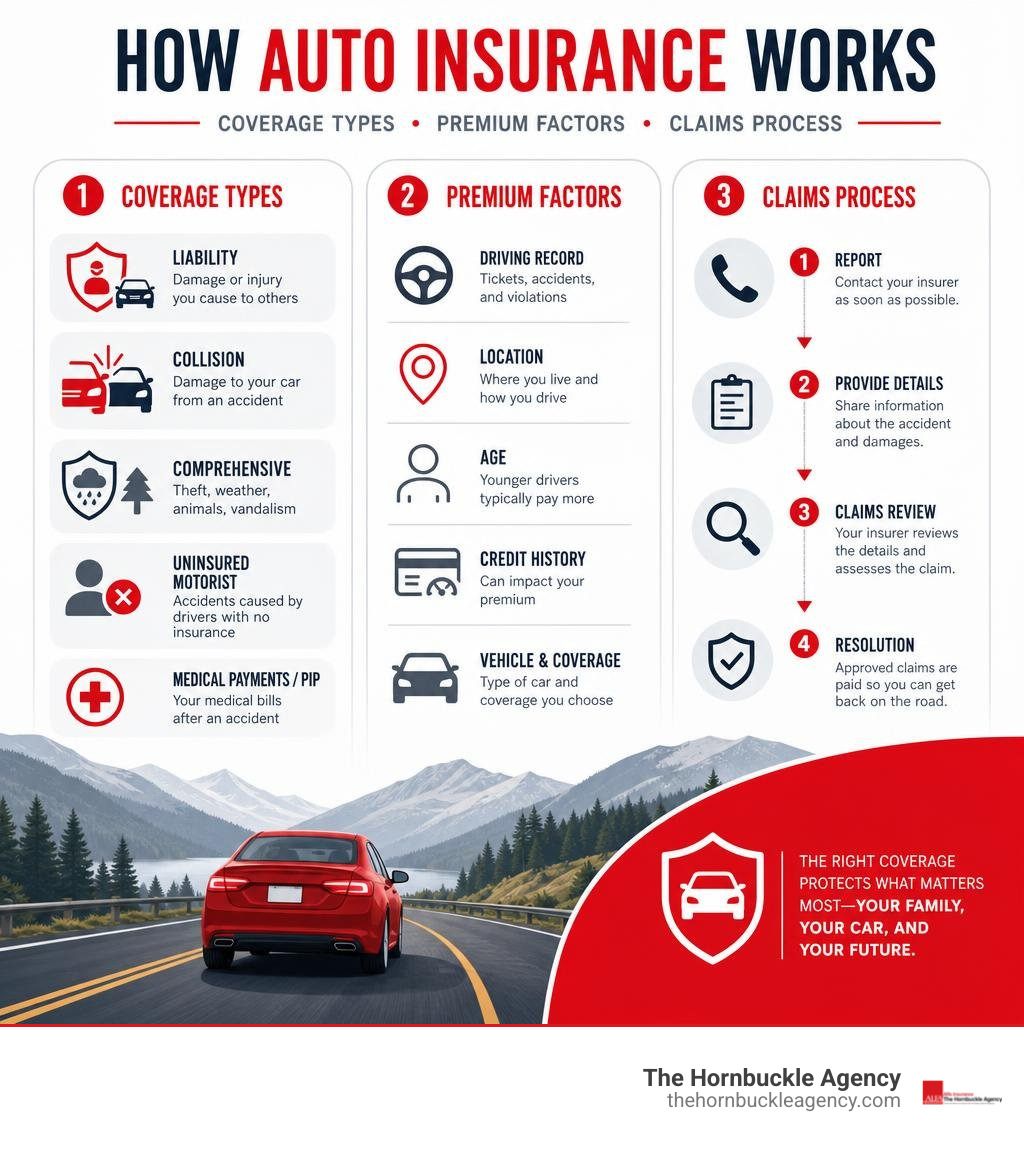
| Coverage Type | What It Covers |
|---|---|
| Liability | Damage or injury you cause to others |
| Collision | Damage to your car from an accident |
| Comprehensive | Theft, weather, animals, vandalism |
| Uninsured Motorist | Accidents caused by drivers with no insurance |
| Medical Payments / PIP | Your medical bills after an accident |
A few things worth knowing right away:
- Nearly every state requires minimum liability coverage before you can legally drive
- Lenders and leasing companies almost always require collision and comprehensive coverage too
- Your rate is shaped by your driving record, location, age, credit history, and the coverage you choose
- You can often lower your premium by bundling policies, maintaining a clean record, or using a safe driving app
Whether you’re comparing quotes for the first time or reviewing an existing policy, the goal is the same: get the right coverage at a price that makes sense for your family.
I’m Dustin Hornbuckle, Owner and Agent at The Hornbuckle Agency in Albertville, Alabama, and with nearly 18 years of experience helping families find the right auto insurance protection, I’ve seen how the right policy can mean the difference between a manageable setback and a financial crisis. In this guide, I’ll walk you through everything you need to know to make a confident, informed decision.
Understanding Auto Insurance: Why Coverage is Essential
At its core, auto insurance is a legal contract designed to safeguard your financial responsibility. When you get behind the wheel, you are operating a heavy piece of machinery. If something goes wrong, the financial consequences can be staggering. If you cause an accident without coverage, you could be held personally liable for medical bills, vehicle repairs, and legal fees—putting your home, savings, and future earnings at risk.
Because Alabama operates under a traditional tort (fault) system, the driver who is determined to be at fault for an accident is legally responsible for paying the resulting damages. To ensure drivers can cover these costs, the state mandates minimum liability insurance limits.
In Alabama, the minimum liability limits are established under the 25/50/25 rule:
- $25,000 for bodily injury or death per person in a single accident.
- $50,000 total for bodily injury or death per accident if multiple people are hurt.
- $25,000 for property damage per accident (to cover the other driver’s car, a mailbox, or a storefront).
While staying legally compliant is important, relying solely on state minimums can be a dangerous gamble. Imagine a scenario on Highway 431 between Albertville and Guntersville where a driver accidentally rear-ends a modern luxury SUV. The property damage alone could easily exceed $25,000. If the passengers require emergency medical care, those bills will quickly surpass the $50,000 bodily injury limit. Once your insurance limits are exhausted, you are personally on the hook for the remaining balance.
That is why we always recommend looking past the bare minimums. Purchasing higher liability limits provides a much sturdier safety net for your family’s financial security. For comprehensive protection, you can also explore how More info about auto insurance can be tailored to your specific driving habits, helping you avoid devastating out-of-pocket expenses.
The Core Types of Car Insurance Coverage
Navigating insurance policies can feel like reading a foreign language, but understanding your coverage options is the best way to build a policy that fits your lifestyle. A solid policy is made up of several different types of coverage, each designed to protect you in different scenarios.
First, there is Liability Coverage, which is divided into bodily injury and property damage. This is the foundational element required by law. It only pays for damage and injuries you cause to others; it does not pay for your own vehicle repairs or medical bills.
To protect yourself and your passengers, you should consider Medical Payments (MedPay) coverage. MedPay helps pay for medical, dental, or funeral expenses for you and your passengers after an accident, regardless of who was at fault. In states where it is available, Personal Injury Protection (PIP) goes a step further by covering lost wages and other rehabilitation costs.
Working with an experienced local agent can help you structure these coverages to fit your specific needs and ensure you are fully protected on the road.
Collision vs. Comprehensive Auto Insurance
When people talk about having “full coverage,” they are usually referring to a policy that includes liability alongside collision and comprehensive coverages. These two forms of physical damage protection are essential if you want your insurance to pay for repairs to your own vehicle.
- Collision Insurance covers damage to your vehicle resulting from an accident with another car or a physical object. If you accidentally back into a tree in your driveway, hit a guardrail on a rainy evening, or get into a fender-bender at a local intersection, collision coverage is what pays to get your car back on the road.
- Comprehensive Insurance (often called “other than collision”) covers damage to your vehicle caused by events outside of your control. This includes theft, vandalism, fire, cracked windshields, and natural disasters.
In Marshall County, AL, comprehensive coverage is particularly critical. Our local area is no stranger to severe spring weather, hail, and tornadoes that can ruin a car’s exterior in seconds. Furthermore, rural roads in our region present a high risk of animal collisions-specifically deer darting across the road at dusk. If you strike a deer, it is covered under your comprehensive policy, not collision.

Both of these coverages require you to pay a deductible-the amount you agree to pay out of pocket before your insurance coverage kicks in. Choosing the right deductible is a balancing act between your monthly premium and your immediate savings.
Uninsured and Underinsured Motorist Auto Insurance
Did you know that Alabama consistently ranks among the states with the highest percentage of uninsured drivers? Industry estimates show that roughly 15% to 20% of drivers on our state’s roads are driving without any insurance at all. Many others carry only the bare minimum state liability limits, which won’t go very far if they cause a major multi-car collision.
This is where Uninsured/Underinsured Motorist (UM/UIM) Coverage becomes your best friend.
- Uninsured Motorist Coverage pays for your medical bills and property damage if you are struck by a driver who has no insurance, or if you are the victim of a hit-and-run accident.
- Underinsured Motorist Coverage steps in when the at-fault driver has insurance, but their policy limits are too low to cover the full extent of your medical bills or repair costs.
Alabama’s Mandatory Liability Insurance information explains the state’s requirements, but minimum coverage rules cannot guarantee that every driver on the road has enough insurance to pay for a serious loss. Without UM/UIM, you could find yourself facing massive medical bills through no fault of your own, with no realistic way to collect compensation from the negligent driver. For residents in Boaz, Guntersville, Albertville, and across Marshall County, reviewing your auto insurance options can help ensure you have this vital layer of protection in place before you hit the road.
Premium Factors and How to Save on Your Policy
When an insurance company calculates your premium, they use a process called underwriting to assess how much risk you represent, and a process called rating to assign a price to that risk.
Several key factors influence what you pay for auto insurance:
- Your Driving Record: A clean record with no speeding tickets, at-fault accidents, or DUI convictions is the single best way to keep your rates low. Drivers with clean records can qualify for excellent safe driving discounts.
- Credit History: In Alabama, insurance companies are legally permitted to use your credit-based insurance score to help determine your premium. A higher credit score generally correlates with lower premiums.
- Age and Driving Experience: Statistically, younger, less experienced drivers (particularly teens) are involved in more accidents, making their coverage more expensive.
- Your Location: Where you park your car matters. Urban areas with high traffic density and higher accident rates typically command higher premiums than rural areas.
- Vehicle Type: The make, model, year, and safety features of your vehicle play a major role. Cars that are cheaper to repair or have high safety ratings cost less to insure.
To help you understand how these factors affect your monthly bill, we have broken down their relative impact:
| Premium Factor | Level of Impact | What Insurers Look For |
|---|---|---|
| Driving Record | Extreme | Traffic violations, at-fault wrecks, and claims history over the past 3 to 5 years. |
| Credit Score | High | Your history of on-time payments and overall financial stability. |
| Age / Experience | High | Younger drivers under 25 and newly licensed drivers pay higher rates. |
| Deductible Choice | Medium | Higher deductibles lower your premium; lower deductibles raise it. |
| Location (ZIP Code) | Medium | Local accident rates, vehicle theft statistics, and weather risks. |

Fortunately, you do not have to be at the mercy of high rates. There are several highly effective strategies to save money on your policy:
- Multi-Policy Bundling: One of the easiest ways to save is by bundling your auto policy with your Home Insurance or Life Insurance. Across the industry, bundling can save you up to 15% or more on your annual premiums.
- Telematics and Safe Driving Programs: Many modern insurers offer usage-based insurance programs. By using a mobile app to track your driving habits—such as hard braking, speed, and phone usage—you can earn massive discounts of up to 30% or 40% for safe driving.
- Increase Your Deductible: If you have a healthy emergency fund, raising your collision and comprehensive deductibles from $250 to $500 or $1,000 can immediately slash your monthly premium.
- Ask for Discounts: Always ask your agent about available discounts. Common options include:
- Good Student Discounts (typically for students maintaining a B average or 3.0 GPA).
- Multi-Vehicle Discounts (for insuring more than one car on the same policy).
- Paperless Billing and Paid-in-Full Discounts.
- Anti-Theft and Vehicle Safety Feature Discounts.
Before you commit to a policy, make sure you read our Ultimate Guide to Auto Insurance Quotes to ensure you are comparing coverages accurately line-by-line.
Frequently Asked Questions about Car Insurance
Buying car insurance can raise a lot of questions. Here are detailed answers to some of the most common queries we receive from drivers in Marshall County.
How does a deductible affect my premium?
Your deductible and your monthly premium share an inverse relationship. If you choose a higher deductible, you are taking on more of the immediate financial risk yourself in the event of an accident. Because the insurance company will not have to pay out as much for a minor claim, they reward you with a lower monthly premium.
Conversely, if you choose a lower deductible (like $100 or $250), the insurance company assumes more of the financial burden. As a result, your monthly premium will be higher.
When deciding on a deductible, evaluate your personal risk tolerance and savings. If you get into an accident tomorrow, can you comfortably write a check for $1,000 to the repair shop? If the answer is yes, a higher deductible is an excellent way to keep your ongoing insurance costs low.
Who should be added to my policy as a regular driver?
As a general rule of thumb, you should add any individual of legal driving age who lives in your household or who regularly drives your vehicle (more than once a month) to your auto policy. This includes:
- Spouses or domestic partners.
- Teenagers who have recently earned their driver’s license or permit.
- Roommates who share access to your vehicle.
- Nannies, babysitters, or caregivers who use your car to run errands or transport your children.
Failing to list a regular driver on your policy can have severe consequences. If an unlisted household member gets into an accident while driving your vehicle, the insurance company could deny the claim entirely, leaving you personally responsible for all damages.
If you live in the Guntersville area and need to update your household drivers or review your policy limits, contact The Hornbuckle Agency to help get your policy squared away.
Conclusion
Finding the right auto insurance policy does not have to be a stressful chore. By understanding the core coverage types, choosing deductibles that align with your budget, and taking advantage of money-saving discounts, you can hit the road with complete peace of mind.
At The Hornbuckle Agency, we believe that insurance is not just about writing a policy—it is about building relationships and protecting our neighbors. As a local Alfa Insurance provider in Albertville, AL, we serve families across Guntersville, Boaz, and all of Marshall County. We pride ourselves on providing personalized risk education to help you understand exactly what you are paying for and how it protects your hard-earned assets.
Whether you need coverage for your daily commuter car, your family SUV, your home, or even specialized protection like Umbrella Insurance or Commercial Insurance, we are here to help.
When you are ready for a local partner who truly understands Marshall County roads, we invite you to Get a personalized auto insurance quote with us today or Contact Us to start a conversation. Let us help you protect what matters most!
