
What Operational Risks Spike During Fall Harvest Season?
Fall harvest is the most demanding time of the year for any farming operation. As equipment runs long hours and field activity peaks, exposure to operational hazards increases exponentially. Understanding where these seasonal risks concentrate allows you to manage hazards effectively and ensure your insurance limits match your true operational exposures.
1. Roadway Transport Hazards
Transporting heavy, wide equipment between scattered fields creates major roadway exposures across rural counties. Most modern farm equipment travels at low speeds — typically between 15 and 20 miles per hour. When fast-moving passenger vehicles share two-lane country roads with slow machinery, speed differentials create dangerous situations.
Traffic studies consistently show that nearly 50% of all collisions between motorists and farm implements involve either left-hand turns or rear-end crashes. A typical scenario occurs when a farm operator slows down and veers slightly to the right to line up a wide turn into a narrow field gate or driveway. Following motorists often misinterpret this rightward positioning as an invitation to pass, accelerating directly into the path of the turning machine.
2. Physical Equipment and Field Fires
Combines, tractors, and balers work under maximum stress during harvest. Dry conditions combined with accumulated chaff, dust, spilled hydraulic fluid, and hot engine surfaces turn minor electrical sparks or friction into catastrophic equipment fires. A combine fire during peak harvest does not just destroy an expensive piece of machinery — it brings field operations to a sudden halt, threatening unharvested crops if weather conditions turn severe.
3. Grain Storage and Bin Entrapment
Grain handling creates severe physical safety hazards. Crusting and bridging occur when stored grain forms a deceptive hard crust on top with hollow voids beneath. If an operator steps onto the surface, the bridge can collapse, leading to grain entrapment within seconds. Dusty grain atmospheres also pose explosion and fire hazards if grain leg belts slip or bearing friction overheats.
4. Livestock and Poultry Stress
Increased traffic from combines, grain trucks, and heavy tractors brings noise and dust to surrounding pastures and poultry operations. Spooked cattle or horses can break through fences, escaping onto nearby roadways. Poultry farms also face harvest-season disruptions when extra truck traffic, generator use, feed deliveries, or severe weather threaten house ventilation, backup power, water systems, and biosecurity controls. If livestock escapes or a poultry-house system failure leads to animal losses, the farm owner may face substantial property, income, and liability concerns.
5. Emerging Side Businesses and Agritourism
With agricultural market dynamics changing, modern farm operations increasingly rely on non-commodity income streams. In fact, research indicates that as many as 40% of today’s U.S. farms generate some form of farm-related or off-commodity income. National farm net income is projected to decline, prompting producers to diversify into direct-to-consumer activities such as:
- Roadside farm stands and U-pick produce operations
- Autumn pumpkin patches, corn mazes, and hayrides
- On-farm venue rentals, weddings, and educational tours
- Value-added processing like cider making, canning, or salsa production
While diversification builds operational financial resilience, it introduces public visitors, product liability, and commercial property hazards that standard agricultural policies are not designed to cover. Hosting the public or selling manufactured food products can move part of your farm into commercial enterprise territory. Without explicit endorsements, liability claims from injured visitors or product issues can be excluded under base farm property policies.
How Do You Audit Machinery, Buildings, and Crop Assets Before Harvest?
Before heavy field operations begin, conducting a systematic audit of your physical farm assets ensures that policy limits match current real-world replacement costs.
Creating an Updated Farm Asset Inventory
Farms grow incrementally. Over a twelve-month period, you may purchase a secondary tillage tool, upgrade a grain cart, install a new lean-to structure, or increase seed and fertilizer stores. Without an annual pre-harvest audit, these additions remain unlisted, leaving you underinsured if a storm, fire, or theft occurs.
To conduct a thorough audit, gather:
- Equipment Schedules: Make, model, year, serial number (VIN), and current market valuation for every powered unit and pull-type implement.
- Structure Audits: Square footage, construction materials, use changes, and recent structural additions for every barn, shed, and silo.
- Inputs and Yield Projections: Estimated value of stored grain, hay bales, standing crops, chemical supplies, and diesel fuel.
Scheduled vs. Blanket Equipment Coverage
When structuring coverage for farm machinery under a Farm Insurance policy, you generally choose between scheduled coverage and blanket coverage:
- Scheduled Coverage: Lists each item individually with a specific description and agreed-upon limit. This approach is recommended for high-value machinery like primary combines, harvesting heads, large tractors, and sprayers. Scheduling ensures that high-value equipment is insured up to its actual replacement cost without triggering coinsurance limitations.
- Blanket Coverage: Groups all equipment, tools, and implements under one single total limit. While convenient for smaller implements, shop tools, and auxiliary equipment, blanket limits require maintaining total policy limits equal to at least 80% or 90% of your total fleet value to avoid underinsurance penalties during partial losses.
Replacement Cost vs. Actual Cash Value (ACV) for Outbuildings
Building replacement costs have fluctuated significantly over recent years due to material and labor costs. Reviewing structural valuation clauses prevents devastating out-of-pocket expenses following a loss:
- Replacement Cost (RC): Pays to repair or rebuild structures with materials of like kind and quality without subtracting physical depreciation. This coverage is critical for essential working buildings like modern grain storage complexes, shop buildings, and automated poultry or cattle structures.
- Actual Cash Value (ACV): Reimburses the repair or replacement cost minus physical depreciation. Older equipment sheds, dry hay barns, or storage outbuildings may be insured under ACV to lower premium costs, but you must be prepared to pay the difference out-of-pocket if rebuilding is necessary.
Reviewing building usage changes annually — such as converting a machinery shed into grain bag storage or processing space — prevents valuation disputes at claim time.
| Coverage Element | Option A: Scheduled / Replacement Cost | Option B: Blanket / Actual Cash Value (ACV) | Best Applied To |
|---|---|---|---|
| Machinery Valuation | Scheduled: Individual items listed with specific policy limits. | Blanket: Fleet grouped under one overall aggregate limit. | Combines & primary tractors = Scheduled. Implements & hand tools = Blanket. |
| Building Valuation | Replacement Cost: Pays full rebuild cost without depreciation deductions. | Actual Cash Value: Deducts depreciation from claim payout. | High-value operational shops = Replacement Cost. Older storage sheds = ACV. |
| Stored Harvested Crops | Peak Season Endorsement: Adjusts limit up during harvest window. | Standard Annual Limit: Flat coverage year-round. | Grain bins & bulk hay stores with high seasonal valuation swings. |
What Specific Coverages Protect Farm Income, Employees, and Visitors?
While physical equipment and structures represent substantial capital, a farm’s long-term viability depends on protecting cash flow, workforce health, and public liability.
Business Interruption and Extra Expense Endorsements
If a primary combine catches fire or a storm destroys your main grain handling leg during peak harvest, the direct physical loss is only part of the financial blow. The immediate loss of operational capacity creates cascading income interruptions:
- Loss of Income Coverage: Reimburses lost net farm income when covered property damage halts harvesting or processing.
- Extra Expense Coverage: Pays for emergency operational workarounds, such as leasing a replacement combine at peak rental rates, paying custom harvesters to finish fields, or trucking grain to commercial grain elevators when on-farm storage is ruined.
Having Extra Expense coverage ensures you can keep operations moving when time is critical, preventing unharvested crop degradation in the field.
Managing Seasonal Workforce Exposures
Harvest season often requires bringing on temporary farm hands, truck drivers, or family members to handle extended shifts. Managing employee safety and understanding local worker protections is vital:
- Workers’ Compensation: Provides medical coverage and lost wage reimbursement for work-related injuries regardless of fault. Even when state regulations grant statutory exemptions for small agricultural operations, carrying voluntary workers’ compensation or employer’s liability endorsement eliminates costly bodily injury lawsuits from injured seasonal workers.
- Safety Training Records: Documenting routine pre-harvest safety orientations for seasonal help demonstrates operational due diligence and helps maintain favorable loss records.
Public Visitors and Agritourism Exposures
If your farm welcomes the public for seasonal pumpkin picks, corn mazes, farm-stand sales, or hunting leases, third-party liability exposure increases dramatically.
Standard agricultural liability policies cover traditional farming risks — such as a stray cow getting out onto a highway or farm machinery damaging a neighbor’s fence. They generally exclude claims arising from commercial public-facing enterprises. For complete protection:
- Add specialized commercial agritourism endorsements or commercial general liability policies via Commercial Insurance to cover public slip-and-fall claims or parking area accidents.
- Layer excess liability coverage using Umbrella Insurance to protect personal and business assets against severe, high-dollar lawsuit awards.
- Review combined residential and farm risk strategies detailed in our regional guide on Protecting Your Farm and Home with Alfa Insurance in Marshall County.
What Road Safety and Risk Mitigation Protocols Reduce Harvest Claims?
Implementing structured risk management protocols on the farm reduces equipment downtime, protects workers, and lowers the probability of costly insurance claims.
Pre-Shift Equipment Inspection Protocol
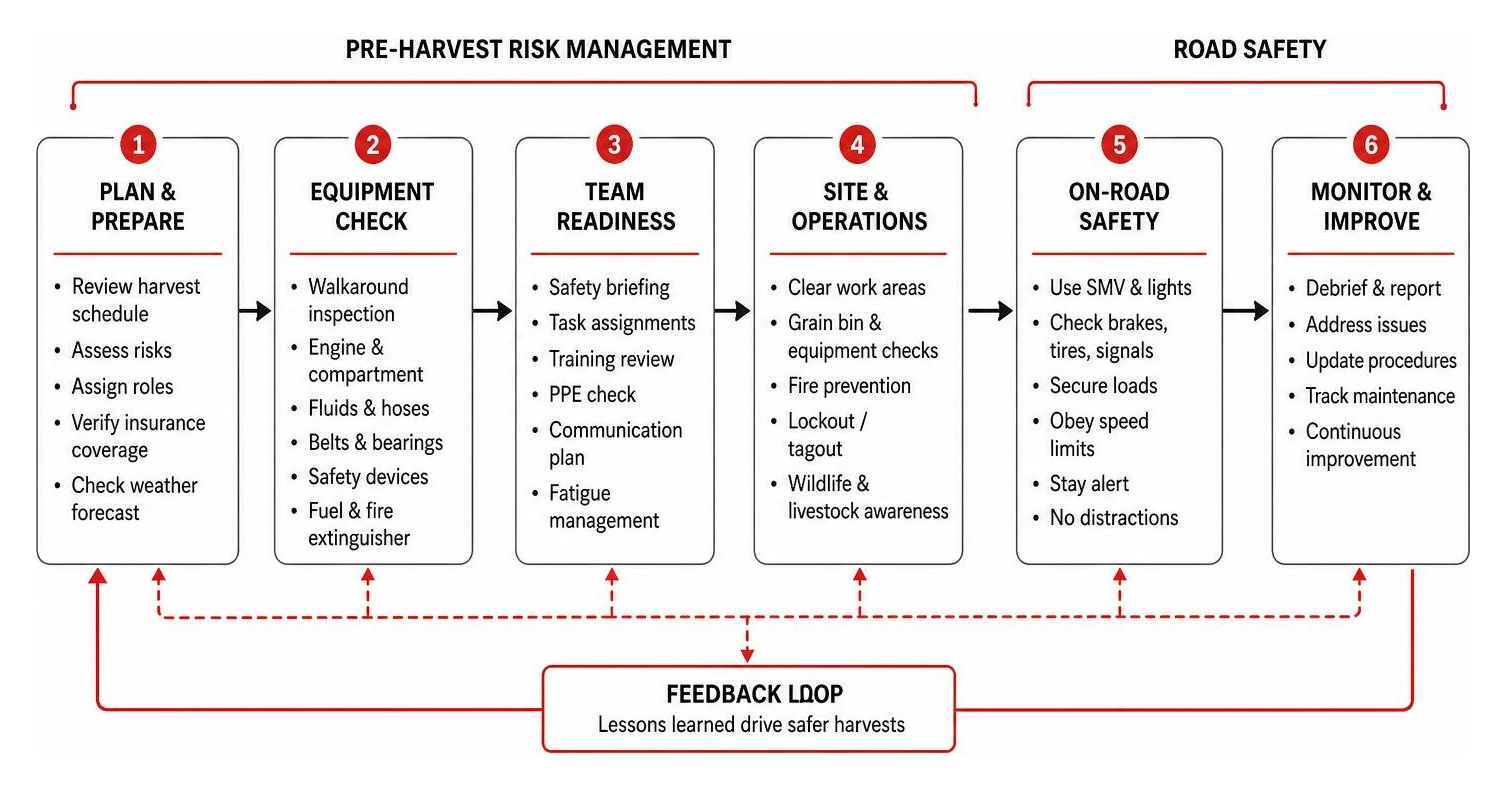
Start every harvest morning with a ten-minute walkaround inspection for every powered unit:
- Engine Compartment: Blow out accumulated chaff and dirt near exhaust manifolds and turbochargers using compressed air.
- Fluid Checks: Inspect hydraulic hoses for leaks, weeping fittings, or fraying.
- Belts and Bearings: Check belt tension and check for worn bearings that generate extreme friction heat.
- Safety Guards: Confirm all Power Take-Off (PTO) shields, chain guards, and drive covers are properly secured.
Roadway Transit and Visibility Best Practices
Making slow machinery visible to trailing motorists prevents high-speed rear-end collisions:
- Clean Warning Lights and Reflectors: Wipe down Slow Moving Vehicle (SMV) placards, flashing amber lights, and turn signals before entering public roads.
- Minimize Machinery Profile: Detach wide harvesting heads and tow them on dedicated head trailers when moving combines along narrow public roadways.
- Manage Trailing Traffic: If traffic queues behind slow-moving machinery on narrow two-lane roads, pull off safely onto a wide shoulder or gravel turnout at the first safe opportunity to let trailing vehicles pass.
Grain Bin Entry and Safety Rules
- Enforce Lockout/Tagout: Disconnect and lock out power sources to all grain augers and unloader sweep systems before anyone enters a bin.
- Implement the Buddy System: Never permit an employee or family member to enter a grain bin alone. Position an observer outside the entry hatch equipped with a safety rope and harness communications.
- Probe Suspicious Grain: Use a probe from the outside to check for hidden voids or crusting before stepping onto stored grain.
Operator Fatigue Management
Harvest fatigue is a severe physical hazard. Exhaustion leads to delayed reaction times, skipped safety checks, and poor operational decisions. Establish mandatory meal breaks, enforce shift rotations during peak harvest weeks, and prohibit operators from running equipment past safe alertness limits.
Pre-Harvest Daily Safety Checklist
- [ ] Clean dust, oil, and crop debris from combine engine compartments and exhaust areas.
- [ ] Inspect fire extinguishers mounted on combines, tractors, and service trucks for full charge.
- [ ] Wipe down all SMV emblems, reflective tape, turn signals, and flashing warning lights.
- [ ] Check tire pressures, wheel lug tightness, and hydraulic connections on transport trailers.
- [ ] Verify that all PTO master shields and secondary safety guards are in place.
- [ ] Test horn, backup alarms, and communications radios on all heavy field units.
- [ ] Restock basic first-aid kits, dust masks, safety glasses, and hearing protection in operator cabs.
How Can Farmers Work With Their Local Agent to Close Coverage Gaps?
Reviewing your farm insurance policy should be an interactive process conducted well before harvest begins. Working with a local agent who understands regional agricultural practices ensures your policy reflects true operational realities.
Information to Prepare Before Your Insurance Review
To streamline your policy review, bring the following updated records:
- Equipment Inventory: Updated machinery lists including newly acquired implements, sold units, and serial numbers.
- Vehicle Schedules: VINs, driver lists, and usage classifications for all farm service pickups, heavy grain haulers, poultry service vehicles, feed trucks, and utility trailers via Auto Insurance.
- Structure Updates: Photographs, square footage measurements, and cost receipts for any outbuildings constructed or modified during the year, including poultry houses, equipment sheds, and feed storage areas.
- Primary Dwelling Verification: Separating residential farmhouse property limits via Home Insurance from surrounding commercial outbuildings and land liability.
- Operational Projections: Updated yield expectations, livestock headcount estimates, poultry flock or contract-production details, and gross revenue figures — including any off-commodity side income.
Local Expertise Across North Alabama Communities
Agricultural risk is deeply local. Roadway conditions, regional weather patterns, and land usage vary across North Alabama. At The Hornbuckle Agency, we proudly serve farm owners and families across multiple local communities, including Albertville, Guntersville, Boaz, Arab, Geraldine, Crossville, Collinsville, Horton, and Douglas.
Whether you are hauling grain along county highways, managing poultry houses, or operating direct-to-consumer farm stands, having an agent rooted in your local area ensures that your policy leaves zero room for unexpected coverage gaps. You can learn more about our local team through the Alfa Insurance Near Me Marshall County Agent Directory.
What Are the Most Common Questions About Harvest Season Farm Coverage?
Does standard farm liability cover agritourism activities like pumpkin patches, corn mazes, or roadside stands?
No. Standard farm liability policies are structured specifically around traditional commodity agricultural production — such as growing corn, cotton, or raising livestock. Once you invite the general public onto your property for retail sales, autumn entertainment, corn mazes, or event hosting, you cross into commercial business liability territory.
Public visitors introduce third-party slip-and-fall exposures, parking lot accidents, and product liability hazards that base farm policies specifically exclude. To protect your farm, you must add dedicated commercial agritourism endorsements or carry a separate commercial general liability policy.
What is the difference between Scheduled and Blanket coverage for expensive farm equipment?
Scheduled coverage lists each machine individually with its own specific description, serial number, and agreed policy limit. This option is ideal for high-value machinery like combines, harvesting heads, large tractors, and self-propelled sprayers, guaranteeing that specific equipment is fully protected up to its agreed value without coinsurance penalties.
Blanket coverage groups all farm equipment, hand tools, and unscheduled implements under one single total policy limit. While blanket coverage provides convenient protection for smaller tools and miscellaneous attachments, maintaining an accurate aggregate limit is essential to avoid underinsurance during a major loss event.
How does loss of income coverage protect a farm during peak harvest?
Loss of Income and Extra Expense endorsements protect your financial stability if a covered physical disaster — such as a combine fire, storage bin collapse, or severe storm — halts your harvest operations.
Loss of income coverage reimburses lost net revenue while operations are suspended. Extra Expense coverage pays for immediate operational workarounds, such as renting replacement equipment at peak market rates or hiring custom harvesting crews to complete field work before crops degrade.
How Does Pre-Harvest Planning Ensure Long-Term Farm Resilience?
Harvest season brings high financial stakes and demanding physical workloads. Equipping your operation with robust physical risk protocols while maintaining an accurate insurance program creates a safety net that protects your family’s financial future.
Taking time now to audit equipment schedules, evaluate building valuations, verify workforce coverages, and account for public liability ensures that when the combines start rolling, your policy reflects the true way your farm operates today.
If you are ready to review your current policy limits or want an experienced second set of eyes on your operational coverages before harvest begins, we are here to help. Contact our team today at The Hornbuckle Agency Farm Insurance to schedule your personalized pre-harvest risk audit.
