
What Are the Limits and Exclusions for Business Property in Standard Policies?
When you set up a workspace in your house, the line between your everyday household belongings and your business assets might feel blurry. However, in the eyes of insurance carriers, that boundary is strictly defined.
Standard residential policies, typically built on standard ISO HO-3 contract forms, are created to protect personal living risks, not commercial ventures. Under standard home insurance policies, personal belongings (Coverage C) cover furniture, clothing, and home electronics against covered perils like theft, windstorm, or fire. But the moment an item is used “primarily for business purposes,” it is separated into an entirely different classification with severe monetary caps.
The $2,500 On-Premises and $1,500 Off-Premises Property Sublimits
Under an unendorsed policy, coverage for business personal property stored inside your dwelling is strictly capped:
- On-Premises Sublimit: Most policies limit coverage for business property on your residential premises to $2,500 (some carriers allow up to $3,000).
- Off-Premises Sublimit: If you take your equipment on the road—such as taking a laptop to a coffee shop, client meeting, or trade show—coverage drops to $1,500 (and under certain policy forms, as low as $250 to $500).
Consider how quickly standard business equipment exceeds those thresholds:
- High-Performance Tech: A professional graphic workstation, dual monitors, external backup drives, and design software licenses can easily total $4,000 to $6,000.
- Photography and Media: A primary camera body, two lenses, lighting equipment, and audio gear often exceed $8,000.
- E-commerce Inventory: Storing raw materials, finished handmade goods, packaging supplies, or retail stock in a spare bedroom or basement can easily reach $10,000 to $25,000 in replacement value.
If a catastrophic event occurs—such as a pipe bursting over your office setup or an electrical fire destroying your garage inventory—your standard policy will pay only up to its $2,500 sublimit (minus your deductible). For broader structural and property concerns, understanding your underlying homeowners insurance fire coverage limits is vital, but physical business inventory and equipment require dedicated adjustments to avoid massive out-of-pocket losses.
How Insurers Define a “Business” Under Policy Terms
Many entrepreneurs assume that because their operation is a part-time “side hustle” or not registered as a formal corporate entity, it does not count as a business. Insurance contracts, however, rely on objective legal definitions rather than tax filings.
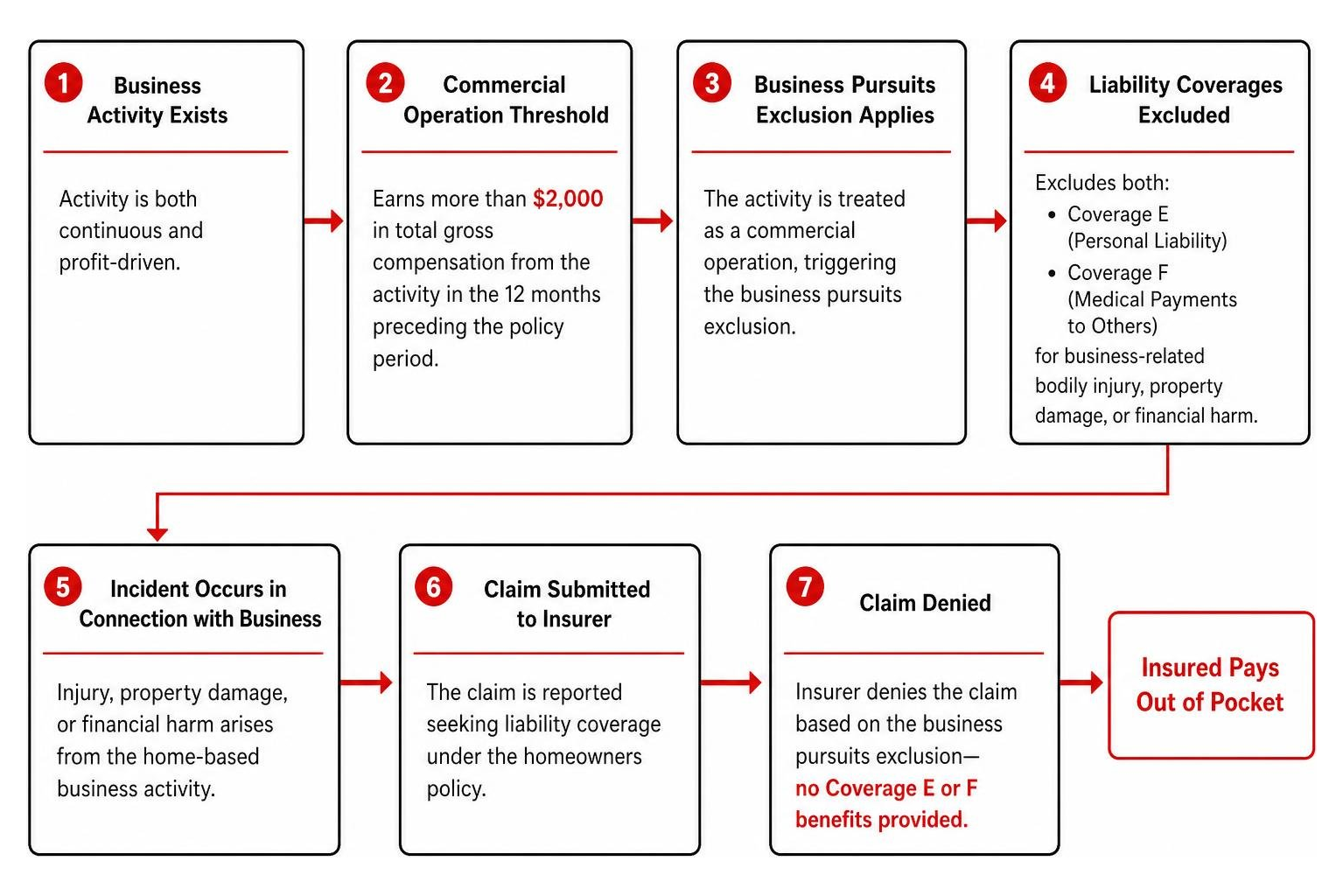
In standard policy forms, courts and adjusters apply a two-part test to determine if an activity constitutes a business:
- Continuity: Is the activity performed regularly or habitually?
- Profit Motive: Is the activity undertaken with the intention of generating income or financial gain?
If both continuity and profit motive are present, the activity is classified as a business.
Furthermore, standard policy language contains a specific monetary baseline: if an insured individual earns more than $2,000 in total gross compensation from an activity in the 12 months preceding the policy period, the activity is treated as a commercial operation.
There are only a few narrow exceptions where activities earning modest income escape the business classification:
- Volunteer and Civic Reimbursements: Activities where compensation is strictly limited to reimbursement for actual out-of-pocket expenses.
- Mutual Babysitting Exchanges: Exchange of childcare services where no money changes hands.
- Minor-Run Enterprises: Sole proprietorships operated exclusively by household members under the age of 21 with no employees (such as a teenager mowing neighborhood lawns or providing occasional babysitting).
If your operation generates more than $2,000 annually and involves regular trade, it triggers the commercial provisions and exclusions of your contract.
Why Does Standard Homeowners Insurance Exclude Business Liability?
While sublimits on physical property can leave you with thousands in uncovered equipment losses, liability gaps present an even greater financial danger.
Standard homeowners policies provide two primary liability coverages:
- Coverage E (Personal Liability): Protects against legal claims if someone is accidentally injured on your property or you cause accidental damage to another party’s property.
- Coverage F (Medical Payments to Others): Covers immediate medical bills for guests injured on your property, regardless of fault.
Every standard homeowners contract includes a strict business pursuits exclusion. This clause eliminates both Coverage E and Coverage F for any bodily injury, property damage, or financial harm arising out of, or in connection with, a business conducted from the residence. For a deeper look at policy mechanics, see our comprehensive 2026 homeowners insurance guide.
According to the Washington State Office of the Insurance Commissioner, homeowners policies may not cover all losses connected to a home business, which is why business owners should review their operations with an agent before relying on a standard residential policy.
The Risk of Client and Delivery Injuries on Residential Premises
When you operate a home-based enterprise, your premises risk profile changes completely. Even occasional commercial interactions introduce exposures that personal liability refuses to cover.
Consider these everyday operational scenarios:
- Client Consultations: If you operate an accounting, tutoring, or design consultancy and a client slips on wet steps while visiting your home office, their resulting medical expenses and legal claims fall squarely under commercial premises liability. Your homeowners policy will deny the claim under the business pursuits exclusion.
- Package Couriers and Freight Deliveries: Frequent visits by delivery drivers dropping off commercial supplies or picking up finished parcels significantly increase the likelihood of slip-and-fall incidents or driveway accidents. If an adjuster discovers the delivery was tied to an active business, personal liability will not respond.
- Customer Pickups: Permitting local customers to pick up orders from your porch or garage turns your residential driveway into a commercial loading zone in the eyes of insurance underwriters.
Product Liability and Professional Errors Blind Spots
Commercial liability risks extend far beyond physical slips and falls on your walkway. If your business produces goods or provides expert services, standard homeowners insurance leaves you completely exposed:
- Product Liability: If you make candles, baked goods, cosmetics, woodwork, or craft items, your homeowners policy offers $0 in product liability coverage. If a customer experiences an allergic reaction, burns, or property damage from an item you sold, you are personally liable for legal defense fees, settlements, and court judgments.
- Professional Liability (Errors & Omissions): If you provide advisory, consulting, bookkeeping, software development, or design services, a client may allege that your mistake, oversight, or late delivery caused them substantial financial loss. Homeowners insurance never covers professional errors or financial damages.
What Are Your Options for Adding Home-Based Business Coverage?

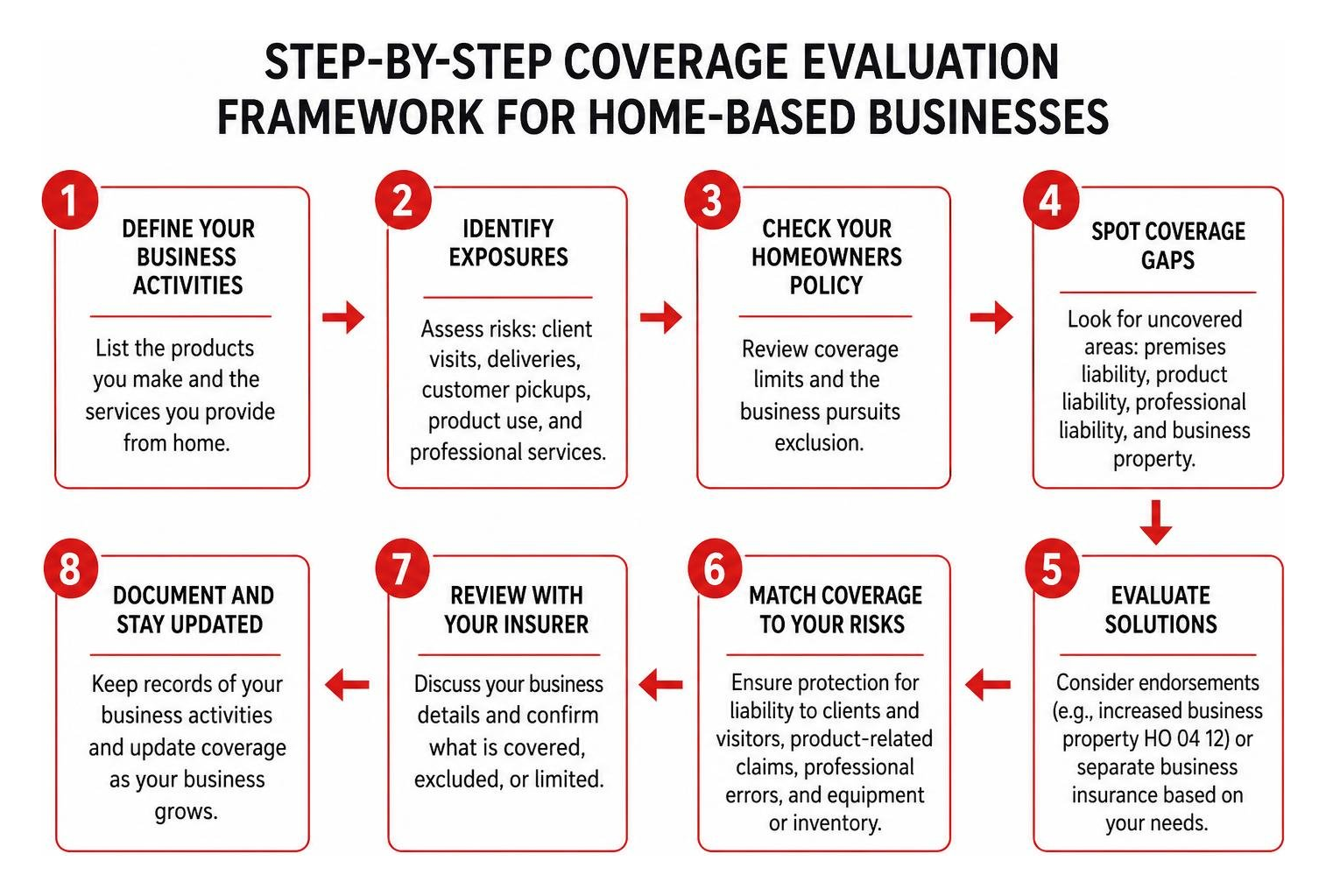
Closing the gap between personal protection and commercial enterprise does not necessarily require an expensive corporate insurance package. Depending on your annual revenue, equipment values, whether clients visit your property, and the products or services you provide, several distinct solutions are available. The right fit usually depends on three questions: how much business property you keep at home, whether anyone visits the property for business reasons, and whether your work could create product, professional, or delivery-related liability.
Home Business Policy Endorsements
For small, low-risk side ventures, adding an endorsement (often called a rider) to your existing homeowners policy is often the most cost-effective starting point.
Increased Business Property Endorsement (HO 04 12):
- What it does: Increases your on-premises business personal property limit from the standard $2,500 up to $5,000 or $10,000, and typically raises off-premises coverage to $2,500.
- Cost: Very affordable, typically running between $25 and $50 per year.
- Limitation: This endorsement covers only physical property. It provides zero liability protection for client injuries, product defects, or professional mistakes.
Permitted Incidental Occupancies Endorsement:
- What it does: Designed for very specific, low-risk, non-inventory enterprises (such as an in-home music teacher with a few students or an author). It extends basic premises liability to visitors receiving instruction or services specified in the policy schedule.
- Limitation: It does not cover product liability, employees, or high-volume foot traffic.
Comprehensive Home Business Insurance Endorsement (HO 07 01):
- What it does: A robust ISO endorsement introduced to bridge property and basic liability for eligible home-based businesses. It can cover business personal property up to the full Coverage C limit, provide accounts receivable and valuable records protection, and include business interruption coverage if a covered physical loss halts your operations.
Caution Regarding the HO 24 71 Endorsement:
- Many policyholders mistakenly assume the standard “Business Pursuits Endorsement” (HO 24 71) covers their home business. In reality, this form is designed for employees working on behalf of an outside employer (such as teachers or sales reps) and explicitly excludes businesses owned or financially controlled by the policyholder.
In-Home Business Policies Versus Business Owner’s Policies (BOP)
When your operations grow beyond the modest scope of a simple rider, standalone commercial coverage becomes essential.
In-Home Business Policy
An in-home business policy is a hybrid product tailored for operations operating strictly from the residence that have outgrown basic endorsements but do not require complex commercial plans.
- Coverage Scope: Bundles general liability (typically $300,000 to $1,000,000), business property coverage up to $10,000 to $50,000, coverage for property in transit, and business income/extra expense coverage.
- Cost: Typically ranges between $250 and $500 annually.
- Best For: Home-based service providers, solo crafters, and freelancers who need liability and moderate property coverage without extensive inventory.
Business Owner’s Policy (BOP)
A Business Owner’s Policy represents the industry standard for established home-based businesses, e-commerce sellers, and full-time entrepreneurs. A BOP bundles three foundational protections into a single comprehensive package:
- Commercial General Liability: Standard $1,000,000 to $2,000,000 limits covering premises slip-and-falls, customer property damage, advertising injury, and comprehensive product liability.
- Commercial Property Insurance: Protects high-value inventory, specialized tools, computer equipment, and supplies on an actual replacement cost basis—both on-site and in transit.
- Business Interruption (Business Income) Insurance: Replaces lost operational income and ongoing operating expenses (like payroll, web hosting, or temporary workspace leases) if your home office is rendered unusable by a covered peril like fire or tornado.
- Cost: For home-based operations and online sellers, a BOP typically starts around $500 per year (averaging between $22 and $41 per month depending on revenue and industry risk).
Exploring dedicated commercial insurance allows you to scale your operational coverage limits smoothly as your customer base and product lines expand.
| Coverage Feature | Homeowners Endorsement (e.g., HO 04 12) | In-Home Business Policy | Business Owner’s Policy (BOP) |
|---|---|---|---|
| Typical Annual Cost | $25 – $50 | $250 – $500 | $500 – $1,200 ($22–$41/mo base) |
| Business Property Limit | $5,000 – $10,000 | $10,000 – $50,000 | $50,000 – $250,000+ |
| General Liability | None (Property only) | $300,000 – $1,000,000 | $1,000,000 – $2,000,000 |
| Product Liability | No | Limited | Yes (Full Commercial Scope) |
| Business Interruption | No (Unless HO 07 01) | Yes (Limited) | Yes (Actual Loss Sustained) |
| Off-Premises Coverage | Minimal ($2,500) | Moderate ($5,000+) | Broad / Full Transit Protection |
| Best Suited For | Casual side hustles (<$5k assets) | Solo consultants, modest shops | Full-time e-commerce, high revenue |
Specialized Add-Ons: Professional Liability and Commercial Auto
Depending on how you conduct business, two additional coverage gaps must be addressed:
- Errors and Omissions (E&O) / Professional Liability: If you offer expert advice, design, marketing, architectural planning, financial consulting, or IT solutions, a general liability policy will not cover claims alleging negligence, mistakes, or missed deadlines. You need a dedicated Professional Liability policy to cover legal defense fees and client financial damages.
- Commercial Auto Endorsements: Standard personal auto insurance policies contain commercial exclusions similar to homeowners policies. If you use your personal vehicle to deliver products, transport expensive client equipment, make daily catering runs, or transport passengers, an accident during business use can result in a total claim denial. Adding a commercial use endorsement or a separate commercial auto policy ensures you are protected behind the wheel.
What Happens If You File a Business Claim Without Notifying Your Insurer?

Some home business owners choose not to mention their enterprise to their insurance provider, believing that what an insurer doesn’t know won’t hurt. In practice, failing to disclose commercial operations is one of the quickest routes to financial disaster.
If a loss occurs—such as a fire starting in an overloaded office circuit or an inventory theft from your garage—an insurance adjuster will inspect the scene, review financial records, and evaluate damaged items.
Here is what happens when undisclosed business activity is uncovered:
- Immediate Claim Denial: The adjuster will apply the business pursuits exclusion to any liability claim and enforce the strict $2,500 property sublimit on equipment. If a client is suing you for a severe injury or you suffered $30,000 in ruined inventory, the unendorsed policy will pay nothing beyond the sublimit.
- Policy Cancellation or Rescission for Material Misrepresentation: When you apply for a homeowners policy, you are asked whether any commercial activity takes place on the property. Failing to report an active business or introducing commercial exposures mid-term without notification can be classified as material misrepresentation. The insurer has the legal right to void or cancel your policy entirely.
- Complications with Your Mortgage Lender: If your homeowners policy is canceled or voided due to undisclosed commercial operations, your insurer is legally required to notify your mortgage holder. Without active insurance in place, your lender can purchase expensive force-placed insurance on your behalf or even initiate default proceedings under the terms of your deed of trust.
Proactively disclosing your business activities to your agent ensures that you find affordable, tailored solutions while keeping your fundamental home protection completely secure.
Frequently Asked Questions About Home-Based Business Coverage
Can I run an online business without extra insurance if clients never visit my home?
Even if no client ever steps foot on your property, an online business carries substantial risks that standard homeowners policies completely exclude. E-commerce businesses face product liability claims if an item sold causes bodily harm or property damage, copyright and advertising injury claims, and transit losses if shipments are damaged. Furthermore, inventory stored in your home quickly exceeds the standard $2,500 property sublimit, leaving your stock unprotected against home fires, water damage, or theft.
How much does insurance for a home-based business cost in 2026?
Pricing depends on the level of protection your business requires:
- Homeowners Endorsement: Increasing property limits to $5,000–$10,000 costs approximately $25 to $50 per year.
- In-Home Business Policy: Mid-level property and general liability protection averages $250 to $500 per year.
- Business Owner’s Policy (BOP): Comprehensive property, $1M+ general liability, product liability, and business income coverage typically starts around $500 per year (or $22 to $41 per month for low-risk online operations).
Does a standard home business endorsement cover product liability?
No. Basic property endorsements (such as the HO 04 12) only increase the physical replacement limits for business tools, computers, and supplies. They do not provide liability protection of any kind. If you manufacture, alter, or sell physical products—such as baked foods, candles, clothing, cosmetics, or custom crafts—you must secure a Business Owner’s Policy (BOP) or a standalone commercial general liability policy to cover product liability claims.
How Can You Ensure Your Home Business Is Properly Protected?
Running an enterprise from home offers incredible flexibility, but leaving your livelihood exposed to personal policy limits is an unnecessary risk. Protecting your investment starts with a practical review of the work you do, the property you use, and the people who interact with your business.
- Calculate Your True Equipment and Inventory Value: Walk through your home and calculate the actual replacement cost of your computers, machinery, office furnishings, raw materials, and finished stock.
- Assess Your Liability Touchpoints: Consider whether delivery drivers, clients, or subcontractors visit your property, and evaluate the potential product or professional risks tied to what you deliver.
- Align With the Right Policy Structure: Determine whether your venture is best served by a simple property endorsement, an in-home business package, or a comprehensive Business Owner’s Policy.
We believe in providing clear risk education so local entrepreneurs can build and protect their dreams with complete confidence. The Hornbuckle Agency serves multiple Alabama communities, including Albertville, Guntersville, Boaz, Arab, Geraldine, Crossville, Collinsville, Horton, and Douglas.
Whether you are launching a new online store, growing a home consulting practice, or expanding a neighborhood craft studio, our team is here to help you pinpoint coverage gaps and build the right protection plan.
Ready to make sure your home and business are fully protected? Feel free to contact us today for a comprehensive, personalized policy review.
