
Does Lending My Car to a Friend Affect My Auto Insurance Coverage?
Yes. Lending your car to a friend can affect your auto insurance coverage because coverage generally follows the vehicle first, not the driver. If your friend has permission to use your car and causes an accident, your personal auto policy is usually the primary source for liability claims and covered vehicle damage. The friend’s policy, if they have one, may only help after your limits are exhausted. Before handing over the keys, confirm three things: your policy allows permissive use, the borrower is eligible and safe to drive, and the trip does not fall under an exclusion such as rideshare, delivery, business use, or regular unlisted use.
The Hornbuckle Agency recommends treating a borrowed-car situation as a coverage decision, not just a favor. In insurance terminology, permissive use means giving another licensed driver permission to operate your vehicle for a temporary, occasional purpose. Most standard personal auto policies include an omnibus clause, which can extend your vehicle’s liability, comprehensive, and collision coverages to another driver using your car with valid consent. However, the details matter because policy forms, exclusions, household-driver rules, and state requirements can vary. In short, does lending my car to a friend affect my auto insurance coverage? Yes, especially when the borrower is a regular driver, excluded driver, uninsured driver, or using the car for a purpose your policy does not allow.
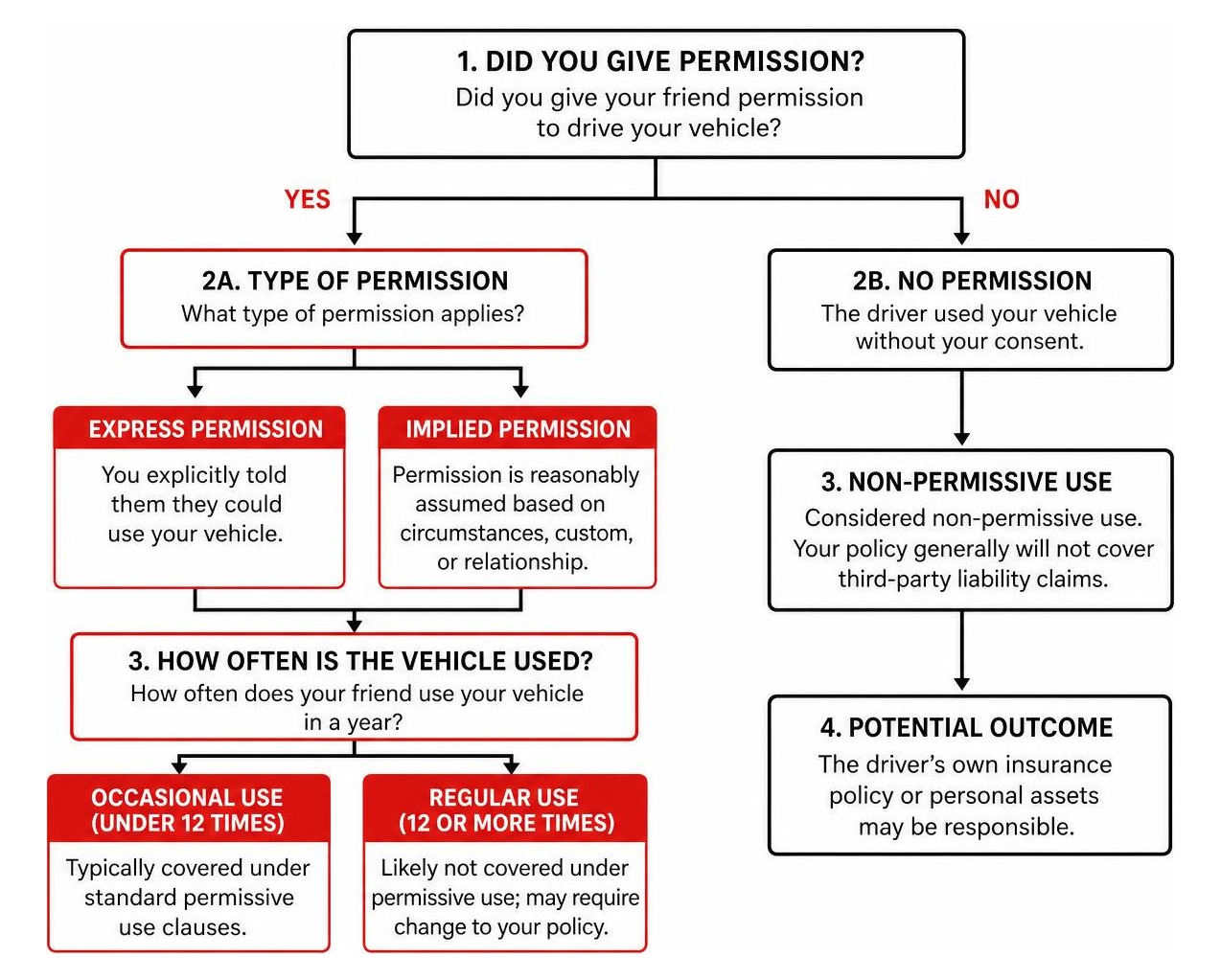
Express Permission vs. Implied Permission
Insurance carriers and legal adjusters categorize permission into two standard types:
- Express Permission: This occurs when you explicitly tell a friend they can take your vehicle. For instance, if your friend asks, “Can I borrow your truck to pick up a couch from the store this afternoon?” and you hand over the keys saying yes, you have granted express permission.
- Implied Permission: This arises from circumstances, ongoing custom, or relationship dynamics where consent is reasonably assumed even without a verbal exchange. For example, if your friend regularly borrows your spare car with your full knowledge and encouragement, an insurer may view this access as implied consent.
Understanding the difference is critical because if an accident occurs and an insurer suspects the driver took the vehicle without consent, the claim may be investigated as non-permissive use. If non-permissive use is established, your policy generally will not cover third-party liability claims caused by the unauthorized driver, leaving the driver’s own insurance policy or personal assets on the hook.
Occasional Lending vs. Regular Use
One of the most common pitfalls involves the frequency of vehicle use. There is a practical underwriting difference between letting a visiting friend run an errand once in a while and letting someone drive your vehicle every week.
Use this rule of thumb:
- Occasional Use: If a friend borrows your car only a few times a year for emergency trips, airport drop-offs, or occasional errands, their driving is typically handled under standard permissive-use language.
- Regular Use: If someone drives your vehicle weekly, commutes in your car, or borrows it on a recurring schedule, insurance companies may classify them as a regular operator.
If a regular operator is not formally listed on your policy as a named driver, your insurer may contest or deny coverage following a serious accident, citing an undisclosed risk or a breach of your policy terms.
Household Members and Roommates vs. Visiting Guests
Insurance policies treat household members and roommates very differently from visiting friends. Because individuals living under the same roof have regular, immediate access to your keys and vehicle, underwriters assume they may drive your car.
Most auto insurance policies require you to disclose all licensed drivers living in your household. If you have a roommate who occasionally uses your car to run errands, you should not rely on informal permissive use without checking your policy. Failing to list a licensed household member can lead to retroactive premium adjustments or claim disputes if they get into a crash while driving your vehicle.
The Hidden Trap of “Step-Down Limits”
Many drivers assume that their full liability limits follow the car whenever a friend takes the wheel. However, some non-standard and budget auto insurance contracts contain step-down provisions.
A step-down clause states that while your policy extends coverage to permissive drivers, the liability coverage limits automatically “step down” to the state’s statutory minimum requirements during permissive use.
For example, even if you carry robust liability limits of $250,000 per person and $500,000 per accident to protect your household assets, a step-down clause could drop that protection down to state minimum limits when your friend drives. If your friend causes a serious multi-vehicle accident, those minimum limits may be exhausted quickly, leaving you exposed to personal lawsuits for remaining damages.
Step 2: Who Pays If Your Friend Gets into an Accident in Your Vehicle?
The golden rule of auto insurance is that insurance follows the vehicle first, not the driver. If you give your friend permission to drive your car and they cause a collision, your personal auto policy acts as the primary coverage.
Understanding how different layers of insurance interact helps clarify who pays for vehicle repairs, medical bills, and out-of-pocket expenses.
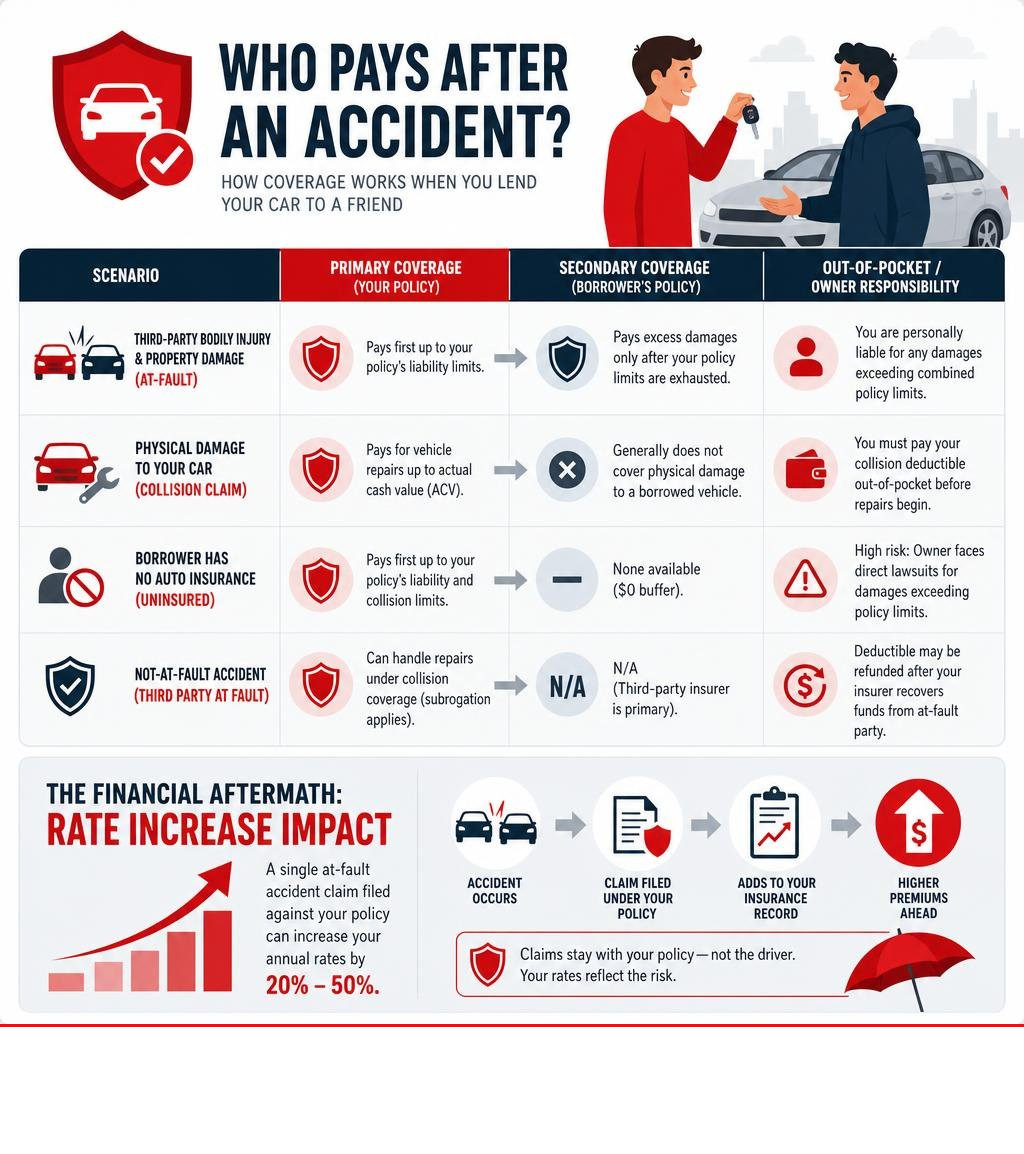
| Scenario / Expense Type | Primary Coverage (Your Policy) | Secondary Coverage (Borrower’s Policy) | Out-of-Pocket / Vehicle Owner Responsibility |
|---|---|---|---|
| Third-Party Bodily Injury & Property Damage (At-Fault) | Pays first up to your policy’s liability limits. | Pays excess damages only after your policy limits are exhausted. | You are personally liable for any damages exceeding combined policy limits. |
| Physical Damage to Your Car (Collision Claim) | Pays for vehicle repairs up to actual cash value (ACV). | Generally does not cover physical damage to a borrowed vehicle. | You must pay your collision deductible out-of-pocket before repairs begin. |
| Borrower Has No Auto Insurance (Uninsured) | Pays first up to your policy’s liability and collision limits. | None available ($0 buffer). | High risk: Owner faces direct lawsuits for damages exceeding policy limits. |
| Not-At-Fault Accident (Third Party at Fault) | Can handle repairs under collision coverage (subrogation applies). | N/A (Third-party insurer is primary). | Deductible may be refunded after your insurer recovers funds from at-fault party. |
How Primary Coverage Operates
Because your vehicle is the insured property, your auto insurance pays first when a covered claim occurs. If your friend runs a red light and hits another vehicle, the injured parties will file their property damage and bodily injury claims directly against your insurance policy.
Your insurer is legally obligated to defend the claim, provide legal representation if a lawsuit is filed, and pay settlements or repair costs up to the liability maximums stated on your declarations page.
When Does Your Friend’s Policy Kick In?
Many car owners believe that if a friend crashes their car, the friend’s insurance will handle the entire claim. In reality, the borrower’s insurance acts exclusively as secondary (excess) coverage.
According to legal insurance analyses on who pays when a friend drives your car, the borrower’s personal policy only responds after your primary policy limits have been completely exhausted.
For instance, suppose your friend causes an accident resulting in $100,000 in property damage, but your policy carries a property damage liability limit of $50,000. Your insurer will pay out its full $50,000 limit. At that point, the claim transitions to your friend’s insurance carrier to cover the remaining $50,000 balance—assuming your friend carries active coverage with sufficient limits.
The Collision Deductible Dilemma
If your vehicle sustains structural body damage while your friend is driving, fixing it requires filing a claim under your own collision coverage. To explore how physical damage protections function during claims, take time to review the ultimate guide to comparing collision car insurance options.
Filing a collision claim means you are immediately responsible for paying your comprehensive or collision deductible—typically $500 to $1,000—directly to the repair shop. Even though your friend was driving, the insurer handles the financial transaction with you, the policyholder. If your friend refuses or is unable to reimburse your deductible, that expense comes directly out of your wallet.
The Financial Aftermath: What Happens to Your Premium Rates?
An accident claim filed against your vehicle does not disappear when your friend leaves the driver’s seat. Because the claim is filed under your policy, it attaches directly to your personal insurance loss history report (such as your C.L.U.E. report).
The financial consequences can be substantial:
- Significant Premium Increases: A single at-fault accident claim filed against your policy can push your annual rates up anywhere from 20% to 50%.
- Average Rate Hike Data: National underwriting data indicates that full coverage rates increase by an average of 48% after an at-fault accident, translating to roughly $1,119 more per year in premium costs.
- Multi-Year Impact: Surcharges from an at-fault accident typically remain on your insurance record for 3 to 5 years, compounding the total out-of-pocket financial cost of a single borrowed-car mishap.
What If You Lend Your Car to an Uninsured Driver?
Lending your car to someone who does not own a vehicle or carry their own auto insurance creates serious personal exposure. Nationally, approximately 13% of motorists are completely uninsured.
When you lend your vehicle to an uninsured driver:
- Your policy remains the primary coverage source for third-party damages and collision repairs.
- There is zero secondary coverage buffer. If the total damages exceed your policy limits, there is no secondary insurer to step in.
- Victims of the accident and their legal counsel can pursue your personal assets—including bank accounts, investments, and future wages—to satisfy outstanding judgments.
Step 3: What Critical Exclusions and Legal Liabilities Could Void Your Protection?

While permissive use provides general protection for everyday lending scenarios, several critical policy exclusions and legal liabilities can completely void your auto insurance coverage, leaving you entirely unprotected.
1. Named Driver Exclusions
A named driver exclusion is a formal endorsement added to your insurance policy that specifically strips away coverage for a designated individual.
Policyholders sometimes exclude high-risk drivers in their household—such as a teenager with multiple speeding tickets or a relative with a suspended license—to keep monthly premiums affordable. However, if you allow a specifically excluded driver to operate your vehicle, your insurance company may deny claims resulting from an accident. You could be personally responsible for property damage, medical treatment, and vehicle repair.
2. Commercial, Gig Delivery, and Rideshare Exclusions
Personal auto insurance policies are written for personal transportation, not commercial driving. Many personal auto contracts exclude business deliveries, courier work, and carrying passengers for hire.
If you lend your car to a friend and they use it to:
- Deliver food or groceries through app-based delivery services,
- Transport packages as an independent gig courier, or
- Provide ridesharing services,
your personal insurance policy may not respond if a crash occurs during commercial operation. The insurer can cite the commercial activity exclusion and deny the claim unless the driver, app, or employer has separate coverage that applies during that specific work period.
3. Negligent Entrustment Risk
Beyond insurance policy language, vehicle owners can face civil liability under the doctrine of negligent entrustment. This risk applies when an owner lets someone drive despite knowing, or reasonably being expected to know, that the person is unfit to drive.
Common examples include:
- Handing your car keys to someone who is visibly intoxicated or impaired by drugs or alcohol.
- Lending your car to an individual who does not hold a valid, active driver’s license.
- Allowing someone with a known history of severe reckless driving, street racing, or medical impairments affecting motor skills to operate your vehicle.
Under a negligent entrustment lawsuit, an injured party can sue you directly for your independent negligence as a vehicle owner. These civil judgments can exceed your auto policy limits, putting personal savings, home equity, and future income at risk.
4. Diminished Value and Automated Traffic Citations
Even if an insurance claim is processed smoothly, lending your car can produce hidden administrative and financial headaches:
- Diminished Vehicle Value: A car that has undergone major collision repairs may lose market value on vehicle history reports. Insurance companies rarely compensate you for this loss on your own collision claim, meaning you may absorb that vehicle depreciation directly. Looking for solid, cost-effective options to manage overall ownership expenses? Exploring car insurance plans get covered without breaking the bank helps ensure you maintain well-structured physical damage limits.
- Camera Violations and Parking Tickets: Traffic camera citations for speeding, running red lights, and unpaid bridge or turnpike tolls are issued directly to the registered vehicle owner based on your license plate, regardless of who was sitting behind the wheel. If your friend fails to inform you or pay the fine, late penalties and license renewal holds may land in your name.
How Can You Protect Your Coverage Before Handing Over the Keys?
Before you agree to let a friend, neighbor, or family member borrow your car, running through a structured risk management process will help ensure you stay fully protected.
1. Execute a Quick Pre-Lending Verification
Never feel awkward about asking basic, protective questions before handing over your car keys. Make sure to:
- Verify Driver’s License Status: Confirm your friend has an active, valid driver’s license. Never lend your vehicle to someone with an expired, suspended, or revoked license.
- Assess Sobriety and Alertness: Ensure the driver is fully capable, alert, and not under the influence of medications, alcohol, or fatigue.
- Check Their Insurance Status: Ask if they carry their own auto insurance policy and verify who their carrier is. Having an active policy provides crucial secondary liability protection.
- Clarify the Purpose of the Trip: Ensure the car is being used solely for personal errands, not for business, delivery gigs, or paid tasks.
2. Establish Strict Ground Rules
Clearly communicate your expectations before your friend pulls out of the driveway:
- No Secondary Drivers: Make it clear that your permission applies strictly to them and that they are not authorized to let anyone else drive your vehicle.
- Geographic and Time Limits: Agree on where the vehicle is going and when it will be returned.
- Reimbursement Agreement: Confirm upfront that if an incident occurs, the borrower is responsible for paying your collision deductible and handling any traffic camera or parking fines incurred during the loan period.
3. Add Frequent Drivers as Listed Operators
If you find that a close friend, extended family member, or roommate borrows your vehicle on a regular basis (more than once a month), contact your insurance provider and formally add them to your policy as a listed driver.
While adding a driver may slightly adjust your premium depending on their driving record, it completely eliminates the risk of an insurer denying a multi-thousand-dollar claim over unlisted regular operator disputes.
4. Consider an Umbrella Liability Policy
If you regularly lend your vehicle or have substantial personal assets, carrying standard auto liability limits of $100,000 or $300,000 may not provide adequate protection.
A personal umbrella insurance policy provides an extra layer of $1,000,000 or more in liability coverage above your standard auto and homeowners policies. If a friend causes a catastrophic accident in your vehicle that exhausts your auto insurance limits, an umbrella policy steps in to shield your personal savings, home, and retirement funds from judgment collection.
5. Review Your Policy with a Local Professional
Insurance language can vary substantially between different policy forms and endorsements. Working with a dedicated, local independent agency ensures that your coverage limits, permissive use clauses, and driver endorsements align with your daily needs.
At The Hornbuckle Agency, we believe that personalized risk education is the cornerstone of community protection. Our team works closely with families and vehicle owners across North Alabama—serving Albertville, Guntersville, Boaz, Arab, Geraldine, Crossville, Collinsville, Horton, and Douglas—to structure tailored auto policies with dependable liability limits. If you have questions about who is protected behind the wheel of your car, contact us to review your coverage details.
Frequently Asked Questions About Lending Your Car?
Will my insurance rates increase if my friend crashes my car?
Yes. If your friend is involved in an at-fault accident while driving your vehicle, the claim is filed under your insurance policy because insurance follows the car.
The at-fault claim is recorded on your loss history report and will typically result in a premium increase ranging from 20% to 50% at your next policy renewal. This rate surcharge generally remains on your policy for three to five years, regardless of whether you were physically inside the vehicle at the time of the collision.
What happens if the friend borrowing my car doesn’t have their own insurance?
If you lend your car to an uninsured friend with your permission, your auto insurance policy still serves as the primary coverage for third-party property damage, bodily injury, and your vehicle’s collision repairs (up to your selected limits).
However, because the borrower has no insurance of their own, there is no secondary policy to provide an excess safety net. If the damages resulting from the crash exceed your policy’s liability limits, injured third parties can sue both your friend and you personally as the vehicle owner to collect the remaining balance.
Does my insurance cover a friend using my vehicle for rideshare or delivery work?
No. Standard personal auto insurance policies contain strict exclusions for commercial activity, business deliveries, courier services, and transporting passengers for a fee.
If your friend uses your car for rideshare driving or app-based food delivery and gets into an accident, your insurer will likely deny coverage based on the commercial use exclusion. You and the driver would be left personally responsible for all vehicle damage, third-party injuries, and legal defense costs.
What Are the Key Takeaways Before Lending Your Vehicle?
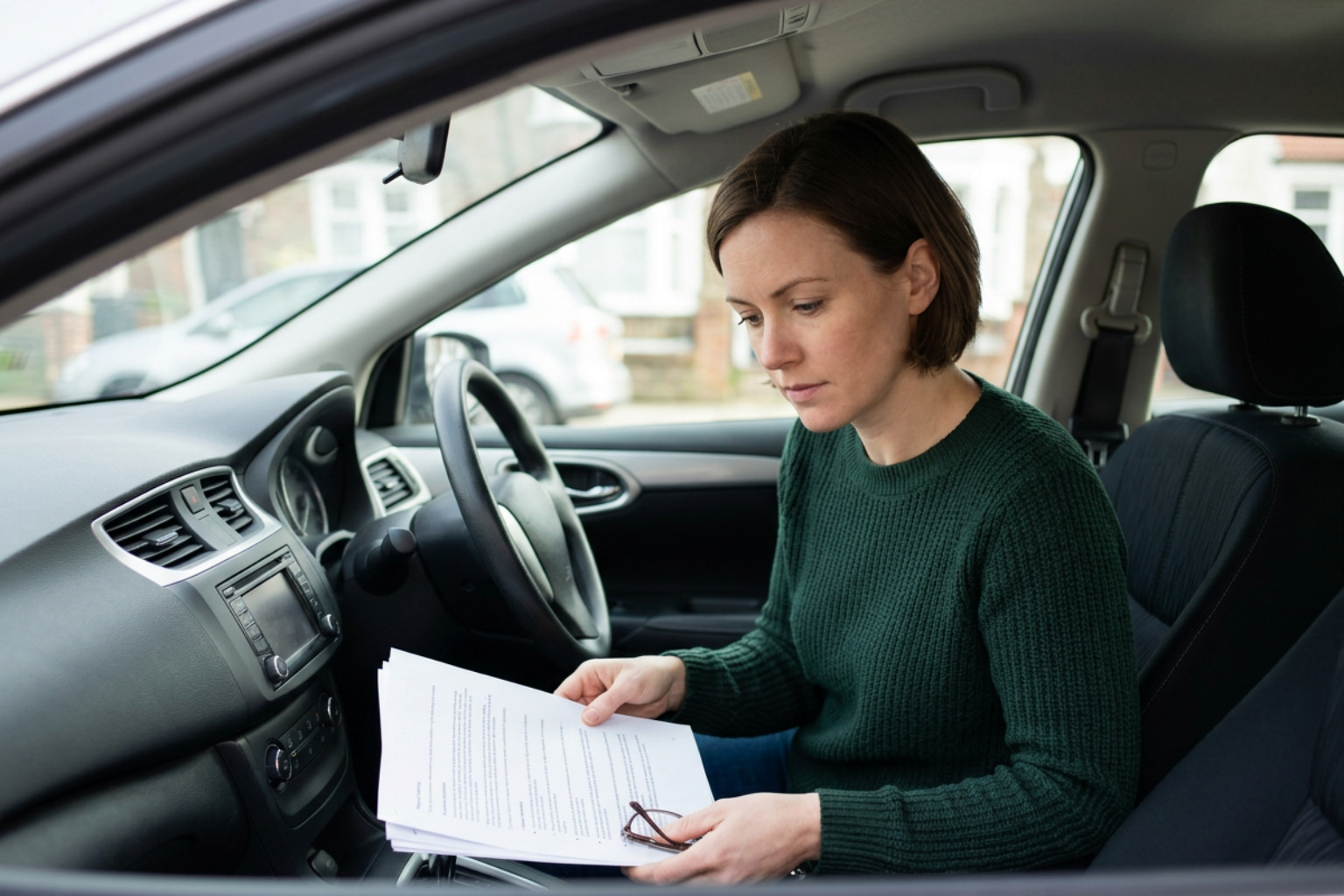
Lending your car is a kind, generous gesture, but it comes with substantial financial and legal responsibilities that every vehicle owner should understand before handing over the keys.
To keep your assets and insurance record protected, keep these essential principles in mind:
- Insurance Follows the Vehicle: When you loan out your car, you are effectively loaning out your insurance policy. Your coverage pays first in the event of an at-fault accident.
- Verify Permissive Use and Driver Fitness: Ensure the borrower has a valid driver’s license, is completely sober, and intends to use the car for personal errands only.
- Watch for Policy Exclusions: Never allow excluded household members to drive your vehicle, and never permit your personal vehicle to be used for commercial deliveries or ridesharing gigs.
- List Frequent Drivers: If someone drives your car more than a dozen times a year, add them to your policy as a named operator to avoid claim disputes.
Taking a few minutes to review your policy terms, set clear ground rules, and verify your coverage limits will ensure you can help out a friend without jeopardizing your financial security.
