
Why Is Insurance Critical Before Your First Customer Walks In?
Before your first customer walks in, a new business owner should secure foundational coverage—specifically a Business Owner’s Policy (BOP) combining general liability, commercial property, and business interruption insurance, along with workers’ compensation and commercial auto. Waiting until after your opening day or first sale leaves your startup exposed to catastrophic legal and financial losses.
Risk does not wait for profitability. The moment you sign a commercial lease, take delivery of equipment, hire a contractor to renovate your space, or invite a vendor inside, you inherit serious liabilities. A courier can trip over an extension cord while delivering hardware, or an electrical spark can ignite a fire overnight. Without coverage, an uninsured startup must absorb these losses out of pocket.
Industry research highlights just how precarious this stage can be:
- 75% of small businesses in the U.S. do not carry enough coverage, leaving them just one major liability claim or property loss away from bankruptcy.
- 25% of businesses never reopen after experiencing a major disaster, largely because they lack the funds to rebuild physical assets and cover fixed ongoing costs while doors are closed.
- 77% of small and medium-sized businesses have underinsurance gaps across basic property and liability protections.
- Only 13% of small business owners feel completely prepared to handle their primary operational risks in today’s environment.
Beyond the threat of physical accidents or lawsuits, third parties will actively demand proof of coverage before allowing you to conduct business. Commercial property landlords rarely hand over the keys without a Certificate of Insurance (COI) that names them as an additional insured on your general liability policy. Equipment leasing companies, municipal licensing boards, wholesale suppliers, and merchant service providers routinely require proof of liability coverage before signing contracts.
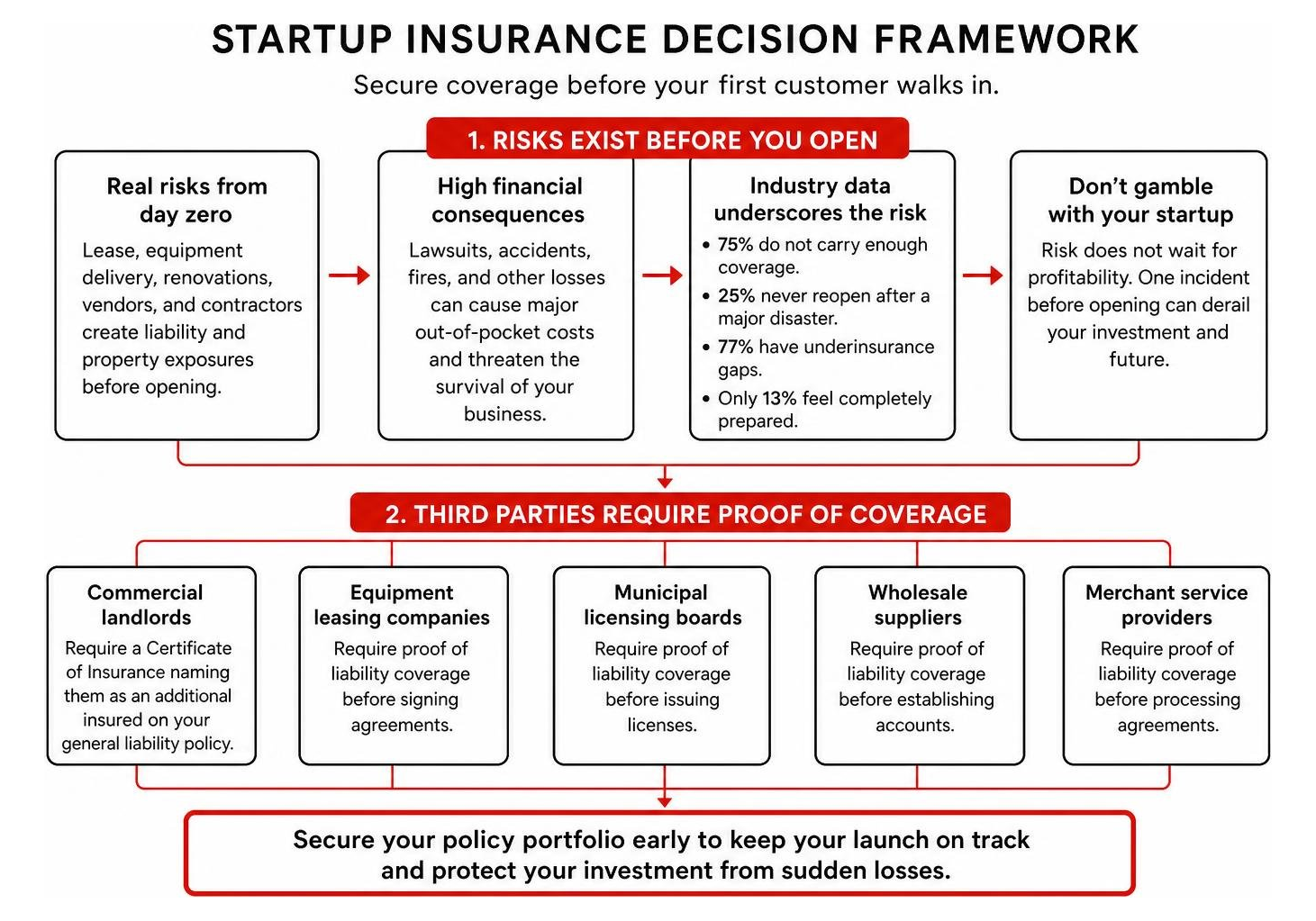
Securing your policy portfolio early ensures your launch timeline stays on track while insulating your initial investment against sudden losses.
What Core Insurance Policies Should a New Business Owner Have on Day One?
Building your initial safety net does not require purchasing every niche endorsement available on the market. Instead, it begins with securing foundational commercial insurance that safeguards your physical premises, operations, employees, and vehicles.
| Policy Type | What It Covers | Who Needs It on Day One? | Average Monthly Cost Range (2026) |
|---|---|---|---|
| General Liability | Bodily injury to third parties, client property damage, slip-and-fall incidents, advertising injury | Every business with physical premises, customer contact, or vendor contracts | $45 – $166 |
| Commercial Property | Leased or owned buildings, tools, inventory, office equipment, furniture against fire, theft, or storms | Any business with physical assets or inventory | $35 – $100 |
| Business Interruption | Replaces lost operating income and covers fixed expenses (rent, payroll) during covered property repairs | Businesses that rely on a physical location or physical machinery to operate | $60 – $140 |
| Business Owner’s Policy (BOP) | Bundles General Liability, Commercial Property, and Business Interruption into a single package | Small-to-medium startups seeking cost efficiency and unified coverage | $40 – $141 |
| Workers’ Compensation | Employee medical bills, disability payments, and lost wages resulting from workplace injury or illness | Mandatory in almost every state as soon as you hire staff | Payroll & industry dependent |
| Commercial Auto | Collision, bodily injury, and liability for vehicles used in business operations | Any business using company-owned, leased, or employee vehicles for work tasks | $100 – $250 |
General Liability and Commercial Property Coverage
General liability insurance is the bedrock of business risk management. It handles non-employee bodily injury, third-party property damage, and personal or advertising injuries (such as libel, slander, or accidental copyright infringement in marketing materials). If a customer slips on wet flooring in your retail shop or a client trips over a display case during your soft launch, general liability pays for medical evaluations, emergency care, legal defense costs, and any court-ordered settlements.
Commercial property insurance protects the physical assets you have invested in to get your business running. This includes:
- Your building (if you own it) or permanent improvements made to a leased suite
- Specialized equipment, manufacturing machinery, registers, and computers
- Furniture, display shelving, lighting, and decor
- Raw materials, stock, and customer-ready inventory
Without property coverage, a broken water pipe or localized fire the week before opening could wipe out your entire starting inventory and fixture investments without compensation.
The Business Owner’s Policy (BOP) Advantage
For the vast majority of small startups, buying general liability, property coverage, and business interruption separately is inefficient and costly. A Business Owner’s Policy (BOP) packages these three vital protections into one policy, typically yielding a 10% to 20% discount compared to separate standalone policies.
A critical, often overlooked component of the BOP is business interruption insurance (also known as business income coverage). If a covered loss—such as a storm or fire—forces you to shut down for repairs shortly after opening, business interruption replaces lost net income and pays mandatory ongoing expenses, such as commercial rent, utility contracts, loan payments, and key staff payroll. This cash flow protection is frequently what prevents a temporary disaster from turning into a permanent liquidation.
Commercial Auto and Workers’ Compensation Requirements
If you plan to have employees assisting you on opening day, workers’ compensation insurance is not merely a smart operational choice—it is a legal requirement in nearly every state. Workers’ comp pays for medical treatment, rehabilitation expenses, and replacement wages if an employee gets hurt lifting inventory, operating machinery, or slipping in a back room. Operating without mandatory workers’ comp can result in stop-work orders, substantial state fines, and direct personal exposure to employee injury lawsuits.
Additionally, if your business owns vehicles, delivers goods, or transports tools between work sites, you need commercial auto insurance. Personal auto policies strictly exclude coverage for claims that occur while carrying out business errands or commercial tasks. If you or an employee causes an accident while picking up opening-week supplies or transporting inventory, a personal auto insurer will likely deny the claim, leaving the business liable for all vehicle repairs and bodily injury costs.
What Additional Coverages Should You Consider Based on Your Business Type?

While a Business Owner’s Policy and mandatory employee coverages form your starting foundation, your industry model determines what specialized protections you must add before servicing your first account.
Professional Liability (Errors & Omissions)
If your business provides specialized advice, consulting, design, accounting, or professional services, general liability will not shield you from allegations of subpar work or professional mistakes.
Professional Liability Insurance, often called Errors & Omissions (E&O), covers:
- Negligence or breach of contract claims
- Errors, miscalculations, or omissions in work deliverables
- Failure to deliver promised professional results or missed deadlines that cause a client financial harm
- Legal defense fees and negotiated settlements, even if the client’s claim is groundless
Corporate clients and prime contractors routinely require proof of an active E&O policy—often with $1,000,000 minimum coverage limits—before they will sign an agreement or permit you to begin work.
Cyber Liability Insurance
A common misconception among new owners is that cybercriminals only target massive corporations. In reality, over 60% of small businesses are targeted by cyberattacks, because small firms frequently have newer, less defended digital systems.
The financial fallout is substantial: the average cost of a data breach incident for a small business reaches $108,000. If your business processes digital credit card payments, stores customer email addresses and phone numbers, or utilizes cloud-based customer management platforms, a cyber liability policy is indispensable.
Cyber insurance covers:
- Forensic investigations to identify system vulnerabilities and contain the intrusion
- Legal fees and compliance fines associated with privacy regulations
- Mandatory customer notification campaigns and credit-monitoring services
- Ransomware extortion negotiations and data restoration expenses
- Business interruption losses resulting from digital downtime
Commercial Umbrella and Key Person Protection
High-severity accidents can quickly exceed standard policy limits. If a serious multi-party vehicle accident or complex premises injury results in a $1.5 million judgment, a basic $1,000,000 general liability limit leaves your company on the hook for the remaining $500,000. Adding commercial umbrella insurance extends supplemental liability protection across your underlying general liability, commercial auto, and employer’s liability policies.
For businesses with co-founders or indispensable talent, establishing continuity protection using commercial life insurance structured as key person insurance is equally essential. If an essential founder passes away, key person coverage provides the business with liquidity to recruit replacement talent, pay down guaranteed commercial loans, and reassure lenders and investors during operational transitions.
How Much Does New Business Insurance Cost in 2026?
Budgeting for insurance as a predictable fixed operating cost prevents cash flow surprises. Across the country, a typical comprehensive bundle of core small-business policies averages approximately $340.75 per month.
However, entry-level costs vary based on the specific policies your startup needs on day one:
- General Liability: $45 to $166 per month ($540 to $1,992 annually)
- Business Owner’s Policy (BOP): $40 to $141 per month ($480 to $1,692 annually)
- Professional Liability (E&O): $50 to $120 per month ($600 to $1,440 annually)
- Cyber Liability: $100 to $145 per month ($1,200 to $1,740 annually)
- Commercial Auto: $100 to $250 per month ($1,200 to $3,000 annually)
For detailed information on gathering your startup documentation and understanding premium structures, explore How-To Shop for Small Business Insurance and review A Quick Start Guide to Insurance Quote before approaching underwriters.
Primary Pricing Factors
Underwriters evaluate several primary variables to calculate your startup’s premium rates:
- Industry Classification & Risk Profile: A retail clothing boutique pays considerably less for liability coverage than a commercial roofing contractor or a restaurant operating open-flame kitchens.
- Projected Annual Revenue & Payroll: Higher projected customer traffic and larger payrolls increase overall risk exposure, affecting general liability and workers’ compensation rates.
- Physical Location & Property Construction: Building age, neighborhood crime statistics, proximity to fire hydrants, and regional weather patterns dictate property insurance premiums.
- Coverage Limits and Deductibles: Choosing standard $1,000,000/$2,000,000 limits versus higher aggregate limits, alongside your choice of deductible ($500, $1,000, or $2,500), directly impacts monthly costs.
- Safety and Risk Controls: Installing monitored security alarms, automatic fire suppression systems, and clear employee safety protocols immediately earns underwriting credits.
Strategic Ways to Manage Startup Premiums
New owners can optimize their insurance budget without creating hazardous coverage gaps by implementing these practices:
- Bundle Core Policies into a BOP: Combining property, liability, and business interruption into a single package captures instant bundle discounts.
- Increase Deductibles Strategically: If your business maintains an adequate emergency cash reserve, raising your property or liability deductible from $500 to $1,000 or $2,500 will noticeably reduce your monthly payments.
- Maintain Accurate Payroll Projections: Workers’ compensation premiums are estimated upfront and audited annually. Estimating payroll accurately prevents surprising audit adjustment bills at the end of the policy year.
- Pay Premiums Annually: Many insurance carriers offer a 5% to 10% discount when you pay your annual premium upfront rather than through monthly installments.
- Adopt the 20% Growth Reassessment Rule: As your company grows, schedule a policy review whenever your annual revenue, physical inventory, or payroll increases by 20% to adjust limits efficiently.
What Common Insurance Pitfalls Should New Entrepreneurs Avoid?

Starting a company involves navigating unfamiliar legal and regulatory requirements. Misunderstandings about what existing entities or policies cover can leave new owners entirely unprotected during their opening months.
The LLC Protection Myth
One of the most widespread and dangerous assumptions made by new business owners is believing that forming a Limited Liability Company (LLC) eliminates the need for commercial insurance.
An LLC is a legal structure, not an insurance policy. While an LLC helps separate your personal assets (such as your home or personal savings) from business debts and commercial contracts, it does not:
- Prevent your business from being sued for negligence, bodily injury, or property damage
- Pay for legal defense attorneys, expert witnesses, or court fees to defend the company
- Cover the cost of repairing storm damage, replacing stolen inventory, or rebuilding damaged premises
- Protect your business bank accounts and assets from being completely drained by a court judgment
Furthermore, if an owner personally commits a negligent act—such as causing a car accident while driving for business or personally creating a hazardous condition—courts can “pierce the corporate veil,” exposing personal assets. Commercial insurance provides the actual financial capital needed to defend claims and pay settlements.
Gaps in Personal Home and Auto Policies
Entrepreneurs operating home-based businesses frequently assume their existing personal home insurance covers their business operations. This is almost never true.
Standard homeowner and renter policies contain strict commercial exclusions:
- Business Property Limits: Most home policies cap coverage for business-related equipment (such as specialized tools, servers, or inventory) at $1,500 to $2,500, which is rarely enough to replace commercial assets.
- Premises Liability Exclusions: If a business client, delivery carrier, or supplier slips on your front porch while delivering commercial goods or attending a meeting, your homeowner’s insurance will almost certainly deny the liability claim.
- Personal Auto Exclusions: Using a personal vehicle to deliver products, transport business equipment, or visit client sites without a commercial auto policy or business-use endorsement leaves you unprotected in an accident.
Home-based business owners should look into an affordable home-business endorsement or a dedicated Business Owner’s Policy to bridge these liability and property gaps.
Frequently Asked Questions About Startup Business Insurance?
Do I need business insurance before I make my first dollar in revenue?
Yes. Operational risk begins long before your first financial transaction. The moment you sign a commercial property lease, purchase tools, store inventory, hire staff, or have vendors visit your work site, you face real liability and property perils. Furthermore, landlords, equipment leasing companies, and local licensing authorities routinely mandate proof of insurance before granting access to premises or approving business licenses.
Does forming an LLC mean I can skip buying business insurance?
No. An LLC creates a corporate boundary that separates personal assets from business obligations, but it does not provide financial protection against lawsuits, property destruction, employee injuries, or professional errors. When an LLC is sued, its corporate bank accounts, equipment, and accounts receivable are fully exposed to judgments. Insurance provides the liquidity required to hire defense counsel, satisfy settlements, and repair damaged property.
Can I run a home-based business using only my homeowners insurance?
In almost all cases, no. Standard homeowners policies explicitly exclude coverage for business-related liability and place strict, low caps (often $2,500 or less) on business equipment or inventory stored at home. If a client is injured on your property or your inventory is destroyed in a fire, a standard homeowner policy will not cover the resulting commercial losses. Home-based owners should add a business endorsement to their policy or secure a standalone Business Owner’s Policy.
How Can You Get Your Startup Protected Before Opening Day?
Opening your new venture should be an exciting milestone, not a source of vulnerability. By securing the proper insurance foundation before your first customer walks in, you protect your capital investment, comply with lease and licensing requirements, and ensure long-term resilience against disruptions.
Before opening day, follow this simple checklist:
- Identify Your Specific Risk Exposures: List your physical property, customer touchpoints, vehicle usage, employee headcount, and digital data collection.
- Secure Core BOP Coverage: Bundle general liability, commercial property, and business income insurance to capture package savings.
- Fulfill Legal and Contractual Mandates: Bind workers’ compensation for your staff, commercial auto for business vehicles, and professional liability if required by client contracts.
- Obtain and Store Your Certificates of Insurance (COI): Have digital and printed COIs ready for landlords, financial lenders, suppliers, and municipal licensing offices.
- Establish an Annual Policy Review Schedule: Partner with a trusted advisor to re-evaluate limits as your revenue and operations expand.
Working with an experienced local insurance advisor ensures you receive personalized risk guidance tailored to your specific community and trade. At The Hornbuckle Agency, we are dedicated to helping entrepreneurs protect their investments with tailored coverage solutions. We proudly guide and support new business owners across multiple Alabama communities, including Albertville, Guntersville, Boaz, Arab, Geraldine, Crossville, Collinsville, Horton, and Douglas.
Reach out to our team today to evaluate your startup’s risks and secure your commercial protection package before welcoming your very first customer.
