
What Types of Equipment Are Covered Away From the Farm and Under What Structures?
When evaluating off-premises protection, insurance policies make a fundamental distinction between fixed infrastructure and mobile agricultural machinery. Understanding how policy structures categorize these items is essential for preventing major out-of-pocket losses.
Fixed or permanently installed equipment—such as automated poultry house feeding lines, stationary grain dryers, and fixed irrigation pumps—is covered under your farm dwelling, barn, or outbuilding forms. Because these assets are affixed to real property, standard policies do not extend coverage if they are dismantled and moved elsewhere unless an endorsement is specifically added.
Mobile agricultural machinery, on the other hand, is built to move. Tractors, combines, balers, seeders, and utility vehicles are designed to work across varying terrain. Most insurers protect mobile machinery through scheduled farm personal property, blanket farm personal property, or an inland marine-style equipment floater that can follow machinery while it is in transit, in leased fields, or temporarily stored away from the home farm.
| Coverage Structure | Typical Off-Premises Limit | Best Suited For | Key Conditions & Restrictions |
|---|---|---|---|
| Scheduled Personal Property | Up to the declared item value, subject to policy territory | High-value machinery such as tractors, combines, and self-propelled sprayers | Each machine should be listed with its serial number, description, and specific valuation limit. |
| Blanket Farm Personal Property | One aggregate limit across qualifying farm property | Mixed fleets, attachments, tools, and mid-tier implements | Coinsurance requirements may apply; unlisted items depend on aggregate limits and policy wording. |
| Unscheduled Farm Personal Property | Limited by policy sublimits for miscellaneous property | Small tools, portable gear, and general farm supplies | Strict off-site caps may apply, especially for property stored away from the insured premises. |
| Equipment Floater / Inland Marine-Style Coverage | Scheduled value within the policy territory | High-dollar, high-mobility machinery and leased equipment | Often used when equipment regularly moves between farms, job sites, dealers, or leased acreage. |
Scheduled Farm Personal Property vs. Blanket Protection
Choosing between scheduling your equipment and using blanket coverage significantly affects how off-site claims are paid.
Under scheduled farm personal property coverage, each machine is itemized on the policy declarations page alongside its specific make, model, vehicle identification number (VIN) or serial number, and an agreed-upon insurance limit. If you transport a $175,000 tractor to a leased tract thirty miles away and it suffers a covered loss, the claim is evaluated against that tractor’s dedicated limit using either Actual Cash Value (ACV) or replacement cost provisions.
Scheduled coverage may also include limited automatic protection for newly acquired machinery, but the limit and reporting deadline vary by carrier. Farmers should contact their agent promptly after buying or leasing equipment so the machine can be added with the correct description and value.
Blanket coverage, by contrast, establishes a single lump-sum limit over an entire category of farm assets without requiring an itemized list. While this approach provides flexibility when buying and selling smaller implements, it requires careful valuation and may leave high-value individual machines subject to coverage adequacy issues if overall blanket values are underreported.
Unscheduled Farm Personal Property and Incidental Off-Site Storage
Unscheduled farm personal property acts as a broad safety net for general farm gear, portable tools, and miscellaneous supplies. However, off-premises coverage for unscheduled items is usually limited:
- Miscellaneous Equipment Caps: Individual unscheduled items may be subject to internal caps, frequently far below the cost of specialized agricultural tools. If an expensive handheld diagnostic tool or hydraulic power pack is stolen from an off-site job trailer, unscheduled coverage may not cover the full replacement cost beyond that sublimit.
- Off-Site Produce and Supplies: Farm produce, feed, seed, and chemical supplies may have special sublimits or location restrictions when temporarily stored in structures away from the primary insured premises.
To determine which structure fits your machinery inventory, you can compare farm insurance options to align your operational assets with the proper policy structure.
What Geographic Limits and Time Restrictions Apply to Off-Premises Machinery?
A standard policy does not automatically protect your farm machinery worldwide. Policies contain territorial boundaries and time parameters that define exactly when coverage applies away from home.
Many farm policies limit off-premises protection to a stated territory or radius around the insured farm location. If you transport a tractor across county or state lines for a seasonal project, dealer service, auction, or specialized maintenance, confirm the trip falls within your policy territory before the machine leaves the farm.
If equipment will be used or stored beyond the standard territory, your agent may need to endorse the policy, schedule the temporary location, or place the machine on broader equipment floater coverage. This is especially important for farmers who operate leased acreage in multiple counties or who share machinery between related farm entities.
Time Restrictions and Grace Periods
Off-premises protection involves several critical time restrictions:
- The Acquisition Reporting Window: When you purchase or lease a new piece of mobile equipment, your policy may provide temporary automatic coverage for a limited period. The deadline and limit vary by carrier, so report new machinery immediately rather than waiting until renewal.
- Emergency Property Removal: If an impending wildfire, flood, tornado, or severe storm forces you to move machinery to a neighbor’s property or an open holding lot for safety, emergency removal provisions may maintain coverage at the temporary location for a limited period.
- Seasonal Off-Site Storage: If machinery is parked at a third-party commercial storage facility or secondary farm workshop during the winter months, policies may require that location to be listed or endorsed if the duration exceeds temporary-use definitions.
The 80% Coinsurance Requirement on Unscheduled Property
When utilizing unscheduled or blanket personal property coverage for equipment that moves off-site, you must monitor any coinsurance clause in the policy.
Some insurers require the policy limit for unscheduled or blanket farm personal property to equal a stated percentage of the total Actual Cash Value (ACV) of eligible farm personal property across the operation. Because equipment, grain inventories, and livestock values fluctuate throughout the year, an off-site claim can trigger severe penalties if your total farm inventory exceeds your policy limit.
$$\text{Claim Payment} = \left( \frac{\text{Limit of Insurance Carried}}{\text{Limit of Insurance Required}} \right) \times \text{Total Loss} – \text{Deductible}$$
If you carry $400,000 in blanket coverage on an equipment inventory valued at $600,000, and your policy requires an 80% coinsurance level, the required limit is $480,000. If a $60,000 tractor is destroyed in an off-site covered loss, the insurer may reduce the claim payment because the carried limit was below the required amount.
Does Farm Insurance Cover Custom Harvesting and Hired-Out Equipment?
One of the most frequent coverage pitfalls occurs when farmers use their equipment to perform contract work for others.
Standard agricultural property and liability policies may restrict or exclude custom farming, custom harvesting, or hired-out equipment operations. If you take your combine, planter, or tractor onto another producer’s land and perform field operations in exchange for a fee, do not assume your baseline farm policy automatically covers both physical damage and liability for those operations.
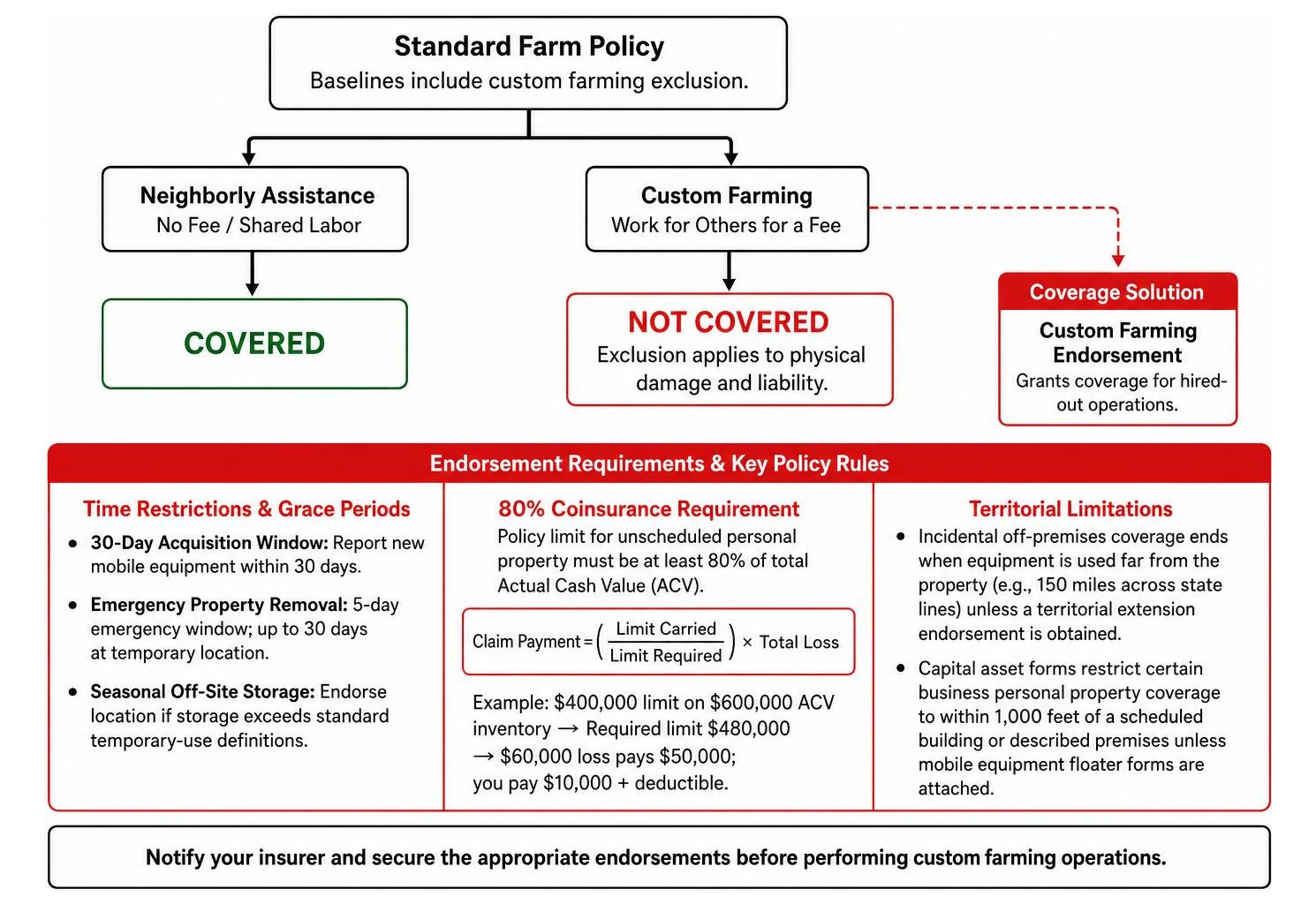
To maintain coverage while doing custom work, specific steps are required:
- Disclose Custom Work Before the Season Starts: Tell your agent where the equipment will be used, what services you will perform, and how much revenue you expect from hired-out operations.
- Add the Proper Custom Farming or Business Use Endorsement: If you generate revenue by doing fieldwork for others, your policy may need an endorsement that specifically permits those operations and sets the right liability and physical damage limits.
- Transitioning to Commercial Coverage: If custom harvesting or commercial field preparation becomes a substantial income stream exceeding incidental farm thresholds, standard agricultural endorsements may no longer be sufficient. You may need dedicated commercial insurance to operate alongside your core farm insurance portfolio.
Before dispatching machinery for seasonal contract runs, refer to The Ultimate Guide to Evaluating Farm Insurance Coverage for Harvest Season to evaluate operational risks and ensure your endorsements are active.
How Are Borrowed, Rented, and Leased Machines Handled Off-Site?
Modern agricultural operations frequently rely on rented or borrowed machinery to manage peak seasonal workloads. However, assuming your primary policy automatically absorbs these high-dollar units creates significant financial exposure.
Borrowed, rented, or leased mobile agricultural equipment may receive only limited automatic protection unless it is specifically endorsed. The available limit, reporting deadline, and covered locations depend on the policy, the rental agreement, and whether the equipment is in your care, custody, or control.
A small automatic limit is inadequate when renting a modern combine or self-propelled sprayer valued at $350,000 to $500,000. If that rented unit catches fire while working an off-site parcel, an unendorsed policy can leave you personally responsible for the difference between the policy sublimit and the machine’s full replacement value.
Confirm When Borrowed Gear Becomes Your Responsibility
A critical nuance in borrowed-equipment claims is timing: coverage may depend on when the machine leaves the owner’s premises, when you accept custody, and what the rental or loan agreement says about physical damage responsibility. Do not rely on verbal assumptions about who is responsible while the equipment is being loaded, transported, or returned.
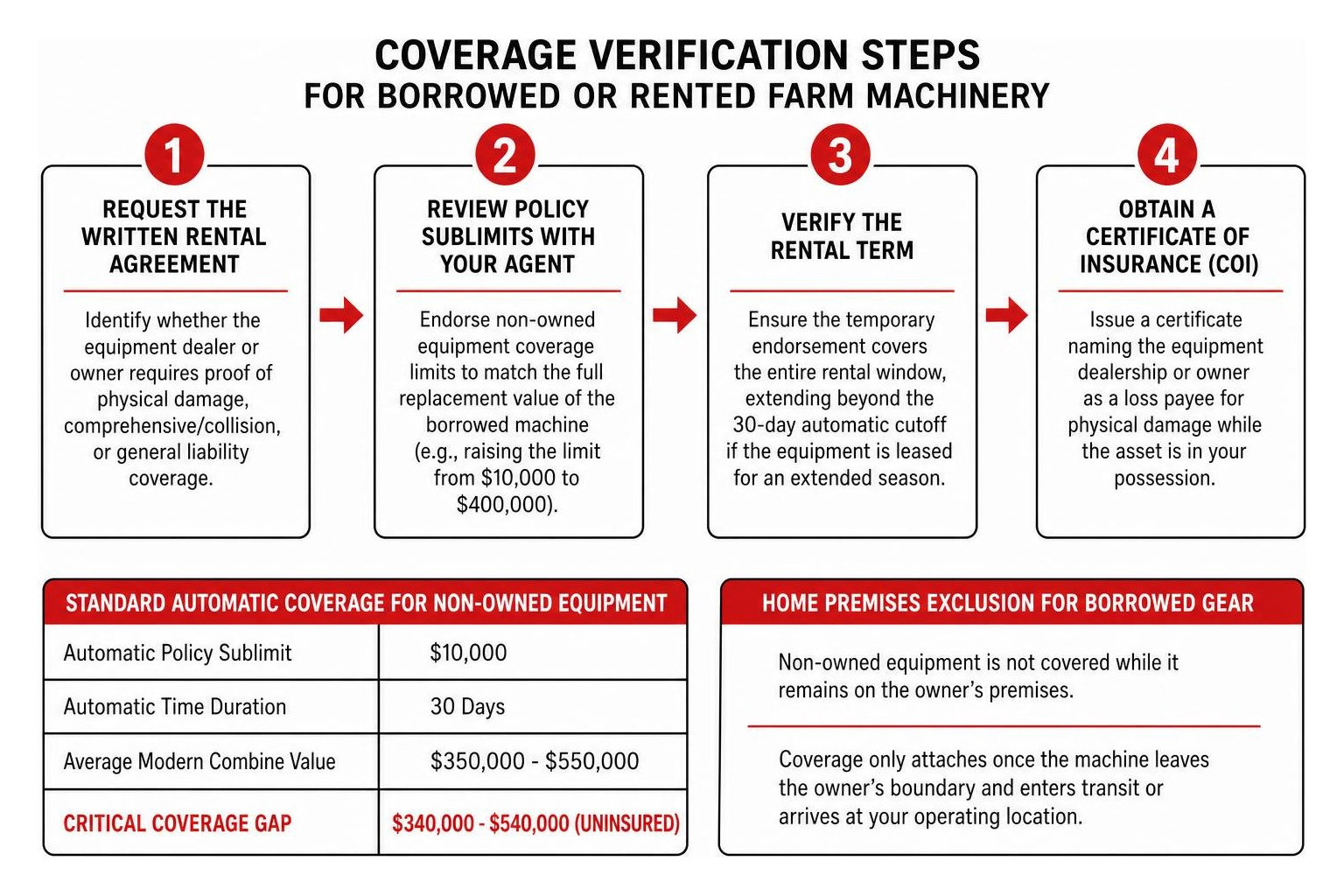
Before taking custody of borrowed or rented farm machinery, follow this verification checklist:
- Request the Written Rental Agreement: Identify whether the equipment dealer or owner requires proof of physical damage, comprehensive/collision, or general liability coverage.
- Review Policy Sublimits with Your Agent: Endorse non-owned equipment coverage limits to match the full replacement value of the borrowed machine, rather than relying on a small automatic limit.
- Verify the Rental Term: Ensure the temporary endorsement covers the entire rental window, especially if the equipment is leased for an extended season.
- Obtain a Certificate of Insurance (COI): Issue a certificate naming the equipment dealership or owner as a loss payee for physical damage while the asset is in your possession.
What Perils Are Covered and Excluded for Equipment Away From Home?
When mobile machinery leaves your home property, the scope of covered perils depends on whether your policy is written under named-peril or open-peril coverage.
Road Transit vs. Motor Vehicle Insurance Rules
When moving machinery along public roadways, questions often arise regarding whether equipment is covered by farm property insurance or auto insurance.
Implements of husbandry—such as tractors pulling wagons, combine harvesters, and sprayers—are classified as mobile equipment and may remain covered for physical damage under your farm property schedule or equipment floater while driving on public roads. Third-party liability arising from driving mobile machinery on public roadways may be addressed through farm liability coverage, but licensed vehicles and highway exposures should always be reviewed with your agent.
However, standard pickup trucks, grain haulers, semi-tractors, and heavy road trailers licensed for highway use must be insured under a dedicated auto or commercial auto policy. For licensed vehicles operating between farm fields, review our practical guide to comparing and buying new vehicle insurance to maintain seamless coverage across all road-going farm transport.

Common Carrier Transit Exclusions
If you hire an independent freight company or contracted third-party flatbed transporter to move machinery, confirm whether your farm policy, the hauler’s motor truck cargo coverage, or a separate transit endorsement responds during transport. Do not assume your baseline farm personal property coverage follows the machine while it is in the custody of a commercial carrier.
Frequently Asked Questions About Farm Equipment Away From the Property
Can I transport my tractor to a county fair or agricultural show under standard coverage?
Yes. Transporting equipment to exhibitions, county fairs, or agricultural demonstrations is permitted under scheduled Coverage E and inland marine floaters, provided the event occurs within the standard 100-mile territory. However, coverage is strictly voided if the tractor participates in competitive tractor pulls, drag contests, or stunting activities.
Does farm insurance pay for roadside extraction if a tractor overturns in a ditch away from home?
Most mobile machinery forms include supplementary coverages for debris removal, emergency towing, and extraction costs if an overturn or collision occurs due to a covered peril. These limits typically range from $2,500 to $5,000 per occurrence, though higher limits can be endorsed for heavy harvesting machinery.
How quickly must I notify my insurance agent after purchasing or leasing new mobile equipment?
You have a strict 30-day notification window from the date of physical purchase or lease signing. During this 30-day period, automatic coverage is capped (often at $100,000 or 25% of the scheduled item limit). To ensure full valuation coverage, contact your insurance agent immediately upon purchase to add the specific VIN and replacement value to your schedule.
How Can The Hornbuckle Agency Ensure Your Machinery Is Protected Anywhere in Alabama?
Agricultural operations require specialized insurance solutions. Equipment frequently moves across parcels, between leased acreage, and along state highways. Leaving your off-premises protection to guesswork can expose your farm to severe financial disruptions.
At The Hornbuckle Agency, we conduct detailed equipment reviews to identify coverage gaps, clarify transit exposures, update scheduled machinery valuations, and structure custom farming endorsements. By working with a dedicated local provider, you can secure comprehensive protection through options like Protecting Your Farm and Home with ALFA Insurance in Marshall County.
The Hornbuckle Agency serves multiple Alabama communities, including Albertville, Guntersville, Boaz, Arab, Geraldine, Crossville, Collinsville, Horton, and Douglas. Contact our team today to evaluate your farm personal property schedules, adjust inland marine floaters, and confirm your machinery is fully protected wherever your work takes you.
