
What Insurance Do You Need When Buying a Manufactured Home on Private Land?
When you purchase a manufactured home on private acreage, your property profile is fundamentally different from that of someone leasing a lot in a mobile home park or buying a traditional site-built house. Because you own both the structure and the underlying real estate, you need an insurance package that covers the building, protects your land from broad premises liability, and covers detached outbuildings across your parcel.
In the insurance industry, factory-built residences are insured under an HO-7 policy form (often referred to as a manufactured home policy). Standard homeowners insurance forms (such as the HO-3) are specifically designed for stick-built structures constructed directly on-site. The HO-7 form accounts for the specific architectural engineering, steel chassis frames, factory-assembled building materials, and anchoring systems unique to modern manufactured housing.
A complete manufactured home insurance policy on private property brings together five essential protection layers:
- Dwelling Coverage (Coverage A) to repair or replace the home after sudden physical damage.
- Other Structures Coverage (Coverage B) to insure outbuildings like detached garages, barns, workshops, and perimeter fences.
- Personal Property Coverage (Coverage C) to protect the furniture, electronics, clothing, and household goods inside.
- Loss of Use / Additional Living Expenses (Coverage D) to pay for temporary housing and meal surcharges if your home becomes unlivable due to a covered peril.
- Personal Liability and Medical Payments (Coverages E and F) to shield your family finances if a guest or contractor is injured anywhere on your acreage.
Securing the proper policy is rarely optional if you are financing your purchase. Whether you take out a conventional mortgage, an FHA Title II loan, a VA loan, or a specialized land-home package, your lender will mandate comprehensive hazard insurance before closing funds are disbursed.
Beyond lender mandates, manufactured homes permanently sited on private ground represent a fast-appreciating asset. Recent market data shows manufactured homes sold with land appreciated by 70.1% over a seven-year period, compared to 58.6% for traditional site-built properties. Putting proper protection in place ensures that your growing property equity remains secure against unpredictable disasters.
What Core Coverages Protect Your Manufactured Home and Acreage?
Building a dependable insurance shield starts with understanding how a comprehensive manufactured home insurance policy is structured. Unlike basic policies that only pay for a narrow list of perils, top-tier manufactured home policies can be written on either a named perils or an open perils (comprehensive) basis.
- Named Perils Coverage: Protects your property exclusively against specific causes of loss listed directly in the policy contract, such as fire, lightning, hail, windstorms, explosion, and vandalism. If a peril is not explicitly named, the damage is not covered.
- Open Perils Coverage: Covers direct physical loss caused by any peril unless the policy specifically excludes it (such as floodwaters, earthquakes, or intentional neglect). Open perils policies offer far broader financial protection for your physical dwelling.
Dwelling Coverage (Coverage A)
Dwelling coverage forms the baseline of your policy. It covers the physical structure of your manufactured home, including the factory-built envelope, roofing, siding, load-bearing walls, subflooring, cabinetry, plumbing lines, heating/cooling systems, and built-in kitchen appliances. It also extends to permanently attached additions, such as custom porches, steps, sunrooms, and carports.
When setting your Coverage A limit, focus strictly on the reconstruction cost of the home rather than the combined real estate market value of your home and land. Your land will not burn down in a fire or blow away in a windstorm, so insuring the market purchase price can result in overpaying for coverage you cannot collect. Dwelling calculations must factor in current local labor rates, material shipping costs, foundation installation, and utility hookup reconnection.
Other Structures and Outbuildings (Coverage B)
Private land ownership frequently includes external structures scattered across the property. Coverage B safeguards unattached physical structures on your acreage, including:
- Detached two-car garages and workshops
- Pole barns, tractor sheds, and storage outbuildings
- Well houses, pump stations, and utility sheds
- Boundary fencing, security gates, and paved driveways
Standard policies typically allocate 10% to 20% of your primary dwelling coverage toward other structures. For instance, if your manufactured home is insured for $200,000, your baseline policy will provide $20,000 to $40,000 for detached outbuildings. If you have built an expansive custom workshop or substantial equestrian fencing, we can increase this limit with specific endorsements to match your outbuilding values.
Personal Property and Belongings (Coverage C)
Personal property coverage protects everything you bring into your home: furniture, beds, televisions, computers, kitchenware, clothing, and power tools. Standard policies generally set personal property limits between 50% and 70% of your dwelling coverage limit.
Standard policies place internal sub-limits on specific high-value categories. For example, standard limits might cap firearm payouts at $2,500, jewelry at $1,500, and specialized collectibles or power tools at set amounts. To protect valuable assets against theft, fire, or loss, we recommend adding a scheduled personal property endorsement, which provides dedicated, itemized protection with zero deductible.
Liability and Medical Payments (Coverages E and F)
Premises liability is one of the most critical components of private land ownership. If a delivery driver trips on your front walkway, a visitor falls down your porch steps, or a family pet injures a neighbor, Coverage E defends you against lawsuits, covers attorney fees, and pays court judgments up to your policy limit.
For homeowners on private acreage, standard baseline liability ($100,000) is rarely sufficient. We advise landowners to carry at least $300,000 to $500,000 in personal liability coverage.
Coverage F (Medical Payments to Others) provides a quick-response layer for minor guest injuries occurring on your property—regardless of who was at fault. It typically provides $1,000 to $5,000 to cover immediate emergency room visits, stitches, or X-rays, resolving incidents smoothly before they escalate into formal legal claims.
Loss of Use and Additional Living Expenses (Coverage D)
If a severe storm, kitchen fire, or falling tree renders your manufactured home uninhabitable, Coverage D reimburses the necessary additional living costs your household incurs while the structure is repaired or replaced.
Coverage D handles:
- Extended-stay hotel or rental home costs
- Restaurant meal costs that exceed your standard grocery budget
- Temporary pet boarding fees
- Increased commuting costs and temporary utility setup fees
Basic policies sometimes offer a fixed per-day allowance (e.g., up to $10–$50 per day for a limited duration), which quickly falls short during extensive structural rebuilds. Choosing an open policy that covers full additional living expenses based on actual incurred costs prevents out-of-pocket strain during major restorations.
How Does Owning Private Land Change Your Insurance Requirements?
Insuring a manufactured home on your own deeded land is vastly different from insuring a unit in a mobile home park. In a park setting, the community owner carries master liability insurance for access roads, common grounds, drainage basins, and shared amenities. On private property, every square foot of risk rests squarely on your shoulders.
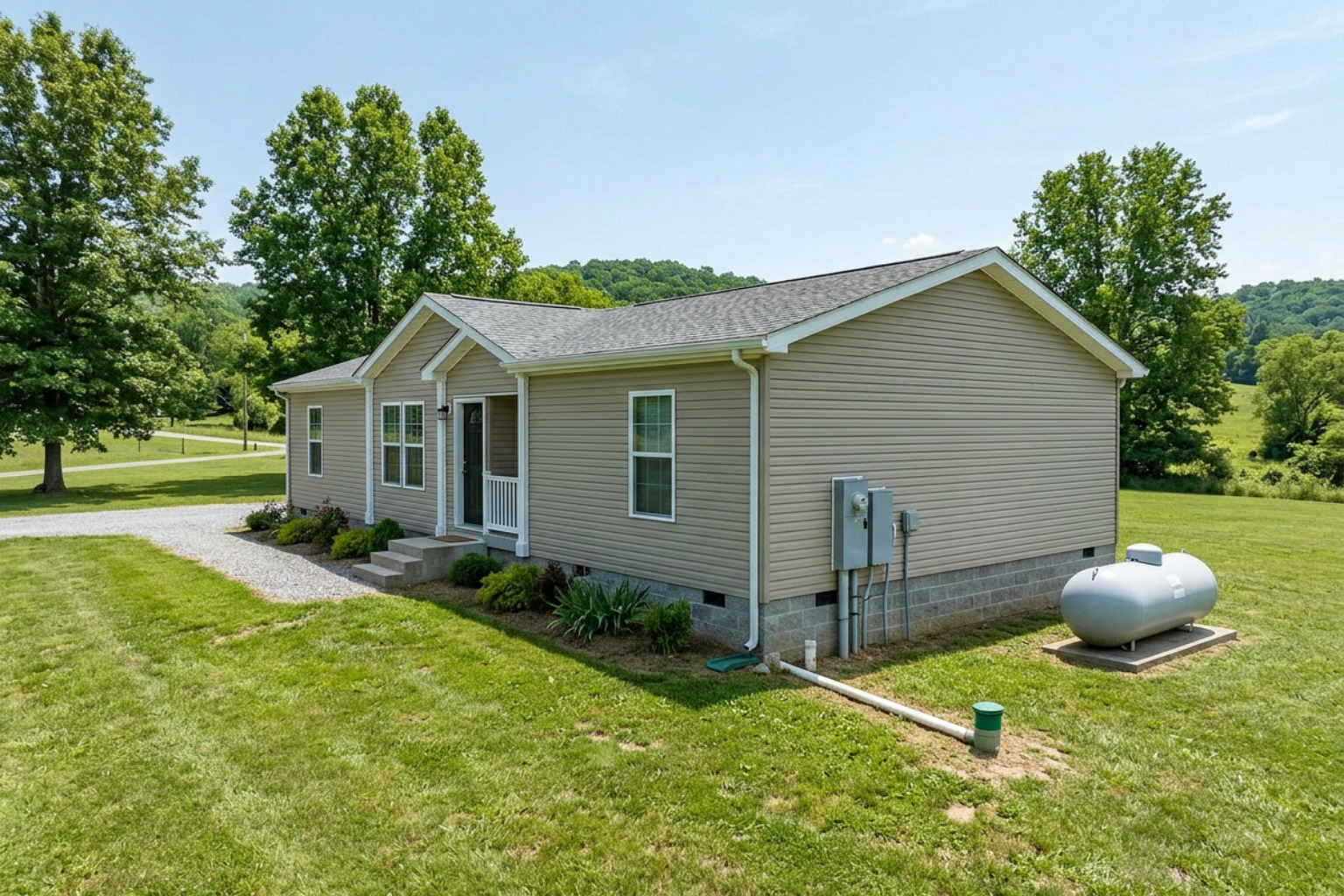
When placing a manufactured home on private land, you must navigate the legal and structural classification of your home:
- Personal Property (Chattel Titling): If your home sits on temporary blocks with standard metal skirting and retains a vehicular title through the state department of motor vehicles, insurers classify it as personal property.
- Real Property Conversion (De-titling): When you place your home on a permanent masonry perimeter foundation, connect permanent utilities, remove the axles/hitch, and legally surrender the vehicle title to record the home on the county land deed, it becomes classified as real property.
Converting your home to real property on deeded land improves loan financing options and enhances long-term market value. For an in-depth review of how these property designations shape policy selection, explore A Comprehensive Guide to Mobile Home Insurance Cover Options.
Private acreage introduces broader liability risks that park dwellers do not face. If your property features long private gravel drives, wooded boundary lines, livestock fencing, utility easements, or recreational features like ponds, your potential exposure to trespasser claims, hunting accidents, or delivery vehicle incidents increases. Structuring higher liability limits and backing them with an umbrella policy creates a vital safeguard for rural landowners.
Should You Choose Replacement Cost Value or Actual Cash Value?
The choice between Replacement Cost Value (RCV) and Actual Cash Value (ACV) is the single most important financial decision you will make when structuring your manufactured home policy. The method you select dictates how your insurance company calculates claim checks following a total loss.
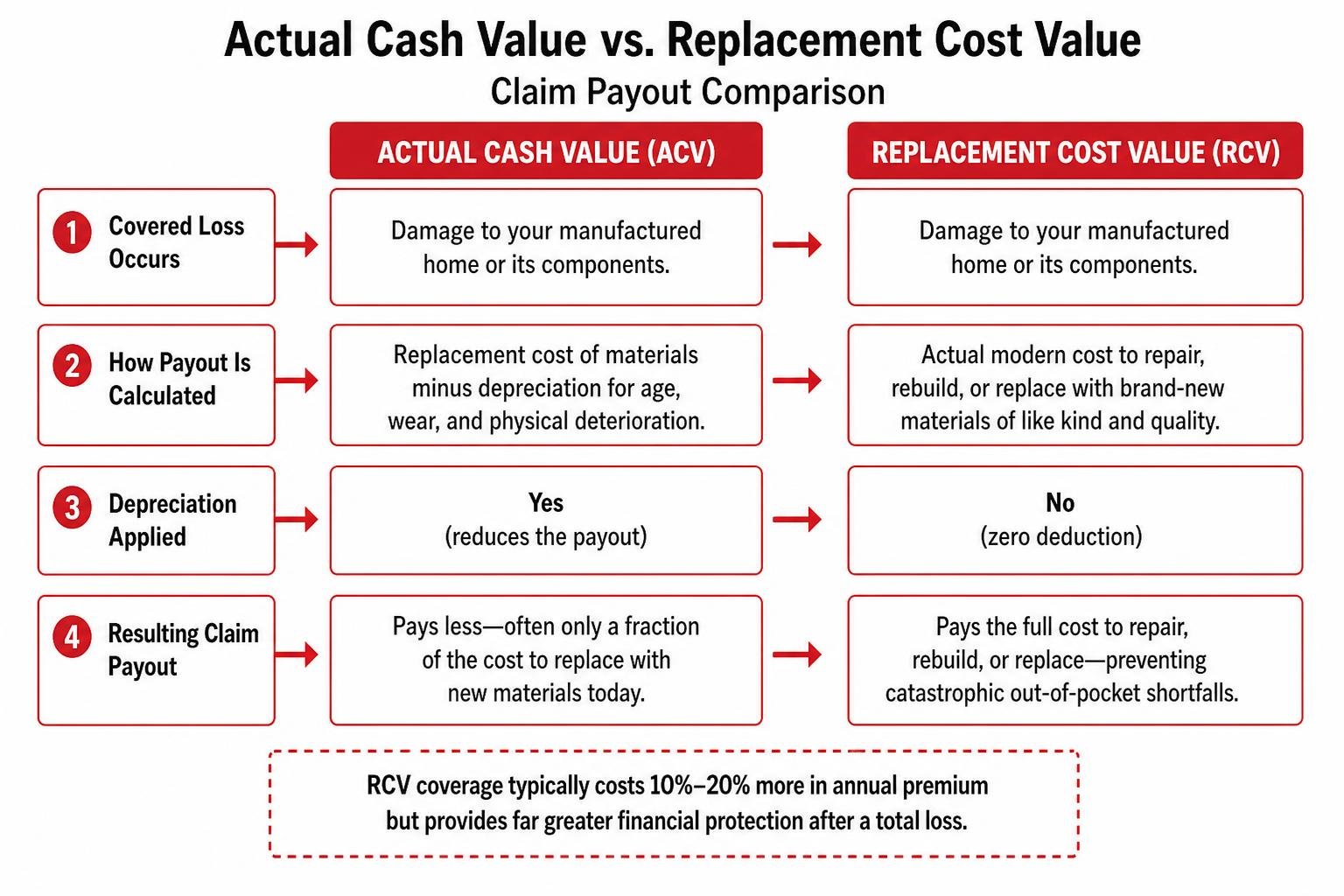
- Actual Cash Value (ACV): Calculates payouts based on the replacement cost of materials minus depreciation for age, wear, and physical deterioration. Because factory-built components depreciate steadily over time, an ACV payout on a 15-year-old roof or interior floor will only cover a fraction of the actual cost to purchase new materials today.
- Replacement Cost Value (RCV): Pays the actual modern cost to repair, rebuild, or replace damaged components with brand-new materials of like kind and quality—with zero deduction for depreciation.
While an RCV policy generally costs 10% to 20% more in annual premium than an ACV policy, it prevents catastrophic out-of-pocket shortfalls when disaster strikes. Consumer protection organizations such as United Policyholders point out in their Mobile/Manufactured Home Insurance Basics guide that choosing ACV leaves homeowners bearing the brunt of post-disaster inflation and material price spikes.
| Policy Feature | Actual Cash Value (ACV) | Replacement Cost Value (RCV) |
|---|---|---|
| Annual Premium Cost | Lower (Baseline) | 10% to 20% higher than ACV |
| Depreciation Deduction | Yes (subtracted based on item age) | No (paid at full modern replacement rate) |
| Roof Claim Settlement | Payout reduced heavily by roof age | Pays for new comparable roof installation |
| Personal Property Payouts | Used garage-sale value of belongings | Pays current retail prices for replacements |
| Total Loss Protection | Risk of substantial out-of-pocket deficit | Rebuilds home to modern equivalent specs |
Extended Replacement Cost (ERC) and Code Upgrades
To protect against severe post-disaster labor shortages and regional building material surges, you can attach an Extended Replacement Cost (ERC) endorsement. An ERC rider adds an extra 25% to 50% buffer over your base dwelling coverage limit if regional rebuilding costs spike following widespread storms.
Additionally, make sure your policy includes Ordinance or Law (Building Code Upgrade) Coverage. Manufactured homes built after the landmark June 15, 1976 HUD Code must adhere to strict federal construction guidelines. If local municipal codes or wind-zone tie-down requirements have updated since your home was manufactured, code upgrade coverage reimburses the required structural modifications during a rebuild.
What Optional Endorsements and Peril Riders Should You Consider?
Standard manufactured home policies contain specific exclusions for catastrophic natural events, utility disruptions, and transport risks. Adding targeted riders ensures your policy leaves no blind spots.

Flood and Surface Water Endorsements
Standard manufactured home insurance policies never cover flood damage. If rising surface runoff, overflowing creeks, heavy rain ponding, or saturated ground conditions push water into your home, standard coverage will deny the claim.
Because manufactured homes sit closer to the ground than elevated multi-story dwellings, floodwaters can quickly ruin subflooring, insulation, and cabinetry. To safeguard your investment, purchase a separate flood insurance policy through the National Flood Insurance Program (NFIP) or secure a private flood insurance policy tailored to rural acreage.
Earth Movement and Sinkhole Riders
Damage caused by shifting ground, earthquakes, tremors, mudslides, or sinkhole collapse is excluded under baseline property forms. If your private land is located in an area with karst geology (limestone formations prone to underground collapse) or seismic fault lines, adding an optional earth-movement endorsement covers catastrophic foundation displacement and structural cracking.
Transit and Trip Collision Protection
If you are buying a new manufactured home or moving a unit to your private land from another location, it is not covered while in transit under a standard stationary policy.
To protect the home against highway collisions, roll-overs, bridge strikes, or severe road gouging during transport, you must secure a specialized Trip Collision / Transit Endorsement. This temporary rider provides comprehensive protection during the 30-day moving window and must be bound before the transporter moves the home onto public roads.
Water Backup and Sump Overflow Endorsements
Private rural properties frequently rely on on-site septic tanks, drain fields, or basement sump systems. If heavy seasonal rains overwhelm your drain field or a mechanical pump failure forces sewage and water back up through interior drains, cleanup and floor restoration costs can easily reach thousands of dollars. A water backup endorsement covers the necessary interior drying, sanitizing, and subfloor replacement.
What Factors Determine Insurance Premiums and How Can You Save?
Manufactured home insurance premiums typically range between $700 and $1,500 annually across standard risk zones, but can exceed $1,800 per year in regions prone to severe windstorms, hail, or tornado activity.
Underwriters evaluate several primary risk factors when calculating your annual rate:
- Home Age and HUD Compliance: Homes built after June 15, 1976 (meeting federal HUD safety standards) qualify for standard preferred rates, while newer units built to recent thermal and wind-load standards enjoy lower premiums.
- Foundation and Anchoring: Homes secured to permanent concrete footers, engineered tie-down straps, and masonry perimeter underpinning receive substantial wind-mitigation credits.
- Geographic Location and Fire Protection: Distance to the nearest responding fire department, proximity to municipal hydrants, and regional severe weather history directly impact rates.
- Claims History and Credit Rating: Maintaining a claims-free record and a solid credit profile helps you secure top-tier pricing tiers.
Actionable Ways to Lower Your Annual Premium
- Upgrade Wind Mitigation Systems: Install engineered tie-downs, heavy-gauge ground anchors, and reinforced masonry skirting to qualify for wind-resistance discounts.
- Adjust Your Deductible: Raising your property deductible from $500 to $1,000 or $2,500 can reduce your annual premium by 10% to 15%.
- Bundle Multiple Policies: Packaging your manufactured home insurance alongside your auto, boat, farm, or life insurance coverage can yield multi-policy discounts of 5% to 15%.
- Install Monitored Safety Devices: Adding centrally monitored burglar alarms, smoke detectors, deadbolts, and automatic water-shutoff valves earns protective device credits.
- Maintain Ongoing Maintenance: Keeping your roof sealed, skirting intact, and overhanging tree limbs trimmed prevents avoidable damage and keeps your policy in good standing.
What Are the Most Common Questions About Manufactured Home Insurance?
Is insurance mandatory when purchasing a manufactured home on private land?
There is no federal or state statute requiring an outright cash buyer to purchase manufactured home insurance. However, if you finance the purchase through a mortgage company, credit union, or manufactured home lender, insurance is mandatory. Lenders require comprehensive physical damage and premises liability coverage with the financial institution named as the primary loss payee before releasing funds.
Even without a loan, going without insurance leaves you personally responsible for total rebuilding costs, outbuilding repairs, and premises liability lawsuits.
Can I buy standard homeowners insurance (HO-3) for my manufactured home?
No. Standard HO-3 homeowners insurance contracts are written strictly for site-built (stick-built) homes constructed on permanent foundations from the ground up.
Because manufactured homes are constructed off-site in controlled factory settings on steel I-beam chassis, transportable sections, and specialized structural assemblies, insurers write them using the dedicated HO-7 manufactured home policy form. The HO-7 mirrors the essential protections of an HO-3 while matching the structural realities of factory-built housing.
How does the age of a manufactured home affect insurability?
The structural cutoff in the manufactured housing sector is June 15, 1976—the date the federal Manufactured Home Construction and Safety Standards (HUD Code) took effect. Units built prior to this date are technically classified as “mobile homes” and face strict underwriting scrutiny; many insurers decline pre-1976 units altogether due to outdated wiring, plumbing, and structural framing.
Homes built after June 1976 are broadly insurable. Newer units built to modern wind-zone and energy standards qualify for the lowest premium tiers. For older units, completing major system updates—such as installing a new metal or architectural shingle roof, updating to copper wiring, and replacing older plumbing lines—helps qualify the home for comprehensive replacement cost coverage.
How Can You Get the Right Coverage for Your Property in Alabama?
Protecting a manufactured home on private land requires balancing structural replacement costs, personal property limits, outbuilding valuations, and liability across your entire parcel. Because severe storms, straight-line winds, and heavy seasonal precipitation are common in North Alabama, setting up coverage with the right peril protections and deductibles is essential.
At The Hornbuckle Agency, we believe in personalized risk education. We don’t believe in generic, one-size-fits-all policies. We sit down with you to review your property deed, evaluate your outbuildings and workshops, calculate accurate rebuild costs, and ensure your acreage is shielded against liability.
We serve families and landowners across multiple North Alabama communities, including Albertville, Guntersville, Boaz, Arab, Geraldine, Crossville, Collinsville, Horton, and Douglas.
When you are ready to prepare your property details, serial numbers, foundation certifications, and purchase documents, start with A Quick Start Guide to Insurance Quote to see what information you will need.
Ready to secure comprehensive coverage tailored to your manufactured home and private acreage? Contact Us today to speak with our local team and get a personalized policy quote built for your property.
