
Does Liability, Comprehensive, or Collision Insurance Cover Hitting a Deer?
When drivers buy auto insurance, many assume that carrying “full coverage” or a state-mandated auto policy automatically protects them against every roadside hazard. Unfortunately, thousands of drivers discover the truth only after a buck leaps out from the tree line: standard liability insurance does not cover vehicle damage from hitting a deer.
Understanding which policy component pays for animal strikes—and how different driving choices impact your claim—is critical before fall arrives. Here is how the three primary auto coverage types respond to a deer accident.
1. State Liability Coverage (No Vehicle Coverage)
Liability coverage is mandatory under state law, but its purpose is strictly to pay for injuries and property damage you cause to other people. If a deer suddenly crosses your path and you strike it, there is no third-party driver or property owner involved. Because liability coverage never pays for damage to your own vehicle, carrying liability-only insurance leaves you responsible for 100% of the repair bills out of pocket.
2. Comprehensive Coverage (The Protection That Covers Animal Strikes)
To get financial protection when hitting a deer, you must carry Comprehensive coverage (sometimes referred to in policies as “other than collision” coverage). Comprehensive coverage protects your vehicle against non-collision hazards outside your direct control, such as severe weather, falling trees, theft, vandalism, and direct physical contact with animals.
When your vehicle makes direct physical contact with a deer, insurance companies classify the incident as an “Act of Nature” or an unpredictable wildlife hazard. Because you could not reasonably prevent the animal from leaping into your path, comprehensive claims are treated as not-at-fault accidents. This distinction is vital because not-at-fault comprehensive claims typically do not trigger the steep premium surcharges associated with driver error.
3. Collision Coverage (The Swerving Distinction)
Collision coverage pays to repair your vehicle if it collides with another car or a stationary object, such as a tree, utility pole, guardrail, or ditch. While this sounds straightforward, collision coverage plays a unexpected role in deer season accidents:
- Direct Contact: If you hit the deer directly, the claim is processed under Comprehensive coverage.
- Swerving to Avoid: If you swerve to avoid the deer and strike a guardrail, tree, or another vehicle—without touching the deer—the incident is classified under Collision coverage.
- Hitting a Dead Deer: If a deer was already hit by another vehicle and lies stationary in the roadway when you run over it, insurers usually classify the damage under Collision coverage because the animal was a stationary road object rather than an unpredictable moving creature.
How Deductibles and Total Loss Scenarios Work
Whenever you file a comprehensive or collision claim, you are responsible for paying your chosen deductible before insurance funds kick in. Comprehensive deductibles are often lower than collision deductibles—typically set between $250 and $500.
Because modern vehicle repairs after a deer strike frequently range between $3,500 and $8,000, severe front-end structural or mechanical damage can easily exceed the actual cash value (ACV) of an older or heavily used vehicle. If your car is declared a total loss, the insurance company pays out the vehicle’s fair market value minus your comprehensive deductible.
If you are leasing or financing a modern vehicle, carrying Gap insurance is equally important. Gap coverage pays the difference between your car’s actual cash value payout and the remaining balance on your auto loan, preventing you from paying off a total loss out of your own pocket. For more insight on aligning your policy limits with financing requirements, review a practical guide to comparing and buying new vehicle insurance.
| Policy Coverage Type | Does It Cover Direct Deer Contact? | Does It Cover Swerving Into Objects? | Claim Classification | Typical Deductible Range | Impact on Rates |
|---|---|---|---|---|---|
| Liability Only | No | No | N/A | $0 (No Coverage) | None (Out-of-Pocket) |
| Comprehensive | Yes | No | Not-at-Fault | $250 – $500 | Generally No Surcharge |
| Collision | No | Yes | At-Fault | $500 – $1,000 | Likely Rate Increase |
Why Is Swerving to Avoid a Deer Worse Than Hitting It?
When a 150-pound deer suddenly appears in front of your headlights at dusk, your natural biological instinct is to jerk the steering wheel away from the threat. However, from both a physical safety standpoint and an insurance protection standpoint, swerving is almost always the most dangerous decision a driver can make.
The Physical Hazards of High-Speed Swerving
Swerving at 55 mph or higher on rural highways, county roads, or two-lane routes carries catastrophic physical risks:
- Rollover Crashes: Sudden steering inputs shift a vehicle’s center of gravity rapidly, often causing drivers to lose control, trip on soft dirt shoulders, and roll over into ditches.
- Collisions with Fixed Objects: Steering off the pavement dramatically increases your risk of striking large oak trees, utility poles, concrete culverts, or guardrails at full speed.
- Head-On Traffic Hazards: Swerving to the left pushes your vehicle directly into oncoming traffic lanes, turning a single-vehicle wildlife encounter into a multi-vehicle head-on crash.
The Insurance Trap: Comprehensive vs. At-Fault Collision
Beyond physical safety, swerving creates a major financial trap. In the insurance industry, swerving to avoid an animal and striking another object or leaving the roadway is cited as “Faulty Evasive Action.”

If you maintain your lane and strike the deer directly, the event falls under Comprehensive coverage as a non-at-fault incident. But if you swerve, miss the deer entirely, and crash into a tree or ditch:
- The claim shifts from Comprehensive to Collision coverage.
- You must pay your collision deductible, which is usually higher than your comprehensive deductible.
- The insurance company classifies you as at fault for losing control of the vehicle.
- An at-fault collision claim remains on your driving record, which can lead to policy rate surcharges lasting three to five years.
The “Brake and Brace” Safe Driving Technique
Safety experts and law enforcement agencies across the country strongly urge drivers to practice the “Brake and Brace” method when an animal enters the roadway:
- Don’t Swerve: Keep your hands firmly at the 9-and-3 position on the steering wheel and maintain your lane.
- Brake Firmly: Apply steady, maximum pressure to your brake pedal in a straight line. Modern anti-lock braking systems (ABS) will assist in bringing the vehicle down to the lowest possible speed before impact.
- Brace for Impact: Hold the steering wheel tight, keep your head against the headrest, and let the vehicle’s crumple zones and airbag safety systems do their job.
By staying in your lane and reducing speed as much as safely possible, you minimize the severity of physical injuries and preserve your non-at-fault insurance standing. You can review official State guidance on deer season driving safety for additional seasonal roadway recommendations.
When Are Deer Collisions Most Common and How Have Repair Costs Risen?
Understanding when deer are most active—and why fixing modern vehicles after a collision costs far more today than it used to—helps drivers prepare for seasonal hazards effectively.
Peak Season Months and Daylight Saving Time Shifts
Deer-vehicle collisions follow predictable biological patterns tied to the autumn mating and migration period, commonly known as “the rut.”
- The Fall Peak: October, November, and December account for 41% of all annual animal collision claims across the United States.
- Daily Danger Windows: Deer are crepuscular animals, meaning they are most active during twilight hours. The highest risk window occurs between 5:00 PM and 8:00 PM, with a secondary surge occurring during early morning twilight between 5:00 AM and 8:00 AM.
- The Daylight Saving Time Spike: National crash statistics show that deer collisions spike by 16% during the week immediately following the fall daylight saving time change. As drivers commute home earlier in dark conditions during peak animal movement hours, visibility drops while wildlife activity reaches its daily height.
Drivers should take extra precautions during autumn, just as they would when traffic patterns change around school starts and sports events. To keep your coverages up to date ahead of busy fall travel, make sure to review auto coverage before football season.
Why Modern Repair Bills Total $5,000 to $6,000+
A decade ago, hitting a deer meant replacing a stamped metal bumper, bending a steel hood back into place, and buying a $100 halogen headlight bulb—often keeping repair bills around $2,500 to $3,800. Today, the average deer strike claim consistently runs between $5,000 and $6,000, with complex vehicle claims climbing past $8,000.
Modern vehicle safety technology is the primary driver behind these elevated repair costs:
- Advanced Driver Assistance Systems (ADAS): Modern front grilles and bumpers house sensitive radar units, ultrasonic parking sensors, and adaptive cruise control modules. Even minor front-end contact requires expensive sensor replacements and precise digital recalibration.
- Windshield Cameras: Front-facing cameras mounted behind the rearview mirror power lane-keeping assist and automatic emergency braking systems. Replacing a damaged windshield requires specialized shop recalibration equipment.
- High-Tech Headlight Assemblies: Older glass bulb setups have been replaced by adaptive LED and laser headlight clusters, which often cost between $1,200 and $2,500 per headlight unit to purchase and install.
Essential Policy Add-Ons for Full Protection
Given how long modern repairs take—and how sudden wildlife impacts can be—carrying basic comprehensive coverage alone may still leave financial gaps. Consider adding these crucial policy options:
- Rental Reimbursement Coverage: Body shop delays and backordered tech sensors mean your vehicle could sit in repair for three to four weeks after a deer strike. Rental reimbursement pays for a replacement vehicle while yours is in the shop, saving you hundreds in out-of-pocket rental fees.
- Medical Payments (MedPay) / Personal Injury Protection (PIP): While comprehensive insurance covers physical vehicle damage, it does not cover medical bills for you or your passengers if an animal strike causes injury. MedPay and PIP step in to cover immediate medical expenses, ER visits, and ambulance fees regardless of who was driving.
For additional driving safety strategies during peak autumn movement, read these tips on how to Dodge the Deer: Safe Driving Tips for Deer Season.
What Immediate Steps Should You Take After Hitting a Deer?
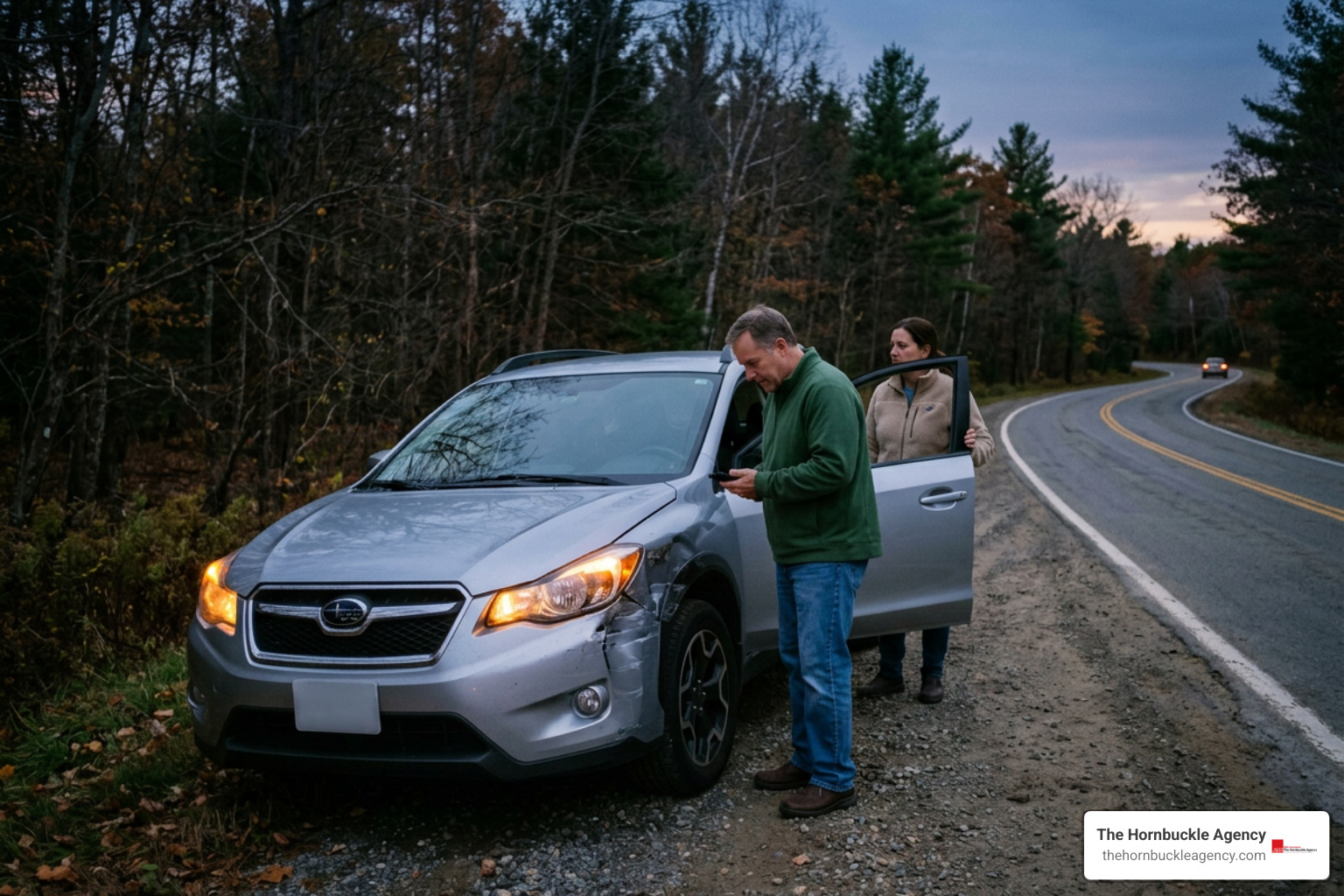
Experiencing a sudden wildlife strike on a dark rural highway is jarring. Knowing exactly what steps to take immediately following an impact keeps you physically safe and protects your upcoming insurance claim.
Post-Collision Action Plan
- Pull Over to a Safe Location: Activate your hazard lights immediately. Carefully move your vehicle off the main driving lane onto a wide paved shoulder, side road, or well-lit parking lot if available.
- Stay Inside the Vehicle: Never exit your vehicle on an unlit road or near active highway lanes. Surrounding traffic may not see you standing on the shoulder.
- Assess Injuries: Check yourself and all passengers for injuries before unbuckling or opening doors.
- Call Law Enforcement: Notify local police or state troopers to report the accident. Request an official police crash report, especially if vehicle damage exceeds local damage thresholds or if traffic is blocked.
- Keep Your Distance from the Animal: If the deer is lying in or near the roadway, do not approach or touch it. An injured, frightened deer possesses sharp hooves and immense physical strength that can cause severe bodily harm if it panics.
- Document Scene Evidence: Take detailed photographs of your vehicle’s damage, the surrounding roadway, weather conditions, and visible evidence on the vehicle (such as deer hair, blood, or impact marks on the grille). This visual evidence verifies direct contact for your comprehensive claim.
- Inspect for Mechanical Leaks: Check under the bumper and engine bay for leaking fluids, broken radiator lines, or steam before attempting to drive away.
The Costly Mistake That Gets Claims Denied
One of the most common and expensive mistakes drivers make after hitting a deer is trying to drive a damaged car home or to work.
If a deer strike cracks your vehicle’s radiator or punctures a coolant line, the engine will overheat within a few miles of driving. Continued operation without coolant will cause complete engine block seizure—costing anywhere from $7,000 to $12,000+ to replace.
When an insurance adjuster inspects the vehicle, they will cover the initial physical deer damage (e.g., the $1,500 bumper and radiator replacement) under comprehensive coverage. However, they will deny coverage for the seized engine, classifying the blown motor as secondary damage caused by driver negligence. If your car leaks fluid or shows steam post-impact, turn off the engine and call a tow truck immediately.
For a helpful local driving guide, check out our resource on cruising sand mountain your guide to car insurance in albertville al.
How Can The Hornbuckle Agency Help Protect Drivers Across Alabama Communities?
Navigating auto coverage options before peak deer migration season shouldn’t be stressful or confusing. At The Hornbuckle Agency, our goal is to help local families review their policy details, select manageable deductibles, and avoid costly coverage traps long before unpredictable risks arise on local roads.
The Hornbuckle Agency serves multiple Alabama communities, including Albertville, Guntersville, Boaz, Arab, Geraldine, Crossville, Collinsville, Horton, and Douglas. As a local Alfa Insurance provider, we bring deep regional insight to every policy review. We know the specific rural highway routes, agricultural corridors, and seasonal wildlife patterns that local drivers encounter every day.
Our agency assists policyholders by:
- Evaluating Deductibles: Helping you choose comprehensive deductibles that protect your household budget if you hit a deer during peak autumn rutting season.
- Verifying Rental Reimbursement: Ensuring you aren’t left stranded without transportation while local body shops complete sensor recalibrations and front-end repairs.
- Providing Responsive Local Claim Support: Offering hands-on assistance when filing claims through Alfa Insurance, guiding you step-by-step from roadside reporting to vehicle pickup.
Whether you need to add comprehensive protection to an existing policy or update coverages for a newly purchased family vehicle, exploring a tailored policy review is quick and easy. Learn more about navigating guntersville alfa insurance claims and services or check out our ultimate guide to auto insurance quotes to see how custom policy guidance makes all the difference.
Frequently Asked Questions About Deer Season Auto Insurance?
Will my auto insurance premium increase if I hit a deer?
In most cases, hitting a deer directly will not cause your auto insurance rates to go up. Direct physical contact with an animal falls under Comprehensive coverage, which insurance companies classify as a non-at-fault event. Because a wildlife encounter is an unpredictable event outside your direct control, insurers generally do not apply rate surcharges for a single comprehensive claim.
However, if you swerve to avoid the deer and crash into a static object like a guardrail or tree, the claim shifts to Collision coverage. Collision claims are classified as at-fault accidents, which usually trigger policy surcharges and higher renewal rates for three to five years. Additionally, filing multiple comprehensive claims within a short time frame could influence your overall policy tier at renewal depending on state regulations.
Does liability insurance cover repairs if I hit a deer?
No, state-mandated liability insurance does not pay for repairs to your own vehicle after a deer collision. Liability insurance strictly pays for bodily injury or property damage that you legally cause to other people in an accident. Because a deer strike is a single-vehicle event involving wild animals, there is no third party to compensate. To receive coverage for damage to your own car from an animal strike, you must carry Comprehensive coverage on your policy.
What should I do if a deer is injured but still alive in the roadway?
If a deer is injured but remains alive in or near the roadway after an impact, keep a safe distance and stay inside your vehicle. Do not attempt to approach, pet, or move the animal yourself. A panicked, wounded deer can kick violently with sharp hooves, causing severe physical injuries.
Activate your emergency flashers to alert approaching motorists, pull over to a safe area, and call local police or state wildlife conservation officers immediately. Law enforcement officers have trained protocols to handle injured wildlife safely and clear hazards from active driving lanes.
What Are the Key Takeaways for Staying Safe and Covered This Deer Season?
As deer season peaks across Alabama highways and county roads, taking proactive safety steps behind the wheel—and verifying your insurance policy beforehand—is the best protection against unexpected repair bills.
Summary Checklist for Deer Season Protection:
- Carry Comprehensive Coverage: Verify that your auto policy includes comprehensive insurance, which covers direct physical contact with wildlife as a non-at-fault claim.
- Practice “Brake and Brace”: Never swerve abruptly to avoid a deer. Brake firmly in a straight line within your lane to avoid severe rollover crashes or converting a non-at-fault comprehensive claim into an at-fault collision claim.
- Stay Alert During Peak Hours: Exercise extra caution between 5:00 PM and 8:00 PM and during morning twilight, particularly in the weeks following the fall daylight saving time change.
- Add Essential Policy Options: Ensure your coverage includes rental reimbursement to handle multi-week repair delays, along with MedPay or PIP for passenger injury protection.
- Stop Immediately After an Impact: If your vehicle leaks fluids or steam after hitting a deer, turn off the engine and call a tow truck to avoid engine seizure and claim denials.
Don’t wait until a deer jumps across your headlights to find out what your insurance policy covers. Contact The Hornbuckle Agency today to review your auto policy, confirm your comprehensive deductibles, and enjoy total peace of mind on the road this deer season.
