
To understand why your personal policy falls short, you have to look at how insurance carriers define risk. A standard Personal Auto Policy (PAP)—typically built around standard forms like the Insurance Services Office (ISO) PP 00 01—is designed, rated, and underwritten strictly for private passenger transport. It assumes you are driving to the grocery store, taking your kids to school, heading out for weekend recreation, or making a daily commute to a single, fixed workplace.
The moment a vehicle generates revenue or supports operational commercial tasks, the risk profile shifts completely. Business driving introduces tighter delivery deadlines, multi-stop driving in unfamiliar areas, heavier vehicle loads, and higher annual mileage. Because personal policy premiums do not account for these hazards, standard contracts contain strict business-use exclusions.
The “Public or Livery Conveyance” and Commercial Exclusions
Every standard personal auto policy includes explicit exclusionary language regarding commercial operations. The two most critical exclusions include:
- Public or Livery Conveyance: This clause excludes coverage whenever a vehicle is used to transport people or property for a fee. This is the exact clause carriers trigger to deny claims from rideshare driving, taxi services, and courier tasks.
- Business Operations & Commercial Delivery: If your vehicle is carrying commercial cargo, hauling business inventory, transporting specialized tools, or being driven by an employee, the personal insurer excludes liability, collision, and comprehensive payouts.
Personal policies and commercial policies are built around different assumptions: personal coverage is rated for ordinary household driving patterns, while commercial coverage accounts for cargo types, vehicle weight, operating radius, employee drivers, and business liability exposure.
High-Risk Driving Activities That Void Personal Coverage
If you are involved in an accident while performing any of the following tasks, your personal auto insurance carrier will likely deny the claim:
- Hauling equipment and tools: Carrying ladders, power tools, lawn care equipment, or plumbing fixtures between variable job sites.
- App-based delivery services: Delivering hot food, groceries, packages, or auto parts using on-demand apps.
- Rideshare driving: Transporting passengers via ride-hailing networks.
- Transporting clients or business associates: Regularly shuttling customers, prospective buyers, or team members to appointments for commercial purposes.
- Door-to-door sales and mobile service: Driving an unendorsed vehicle as a mobile workshop or field-sales office across changing routes.
- Employee operation: Handing your vehicle keys to a staff member to pick up supplies, visit the bank, or run business errands.
The Problem with Gig and Rideshare Driving
Gig economy platforms have created massive confusion for drivers. In fact, Statistics Canada found that approximately 8.2% of people aged 15 and older participated in gig work in late 2023, a trend mirrored across North America. Many gig workers assume their app or their personal policy covers them at all times.
In reality, app-based platforms operate on strict “periods”:
- Period 0 (App Off): Your personal policy applies.
- Period 1 (App On, Waiting for Request): Your personal insurer denies coverage due to the commercial intent, while platform coverage is often limited to low contingent liability.
- Periods 2 and 3 (Trip Accepted / Passenger or Cargo in Vehicle): Platform commercial policies apply, but they often come with high deductibles (often $1,000 to $2,500) and zero coverage for your own physical damage unless you maintain specific rideshare endorsements.
The Risks of Remote and Hybrid Work Driving
The explosion of flexible work has created unexpected insurance blind spots. Nearly 75% of companies with fewer than 500 employees now embrace a remote or hybrid workforce. When team members work from home, the traditional “commute” disappears, and daily driving turns into irregular operational transit.
Impromptu midday errands—such as driving to the post office to mail client invoices, picking up office stationery, or traveling between off-site coffee shop meetings—exist in a legal gray area. If an accident occurs while you are actively carrying out a work assignment, an adjuster can argue the trip was an operational business errand rather than personal travel.
Furthermore, relying on standard mileage reimbursement creates a dangerous false sense of security. For 2026, the IRS standard mileage rate is 72.5 cents per mile for business use. While this rate reimburses you for gas, depreciation, maintenance, and basic wear, mileage reimbursement provides zero insurance protection. It does not defend you in a lawsuit, nor does it pay for property damage or bodily injury if you cause a crash while on the clock.
What Happens If You Have an Accident While Driving for Work Without the Right Policy?
When a collision occurs, the financial consequences of carrying the wrong policy become immediate and severe. Many drivers believe they can simply omit the business purpose of their trip during the claims process. However, modern insurance investigations are thorough, and misrepresenting facts during a claim constitutes insurance fraud.
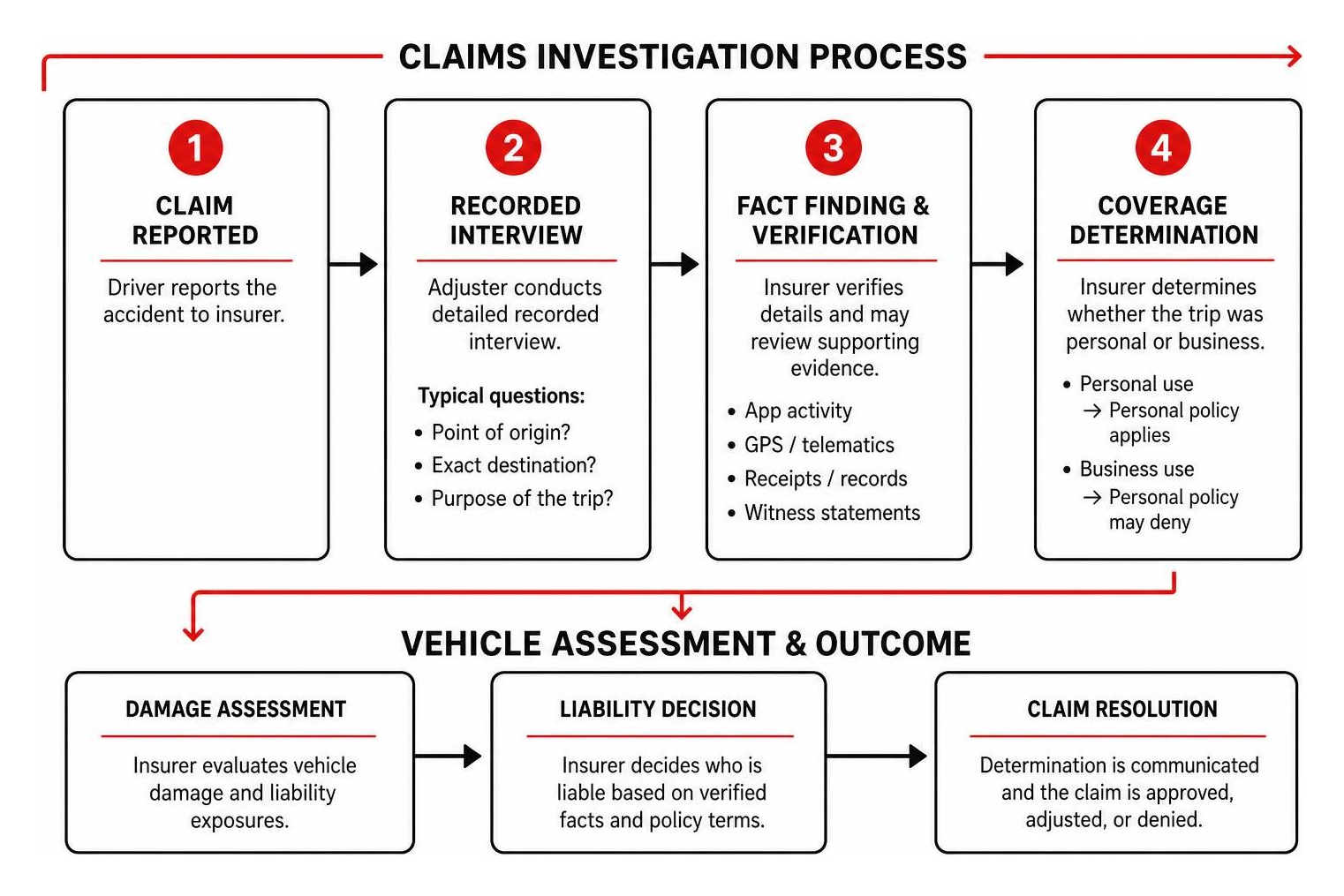
The Claims Investigation Process
When a claim is reported, claims adjusters conduct detailed recorded interviews. They routinely ask:
- What was your point of origin and your exact destination?
- What was the purpose of your trip?
- Who owns the contents and cargo inside the vehicle?
- Were you logged into any gig apps, dispatch platforms, or work communication channels?
- Were you receiving mileage reimbursement or hourly pay during this drive?
If an adjuster discovers tools, client paperwork, company logos, delivered goods, or evidence that you were en route to a commercial job, they will place the claim under a reservation of rights and initiate a coverage investigation.
The Financial Fallout of a Denied Claim
If the carrier confirms a business-use exclusion applies, they will issue a formal denial. This triggers a catastrophic chain reaction:
- Zero payout for your vehicle: You receive nothing for your own vehicle’s collision or comprehensive damage, leaving you to pay repair bills or loan balances out of pocket.
- Personal liability for third-party damages: You become personally responsible for the other party’s vehicle repairs, property destruction, medical bills, lost wages, and pain and suffering.
- Severe underinsurance risks: Standard personal auto liability limits are frequently set at state minimums (such as $25,000 bodily injury per person, $50,000 bodily injury per accident, and $25,000 property damage). In commercial settings, severe multi-vehicle collisions or serious bodily injuries routinely exceed $100,000 to $1,000,000.
- Corporate and personal asset exposure: If you operate as a sole proprietor, your personal bank accounts, home equity, and future earnings are at risk. If you operate an LLC or corporation, the business itself can be sued for vicarious liability, exposing all company revenue and equipment.
- Policy cancellation: The carrier may immediately cancel or non-renew your policy due to material misrepresentation or unrated commercial exposure, making future coverage significantly more expensive.
Employee use adds another vital factor: permissive-use language in a personal auto policy is generally meant for occasional personal borrowing, not staff members using a vehicle to complete commercial tasks. If an employee drives your personal vehicle for a business errand and crashes, your business may still need commercial auto or hired and non-owned auto protection to respond properly.
How Do You Choose Between a Business-Use Endorsement, Commercial Auto, and HNOA Coverage?
Choosing the right coverage does not always mean buying an expensive, full-scale commercial fleet policy. Depending on your business model, vehicle ownership structure, and daily driving duties, you generally have three distinct paths to secure complete protection.

1. The Business-Use Endorsement
A business-use endorsement is an optional rider attached directly to your personal auto insurance policy. It bridges the coverage gap for professionals who use their personally titled vehicle for light, incidental business tasks without hauling heavy cargo or making paid deliveries.
- Best suited for: Real estate agents, traveling consultants, insurance adjusters, corporate sales representatives, and home-based service professionals visiting occasional client locations.
- What it covers: Business transit between client sites, travel to multiple offices, and incidental business errands while keeping personal comprehensive and collision intact.
- What it excludes: Transporting heavy tools, carrying goods for hire, app-based delivery, rideshare services, and vehicles titled to a business entity.
2. Standalone Commercial Auto Insurance
A full commercial auto policy is a dedicated policy designed specifically for business risk. It provides comprehensive physical damage coverage, high combined single limit (CSL) liability (often $500,000 to $1,000,000+), and endorsements for specialized equipment.
- Best suited for: Contractors, landscapers, plumbers, electricians, couriers, caterers, companies with vehicles titled in an LLC or corporate name, and any business operating trucks or vans over 10,000 lbs GVWR.
- What it covers: All operational business driving, material and tool transit, multi-employee driver rosters, trailer towing, and loading/unloading liability.
- Unique benefits: Satisfies client contract requirements for Certificates of Insurance (COI) and allows higher liability protection than personal policies permit.
If you operate a growing enterprise, exploring dedicated commercial insurance ensures your vehicles and general operations are fully aligned under one comprehensive risk management plan.
3. Hired and Non-Owned Auto (HNOA) Coverage
Hired and Non-Owned Auto insurance is a specialized liability policy (often added to a Commercial General Liability or Business Owner’s Policy) that protects your company when employees drive their personal cars for company business or when your company rents vehicles.
- Best suited for: Any business owner whose employees run errands, make sales calls, or travel to job sites in their own vehicles.
- What it covers: Third-party bodily injury and property damage lawsuits filed against your business if an employee causes a crash while working.
- What it does NOT cover: HNOA does not pay for physical damage to the employee’s personal car. The employee’s own policy must address their vehicle repairs.
Reviewing industry perspectives on Commercial Auto Insurance vs Personal underscores the importance of choosing a policy that matches your liability exposure rather than simply hunting for the lowest monthly price.
Comparing Your Coverage Options
| Feature | Personal Policy + Business Endorsement | Standalone Commercial Auto Policy | Hired & Non-Owned Auto (HNOA) |
|---|---|---|---|
| Primary Vehicle Title | Individual / Personal Name | Business Name or Individual | Employee-Owned or Rented |
| Eligible Use Cases | Client visits, sales calls, professional travel | Tool transit, delivery, hauling, fleet work | Employee business errands, client runs |
| Typical Liability Limits | Split limits up to $250k/$500k | Combined Single Limit: $500k to $1M+ | Up to $1,000,000 CSL |
| Covers Delivery / Livery? | No | Yes (when scheduled) | No (covers liability only) |
| Covers Employee Drivers? | Rarely (household only) | Yes (all scheduled/permissive drivers) | Yes (protects the business entity) |
| Physical Damage Included? | Yes (subject to personal deductibles) | Yes (tailored commercial deductibles) | No (liability defense only) |
Cost Expectations and Rating Factors for 2026
Insurance pricing reflects the level of exposure an insurer takes on. Personal auto policies across the country average between $800 and $2,500 per year per vehicle depending on location, vehicle make, and driving record. Adding a business-use endorsement is remarkably affordable, typically increasing an existing personal premium by only 10% to 25%.
Standalone commercial policies require a higher investment, with small-to-medium business premiums generally ranging from $1,500 to $5,000+ annually per vehicle.
Key rating factors that determine commercial auto costs include:
- Gross Vehicle Weight Rating (GVWR): Vehicles over 10,001 lbs introduce more damage risk and higher premiums.
- Operating Radius: Local driving (under 50 miles) costs substantially less than regional (50–200 miles) or long-haul operations.
- Driver Motor Vehicle Records (MVR): Every listed employee’s three-year driving history impacts the policy baseline.
- Industry Classification & Cargo Hazard: Hauling hazardous building chemicals or heavy steel carries a higher rate than transporting real estate signage.
To explore your baseline options efficiently, you can use a quick start guide to insurance quote to gather the necessary vehicle identification numbers (VINs), driver rosters, and operational details before speaking with an agent.
Does Commercial Auto Insurance Cover Personal Use of Your Vehicle?
A common worry among small business owners and sole proprietors is that moving to a commercial auto policy will prevent them from using their truck or SUV for personal life. Fortunately, the answer is straightforward: Yes, commercial auto insurance can cover personal use, provided the policy is structured properly.
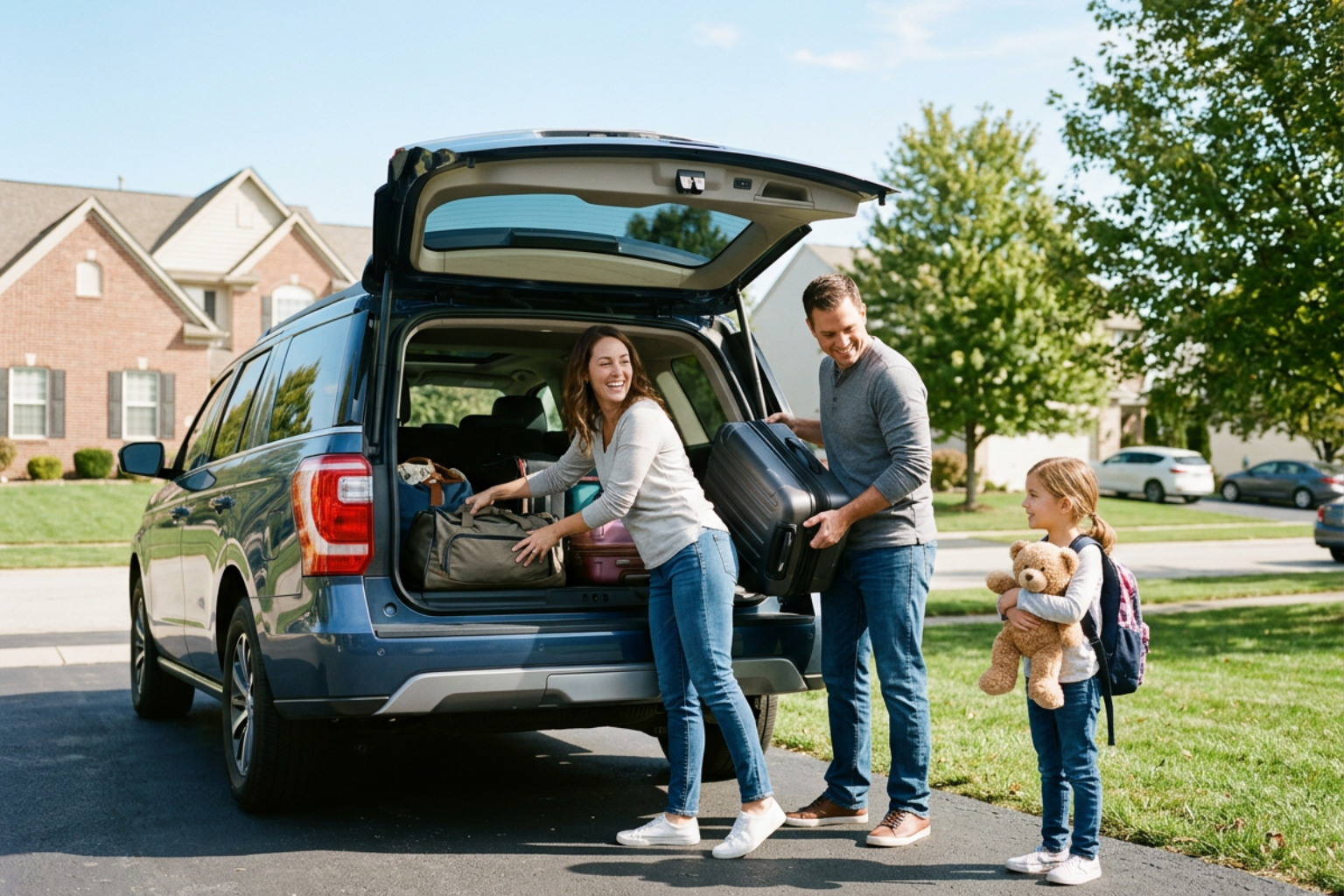
Many business owners rely on a single mixed-use vehicle for both job-site management during the week and family activities on the weekend. Commercial insurers accommodate this through specific underwriting classifications:
- Permitted Personal Use: When setting up your commercial policy, you can specify that the vehicle will be used for mixed operations (e.g., 70% business, 30% personal).
- Listing Household Drivers: If your spouse or teenage children might operate the commercial vehicle for errands or weekend trips, they must be formally listed as permitted drivers on your commercial policy declaration page. Unlisted household drivers can create claim disputes following an accident.
- Territory and Radius Compliance: Commercial policies often rate your premium based on an agreed local operating radius (such as a 50-mile radius from your shop). If you take a personal road trip out of state, ensure your policy includes personal-use endorsements that lift radius restrictions during personal travel.
- Matching Title and Named Insured: If the vehicle is titled in your personal name, you can still obtain a commercial policy if you operate as a sole proprietor or single-member LLC. However, if the vehicle is titled to an LLC or corporation, the business entity must be listed as the named insured, with an endorsement added to cover individual personal use.
With the right personal-use permissions, a commercial policy can protect weekday business driving while still allowing ordinary household errands, weekend trips, and family use when the correct drivers and vehicle use are disclosed.
What Are the Most Common Questions About Business Driving Insurance?
Navigating mixed-use vehicle coverage often brings up specific operational scenarios. For a wider perspective on vehicle coverage types, our guide on the ultimate auto insurance roundup finding the best coverage for your ride provides comprehensive insight into collision, comprehensive, and liability structures.
Can I switch from a personal auto policy to a commercial policy mid-term?
Yes. You do not have to wait for your personal policy renewal date. If your business operations expand or you purchase heavy equipment, you can bind a commercial auto policy immediately. Once the new commercial policy is active and you have proof of coverage, you can cancel your personal policy (or remove the specific vehicle) and receive a pro-rated refund for any unused premium. Never cancel your personal policy until the commercial binder is officially issued to prevent any coverage lapse.
Does my personal insurance cover my employees if they drive my car for work?
In almost all cases, no. While personal auto policies include “permissive use” provisions allowing friends or family to borrow your car occasionally for personal tasks, these clauses specifically exclude commercial use. If an employee drives your personal vehicle to complete a delivery, visit a job site, or run a business errand and causes a crash, the personal insurer will likely deny liability and collision claims. You need a commercial policy listing the employee or an HNOA policy to cover commercial staff driving.
Does mileage reimbursement from my employer replace the need for commercial coverage?
No. Receiving mileage reimbursement (such as the 2026 IRS rate of 72.5 cents per mile) simply reimburses you for the operating cost of the car. It transfers zero risk to your employer’s insurance and does not alter the terms of your personal auto contract. If you cause a crash while conducting work tasks, your personal insurer will still evaluate the commercial nature of the trip and can enforce their business-use exclusions regardless of whether you received mileage compensation.
How Can Alabama Business Owners Secure the Right Auto Coverage Today?
Protecting your livelihood on the road requires an honest assessment of how your vehicles are used every day. Operating with an unendorsed personal policy while performing commercial tasks is a gamble that puts your business assets, personal savings, and peace of mind at risk.
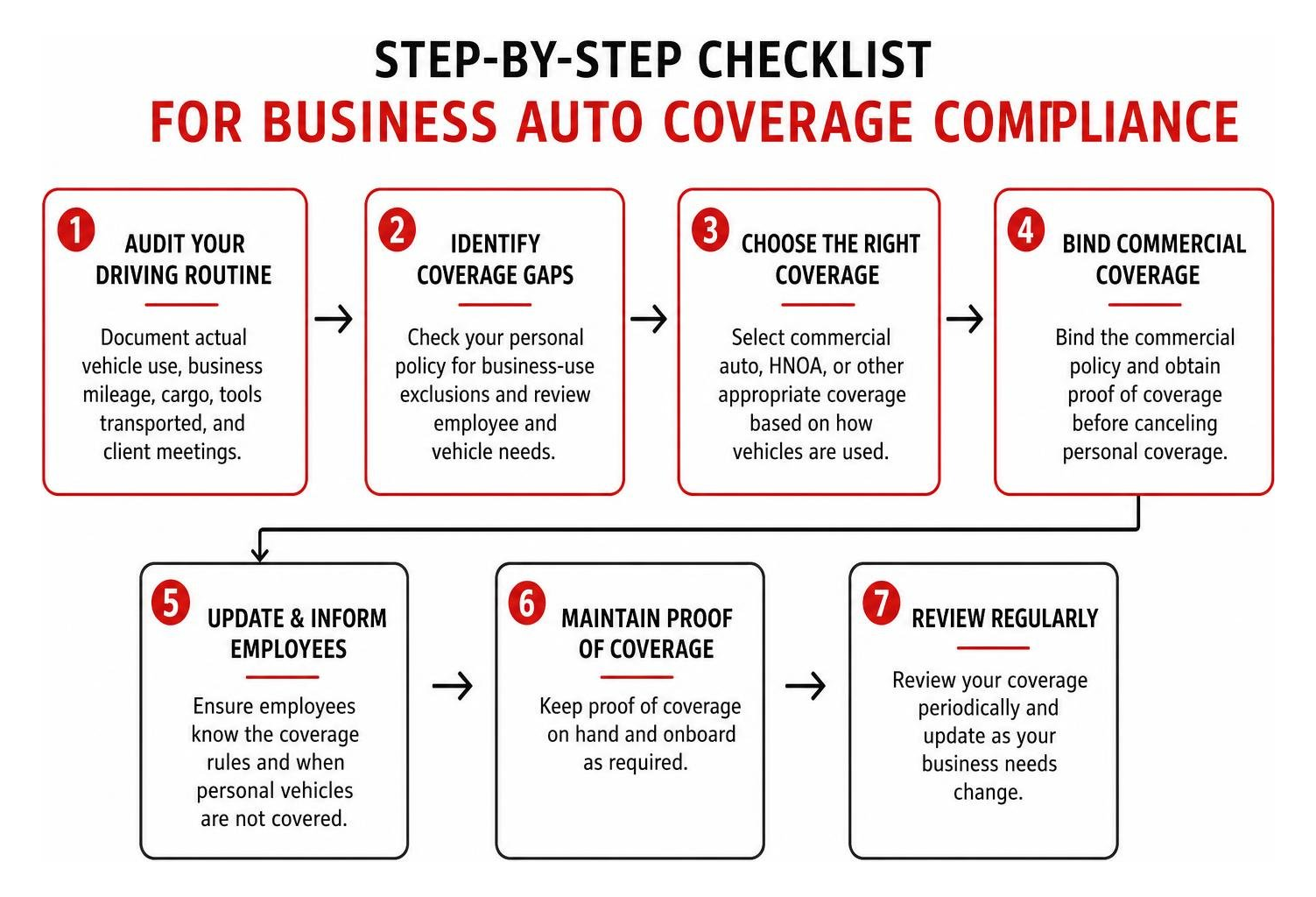
Your Actionable Auto Coverage Checklist
Before you head out on your next work trip, take these proactive steps:
- [ ] Audit Your Driving Routine: Write down your actual vehicle usage, including estimated business mileage, cargo types, tools transported, and client meetings.
- [ ] Review Policy Exclusions: Examine your current personal policy declaration pages and endorsement forms for “public or livery” and business operation exclusions.
- [ ] Check Vehicle Titles: Align your named insured status with how your vehicles are titled at the DMV (individual vs. LLC or corporate entity).
- [ ] Verify Employee Records: Pull Motor Vehicle Records (MVR) for any staff members who drive company vehicles or their own cars on company time.
- [ ] Evaluate Commercial Contract Limits: Check if your commercial clients, general contractors, or vendors require proof of $500,000 or $1,000,000 in commercial auto liability before entering job sites.
Personalized Guidance for Alabama Communities
At The Hornbuckle Agency, we believe in providing personalized risk education so local business owners and families can make informed decisions. We understand the specific driving conditions, agricultural needs, and commercial contracting environments throughout North Alabama.
Whether you operate a single work truck or manage a small commercial fleet, our team helps business owners across multiple Alabama communities, including Albertville, Guntersville, Boaz, Arab, Geraldine, Crossville, Collinsville, Horton, and Douglas. We can review your existing personal policies, determine whether a low-cost business-use endorsement is sufficient, or build a tailored commercial auto policy that protects your business wherever the road takes you.
Contact our Albertville office today to schedule a comprehensive commercial auto review, verify your coverage language, and ensure you are fully protected for every mile you drive.
