
What Is the Difference Between a Hobby Farm and a Working Farm for Insurance Purposes?
A hobby farm needs farm insurance, or at least a hobby farm endorsement, when it creates agricultural exposures a standard homeowners policy excludes. Common triggers include housing livestock, operating utility tractors or other heavy agricultural machinery, using detached barns or outbuildings for farm purposes, generating agricultural revenue above a carrier’s incidental limit – often around $2,500 to $10,000 annually – employing non-family farm labor, selling farm goods, or hosting public visitors for agritourism or on-farm sales. In those situations, the risk is no longer purely residential.
From an underwriting perspective, the boundary between a traditional residential property, a hobby farm, and a full-scale commercial farm comes down to risk exposure and operational intent. Many property owners assume that the size of their acreage dictates what kind of policy they need. However, insurers care far more about how the land is used, what hazards are present, and whether any financial gain is involved.
Underwriters define agricultural exposure as any condition or activity tied to raising animals, cultivating land, using specialized farming machinery, or storing agricultural commodities. Carriers typically classify rural properties based on specific criteria:
- Primary Intent: Is the property maintained purely for personal enjoyment and recreation, or is it operated with the intention of generating a profit?
- Annual Gross Revenue: Most insurance carriers consider agricultural revenue under $2,500 to $10,000 per year as incidental hobby farming. Once revenue surpasses this threshold, the operation enters commercial farm territory.
- Labor and Employment: A property maintained solely by family members carries a vastly different risk profile than one utilizing paid part-time farmhands, seasonal laborers, or full-time staff, which introduces employer liability and workers’ compensation exposures.
- Public Access: Allowing visitors on the property – whether to purchase produce, pick pumpkins, or take riding lessons – introduces commercial public premises liability that standard personal policies refuse to underwrite.
Understanding how your local carrier evaluates these four pillars is essential. If your daily operations shift even slightly into commercial territory, relying on standard home insurance leaves you vulnerable to uncovered catastrophic losses.
Defining Incidental Agricultural Use on Residential Properties
Incidental agricultural use refers to minor, low-risk farming activities carried out strictly for personal household consumption or leisure, with zero commercial intent. Examples include:
- Tending a small family raised-bed vegetable or herb garden.
- Keeping a small coop with four or five laying hens to supply eggs exclusively for your family’s breakfast table.
- Maintaining a single family riding horse or a pair of miniature donkeys kept strictly as companion animals.
- Using a standard residential riding lawnmower to maintain a two-acre grassy yard.
In these specific, limited scenarios, your primary exposure remains residential. However, even small animal setups can challenge standard policy terms. As detailed in our Homeowners Insurance Complete Guide, traditional personal lines policies are drafted with suburban subdivisions in mind. They feature restrictive limits on detached structures and strict definitions regarding personal property and domestic pets. The moment your agricultural footprint expands beyond a simple backyard garden, personal lines forms start losing their protective strength.
When Side Income Classifies Your Property as a Commercial Farm
The moment your small-scale homestead begins generating revenue, insurance underwriters view your property through a commercial lens. It does not matter whether your agricultural venture turns an accounting profit at tax time; what matters is the presence of commercial commerce on residential grounds.
Activities that immediately trigger business classifications include:
- Operating a roadside stand selling sweet corn, tomatoes, fresh-cut flowers, or cartons of farm-fresh eggs.
- Selling honey, handmade goat milk soaps, or artisanal jams at local weekend farmers markets.
- Boarding horses for neighbors or charging a fee for pasture access.
- Baling and selling surplus hay from your back pasture.
- Selling registered puppies, livestock breeding stock, or broiler chickens to the public.
Every standard homeowners contract contains a strict “business pursuits” exclusion. This clause explicitly removes coverage for bodily injury, property damage, or structural losses that arise out of, or in connection with, any business conducted on the premises. If a customer slips on gravel near your egg stand, or if a fire starts in a workshop where you process honey for sale, your personal insurer can deny the claim entirely based on the unendorsed commercial activity.
What Specific Activities and Risk Triggers Require Farm Insurance Coverage?
Moving from standard personal insurance to specialized agricultural coverage is usually driven by physical hazards and operational activities. Understanding these key triggers helps you evaluate whether your existing policy leaves your property exposed.
- Presence of Livestock and Equines: Horses, cattle, goats, sheep, and swine introduce serious liability risks. If an animal breaks through a fence and wanders onto a county highway, the resulting motor vehicle collision can lead to catastrophic medical and property damage claims. Standard personal liability frequently excludes damage caused by farm animals or restricts animal-related payouts.
- Agricultural Machinery and Implements: Operating utility tractors, round balers, bush hogs, skid steers, or front-end loaders creates mechanical, rollover, and transport hazards that personal policies do not contemplate. Standard home policies cap coverage on motorized off-road vehicles and exclude equipment used for land management or agricultural production.
- Specialized Detached Outbuildings: Pole barns, enclosed workshops, stables, livestock loafing sheds, and grain bins represent substantial financial investments. Homeowners policies generally cap detached structure coverage at a default 10% of the main dwelling limit—an amount that falls drastically short when replacing modern agricultural buildings.
- Bulk Storage of Flammable or Chemical Materials: Storing bulk diesel tanks, propane cylinders for heating coops, synthetic fertilizers, or agricultural pesticides creates distinct environmental and fire hazards that require dedicated underwriting.
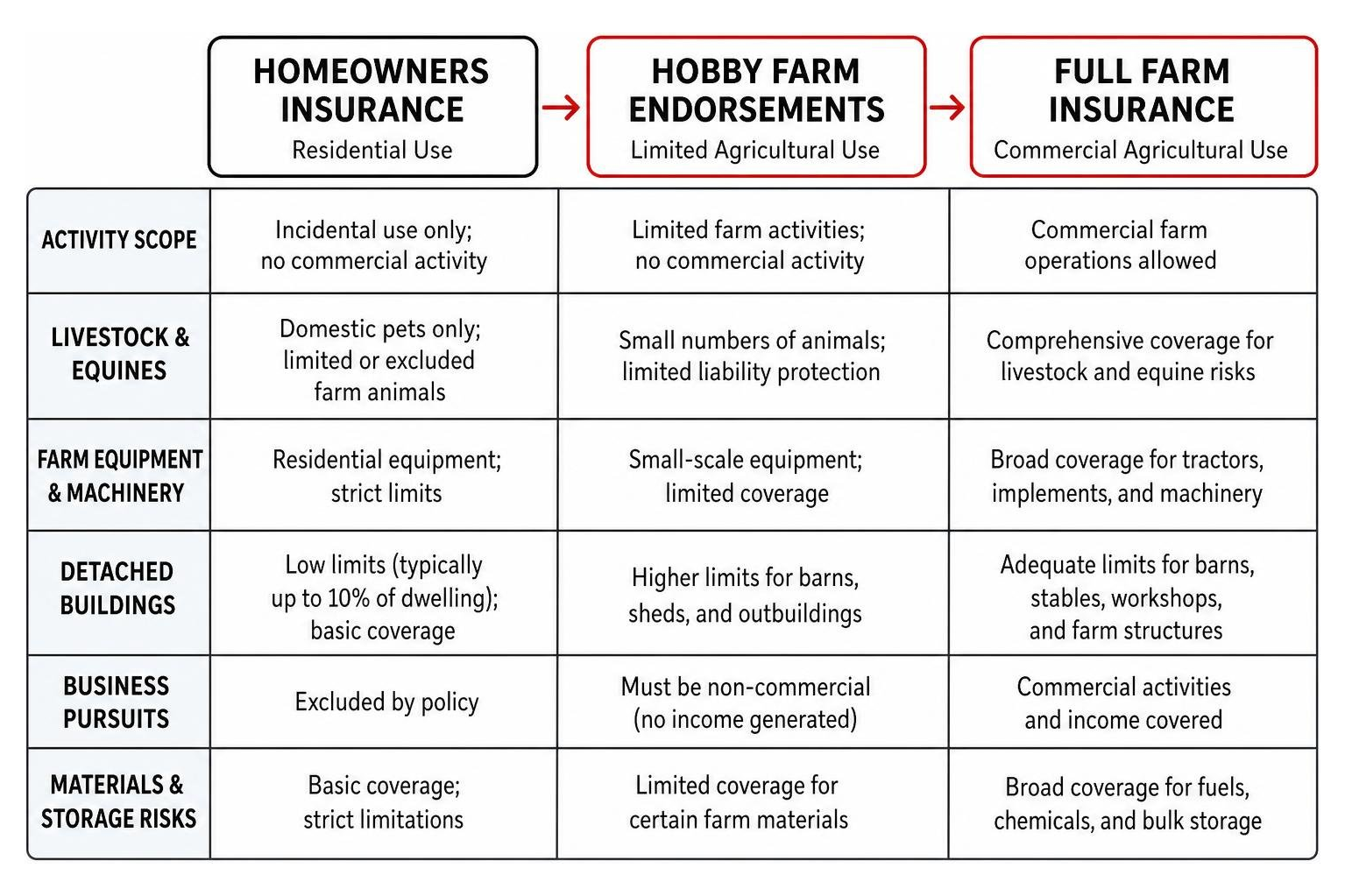
The table below illustrates how coverage options compare across typical rural scenarios:
| Coverage Area | Standard Homeowners Policy | Homeowners with Hobby Farm Endorsement | Full Farm Insurance Policy |
|---|---|---|---|
| Primary Dwelling | Replacement Cost | Replacement Cost | Replacement Cost |
| Detached Barns & Outbuildings | Capped at 10% of dwelling (often excludes farm use) | Scheduled limits up to endorsement cap | Full scheduled replacement cost or Actual Cash Value |
| Utility Tractors & Implements | Excluded or capped under $1,500–$2,500 | Scheduled coverage up to policy sublimits | Comprehensive farm machinery coverage (on and off premises) |
| Livestock Mortality & Liability | Excluded | Limited liability; low mortality limits for specified herds | Comprehensive farm liability, transit coverage, and broad peril mortality |
| Farm Product Liability | Excluded (business pursuits exclusion) | Limited coverage for incidental sales (under income cap) | Full commercial product and completed operations liability |
| Public Agritourism / Guest Events | Excluded | Excluded | Covered via dedicated commercial agritourism endorsements |
Commercial Sales and Agritourism Exposures
Direct-to-consumer sales and on-farm experiences have surged in popularity across rural areas. However, these activities introduce liability that standard residential insurance is simply not built to handle.
When you sell raw agricultural products—such as raw honey, unpasteurized milk, butchered poultry, or canned preserves—you take on product liability risks. If a customer claims that your eggs caused salmonella or your preserves caused foodborne illness, defending against those legal claims requires commercial product liability coverage. Personal liability explicitly denies claims arising from sold consumables.
Similarly, agritourism activities present significant premises liability exposures. Bringing members of the public onto your acreage for activities like:
- U-pick strawberry, blueberry, or blackberry patches
- Pumpkin patches, corn mazes, and seasonal fall festivals
- Farm-to-table dinners, educational homesteading workshops, and private photography sessions
- Farm tours, petting zoos, and horseback riding lessons
creates an environment where uneven terrain, active farm animals, moving tractors, and rustic outbuildings can lead to slip-and-fall injuries, animal bites, or equipment-related accidents. A standard personal policy will not defend you if a paying visitor gets injured while picking fruit or touring your barn. Dedicated farm insurance or specialized commercial liability endorsements are non-negotiable for these operations.
Rural Property Characteristics and Emergency Fire Protection Distance
Beyond the day-to-day operations of your homestead, the geographical location and physical infrastructure of your property heavily influence underwriting and policy options. Rural acreage faces distinct environmental and logistical factors that do not exist in suburban neighborhoods.
One critical underwriting consideration is your property’s Public Protection Classification (PPC), which measures the distance from your property to the nearest responding fire department and recognized municipal water supply or pressurized fire hydrant. In rural areas, properties located more than five road miles from a responding fire station, or more than 1,000 feet from a certified hydrant, are classified under higher-risk protection classes.
Furthermore, hobby farms introduce concentrated physical fire hazards:
- Brooder Heat Lamps: Infrared heat lamps used for warming chicks or ducklings in wooden barns or coops remain one of the leading causes of rural structural fires.
- Hay Storage: Storing un-cured or damp hay can lead to spontaneous internal combustion, destroying barns and adjacent equipment within minutes.
- Fuel and Chemical Storage: On-site gravity fuel tanks and stored propane increase fire load intensity, requiring higher liability and property coverage limits.
Navigating these rural structural risks requires reviewing The Ins and Outs of Farm House Insurance Coverage to ensure that both the residential home and all auxiliary agricultural buildings maintain proper valuation terms and protection endorsements.
What Does Standard Homeowners Insurance Exclude That Farm Policies Protect?

Many hobby farmers assume their standard homeowners insurance will step in when severe weather, theft, or accidents occur on their land. In reality, standard Insurance Services Office (ISO) homeowners policy forms contain explicit exclusions that leave rural homesteaders self-insuring their largest agricultural assets.
Understanding these structural exclusions is the first step toward closing costly coverage gaps:
- Coverage B (Other Structures) Exclusions: Under standard homeowners forms (such as HO-3 or HO-5), detached structures used in whole or in part for business or farming purposes are entirely excluded from coverage. If you store a tractor, keep goats, or store market produce inside your pole barn, a fire or tornado that levels that barn could result in a total claim denial because the building was utilized for agricultural activity.
- Personal Property Limitations: Standard Coverage C (Personal Property) is intended for household furnishings, clothing, and consumer electronics. It strictly limits or excludes “property pertaining to a business” and motorized land conveyances. If your $35,000 utility tractor, post-hole digger, or rotary cutter is stolen or damaged by a falling tree, your homeowners policy will typically offer $0 to $1,500 at most.
- Livestock Mortality and Ingestion: Standard homeowners policies do not cover animal mortality. If a lightning strike kills three head of cattle in your pasture, or if your flock of laying hens is lost to a predator or barn collapse, personal insurance offers no financial reimbursement.
- Consequences of Material Misrepresentation: If you experience a loss and file a claim under a personal homeowners policy without having disclosed your agricultural operations, the insurer’s special investigations unit may review your land use. If they find unendorsed commercial or agricultural activities, the carrier can deny the immediate claim, cancel your coverage, and flag your underwriting profile, making future property coverage significantly more expensive.
Liability Protection Gaps for Farm Operations
Personal liability under Section II of a homeowners policy is strictly designed for private, non-commercial, non-agricultural activities. When farming risks enter the equation, significant liability gaps emerge:
- Escaped Livestock Collisions: If your boundary fence fails and your livestock wanders onto a nearby road, causing a vehicle collision, you face legal liability for vehicular damage, severe bodily injuries, or lost lives. Standard personal liability often denies claims arising from livestock maintenance unless covered by a specific farm endorsement.
- Chemical and Herbicide Drift: If you spray weed control or liquid fertilizer on your pastures and wind drift carries the chemicals onto a neighbor’s specialty crop, timber, or ornamental garden, standard home policies exclude pollution and overspray claims. Farm policies provide explicit pesticide and herbicide drift liability coverage.
- Equipment Incidents on Public Roadways: Transporting a tractor, hay wagon, or utility trailer down a public road to reach an adjacent pasture creates substantial road liability. If a trailing implement strikes an oncoming vehicle, dedicated farm liability steps in where personal liability falls short.
Specialized Farm Property Coverages You Might Be Missing
Dedicated farm policies and broad hobby farm endorsements provide a suite of specialized property coverages specifically engineered for rural land management. When evaluating coverage options, property owners should review terms via Compare Farm Insurance Options to ensure their policy includes:
- Scheduled Farm Personal Property: Specific line-item coverage for high-value agricultural machinery, utility vehicles, implements, and portable livestock equipment based on true valuation.
- Blanket Farm Personal Property: Broad coverage protecting stored feed, seed, fertilizers, tools, and non-scheduled small equipment under a single overall limit.
- Custom Agricultural Endorsements: Tailored endorsements providing financial protection for perimeter fencing, automated corral gates, solar-powered water wells, windmills, silos, standing timber, and specialized apiary equipment for beekeepers.
- Farm Extra Expense and Loss of Use: Coverage for the additional expenses required to maintain livestock operations—such as purchasing emergency feed or renting temporary corrals—if a primary barn is rendered unusable by a covered peril.
For additional answers regarding general property terms, reviewing our Cheat Sheet to Common Insurance Questions for North Alabama Homeowners can help you identify basic residential versus extended property coverage limits.
When Is a Hobby Farm Endorsement Sufficient Versus a Dedicated Farm Policy?
Deciding whether you need a simple policy endorsement or a standalone farm package depends on the scale of your operations, your annual gross income, and the physical assets situated on your land.
When a Hobby Farm Endorsement Is Sufficient
A hobby farm endorsement is an optional rider added directly to an existing residential homeowners policy. It bridges the gap for small-scale operations without requiring a full commercial package. This endorsement is typically sufficient if:
- Your annual gross revenue from selling agricultural products remains strictly below your carrier’s limit (usually capped between $2,500 and $10,000).
- You do not employ any non-family members or paid farm workers.
- You do not host public events, tours, classes, or commercial visitors on the property.
- Your livestock count is limited to a small number of head kept for pleasure, 4-H youth projects, or personal subsistence.
- Your outbuildings do not house commercial processing facilities or extensive commercial inventory.
Specifically, this endorsement modifies the base policy by removing the business pursuits exclusion for specific, approved agricultural activities, extending personal liability to your livestock, and adding scheduled coverage for smaller detached barns.
When You Must Transition to a Dedicated Farm Insurance Policy
If your property expands beyond the restrictive limits of an endorsement, you must transition to a comprehensive, multi-line Farm Insurance policy. A standalone farm policy can package the dwelling, farm structures, machinery, livestock, and farm liability under coverage designed for agricultural exposures; Triple-I’s farms and ranches insurance guidance describes these as core coverage areas for farm and ranch risks.
A dedicated farm policy becomes mandatory when:
- Revenue Exceeds Endorsement Caps: Gross farm sales regularly surpass $10,000 per year.
- You Employ Labor: You hire seasonal workers, pasture hands, or equipment operators, requiring farm employer liability coverage.
- High Asset Values: The combined replacement value of your barns, tractors, fencing, and livestock exceeds the restrictive property sublimits of standard personal endorsements.
- You Host Agritourism or Commercial Services: You offer horse boarding, riding arenas, u-pick orchards, or wedding venues on your land.
Operating a commercial-level farm under a basic hobby farm endorsement creates dangerous co-insurance penalties and coverage voids. Moving to a dedicated policy ensures that your entire operation is accurately valued, scheduled, and protected against catastrophic loss.
How Can Working with a Local Independent Agent Protect Your Property?
Navigating the transition between residential homeowners coverage, hobby farm riders, and full agricultural policies requires local expertise. Online quoting tools and national call centers frequently overlook the nuanced structural, operational, and liability exposures unique to rural properties.
An experienced local agent provides several critical advantages:
- On-Site Risk Evaluation: A knowledgeable agent will walk your acreage to catalog outbuildings, measure distances to property lines, inspect perimeter fencing, review heating systems in animal housing, and inventory agricultural equipment.
- Accurate Valuation and Co-Insurance Avoidance: Underinsuring rural outbuildings is a common mistake that leads to painful co-insurance penalties following a partial loss. An independent agent ensures your barns, shops, and homes are insured to accurate replacement costs or agreed values.
- Matching Operations to Carrier Appetite: Every insurance company maintains strict underwriting guidelines regarding livestock limits, equipment horsepower, and allowable gross revenue. A local agent matches your specific operational profile with the carrier offering the strongest protection and most competitive rates.
- Local Proximity and Claims Advocacy: When severe weather or unexpected liability events impact your homestead, working with an agency rooted in your local community ensures you receive prompt, hands-on claims support from professionals who understand the regional agricultural landscape.
Local expertise is particularly valuable when Protecting Your Farm and Home with Alfa Insurance in Marshall County. We help landholders craft integrated protection strategies that shield their families, homesteads, and agricultural investments from costly coverage gaps. The Hornbuckle Agency serves multiple Alabama communities, including Albertville, Guntersville, Boaz, Arab, Geraldine, Crossville, Collinsville, Horton, and Douglas.
Frequently Asked Questions About Hobby Farm vs Homeowners Insurance
Can I keep my hobby farm on a standard homeowners policy if I don’t sell anything?
Even if you generate zero income, a standard homeowners policy may still leave you underinsured if you maintain livestock, operate utility tractors, or own substantial outbuildings. Standard policies frequently exclude or restrict liability for large animals (such as horses or cattle) and severely cap coverage for detached structures and agricultural machinery. To ensure full protection, you should at minimum add a specialized hobby farm endorsement to your existing residential policy.
What happens if my horse or cow gets loose and causes a car accident?
If an escaped animal wanders onto a public roadway and causes a motor vehicle crash, you can be held legally liable for the resulting property damage, bodily injuries, and medical expenses. Under an unendorsed standard homeowners policy, insurers often deny these claims under agricultural or animal liability exclusions. However, a dedicated farm insurance policy or an attached hobby farm liability endorsement provides defense costs and pays settlements or judgments up to your policy limits.
How much income can I make before needing full farm insurance?
Most insurance carriers establish an incidental income cap between $2,500 and $10,000 in gross annual sales for hobby farm endorsements. If your gross revenue from selling produce, eggs, livestock, hay, or boarding services exceeds your carrier’s specific threshold, your operation is classified as a commercial farm. At that point, you must transition from an endorsed homeowners policy to a dedicated commercial farm insurance package.
What Are the Next Steps to Properly Insure Your Hobby Farm?
Protecting your rural homestead requires matching your insurance coverage to the actual, physical reality of your day-to-day operations. Relying on an unendorsed homeowners policy while running equipment, tending livestock, and selling goods leaves your life’s work exposed to catastrophic financial loss.
To ensure your property maintains seamless protection, take these actionable steps today:
- Calculate Annual Agricultural Revenue: Tally all gross income generated from on-farm sales, roadside stands, farmers markets, breeding fees, and animal boarding over the past twelve months.
- Conduct a Comprehensive Asset Inventory: Document every detached structure (barns, stables, sheds), motorized machine (tractors, utility vehicles, implements), and livestock head count on your land, noting estimated replacement values.
- Evaluate Public Foot Traffic: Review whether friends, customers, or public visitors enter your property for commercial transactions, tours, or recreational activities.
- Review Your Policy Exclusions: Check your current declarations page and policy jacket for “business pursuits,” “other structures,” and “livestock” exclusions.
- Schedule a Professional Farm Coverage Review: Partner with a specialized rural insurance professional who can guide you through the process of securing the right policy structure.
Whether your homestead needs a targeted hobby farm endorsement or a full commercial agricultural policy, our team is here to help you structure dependable, tailored protection. Contact us today to schedule your comprehensive farm coverage review and protect your land for years to come.
