
Why Farm House Insurance Is Different From Regular Home Coverage
Farm house insurance is a specialized type of policy that protects the home you live in on an agricultural property — along with its contents, detached structures, and personal liability — in ways that a standard homeowners policy simply cannot.
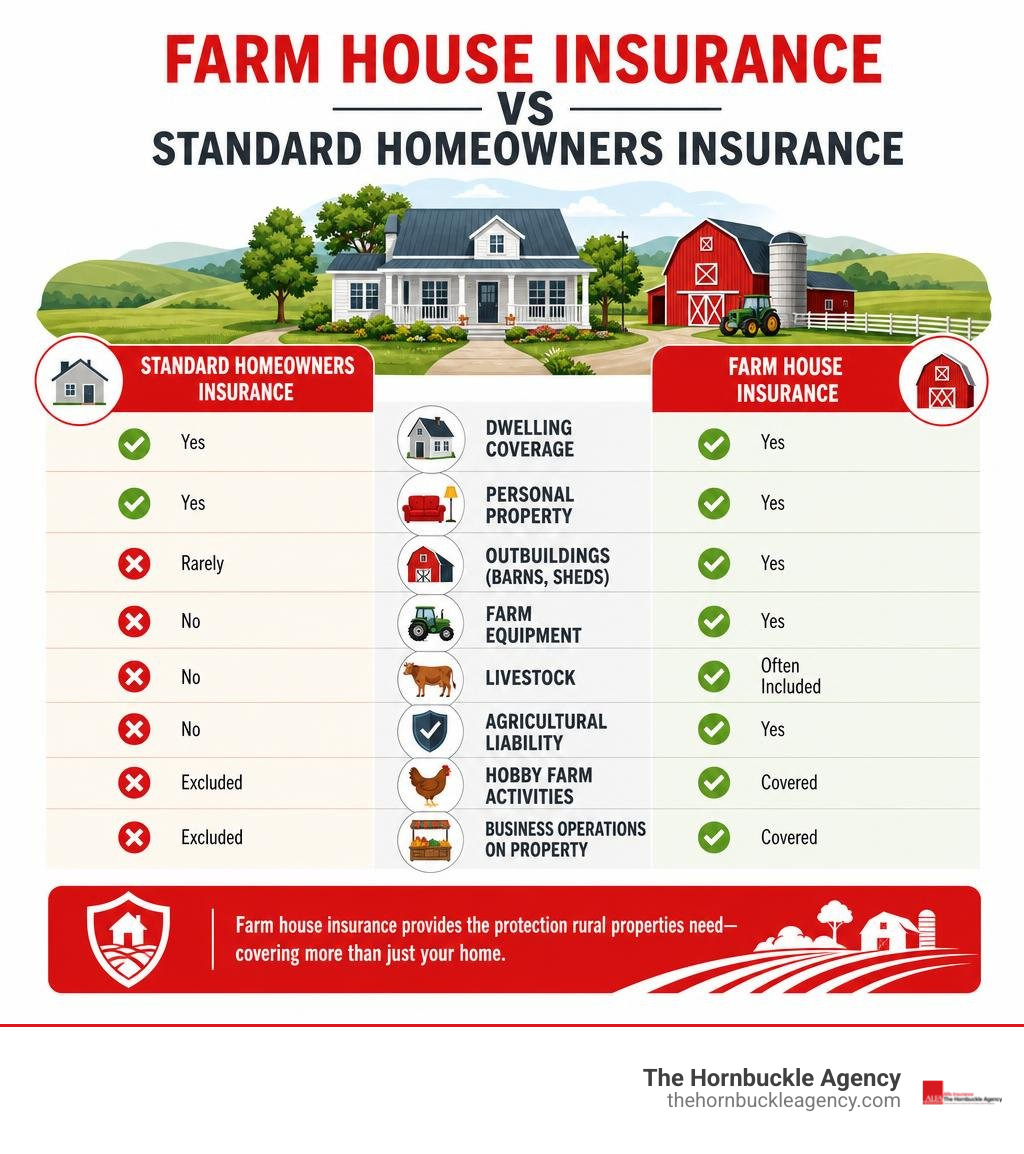
Here is a quick breakdown of what sets it apart:
| Feature | Standard Homeowners | Farm House Insurance |
|---|---|---|
| Dwelling coverage | Yes | Yes |
| Personal property | Yes | Yes |
| Outbuildings (barns, sheds) | Rarely | Yes |
| Farm equipment | No | Yes |
| Livestock | No | Often included |
| Agricultural liability | No | Yes |
| Hobby farm activities | Excluded | Covered |
| Business operations on property | Excluded | Covered |
The core problem is this: if you own a rural property in Alabama and run any kind of agricultural activity — even something as modest as keeping a few animals, cutting hay, or running a small farm stand — your standard home policy likely excludes those risks entirely.
That gap can leave your home, your outbuildings, and your livelihood dangerously exposed.
I’m Dustin Hornbuckle, owner and agent at The Hornbuckle Agency in Albertville, Alabama, and with nearly 18 years of insurance experience I’ve helped countless rural families find the right farm house insurance to protect both their homes and their agricultural way of life. In this guide, I’ll walk you through everything you need to know to make a confident, informed coverage decision.
What is Farm House Insurance and How Does It Work?
At its core, farm house insurance is a hybrid policy. It is specifically designed to handle the dual nature of rural properties in places like Marshall County, Alabama, where a home is not just a place to sleep, but often the operational hub of a working piece of land.

When you live in town, a standard homeowners policy protects your dwelling, your furniture, and your liability if a guest slips on your porch. You can learn more about how those standard structures work in our Homeowners Insurance Complete Guide.
However, once you move out to the countryside of Guntersville or Boaz and begin utilizing your land for agricultural pursuits, the risk profile changes completely. A standard policy will not cover a barn filled with hay, a tractor parked in the yard, or the liability associated with selling fresh eggs to your neighbors.
Farm house insurance steps in to bridge this gap. It works by combining traditional residential protections with specialized agricultural coverages. It ensures that the physical structure of your farmhouse is protected against everyday perils like fire and windstorms, while also extending liability protection to cover the unique risks of rural living.
Farm House Insurance vs. Broad Farm and Ranch Policies
One of the most common questions we hear at The Hornbuckle Agency is: “Do I need a farm house policy, or do I need a full farm and ranch policy?”
The answer depends on the scale of your operations and how your land is structured.
- Farm House Insurance: This policy focuses primarily on the residential dwelling, your personal belongings, and standard detached structures (like a detached garage or a small tool shed). It is ideal for rural homeowners and hobby farmers who may have a few animals or a large garden but do not rely on the land as their primary source of commercial income.
- Broad Farm and Ranch Policies: If your property transitions into a commercial business, you require a broader commercial agricultural package. These comprehensive policies are designed to protect large-scale business operations, commercial farm machinery, large herds of livestock, and business interruption risks. For highly complex agricultural estates, a specialized package like a Farm Combined insurance | Rural Insurance Group policy is used to bundle commercial liability, heavy machinery, and multiple dwellings under a single administrative umbrella.
A general rule of thumb used by major carriers in 2026 is that if you own or cash-rent more than 500 acres of farmland, or if you operate under a share-crop arrangement where expenses and profits are shared with external partners, you have outgrown a standard farm house policy and must transition to a broad farm and ranch policy.
Who Needs Specialized Farm House Insurance?
You might think that farm insurance is only for multi-generational families operating hundreds of acres of row crops in Marshall County. In reality, a wide variety of rural property owners need this specialized protection:
- Hobby Farmers: If you raise alpacas, chickens, goats, or a few head of cattle primarily for recreation or minor side income, standard home insurance will exclude claims related to these animals. You need farm house coverage to protect your property and liability.
- Rural Homeowners with Significant Outbuildings: If you have a large workshop, a greenhouse, or a horse barn on your property, a standard home policy will often cap outbuilding coverage at a tiny percentage of your main dwelling’s value. Farm house insurance allows you to properly schedule and protect these structures.
- Barndominium Owners: Barndominiums have exploded in popularity across Alabama. However, because of their metal-frame construction and dual-use designs (often combining a large workshop or garage with living quarters), standard home insurance companies frequently reject them. Specialized farm dwelling policies are perfectly suited to protect these unique homes.
- Farmers Operating on Leased Land: If you lease land in Boaz or Guntersville to grow crops or graze livestock, you still face massive liability and property risks. A specialized farm policy can protect your equipment and personal property stored on that leased acreage.
If you do not participate in any agricultural activities and simply own a traditional home on a standard lot within city limits, a traditional policy is likely the best fit. You can explore those options on our Home Insurance page.
What Does a Farm House Policy Cover?
To understand how a farm house insurance policy protects your assets, it helps to look at the specific perils it covers and how it compares to standard home insurance.
| Coverage Area | Standard Homeowners Policy | Farm House Insurance Policy |
|---|---|---|
| Fire & Lightning | Covered (Dwelling & Contents) | Covered (Dwelling, Contents, & Outbuildings) |
| Windstorm, Hail, & Tornadoes | Covered (Subject to deductibles) | Covered (Tailored for rural structures) |
| Theft & Vandalism | Covered (Personal items only) | Covered (Includes tools, workshop equipment, and farm personal property) |
| Power Surges & Food Spoilage | Limited coverage | Broad coverage (Includes farm freezers and bulk milk tanks) |
| Agricultural Liability | Excluded | Covered (Protects against farm-related lawsuits) |
| Commercial Farm Equipment | Excluded | Covered (Up to specified limits) |
For families living on acreage in manufactured or mobile homes, specialized rules apply. You can read more about how those structures are handled on our Manufactured Home Insurance page.
Covered Properties and Structures
A standard farm house policy breaks down its property coverages into distinct categories to ensure every physical asset on your land is accounted for:
- The Main Dwelling: This protects the physical structure of the farmhouse where you and your family live, from the foundation to the roof, against covered perils like fire, wind, and lightning.
- Detached Residential Structures: This includes buildings adjacent to the home that are used for personal, non-commercial purposes, such as detached garages, gazebos, and playhouses.
- Household Contents: Your personal belongings inside the home — including furniture, clothing, electronics, and appliances — are protected.
- Farm Outbuildings: This is where farm house insurance shines. It allows you to protect barns, silos, sheds, run-in shelters, and greenhouses that are used for your hobby farming or agricultural storage.
Customizing Your Farm House Insurance with Endorsements
No two farms in Marshall County are exactly alike. A poultry farmer in Albertville has completely different risks than a horse boarder in Guntersville. To make sure you aren’t paying for coverage you don’t need, you can customize a standard policy using endorsements (optional add-ons).
Many carriers design their programs similarly to the highly customizable Farmowner – Mutual of Wausau structure, allowing you to add specific protections such as:
- Equipment Breakdown Coverage: This covers mechanical or electrical breakdowns of critical home and farm systems, including HVAC units, deep well pumps, and electrical panels in your outbuildings.
- Sewer and Sump Pump Backup: Standard policies exclude damage caused by water backing up through drains or sump pumps. This endorsement is crucial for farm homes with finished basements.
- Refrigerated Products Spoilage: If a summer power surge knocks out your farm freezers, this coverage reimburses you for the loss of frozen meats, produce, or temperature-sensitive agricultural goods.
- Added Animal Perils: This extends coverage to your livestock (such as cattle, sheep, goats, or horses) if they are injured or killed by specific accidental events, such as a lightning strike, wild animal attack, or accidental shooting.
- Chemical Drift Liability: If you spray fertilizers or pesticides on your crops and the wind carries those chemicals onto a neighbor’s prize-winning garden, this endorsement protects you from the resulting liability claims.
Key Exclusions, Valuations, and Underinsurance Risks
Understanding what your policy excludes is just as important as knowing what it covers.

Standard farm house policies typically exclude losses caused by:
- Floods (which require a separate policy through the National Flood Insurance Program).
- Earthquakes (unless added via endorsement).
- Normal wear and tear or lack of maintenance.
- Unlicensed vehicles (like personal cars, which must be insured on a commercial or personal auto policy).
When setting up your policy, you must also choose how your property will be valued in the event of a total loss. The two primary methods are Actual Cash Value (ACV) and Replacement Cost.
- Actual Cash Value: This pays out the cost to replace the damaged property minus depreciation for age and wear. While ACV policies have lower premiums, they can leave you with a massive financial gap when trying to rebuild.
- Replacement Cost: This pays the actual cost to rebuild your home or replace your items with materials of like kind and quality, without deducting for depreciation.
To prevent policyholders from falling behind due to inflation and rising material costs, high-quality insurers offer an Inflation Guard feature. This automatically adjusts your policy limits over time to match current local construction costs, ensuring you are never left underinsured.
Understanding these legal and structural definitions is vital, as outlined in detailed guidelines like the Farm Combined insurance (Rural) policy documentation, which highlights the contractual obligations between farm owners and their insurance carriers.
Determining the Value of Your Farm House and Contents
Calculating the true value of a farmhouse requires specialized local knowledge. Unlike a standard subdivision home, a historic farmhouse may feature unique craftsmanship, plaster walls, or non-standard timber framing that is incredibly expensive to replicate today.
To determine your coverage needs, we recommend taking the following steps:
- Calculate Rebuild Costs, Not Market Value: The market value of your property includes the land it sits on. For insurance purposes, you only want to calculate the cost of labor and materials required to rebuild the physical structure from scratch.
- Create a Comprehensive Home Inventory: Walk through your home and outbuildings with a smartphone, filming everything you own. Keep a digital log of serial numbers for expensive tools, electronics, and appliances.
- Account for Construction Cost Adjustments: Local building costs in Albertville, Boaz, and Guntersville fluctuate. Ensure your policy includes automatic construction cost features so your coverage limits keep pace with local economic shifts.
How Deductibles and Underinsurance Affect Your Claims
Your deductible is the out-of-pocket amount you agree to pay before your insurance coverage kicks in. Choosing a higher deductible is a highly effective way to lower your monthly premium payments, but you must ensure you have those funds readily available in a savings account in case disaster strikes.
One of the most dangerous risks rural property owners face is underinsurance. In the insurance industry, this is governed by the “Average Clause” (or Coinsurance Clause).
If you insure your farmhouse for less than 80% of its true replacement value, the insurance company can penalize you on partial claims.
For example, if your farmhouse has a true rebuild value of $200,000, but you only insure it for $120,000 (which is 60% of its value), you are underinsured. If a kitchen fire causes $40,000 worth of damage, the insurer will apply the “Average Clause” penalty. Because you only carried 60% of the required coverage, they will only pay out 60% of your partial claim — leaving you with a check for $24,000 and an out-of-pocket bill of $16,000 for a loss you thought was fully covered.
How to Lower Your Premiums and Qualify for Discounts
While protecting your farm is non-negotiable, paying too much for your coverage is a mistake. There are several strategic steps you can take to lower your insurance costs without sacrificing protection.
Smart Technology and Property Upgrades
Modern technology has made it easier than ever to prevent catastrophic losses before they happen, and insurance companies love to reward proactive homeowners.
- Smart Electrical Monitors: Devices like Ting plug into a standard outlet and constantly monitor your home’s electrical grid for micro-arcs and signal changes that precede electrical fires. Installing these can earn you significant premium discounts.
- Water Leak Detectors: Installing smart shut-off valves and water sensors on utility pipes can automatically shut down your water system if a pipe bursts, preventing thousands of dollars in water damage.
- Monitored Security Systems: A security system that alerts local Marshall County emergency services in the event of a break-in or fire can qualify you for immediate safety discounts.
Policy Structuring and Deductibles
How you structure your insurance portfolio can also unlock massive savings:
- Multi-Policy Bundling: The single easiest way to save money is to bundle your farm house insurance with your personal auto, commercial vehicle, or life insurance policies.
- New Home Discounts: If your farmhouse was built within the last 20 years, or if it has been completely re-wired and re-plumbed by a licensed contractor, let your agent know. Newer systems represent a much lower risk of fire and water damage.
- Mortgage-Free Discounts: If you have fully paid off your farm property, many carriers offer a mortgage-free discount as a reward for your financial stability.
Frequently Asked Questions about Farm House Coverage
Is farm house insurance required by law?
No, the state of Alabama does not legally mandate that you carry farm house insurance. However, if you have a mortgage or an agricultural land loan on your property, your lender will absolutely require you to maintain specific levels of dwelling and hazard insurance to protect their financial investment.
Does standard home insurance cover hobby farming activities?
Generally, no. Standard homeowners policies contain strict exclusions for business activities and agricultural operations. If you are selling produce, boarding horses, or keeping livestock, any property damage or liability claims arising from those activities will likely be denied under a standard residential policy.
Are grain bins and silos covered under a farm house policy?
Grain bins, silos, and other specialized agricultural structures are typically not covered under the basic dwelling or personal property sections of a farm house policy. To protect these structures, they must be individually listed (scheduled) on your policy with their specific replacement values.
Conclusion
Your farm is more than just a piece of real estate — it represents your hard work, your family’s security, and the legacy you are building. Protecting it requires more than a one-size-fits-all insurance policy.
At The Hornbuckle Agency, we believe in providing personalized risk education. We don’t just sell policies; we sit down with our neighbors in Albertville, Guntersville, Boaz, and throughout Marshall County to help them understand their unique risks and build a customized safety net.
If you want to ensure your farmhouse, your outbuildings, and your rural lifestyle are fully protected, we are here to help. You can learn more about our tailored agricultural solutions on our Farm Insurance page, or reach out to us directly to start a conversation. Let us help you protect what matters most.
