
Why Do North Alabama Homeowners Need a Clear Insurance Cheat Sheet?
When North Alabama homeowners consult an insurance agent, the most common questions focus on four critical areas: whether home insurance is legally mandatory (state law does not require it, but mortgage lenders do), what policies exclude (standard forms exclude flood and earth movement), how wind deductibles and roof age impact storm claims, and whether repairs settle at full Replacement Cost Value or depreciated Actual Cash Value. Getting clear answers to these questions ensures structural repairs and personal assets are adequately protected against regional hazards.
As we move through 2026, Alabama homeowners insurance costs an average of $3,614 per year, which sits 38% higher than the national average of $2,628. While inland North Alabama homeowners generally see better rates than coastal property owners—with Huntsville area homeowners averaging $3,166 per year—rates across our state have climbed roughly 37% over the last five years.
Whether you own a craftsman bungalow in Albertville, a lake house near Guntersville, a family property in Boaz, or acreage across Marshall County, knowing how your policy responds to real-world perils protects your household balance sheet. To make informed coverage choices, homeowners must cut through confusing industry jargon and get straight answers to their most critical questions.
What Does Standard Home Insurance Cover (and What Is Excluded) in Alabama?
When you review your policy, it is easy to assume that everything under your roof is fully protected against every conceivable event. However, a standard homeowners policy is a precise legal contract containing specific covered perils, distinct coverage tiers, and explicit exclusions.
Is Homeowners Insurance Mandatory Under Alabama Law?
Alabama state law does not mandate that homeowners carry property insurance. If you own your home free and clear with no outstanding mortgage or equity lines, no government agency will penalize you for going uninsured.
However, if you have a mortgage, your lending institution will require comprehensive property insurance as a non-negotiable condition of your loan. Lenders require this coverage to protect their financial stake in your property against catastrophic losses such as fire or tornado damage.
Even without a mortgage, going without insurance in North Alabama exposes you to extreme financial risk. Severe storms, straight-line winds, hail, and unexpected house fires can cause tens or hundreds of thousands of dollars in structural damage in minutes. Carrying adequate coverage ensures that a single bad afternoon does not erase decades of built home equity.
What Core Protections Are Included in a Standard HO-3 Policy?
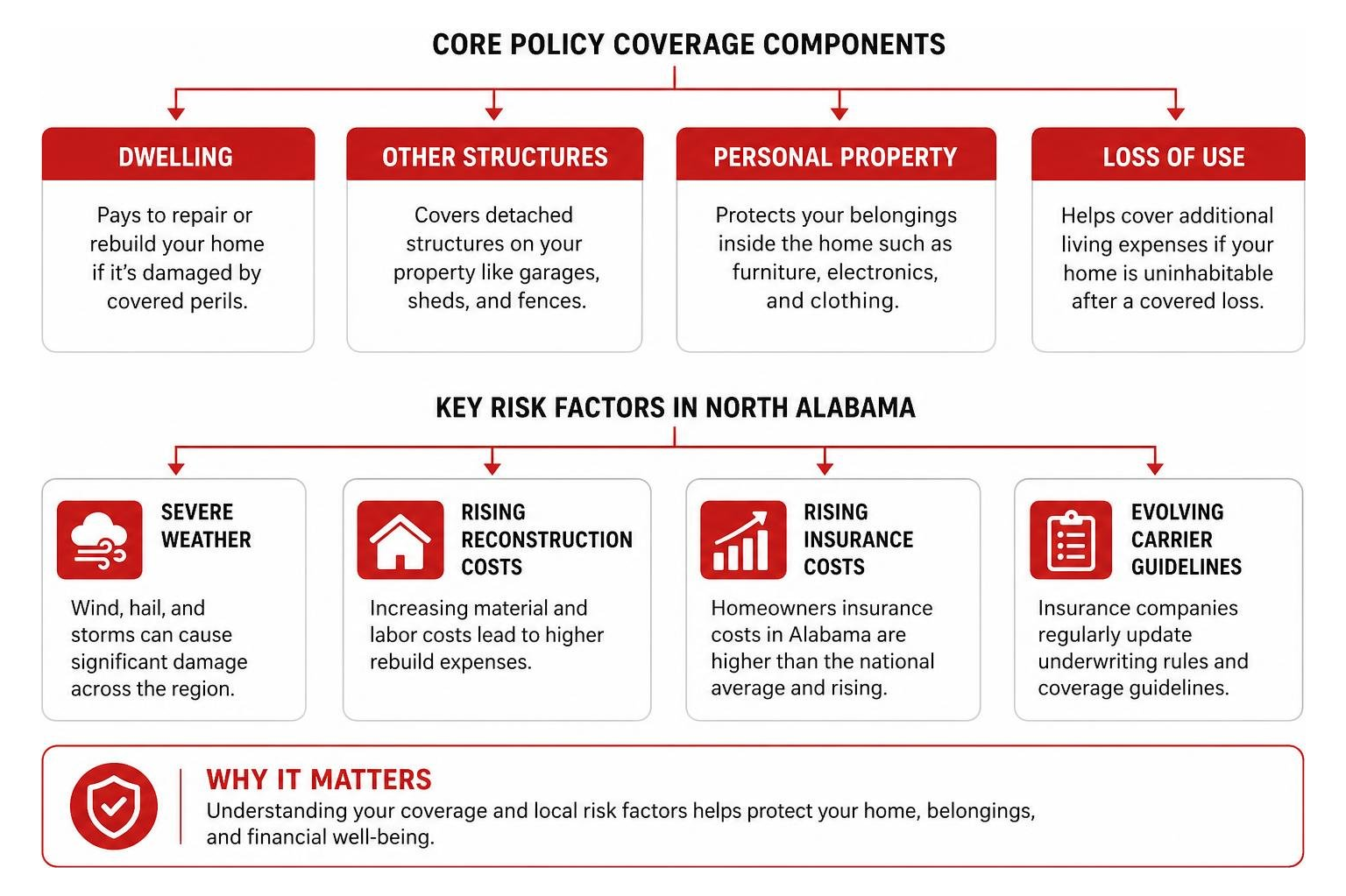
The standard policy type issued to single-family homeowners in Alabama is the HO-3 Special Form. This policy provides coverage divided into six primary categories:
- Coverage A (Dwelling): Pays to repair or rebuild the physical structure of your home, including attached garages, built-in appliances, and permanent fixtures.
- Coverage B (Other Structures): Protects detached buildings on your property, such as detached garages, storage sheds, workshops, fences, and gazebos (typically set at 10% of Coverage A).
- Coverage C (Personal Property): Reimburses you for damaged or stolen personal belongings, including furniture, electronics, clothing, and appliances.
- Coverage D (Loss of Use / Additional Living Expenses): Covers temporary living costs (hotel bills, restaurant meals, storage units) if a covered disaster makes your home uninhabitable during repairs.
- Coverage E (Personal Liability): Shields your family’s personal assets if you are found legally liable for bodily injury or property damage to others on or off your property.
- Coverage F (Medical Payments to Others): Pays for minor medical bills (typically $1,000 to $5,000) for guests injured on your property, regardless of fault.
Your dwelling is typically protected against sudden and accidental perils such as fire, lightning, windstorm, hail, weight of ice or snow, and smoke. When evaluating your policy, make sure you understand your specific fire coverage limits and protections to ensure structural and personal property limits keep pace with current construction costs.
It is also vital to recognize internal sub-limits. Standard policies usually cap payouts on high-risk valuables such as jewelry, firearms, silverware, and fine arts at $1,500 to $2,500 total unless you specifically schedule or endorse those items individually.
What Are the Most Common Exclusions Alabama Homeowners Face?
Standard HO-3 policies operate on an “open perils” basis for the dwelling, meaning damage from any cause is covered unless that cause is explicitly excluded in the policy contract.
Common standard exclusions include:
- Earth movement (earthquakes, sinkholes, mudslides, and earth settling)
- Routine wear-and-tear and deferred property maintenance
- Insect, rodent, or termite infestations
- Sewer, drain, and sump pump backups (unless added via endorsement)
- Surface water flooding and storm surge
The most significant exclusion that surprises local homeowners is flood damage. Standard homeowners insurance policies do not cover water that enters your home from the ground up. According to FEMA, just one inch of standing flood water can cause up to $25,000 in damage to flooring, drywall, cabinetry, and electrical systems.
To protect against rising waters from heavy rains or overflowing creeks and drainage basins, homeowners must purchase a standalone flood policy through the National Flood Insurance Program (NFIP) or a private flood carrier. In Alabama, flood insurance policies average $934 per year (about $78 per month). Reviewing these exclusions with a local agent helps ensure you have addressed all potential gaps.
How Do Storm Risks, Wind Deductibles, and Roof Age Impact Your Policy?
Spring and fall storm seasons in North Alabama bring intense convective weather, tornadoes, high straight-line winds, and damaging hail. Because wind and hail account for a large portion of property losses across our region, insurers pay close attention to roof condition and policy deductible structures.
| Deductible Type | Percentage Rate | $300,000 Dwelling Limit | $450,000 Dwelling Limit | Out-of-Pocket Cost |
|---|---|---|---|---|
| Standard Flat Deductible | N/A | Flat $1,000 | Flat $1,000 | $1,000 |
| Percentage Wind/Hail Deductible | 2% | 2% of Dwelling | 2% of Dwelling | $6,000 – $9,000 |
| Percentage Wind/Hail Deductible | 5% | 5% of Dwelling | 5% of Dwelling | $15,000 – $22,500 |
| Percentage Wind/Hail Deductible | 10% | 10% of Dwelling | 10% of Dwelling | $30,000 – $45,000 |
How Do Percentage Wind and Hail Deductibles Work?
Historically, homeowners paid a single flat deductible—such as $1,000 or $1,500—for any covered claim. Today, many policies in storm-exposed regions feature a separate percentage deductible for wind and hail damage.
Unlike a flat deductible, a percentage deductible is calculated as a percentage of your Coverage A (Dwelling) limit, not the cost of the repair.
For example, if your home is insured with a $300,000 dwelling limit and your policy carries a 2% wind/hail deductible, your out-of-pocket obligation for storm-related roof or siding damage is $6,000 before your insurance pays anything. If your deductible is set at 5%, that out-of-pocket expense jumps to $15,000.
When reviewing your declarations page, always check whether your deductible is a flat dollar amount or a percentage, and ensure you have cash reserves set aside to cover that potential expense.
Why Has Roof Age Become a Major Underwriting Factor?
Your roof is your home’s primary shield against Alabama weather. In recent years, roof age and material type have become central factors in underwriting decisions.
Key factors carriers evaluate include:
- Roof Age Thresholds: Roofs older than 10 to 15 years face stricter underwriting, increased premiums, mandatory pre-inspections, or actual cash value payout schedules rather than full replacement cost.
- Shingle Type: Architectural (laminated) shingles resist higher wind speeds than traditional three-tab shingles, often securing better underwriting terms.
- Prior Damage History: Unrepaired hail strikes or missing shingles flagged during underwriting inspections can delay closings or lead to cancellation notices.
If you are buying an existing property or updating your policy, maintaining detailed records of roof maintenance is critical for protecting farm and residential properties against costly disputes during storm claims.
What Are IBHS Fortified Roof Discounts in Alabama?
To reduce catastrophic storm damage, Alabama has become a national leader in resilient home construction through the Insurance Institute for Business & Home Safety (IBHS) FORTIFIED Home™ standard.
A FORTIFIED roof features sealed roof decks, ring-shank nails, and enhanced edge attachments that prevent wind from tearing shingles and decking away during severe windstorms.
Alabama state law requires insurance carriers to offer meaningful premium discounts on the wind portion of your homeowners policy when you install a certified FORTIFIED roof. Additionally, qualifying homeowners can apply for state-backed grant opportunities through programs like Strengthen Alabama Homes, which provide financial assistance to retrofit existing roofs to FORTIFIED standards, lowering long-term ownership costs while improving storm durability.
How Is Dwelling Coverage Calculated Between Replacement Cost and Actual Cash Value?
One of the most consequential decisions you make when establishing your policy is choosing between Replacement Cost Value (RCV) and Actual Cash Value (ACV) settlement terms.
What Is the Difference Between Replacement Cost and Actual Cash Value?
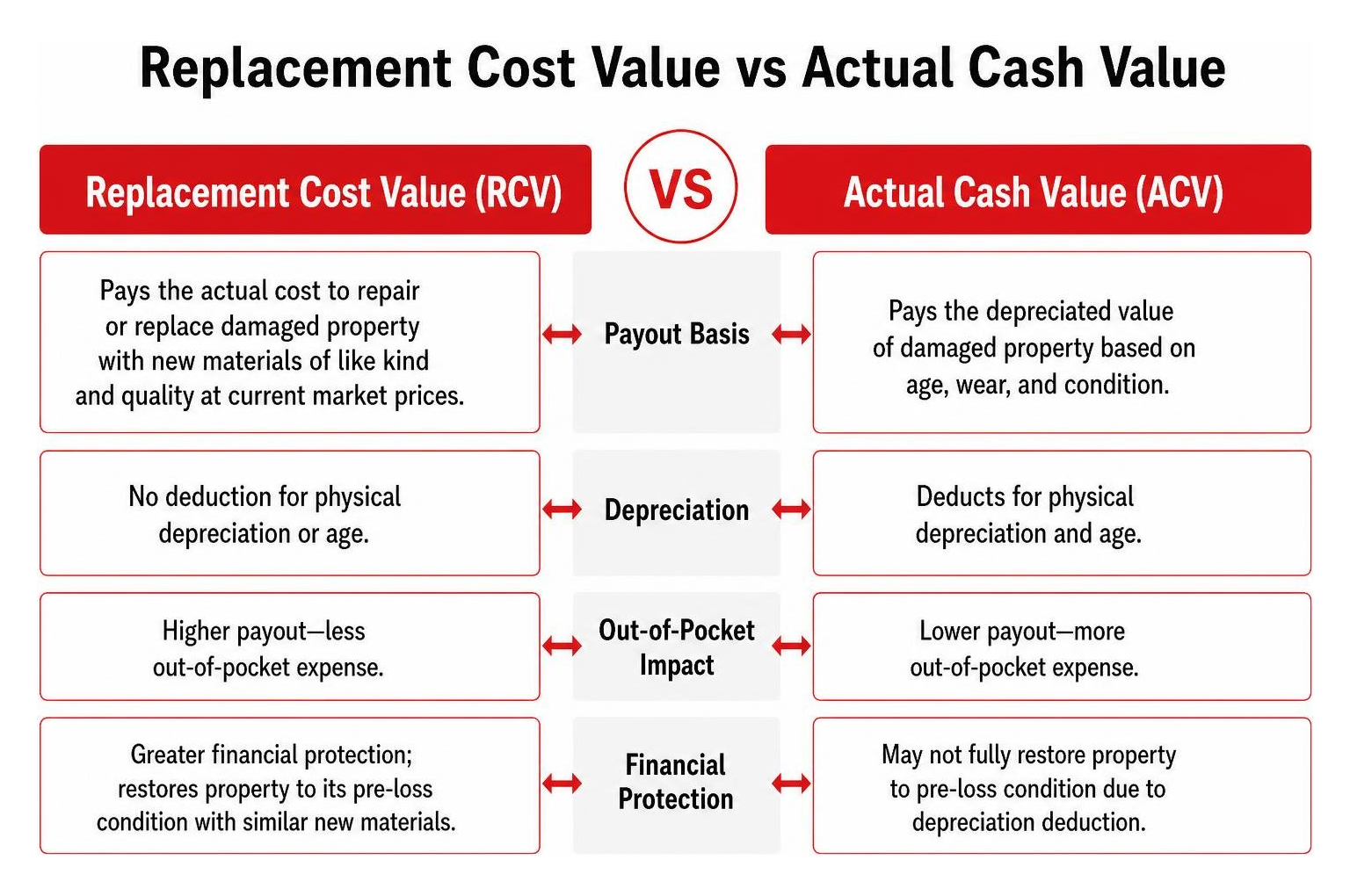
The difference between these two valuation methods determines how much you must pay out of pocket after a loss:
- Replacement Cost Value (RCV): Pays the actual cost to repair or replace damaged property with new materials of like kind and quality at current market prices, with no deduction for physical depreciation or age.
- Actual Cash Value (ACV): Calculates the cost to replace the item today minus depreciation based on the item’s age and pre-loss condition.
For instance, if a 12-year-old roof with a 20-year lifespan is destroyed by hail, a replacement cost policy pays the full cost to install a brand-new roof (minus your deductible). An actual cash value policy depreciates the roof by 60%, paying out only 40% of the replacement cost and leaving you to pay the remaining 60% out of pocket.
We strongly recommend ensuring that both your dwelling (Coverage A) and your personal contents (Coverage C) are written with Replacement Cost coverage endorsements.
How Do You Accurately Calculate Reconstruction Costs in North Alabama?
A common misconception among homeowners is equating their insurance dwelling coverage limit with their home’s real estate market value or county tax assessment.
Your home’s market value includes the land, local neighborhood demand, and school district desirability. By contrast, your insurance dwelling limit must strictly reflect the reconstruction cost—the physical expense of labor, raw materials, heavy equipment, site cleanup, and debris removal needed to rebuild the structure from the foundation up.
To ensure accurate dwelling limits:
- Account for Site Prep and Debris Removal: Clearing a damaged foundation and hauling debris after a total loss can cost $15,000 to $30,000 before rebuilding even begins.
- Include Ordinance or Law Coverage: Building codes change regularly. If your older home suffers major damage, local municipal codes in Albertville, Guntersville, or Boaz may require updated electrical wiring, plumbing, or insulation. Standard policies include only limited ordinance or law coverage, but higher limits can be added via endorsement.
- Add Extended Replacement Cost: Adding an extended replacement cost endorsement (which expands your dwelling limit by 25% to 50% if local material and labor costs surge after widespread regional storms) provides a crucial safety cushion.
For an in-depth breakdown of valuation strategies, review our homeowners insurance complete guide and speak with a local agent about the dwelling limit, ordinance or law coverage, and replacement cost options that fit your property.
How Can You Lower Your Rates and Navigate the Claims Process Locally?

Managing your household budget does not mean you have to strip away essential coverage. By taking advantage of verified discounts and understanding the claims process, you can maintain strong protection at a manageable price.
What Discounts Can North Alabama Homeowners Utilize to Reduce Premiums?
Carriers offer multiple discount programs that reward proactive home maintenance, security measures, and account loyalty:
- Multi-Policy Bundling: Combining your homeowners, auto, and life insurance policies with the same provider is consistently the most effective way to lower premiums, often saving between 10% and 25% on your combined bills.
- Protective Devices: Installing monitored security alarms, central-station fire alarms, deadbolt locks, fire extinguishers, and smart water-leak detection systems yields ongoing premium credits.
- Impact-Resistant Roofing: Upgrading to Class 4 impact-resistant roofing shingles or IBHS FORTIFIED systems provides significant structural and wind-rate discounts.
- Claims-Free Record: Maintaining a clean loss history without non-catastrophic claims for three to five consecutive years qualifies your property for preferred pricing tiers.
- Adjusting Deductibles: Raising your all-peril deductible from $1,000 to $2,500 can reduce your annual premium by 10% to 15%. However, ensure you have that cash reserve accessible if a loss occurs.
To explore how these savings apply across different policy types, read our guide to comparing home insurance quotes in Alabama and review standard home insurance policy structures.
What Is the Step-by-Step Process for Filing a Home Insurance Claim?
Experiencing property damage is stressful. Following a clear, organized claims process ensures you receive a fair, prompt settlement.
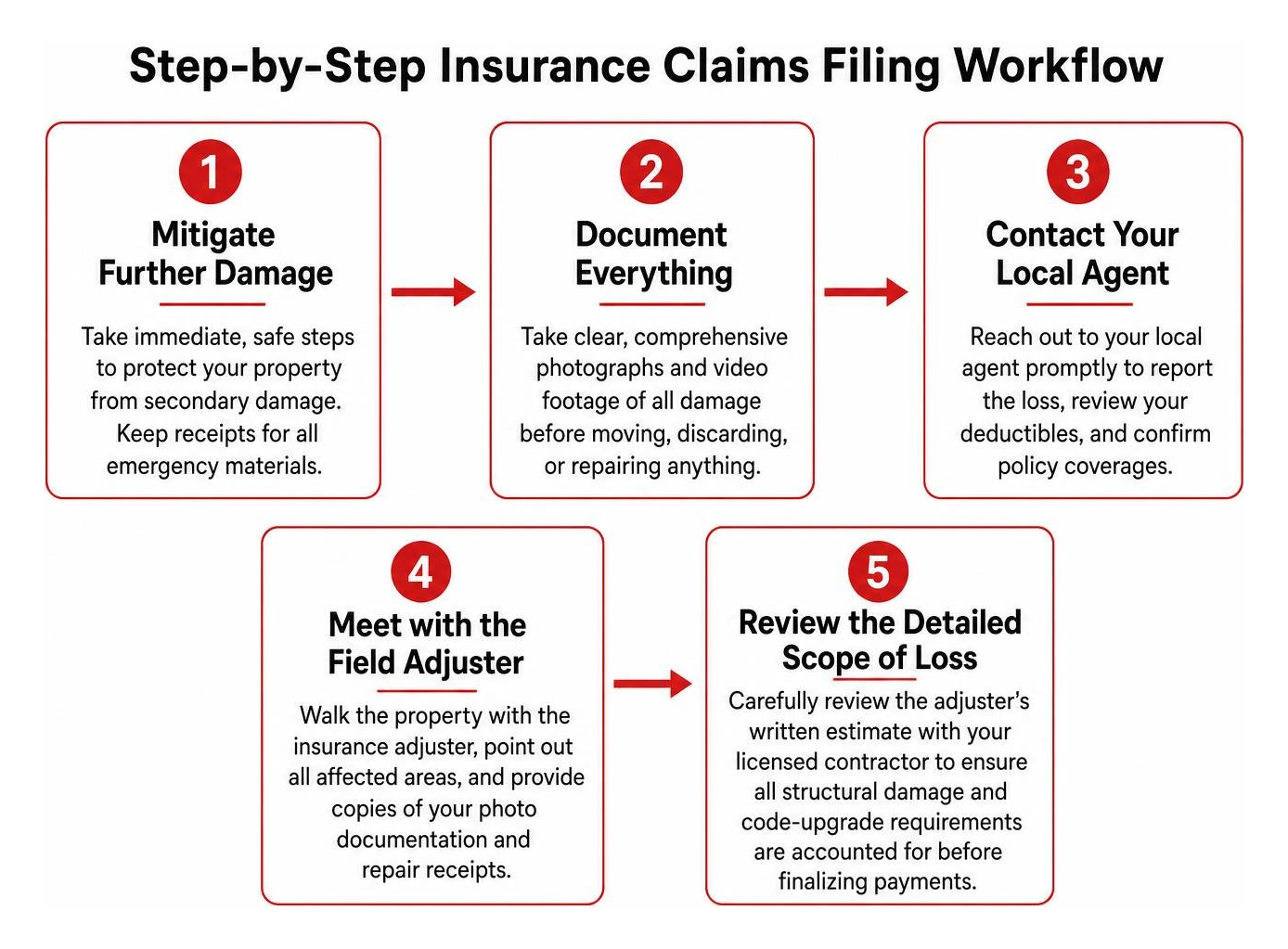
- Mitigate Further Damage: Take immediate, safe steps to protect your property from secondary damage—such as placing a tarp over a damaged roof or shutting off the main water valve. Keep receipts for all emergency materials.
- Document Everything: Take clear, comprehensive photographs and video footage of all damage before moving, discarding, or repairing anything.
- Contact Your Local Agent: Reach out to your local agent promptly to report the loss, review your deductibles, and confirm policy coverages.
- Meet with the Field Adjuster: Walk the property with the insurance adjuster, point out all affected areas, and provide copies of your photo documentation and repair receipts.
- Review the Detailed Scope of Loss: Carefully review the adjuster’s written estimate with your licensed contractor to ensure all structural damage and code-upgrade requirements are accounted for before finalizing payments.
For local claims guidance and settlement support, review our detailed resource on navigating local claims and policy services.
Why Does Working with a Dedicated Local Agent Provide Better Protection?
Purchasing an insurance policy through an anonymous 1-800 number or automated website often leaves homeowners with standardized coverage that ignores local environmental realities.
A dedicated local agent understands the specific geographic risks of North Alabama—from hail corridors along Sand Mountain to lake-effect moisture and high winds near Lake Guntersville. Local agents help tailor coverage to your neighborhood, advocate for your interests during complex claims, and review your policies as construction costs change.
The Hornbuckle Agency serves multiple Alabama communities, including Albertville, Guntersville, Boaz, Arab, Geraldine, Crossville, Collinsville, Horton, and Douglas with customized risk management, clear policy guidance, and dedicated local service.
What Are the Most Common FAQs About North Alabama Home Insurance?
How Does My Credit-Based Insurance Score Affect My Premium?
In Alabama, insurance companies use credit-based insurance scores as part of their underwriting and pricing models. Actuarial data shows a strong correlation between credit stability and claim frequency.
Carriers evaluate factors like:
- On-time payment history
- Credit utilization ratios
- Length of credit history
- Presence of collections or bankruptcies
Maintaining a strong credit profile can earn you preferred pricing tiers, significantly lowering your annual home insurance premiums.
What Is the Alabama Insurance Underwriting Association (AIUA) and Does It Apply to North Alabama?
The Alabama Insurance Underwriting Association (AIUA)—often referred to as the “wind pool”—is a state-created insurer of last resort designed to provide wind and hail coverage for property owners who cannot secure standard insurance in the private market.
The AIUA is specifically restricted to coastal areas (designated high-risk zones in Mobile and Baldwin counties). It does not provide coverage for inland North Alabama properties. If a property in North Alabama is difficult to insure due to claim history, vacancy, or extreme roof age, coverage must be secured through standard private carriers or specialized surplus lines markets.
How Frequently Should Homeowners Review Their Coverage with an Agent?
We recommend completing a comprehensive policy review with your insurance agent at least once every year.
In addition to annual checkups, you should immediately contact your agent whenever you experience these trigger events:
- Completing kitchen, bathroom, or structural home renovations
- Adding detached structures such as workshops, barns, sheds, or guest suites
- Installing an in-ground or above-ground swimming pool, trampoline, or hot tub
- Acquiring valuable items such as jewelry, guns, fine art, or high-end electronics
- Starting a home-based business with inventory or visiting clients
How Can You Get Personalized Protection and Expert Policy Guidance?
Protecting your home, personal belongings, and family assets requires clear answers, accurate property valuations, and tailored policy options. By confirming your dwelling limits reflect current reconstruction costs, monitoring your roof condition, selecting sensible deductibles, and securing all eligible multi-policy discounts, you can protect what matters most with confidence.
Take control of your coverage today. You can get started right now with our streamlined quick start insurance quote process to review your coverage options.
If you have questions about your deductibles, need an endorsement review, or want a comprehensive policy comparison, visit The Hornbuckle Agency or get in touch directly by contacting our local team for a personalized risk assessment. We are here to help you protect your home across every season.
