
When Is Umbrella Insurance Worth the Investment?
Umbrella insurance is worth the investment when your exposed assets, future earnings, or lifestyle risks exceed the liability limits on your standard auto and home policies. For an annual cost of roughly $150 to $300 for the first $1 million in protection, it safeguards your existing savings, home equity, and future earnings from being seized to satisfy a legal judgment.
A standard personal insurance policy is designed to handle common mishaps, but it has defined monetary ceilings. When a catastrophic accident occurs—whether on the road, in your backyard, or through an unexpected legal claim—those base limits can disappear in an instant.
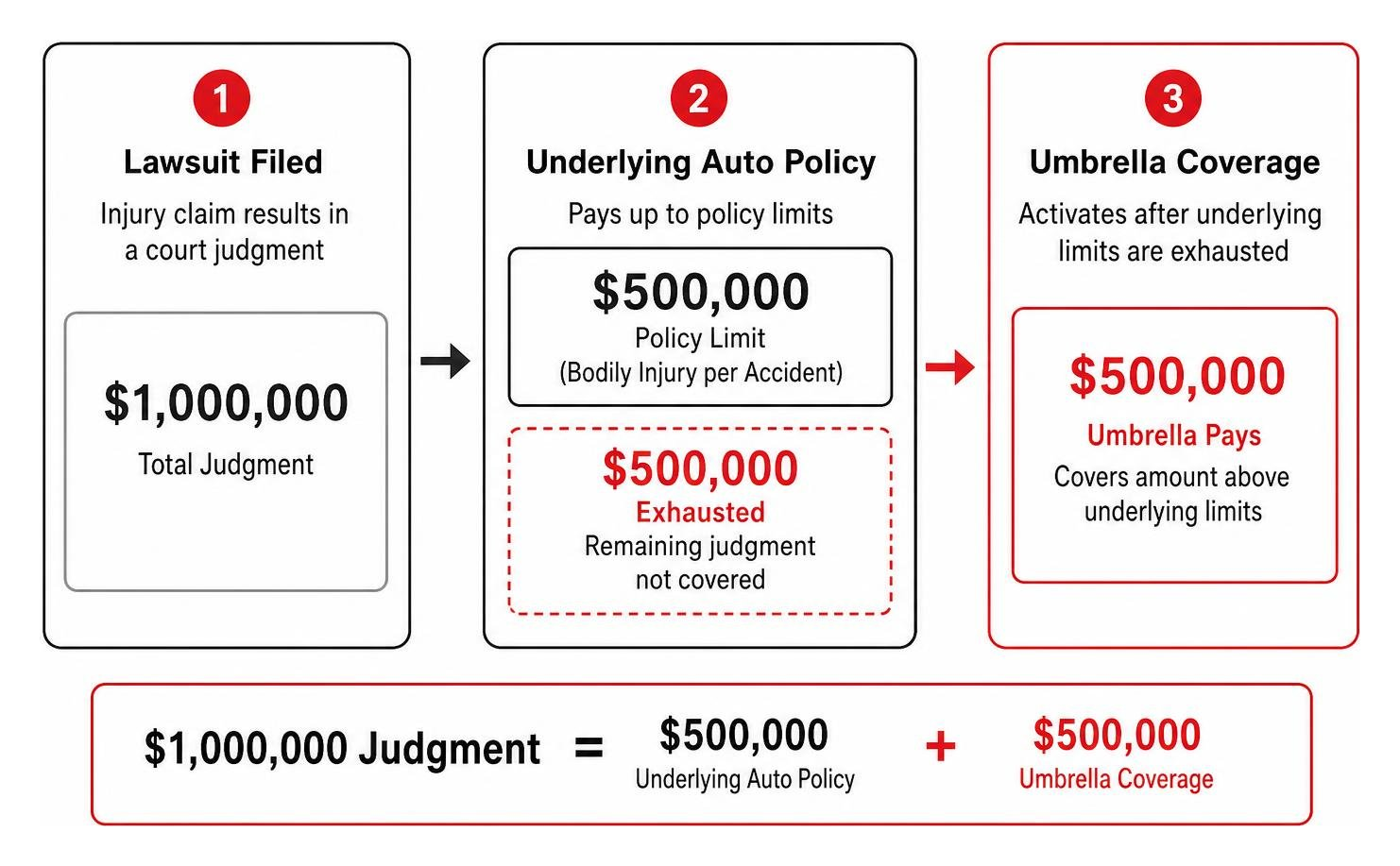
In October 2026, the cost of medical care, vehicle repairs, and legal defense continues to climb. A serious multi-vehicle crash or severe injury on private property can easily generate medical bills, lost wage claims, and pain-and-suffering damages that exceed $1 million. If your underlying auto policy caps bodily injury at $250,000 per person and $500,000 per accident, you are personally on the hook for every dollar awarded above those figures.
This reality is driven by ongoing social inflation—the trend of rising litigation costs, larger jury awards, and broader definitions of liability. Data from the American Bar Association shows that about two-thirds of Americans faced a legal issue over a recent four-year period. Furthermore, industry studies show that personal umbrella claims more than doubled over a ten-year span, while the average payout surged by 67%.
An umbrella policy bridges the financial gap between what your base policies pay and what a court judgment demands.
What Does an Umbrella Policy Cover and Exclude?
At its foundation, umbrella insurance is secondary liability insurance. It does not replace your primary auto or homeowners policy; rather, it sits above them like a protective canopy. When a covered claim exceeds the liability limit of your primary policy, your umbrella policy activates to cover the remaining balance up to its own policy limit (typically sold in $1 million increments).
Beyond providing higher dollar limits, umbrella policies offer two crucial advantages:
- Legal Defense Coverage: The policy pays for your legal defense representation, court costs, and attorney fees outside of the policy limit. If defending a complex lawsuit costs $100,000 in legal bills, those expenses do not reduce your $1 million liability limit.
- Broader Coverage Scope: Umbrella coverage frequently protects against personal injury offenses that standard policies exclude, including libel, slander, false arrest, malicious prosecution, and invasion of privacy.
Core Covered Liability Categories
An umbrella policy steps in across several distinct scenarios:
- Bodily Injury Liability to Third Parties: Severe injuries caused to others where you are found legally liable. This covers hospital bills, surgery costs, ongoing rehabilitation, long-term care, and compensation for lost income.
- Property Damage Liability: Major physical damage you or a covered family member cause to someone else’s property, such as crashing into an expensive commercial storefront or causing multi-car pileups.
- Landlord Liability Claims: If you own residential rental properties, umbrella policies can extend over your landlord liability policy to cover tenant or visitor injuries occurring on the rental premises.
- Worldwide Liability Protection: Unlike many standard domestic policies that restrict liability coverage to North America, personal umbrella policies generally follow you anywhere in the world when traveling or renting vehicles abroad.
Standard Policy Exclusions
While umbrella coverage is comprehensive, it is not an all-risk policy. Standard exclusions include:
- Intentional and Criminal Acts: Any deliberate act intended to cause harm or damage is never covered.
- Business Pursuits and Commercial Activities: Business operations, professional errors, and commercial vehicles require dedicated commercial insurance and commercial umbrella coverage.
- Damage to Your Own Property or Household: Umbrella insurance is strictly third-party liability. It does not pay for your own injuries or damage to your personal belongings.
- Contractual Liability: Claims arising from a breach of contract or assumed liability under a private agreement.
- Excluded Recreational Vehicles or Watercraft: High-powered watercraft, certain aircraft, or unregistered off-road vehicles may be excluded unless specifically endorsed and insured with adequate primary underlying limits.
Who Truly Needs Personal Umbrella Insurance?
A persistent myth surrounding umbrella insurance is that it is only necessary for millionaires and wealthy retirees. In practice, anyone with accumulated assets, steady income, or an active lifestyle that presents liability risks can benefit from this protection.
When a court enters a civil judgment against you following a severe accident, plaintiffs are not limited to collecting what you currently have in checking or savings accounts. Depending on state laws, judgments can attach to:
- Non-exempt home equity
- Brokerage and non-qualified investment accounts
- Second properties, land, and recreational assets
- Future wages, through court-ordered wage garnishment that can seize a percentage of your paychecks for years to come.
As outlined in Fidelity’s guide on umbrella liability, establishing adequate liability limits is a fundamental pillar of wealth preservation, particularly for households earning over $100,000 annually or those with net assets above $250,000.
High-Risk Household Factors
Certain household features and lifestyle activities naturally increase your statistical exposure to costly lawsuits:
- Teenage or Inexperienced Drivers: Motor vehicle crashes are among the leading causes of large liability payouts. Teen drivers have higher crash rates per mile driven, significantly elevating parental liability exposure.
- Attractive Nuisances: Backyard swimming pools, hot tubs, and trampolines carry significant premises liability risk. Even with proper fencing, accidents involving neighborhood children or guests can result in devastating claims.
- Dog Ownership: Dog bites and animal-related injuries accounted for over $1.12 billion in homeowners insurance claim payouts nationwide in recent years, with average claim severity steadily increasing.
- Frequent Entertaining and Hosting: Serving food and alcohol to guests at your residence increases the potential for slips, falls, and social host liability claims if an impaired guest causes an accident on the way home.
- Youth Sports Coaching: Coaching little league, soccer, or community sports teams exposes you to potential negligence claims if a participant suffers a serious injury under your supervision.
Rental Property and Volunteer Exposures
Owning rental properties significantly increases premises liability risks. A tenant slipping on an icy walkway or suffering injury from an unnoticed maintenance defect can bring a claim against the property owner.
Similarly, serving as an officer or board member for a local charity, church, or civic organization can expose you to personal liability for decisions made by the group, especially if the organization’s primary directors and officers policy has low limits. Additionally, in our digital era, personal liability claims arising from social media comments, online reviews, or public statements are increasingly common. An umbrella policy steps in to provide legal defense and judgment settlement for eligible defamation claims.
How Much Does Umbrella Insurance Cost Compared to Raising Standard Liability Limits?
One of the most appealing aspects of personal umbrella insurance is its cost-efficiency. Because an umbrella policy only pays out after primary policies are exhausted, carriers take on less frequency of risk, allowing them to provide high coverage limits for modest premiums.
In 2026, the cost for a basic $1 million personal umbrella policy typically ranges from $150 to $300 per year for a standard household with one home and two vehicles. The cost profile breaks down as follows:
- First $1 Million: $150 to $300 annually (average ~$200 to $250)
- Second $1 Million: Adds approximately $75 to $125 annually
- $5 Million Policy: Averages roughly $600 annually, bringing the incremental cost down to around $120 per million.
Underlying Policy Requirements
To qualify for an umbrella policy, insurance companies require that your base policies carry specific minimum liability limits. Typically, these requirements include:
- Auto insurance: Minimum limits of $250,000 bodily injury per person / $500,000 bodily injury per accident / $100,000 property damage (or a $500,000 combined single limit).
- Home insurance: Minimum personal liability limit of $300,000 (and often $500,000).
If your primary policies are currently set at state minimums (e.g., $25,000/$50,000), you will need to increase those limits first. The cost to raise underlying auto and home limits is usually small, often adding only $50 to $100 annually to your base policies.
| Feature | Standalone Primary Policies Only | Primary Policies + $1M Umbrella Policy |
|---|---|---|
| Max Auto Bodily Injury Limit | Typically capped at $500,000 | $1,500,000 total combined protection |
| Max Home Liability Limit | Typically capped at $300,000 – $500,000 | $1,300,000 – $1,500,000 total protection |
| Personal Injury Coverage (Libel/Slander) | Usually excluded or limited | Fully covered up to policy limits |
| Legal Defense Costs | Paid within or up to base policy terms | Paid in addition to umbrella policy limits |
| Worldwide Coverage | Limited to USA/Canada | Broad worldwide coverage |
| Estimated Annual Premium Difference | Baseline cost | Base + $150 to $300/year |
How Do You Determine How Much Umbrella Coverage You Need?
Choosing the right amount of umbrella insurance is a direct calculation of what you stand to lose in a worst-case scenario.

To size your umbrella coverage accurately, review HomeCostLab’s 2026 umbrella insurance guide and apply this four-step formula:
- Calculate Your Total Exposed Net Worth:
- Add your non-exempt home equity, secondary real estate, and land.
- Add taxable bank accounts, CDs, money market accounts, and non-qualified brokerage funds.
- Add the current market value of vehicles, boats, and major personal property.
- Note: Qualified retirement accounts (like ERISA-qualified 401(k) plans) often enjoy statutory protection against judgments under federal law, but state laws vary regarding IRAs. Consult your legal advisor regarding specific exemptions.
- Factor in Your Future Earning Potential:
- If you are an established professional, business owner, or high earner with years of career growth ahead, plaintiffs can target future income streams through wage garnishment.
- Add 3 to 5 times your annual gross salary to your exposed asset total.
- Apply the Net Worth Sizing Rule:
- Financial planners recommend maintaining total liability limits equal to 1x to 2x your total exposed net worth and income exposure.
- Round up to the nearest whole million. If your exposed assets and future earning exposure equal $1.4 million, a $2 million umbrella policy is the logical tier.
- Coordinate with Your Comprehensive Plan:
- Align your liability protection with your broader financial plan, including your estate documents and life insurance policies, ensuring your family’s legacy is insulated from legal disruptions.
Sizing Your Liability Protection
When choosing between a $1 million, $2 million, or $5 million policy, keep in mind that the incremental cost for higher tiers is minimal. While the first million carries the highest base rate, adding a second million often costs less than $10 a month. For high-income households or families with multiple drivers and recreational vehicles, securing $2 million to $3 million in coverage provides substantial peace of mind for a modest premium difference.
Finally, ensure your umbrella policy and your underlying auto and home policies share synchronized renewal dates. This prevents accidental coverage gaps if an underlying policy lapses or updates without your umbrella carrier’s knowledge.
Frequently Asked Questions About Umbrella Insurance?
Does umbrella insurance cover property damage to my own home or vehicle?
No. Umbrella insurance is strictly third-party liability insurance. It only pays for bodily injury and property damage that you, your covered family members, or your pets cause to other people. Damage to your own vehicle is handled by the collision and comprehensive portions of your auto policy, while damage to your home is covered by your primary homeowners policy.
Can renters purchase umbrella insurance without owning a home?
Yes. Renters can and should consider umbrella insurance if they have significant savings, high earning power, or heightened liability exposure (such as owning a dog or driving frequently). In this scenario, the umbrella policy sits on top of your primary auto policy and your renters insurance liability coverage (which typically must carry a base limit of at least $300,000).
What happens if a lawsuit judgment exceeds my umbrella policy limits?
If a court awards a judgment that surpasses both your underlying policy limits and your umbrella policy limit, you remain personally responsible for paying the remaining balance out of pocket. For example, if you hold a $250,000 auto limit, a $1 million umbrella limit, and face a $1.8 million judgment, insurance pays $1.25 million. You would be responsible for the remaining $550,000 through personal assets or future wage deductions. This is why financial advisors strongly recommend rounding up your umbrella coverage limit.
How Can You Secure the Right Umbrella Coverage for Your Household?
Taking control of your household liability risk begins with a structured review of your existing coverage:
- Audit Your Policy Declarations Pages: Gather your current home, auto, boat, and landlord insurance policies. Check your current bodily injury and property damage liability limits to determine if you meet the baseline requirements for umbrella qualification.
- Identify Hidden Lifestyle Risks: Account for newly licensed teen drivers, recently installed backyard amenities, new pets, or new community board roles that have altered your risk profile over the past year.
- Bundle Policies with a Single Provider: Placing your auto, home, and umbrella coverage with the same carrier often unlocks multi-policy discounts that can offset a significant portion of the umbrella policy’s premium. It also simplifies the claims process if a catastrophic incident occurs.
At The Hornbuckle Agency, we work directly with local families to evaluate their unique liability exposure and build tailored coverage plans that safeguard their hard-earned assets. The Hornbuckle Agency serves multiple Alabama communities, including Albertville, Guntersville, Boaz, Arab, Geraldine, Crossville, Collinsville, Horton, and Douglas. Contact our team today for a personalized liability review and find out how accessible true peace of mind can be.
