
Why Does Your Small Business Need Comprehensive Insurance in Alabama?
A small business in Alabama may need workers’ compensation coverage once it reaches the state’s employee threshold, auto liability coverage for vehicles driven on public roads, and specific insurance required by a contract, lender, landlord, or licensing authority. Many businesses also consider a Business Owner’s Policy (BOP), which commonly combines general liability and commercial property coverage and may include business-income protection. Depending on the operation, professional liability, cyber liability, workers’ compensation, commercial auto, or umbrella coverage may also be appropriate.
Running a business in Alabama brings operational risks that vary by industry, location, payroll, vehicles, property, and customer interactions. A severe storm, customer injury allegation, vehicle crash, employee injury, data incident, or temporary closure can create expenses that strain a small company’s cash flow. The right coverage starts with a practical risk review rather than a one-size-fits-all policy list.
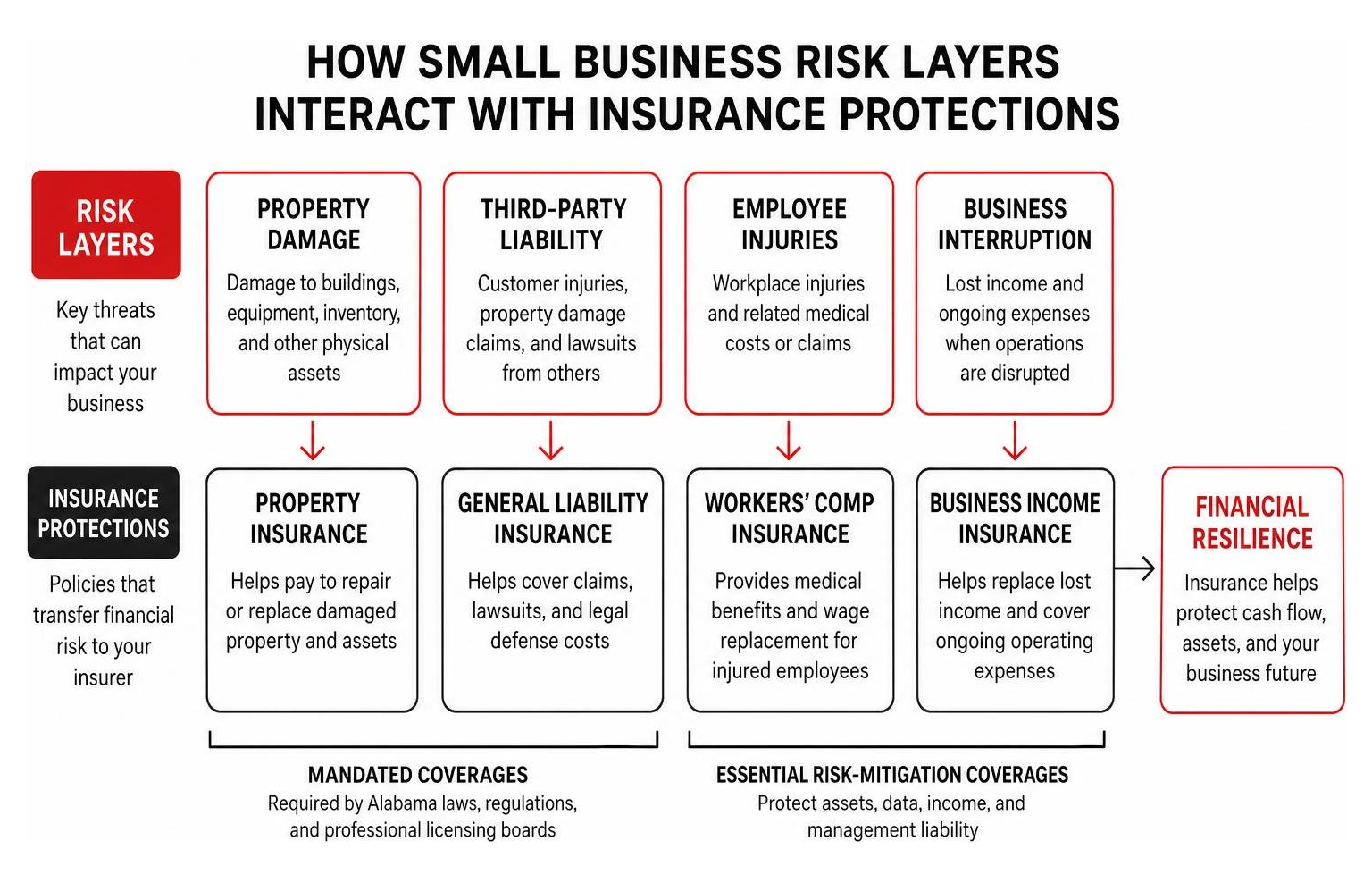
Business insurance functions as a financial safety net. It transfers the catastrophic costs of property damage, third-party liability lawsuits, cyberattacks, and workplace injuries from your balance sheet to an insurer. Selecting the right policies requires understanding two distinct categories:
- Mandated Coverages: Policies required by Alabama state statutes, municipal regulations, and professional licensing boards.
- Essential Risk-Mitigation Coverages: Non-statutory policies that protect physical assets, proprietary data, loss of business income, and management liability.
Navigating state compliance and local weather exposures ensures your enterprise stays resilient against everyday mishaps and severe regional weather events. For state insurance regulatory guidelines and licensing information, business owners can consult the Alabama Department of Insurance.
What Business Insurance Is Legally Required in Alabama?
Alabama does not require every LLC or corporation to buy one universal business-insurance policy. Requirements depend on employee count, vehicle registration and use, licensing rules, contracts, and the type of work performed. Before relying on any requirement, confirm it with the applicable regulator, licensing board, or attorney.
| Coverage or obligation | When it commonly applies | October 2026 takeaway |
|---|---|---|
| Workers’ compensation | Employers that regularly have five or more employees, including full-time, part-time, and corporate officers or LLC members | Coverage is generally required, subject to statutory exceptions. Residential-construction work has separate considerations. |
| Motor-vehicle liability | Vehicles driven on Alabama public roads | Alabama’s minimum liability limits are 25/50/25. Businesses should also assess whether commercial auto or hired and non-owned auto coverage is appropriate. |
| Contractor or professional insurance | Work subject to a board rule, permit, contract, lease, lender condition, or client agreement | Do not assume a license alone creates a universal liability-insurance mandate. Confirm the current rule with the relevant board and review the contract requirements. |
When Does Alabama Require Workers’ Compensation Coverage?
According to the Alabama Department of Labor, an employer that regularly employs five or more employees generally must secure workers’ compensation coverage. The Department counts full-time and part-time workers and includes corporate officers in its guidance. Important exceptions and special rules can apply, including for certain farm labor, domestic employees, casual employees, small municipalities, and businesses involved in constructing or assisting with new single-family detached residential dwellings.
When reviewing the threshold, consider:
- Regular staffing level: Count the people the business regularly employs, not only one department or location.
- Ownership roles: Corporate officers and LLC members may affect the count, even if an owner later elects an available exemption from benefit coverage.
- Construction work: Residential construction can involve different statutory treatment and contract-driven insurance obligations.
- Coverage method: Qualifying employers may purchase approved insurance or use an authorized self-insurance option if eligible.
Operating without required coverage can create penalties and leave a business exposed to the direct cost of a workplace injury. A licensed insurance professional and, when needed, Alabama counsel can help confirm how the rule applies to a particular workforce.
What Are Alabama’s Commercial Auto Insurance Mandates?
Alabama’s Department of Insurance lists the state’s minimum auto liability limits as 25/50/25: $25,000 for bodily injury or death to one person, $50,000 total bodily injury or death per accident, and $25,000 for property damage per accident. Those limits meet the state minimum, but they may not match the risk created by a business vehicle, employee driver, delivery route, or client-facing service call.
A business that owns, leases, or regularly uses vehicles should review whether commercial auto coverage, physical-damage coverage, and uninsured or underinsured motorist protection fit its operations. If employees use personal vehicles for errands, deliveries, or client visits, commercial auto coverage vs. personal auto policies can help explain why hired and non-owned auto liability may be worth discussing.
What Should Contractors and Home Builders Verify?
Insurance obligations for contractors are not one-size-fits-all. Contractors should verify current licensing-board requirements instead of relying on an old checklist. Residential builders must provide a written disclosure to the homeowner stating whether they maintain liability insurance before work begins; that disclosure requirement is not the same as a universal statutory requirement to carry liability insurance. Contract terms, project owners, lenders, and local permit rules may still require specific limits, additional-insured wording, or proof of coverage.
For residential projects, the Home Builders Licensure Board is a useful starting point for current license and disclosure rules. Review project contracts before bidding so insurance requirements are priced into the job.
What Core Optional Policies Should Every Alabama Business Carry?

Beyond state mandates, building a robust risk management foundation requires selecting non-mandatory policies tailored to your trade, physical assets, and customer exposures. Selecting tailored commercial insurance safeguards your venture against catastrophic lawsuits, property destruction, and data loss.
How Does a Business Owner’s Policy (BOP) Save Money?
For small to mid-sized businesses with low-to-moderate hazard profiles, purchasing individual policies piecemeal is often inefficient and expensive. A Business Owner’s Policy (BOP) combines three fundamental protections into a single, bundled policy at a discounted rate:
- Commercial General Liability (CGL): Protects your business against third-party bodily injury claims, property damage you or your employees cause, and personal/advertising injury (such as copyright infringement, slander, or false advertising).
- Commercial Property Insurance: Covers the physical structures you own or lease, along with business personal property (BPP) such as office furniture, specialized trade tools, manufacturing machinery, fixtures, and retail inventory against covered perils like fire, windstorms, hail, and vandalism.
- Business Interruption (Business Income) Insurance: Replaces lost operating income and pays ongoing fixed expenses (including payroll, rent, taxes, and loan payments) if a covered property peril forces your business to shut down temporarily for repairs.
Qualifying for a BOP typically requires operating out of a physical facility under a certain square footage threshold, employing fewer than 100 people, generating annual revenues within carrier underwriting guidelines, and operating in standard commercial, retail, or office sectors.
What Are the Key Non-Mandatory Coverages for Emerging Risks?
1. Professional Liability (Errors & Omissions)
While general liability handles physical slips, falls, and property damage, it explicitly excludes claims arising from professional advice, design errors, software development flaws, or negligent service. Professional Liability (E&O) covers legal defense fees, administrative proceedings, and court-ordered judgments if a client alleges financial loss due to your professional mistake, missed deadline, or incomplete deliverable.
- Applicable Industries: Accountants, real estate agents, IT consultants, engineers, marketing agencies, and private consultants.
2. Cyber Liability Insurance
As Alabama businesses increasingly rely on cloud-based point-of-sale (POS) systems, digital client files, and automated invoicing, data breach exposures have escalated. Standard commercial property and general liability policies do not cover digital extortion or data breach mitigation. A dedicated Cyber Liability policy covers:
- Forensic investigations to locate the security breach.
- Mandatory customer notification and credit-monitoring services.
- Ransomware payments and cyber extortion negotiations.
- Regulatory penalties, legal fees, and third-party lawsuit settlements.
3. Commercial Umbrella Insurance
Every primary liability policy (general liability, commercial auto, employer’s liability) features fixed aggregate policy limits—frequently capped at $1,000,000 per occurrence. If your business is found liable in a severe catastrophic injury claim or multi-vehicle accident, legal defense and verdict costs can exceed those primary policy caps.
Adding umbrella insurance extends supplemental liability coverage in $1,000,000 increments across your underlying commercial auto, general liability, and employer’s liability policies, protecting your company’s operational assets and future revenue.
Real-World Coverage Examples by Industry
The following three practical scenarios illustrate how these coverages may fit together for everyday businesses in Alabama communities.
1. Independent Restaurant & Grill
- Primary Risks: Kitchen fires, customer slip-and-falls on wet floors, food-borne illnesses, and liquor liability incidents.
- Essential Policy Package:
- Commercial Property & General Liability (BOP): Covers dining room furniture, expensive commercial refrigeration equipment, commercial ovens, and slip-and-fall claims.
- Workers’ Compensation: Mandatory if employing five or more cooks, dishwashers, and waitstaff to cover kitchen burns, deep cuts, or heavy lifting strains.
- Liquor Liability Endorsement: Covers alcohol-related altercations or off-premise accidents caused by an overserved customer.
- Food Contamination & Spoilage Endorsement: Replaces thousands of dollars in perishable meat and produce if an electrical outage disables your walk-in freezer.
2. Main Street Retail Store
- Primary Risks: Customer foot traffic injuries, theft of inventory, roof leaks damaging retail displays, and credit card data breaches.
- Essential Policy Package:
- Business Owner’s Policy (BOP): Protects retail store fixtures, seasonal merchandise, point-of-sale registers, and third-party customer falls.
- Cyber Liability: Protects your business if malware compromises your digital payment system or e-commerce storefront.
- Commercial Auto or Non-Owned Auto (HNOA): Covers store staff making local home deliveries or picking up wholesale inventory from regional distributors.
3. Professional Consulting Firm / Tech Practice
- Primary Risks: Professional errors, calculation mistakes, breach of contract claims, lost client digital records, and visitor slip-and-falls in the office suite.
- Essential Policy Package:
- Professional Liability (Errors & Omissions): Protects against client lawsuits claiming financial harm due to flawed analytical reports or missed filing deadlines.
- General Liability & Business Personal Property: Covers leased office space improvements, computers, presentation servers, and visiting client slip-and-falls.
- Cyber Liability & Commercial Umbrella: Provides deep liability layers against cloud data exposures and high-dollar corporate contract disputes.
How Do Alabama’s Climate, Legal Environment, and Geography Impact Your Coverage Needs?
What Natural Hazard Coverages Are Essential in Alabama?
Alabama experiences extreme weather, including severe convective storms, tornadoes, straight-line winds, hail, and tropical depressions. Because North and Central Alabama lie within active tornado pathways, commercial property policies require careful underwriting.
- Wind and hail deductibles: Commercial property policies may apply a separate wind or hail deductible. Review whether it is a flat amount or a percentage of the insured value, and confirm that the business can absorb it after a major loss.
- Replacement cost and actual cash value: Ask how the policy settles a claim for the building, equipment, inventory, and improvements. Actual-cash-value provisions can reduce a payment for depreciation.
- Flood exclusions: Standard commercial property insurance often excludes flood damage. Businesses near flood-prone areas should discuss whether an NFIP policy or private flood coverage fits the property and its contents.
How Does Alabama’s Legal System Affect Liability?
Alabama is one of the few remaining jurisdictions in the United States that enforces the strict doctrine of pure contributory negligence. Under this common-law standard, if an injured plaintiff is found to have contributed even 1% to their own injury or accident, they may be legally barred from recovering damages from the defendant in a tort lawsuit.
While this rule can provide strong legal defenses for business owners in premises liability and product liability lawsuits, it also raises the stakes in litigation. Plaintiffs’ attorneys often invest heavily in complex discovery, expert witness testimonies, and protracted court battles to dispute claims of contributory negligence. As a result, commercial legal defense costs in Alabama can escalate quickly—even for claims where your business ultimately wins in court. Carrying adequate general liability and commercial umbrella limits ensures that your insurer provides and funds your legal defense team without draining your operational cash reserves.
How Do Specialized Niches Manage Unique Risks?
Home-Based Businesses
A common misconception among home-based entrepreneurs is assuming a standard homeowners policy fully covers commercial activities. In practice, a homeowners policy may limit business property coverage and may not cover business-related liability, professional services, inventory, or customer visits. Reviewing home-based business insurance considerations can help an owner decide whether an in-home business endorsement or standalone commercial coverage is appropriate.
Salon and Suite Operators
Estheticians, barbers, massage therapists, and stylists leasing individual booths or private commercial suites face specialized liabilities. Landlords routinely mandate commercial liability before handing over keys. Selecting specialized private suite rental coverage protects individual operators against slip-and-falls, product reactions, and chemical treatment claims.
Agricultural & Agritourism Operations
Farming operations, equestrian stables, and agritourism ventures encounter blended exposures that combine agricultural machinery with public foot traffic. Utilizing specialized farm insurance solutions protects farm outbuildings, livestock, heavy equipment, and visitor liabilities across working agricultural properties.
How Can You Determine the Right Amount of Insurance for Your Alabama Business?

Determining adequate coverage limits requires balancing operational risks, physical asset replacement values, and contractual obligations.
What Factors Influence Your Commercial Premium?
Carriers evaluate several operational factors when pricing commercial coverage:
- Industry and operations: Higher-hazard work, specialized equipment, public-facing services, and professional exposures can affect eligibility and price.
- Revenue, payroll, and staffing: These figures often influence general liability and workers’ compensation pricing.
- Property characteristics: Building construction, protective systems, location, stored inventory, and prior weather losses can affect commercial property terms.
- Vehicles and drivers: Vehicle type, mileage, garaging location, driver history, and delivery activity can shape commercial auto pricing.
- Claims history and coverage limits: Prior losses, deductibles, and selected limits influence both cost and the protection available after a claim.
When launching a new company, review our guidance on coverage before welcoming your first customer to ensure all foundational policies are active before opening your doors to the public.
How Do Contractual Requirements Shape Your Coverage Limits?
Commercial contracts often dictate higher insurance limits than state minimums:
- Commercial Lease Agreements: Commercial landlords routinely require tenants to carry a minimum of $1,000,000 per occurrence / $2,000,000 aggregate in General Liability, naming the landlord as an Additional Insured.
- Client Master Service Agreements (MSAs): Corporate clients and government entities frequently require proof of $1,000,000 in Commercial Auto, active statutory Workers’ Compensation (regardless of employee headcount), and a $1,000,000 to $5,000,000 Commercial Umbrella policy.
- Certificates of Insurance (COI): Always ensure your agency can issue prompt, accurate COIs that include required Waiver of Subrogation and Primary and Non-Contributory endorsements before commencing client projects.
What Are the Most Common Questions About Alabama Small Business Insurance?
Is General Liability Insurance Mandatory in Alabama?
Alabama state law does not mandate general liability for all businesses by default. However, it is practically mandatory for most operators. State licensing bodies (including the Alabama Licensing Board for General Contractors and the Home Builders Licensure Board), commercial landlords, financial lenders, and municipal permit offices require proof of active general liability coverage before approving licenses, leases, or project contracts.
How Much Does Small Business Insurance Cost in Alabama?
Commercial insurance costs vary widely by industry, payroll, revenue, location, claims history, vehicles, property values, deductibles, and selected limits. A current quote is more useful than a generic price range because carrier appetite and underwriting requirements can change. Request comparable quotes using the same limits and deductibles, then review exclusions and endorsements before choosing a policy.
Do I Need Commercial Insurance If I Run a Business From Home in Alabama?
Possibly. A homeowners policy may limit coverage for business property and may exclude or restrict business-related liability, customer visits, inventory, equipment, or professional services. Home-based owners should ask their insurer whether an in-home business endorsement, separate commercial policy, professional liability policy, or cyber coverage is needed for the way the business operates.
How Can The Hornbuckle Agency Help Protect Your Alabama Business?
Securing the right commercial insurance package requires a partner who understands both Alabama regulatory requirements and local market conditions. As a local Alfa Insurance agency, we take a personalized, consultative approach to risk education. We review your leases, analyze your payroll classifications, evaluate your physical storm exposures, and design a customized insurance plan that protects your bottom line without burdening your cash flow.
The Hornbuckle Agency serves multiple Alabama communities, including Albertville, Guntersville, Boaz, Arab, Geraldine, Crossville, Collinsville, Horton, and Douglas. Whether you are launching a startup, adding staff, or reviewing your annual policy renewals, our team is here to help you navigate every policy detail.
Ready to secure comprehensive, cost-effective coverage tailored to your enterprise? We invite you to contact our team today for a personalized risk consultation and policy review.
