
What Alabama Homeowners Need to Know About Home Insurance
Home insurance in Alabama costs more than most people expect — and for rural families, choosing the wrong policy can mean a serious financial loss when disaster strikes.
Here’s a quick snapshot of what you need to know:
| Key Fact | Detail |
|---|---|
| Average annual premium | $3,217/year |
| vs. National average | 14% higher ($2,801 nationally) |
| Cheapest city | Auburn (~$2,455/year) |
| Most expensive city | Dauphin Island (~$13,146/year) |
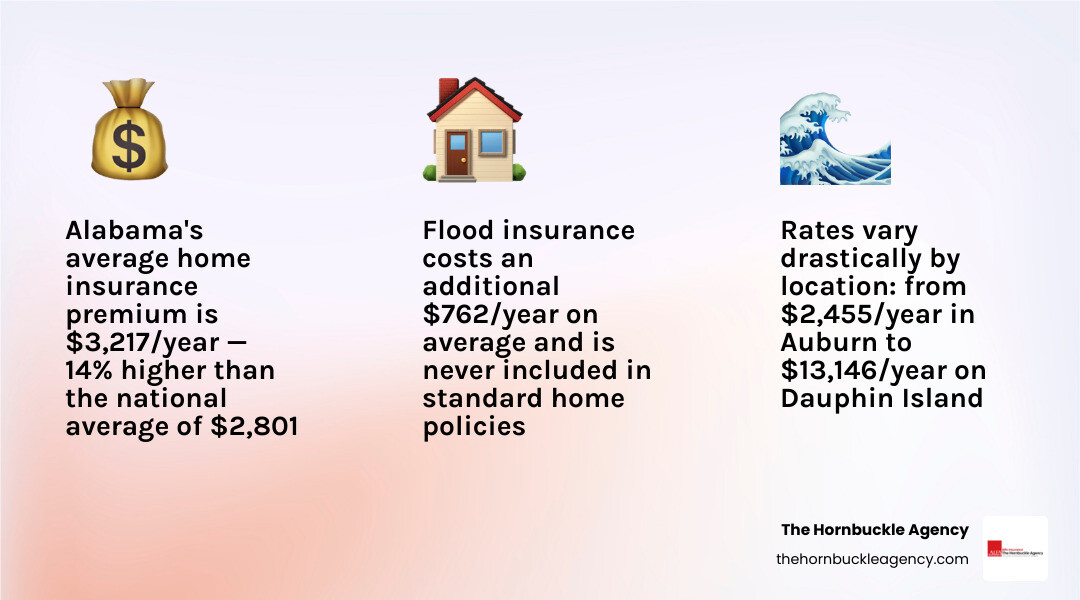
| Average flood insurance cost | $762/year (separate policy required) |
| Required by law? | No — but lenders almost always require it |
Alabama homeowners face risks that most other states don’t — tornadoes, Gulf Coast hurricanes, flooding, and severe hail storms. A standard policy that works fine in Ohio may leave an Alabama family badly exposed.
This guide walks you through everything: average costs, how to choose the right coverage, what your policy actually covers, and how to avoid the coverage gaps that catch families off guard.
I’m Dustin Hornbuckle, owner and agent at The Hornbuckle Agency in Albertville, Alabama, and with nearly 18 years of experience helping local families find the right home insurance in Alabama, I’ve seen what happens when people are underinsured after a storm. In the sections below, I’ll share what I tell my own clients so you can make a confident, informed decision.
Understanding the Cost of Home Insurance in Alabama
When shopping for home insurance in Alabama, the first thing most homeowners notice is the price tag. The average annual cost of home insurance in Alabama is $3,217, which is 14% higher than the national average rate of $2,801.
But why is our state more expensive? The answer comes down to risk. Alabama is situated in a geographically volatile area. From severe spring tornadoes cutting through Marshall County to late-summer hurricanes threatening our southern borders, insurance companies have to account for high-frequency, high-severity weather events.
However, your premium is not a fixed number. Your actual rate depends on several critical factors:
- Dwelling Coverage Limits: This is the maximum amount your policy will pay to rebuild the physical structure of your home. The higher your dwelling coverage, the higher your premium.
- Deductible Choice: Your deductible is the amount you pay out of pocket before your insurance kicks in. Choosing a higher deductible lowers your premium, while a lower deductible increases it.
- Home Age and Construction Type: Older homes, particularly those with outdated electrical, plumbing, or roofing systems, cost more to insure. Homes built with wind-resistant materials or fortified roofs often qualify for lower rates.
To help you understand how dwelling coverage limits directly impact what you pay, we have compiled the average Alabama premiums for different coverage levels. For a comprehensive look at how these elements interact, read our homeowners insurance complete guide.
Average Annual Premiums by Dwelling Coverage Limit in Alabama
| Dwelling Coverage Limit | Average Annual Alabama Premium | Average Monthly Cost |
|---|---|---|
| $350,000 | $2,881 | $240 |
| $400,000 | $3,217 | $268 |
| $450,000 | $3,549 | $296 |
As the data shows, raising your dwelling coverage from $350,000 to $400,000 can increase your rate by 12% on average. This makes it incredibly important to calculate your home’s actual rebuild cost accurately, rather than relying on its market value (which includes the value of the land).
Key Factors and Regional Differences in Alabama Premiums

Alabama’s diverse geography means that a homeowner in Albertville faces entirely different risks than a homeowner on the Gulf Coast. Consequently, insurance companies price policies based on hyper-local risk factors.
Coastal areas are highly susceptible to hurricane-force winds and storm surges, which dramatically drives up premiums. In contrast, inland areas like Marshall County are more prone to severe convective storms, hail, and tornadoes.
Because of these varying risks, insurers in Alabama frequently apply separate windstorm deductibles. Instead of a flat dollar amount (like $1,000), a windstorm deductible is often calculated as a percentage of your total dwelling coverage (usually 1% to 5%). If your home is insured for $300,000 with a 2% windstorm deductible, you would have to pay $6,000 out of pocket for wind damage before your policy pays a dime.
How Location Affects Home Insurance Alabama Rates
Where you live in Alabama is one of the most powerful determinants of your premium. To put this in perspective, let’s look at how average rates vary across different cities in our state. According to data compiled by Best Homeowners Insurance in Alabama | LendingTree , the cost differences are staggering:
- Auburn: This inland college town boasts some of the lowest average rates in the state, coming in at approximately $2,455 a year.
- Albertville: Located right in our backyard in Marshall County, homeowners in Albertville pay an average of $3,173 a year.
- Guntersville: Just down the road, Guntersville residents see average rates of $3,113 a year.
- Boaz: Neighbors in Boaz experience average rates of $3,277 a year.
- Mobile: Due to its proximity to the Gulf of Mexico, Mobile homeowners pay a hefty average of $5,101 a year.
- Dauphin Island: As a barrier island directly exposed to ocean storms, Dauphin Island represents the extreme end of the spectrum, with average premiums soaring to $13,146 a year.
As local agents serving Albertville, Guntersville, Boaz, and the rest of Marshall County, we understand the local climate risks. While we don’t have to worry about ocean storm surges, our hilly terrain and proximity to Guntersville Lake mean we must pay close attention to local wind, hail, and localized flood risks.
Standard Policy Types and Home Insurance Alabama Coverage Options
When shopping for home insurance in Alabama, you will encounter several different policy “forms.” Choosing the right form ensures you aren’t paying for coverage you don’t need—or worse, missing coverage you absolutely require.
- HO-3 (Special Form): This is the most common type of homeowners policy. It provides “open perils” coverage for your dwelling (meaning your home is protected against all risks except those explicitly excluded, like floods or earthquakes) and “named perils” coverage for your personal belongings.
- HO-4 (Renters Insurance): If you rent a home or apartment, this policy protects your personal property and provides liability coverage, but does not cover the physical building structure.
- HO-6 (Condo Insurance): Designed for condominium owners, this covers your personal property, liability, and the specific interior parts of the unit that you are responsible for maintaining under your HOA agreement.
If you own a manufactured or mobile home—which are very common throughout Marshall County—standard HO-3 policies will not cover you. You will need a specialized policy. To learn more about securing the right protection for these structures, read our manufactured home insurance page and explore our comprehensive mobile home insurance guide 2026.
Essential Coverages: Replacement Cost, the 80% Rule, and Coastal Risks
According to the ALDOI – Basic Coverages Available guide, a standard homeowners policy is actually a package of several distinct coverages:
- Property Damage: Covers the cost to repair or rebuild your home and other structures (like detached garages or sheds) after a covered loss.
- Personal Property: Covers your furniture, clothes, electronics, and other personal belongings.
- Additional Living Expenses (ALE): Pays for temporary housing, meals, and storage if your home is rendered uninhabitable by a covered event.
- Personal Liability: Protects you financially if someone is injured on your property or if you accidentally cause damage to someone else’s property.
- Medical Payments: Covers minor medical bills for guests injured on your property, regardless of who was at fault.
However, simply having these coverages isn’t enough. You must understand how your insurer calculates payouts when you file a claim.
The 80% Replacement Cost Rule Explained
One of the most misunderstood aspects of home insurance in Alabama is the 80% replacement cost rule. Most insurance companies require you to maintain dwelling coverage equal to at least 80% of your home’s total replacement cost. If you fail to meet this threshold, your insurer will penalize you on partial losses.
Let’s look at how this math works in the real world:
Imagine your home has a true replacement cost of $300,000. To meet the 80% rule, you must insure the dwelling for at least $240,000. If you decide to save money on premiums and only insure it for $180,000 (which is only 60% of the replacement value, or 75% of the required 80% limit), you have underinsured your home.
If a severe storm hits Albertville and causes $40,000 worth of damage to your roof and siding, your insurance company will apply a coinsurance penalty:
$$\text{Payout} = \text{Loss Amount} \times \left( \frac{\text{Actual Dwelling Limit}}{\text{Required 80\% Limit}} \right)$$
$$\text{Payout} = \$40,000 \times \left( \frac{\$180,000}{\$240,000} \right) = \$40,000 \times 0.75 = \$30,000$$
Instead of receiving the full $40,000 to fix your home, you will only receive $30,000 (minus your deductible), leaving you to pay the remaining $10,000 out of your own pocket.
This penalty highlights the importance of choosing Replacement Cost coverage over Actual Cash Value (ACV).
- Replacement Cost pays to rebuild or repair your home using materials of similar kind and quality without deducting for depreciation.
- Actual Cash Value deducts for depreciation based on age and wear and tear. For example, if a storm destroys a 17-year-old roof with a 20-year lifespan, an ACV policy will only pay a tiny fraction of what a new roof actually costs, whereas a Replacement Cost policy will cover the full cost of putting a new roof over your head.
Flood Insurance and Windstorm Protection
Many Alabama homeowners mistakenly believe that their standard policy covers all water damage. It does not. Standard home insurance policies specifically exclude damage caused by rising surface water or storm surges.
To protect your home from flooding, you must purchase a separate flood insurance policy. Most flood policies are written through the National Flood Insurance Program (NFIP), which provides up to $250,000 in building coverage and $100,000 in personal property coverage.
In Alabama, the average cost of flood insurance is $762 a year. Given how quickly heavy rains can cause localized flooding near Guntersville Lake or along our local creeks in Marshall County, this separate coverage is highly recommended even if you don’t live in a designated high-risk flood zone.
How to Lower Your Alabama Homeowners Insurance Premiums
While Alabama has higher-than-average rates, you do not have to accept defeat. There are several highly effective strategies to lower your premiums without sacrificing critical coverage.
- Bundle Your Policies: One of the easiest ways to save is by bundling your home and auto insurance with the same carrier. Bundling can save you up to 25% on your annual premiums.
- Adjust Your Deductible: Raising your deductible from $1,000 to $2,500 or $5,000 can significantly reduce your monthly payments. Just make sure you keep enough cash in an emergency savings account to cover that deductible if you ever need to file a claim.
- Install Security and Safety Systems: Active smoke alarms, deadbolt locks, burglar alarms, and ring cameras often qualify you for protective device discounts.
- Invest in Wind Mitigation: Upgrading your home to withstand high winds is a double win—it protects your family and lowers your insurance bill. Installing impact-resistant shingles or securing your roof deck can yield substantial discounts.
Ready to explore your options and find ways to save on your policy? Visit our dedicated home insurance page to request a personalized quote assessment.
Frequently Asked Questions about Alabama Home Insurance
Is home insurance required by law in Alabama?
No, the state of Alabama does not legally require you to carry home insurance. However, if you have a mortgage or home equity loan, your lender will almost certainly require you to maintain a continuous homeowners policy as a condition of the loan. This protects their financial interest in the property. Even if your home is paid off, going without insurance leaves you entirely exposed to devastating financial losses.
What is the Strengthen Alabama Homes program?
The Strengthen Alabama Homes program is a state-funded initiative managed by the Alabama Department of Insurance. It provides grants of up to $10,000 to eligible homeowners to help them retrofit their primary residences to the “FORTIFIED Home™” standard. This standard focuses on reinforcing the roof and structure to withstand severe windstorms, tornadoes, and hurricanes. Not only does this keep your home safer, but Alabama law also mandates that insurance companies provide premium discounts to homeowners with certified FORTIFIED homes.
How do I file a complaint with the Alabama Department of Insurance?
If you have a dispute with your insurance company regarding a claim denial, unfair settlement offer, or policy cancellation, you can seek assistance from the Alabama Department of Insurance (ALDOI). You can file an official consumer complaint online through their website or contact their Consumer Services Division directly. The ALDOI regulates insurance rates and investigates consumer complaints to ensure insurance companies operating in Alabama are acting in good faith and complying with state laws.
Conclusion
Navigating home insurance in Alabama can feel overwhelming, but you don’t have to do it alone. While statewide averages and online rate tools provide a general baseline, nothing replaces the value of a personalized risk assessment from a local professional who knows your neighborhood.
At The Hornbuckle Agency, we are proud to be your local Alfa Insurance provider. Based in Albertville, we live and work alongside the families we protect in Guntersville, Boaz, and across Marshall County. We don’t believe in one-size-fits-all policies. Instead, we focus on personalized risk education, helping you understand exactly what you are paying for so your family is never left vulnerable.
To learn more about who we are and our commitment to our local communities, visit our about page. When you are ready to secure a policy that fits your budget and truly protects your home, contact us through our home insurance portal. Let us help you protect what matters most.
