

Why Personal Umbrella Insurance Coverage Matters
Personal umbrella insurance coverage adds liability protection above the limits of your auto, home, or other eligible policies. If you are responsible for a serious accident or injury, it may help pay covered damages and legal costs that your primary insurance cannot fully cover. Policies often start at $1 million, but coverage, exclusions, and required underlying limits vary.
A crash that injures several people could lead to a claim larger than a family’s auto liability limit. This guide explains when an umbrella policy may help, what it leaves out, and how to decide how much protection you need.
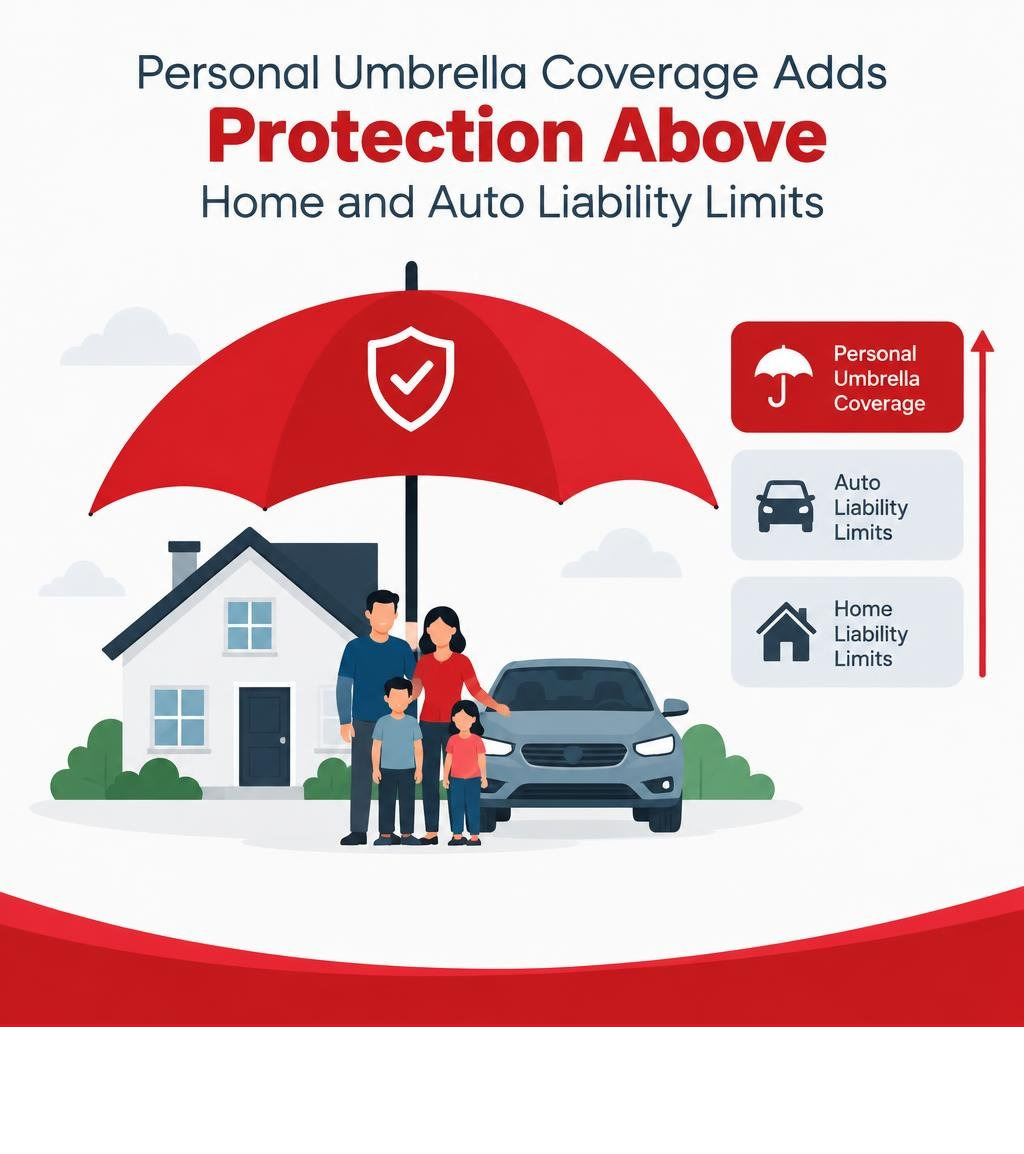
What Is Personal Umbrella Insurance Coverage and How Does It Work?
Personal umbrella insurance acts as an extra layer of liability protection that sits squarely above your standard underlying policies. When life takes an unexpected turn and you are found legally liable for injuries or property damage, your basic policies pay first. However, in catastrophic situations, those baseline limits can be exhausted in a heartbeat. That is where an umbrella policy steps in, providing excess liability limits that shield your savings, home equity, investments, and even future earnings from courtroom judgments.
Think of it as a financial safety net designed for worst-case scenarios. Rather than replacing your primary policies, an umbrella policy coordinates with them. It establishes a “retained limit,” which is simply the amount of liability you must maintain on your base policies before umbrella coverage activates.
In addition to funding settlements or judgments, an umbrella policy pays for your legal defense costs. As outlined in Mass.gov guidance on personal umbrella insurance, standard policies carry strict caps on liability, leaving policyholders exposed if a major judgment exceeds those thresholds. Legal representation during a prolonged trial can cost tens of thousands of dollars on its own; umbrella coverage handles these mounting defense expenses without rapidly draining your bank account.
How Underlying Policy Limits Trigger Personal Umbrella Insurance Coverage
To understand when an umbrella policy pays out, consider how claims flow through your insurance portfolio. When an accident occurs, your primary insurance—such as your auto insurance liability limits or your baseline home insurance policy—is billed first up to its maximum liability threshold.
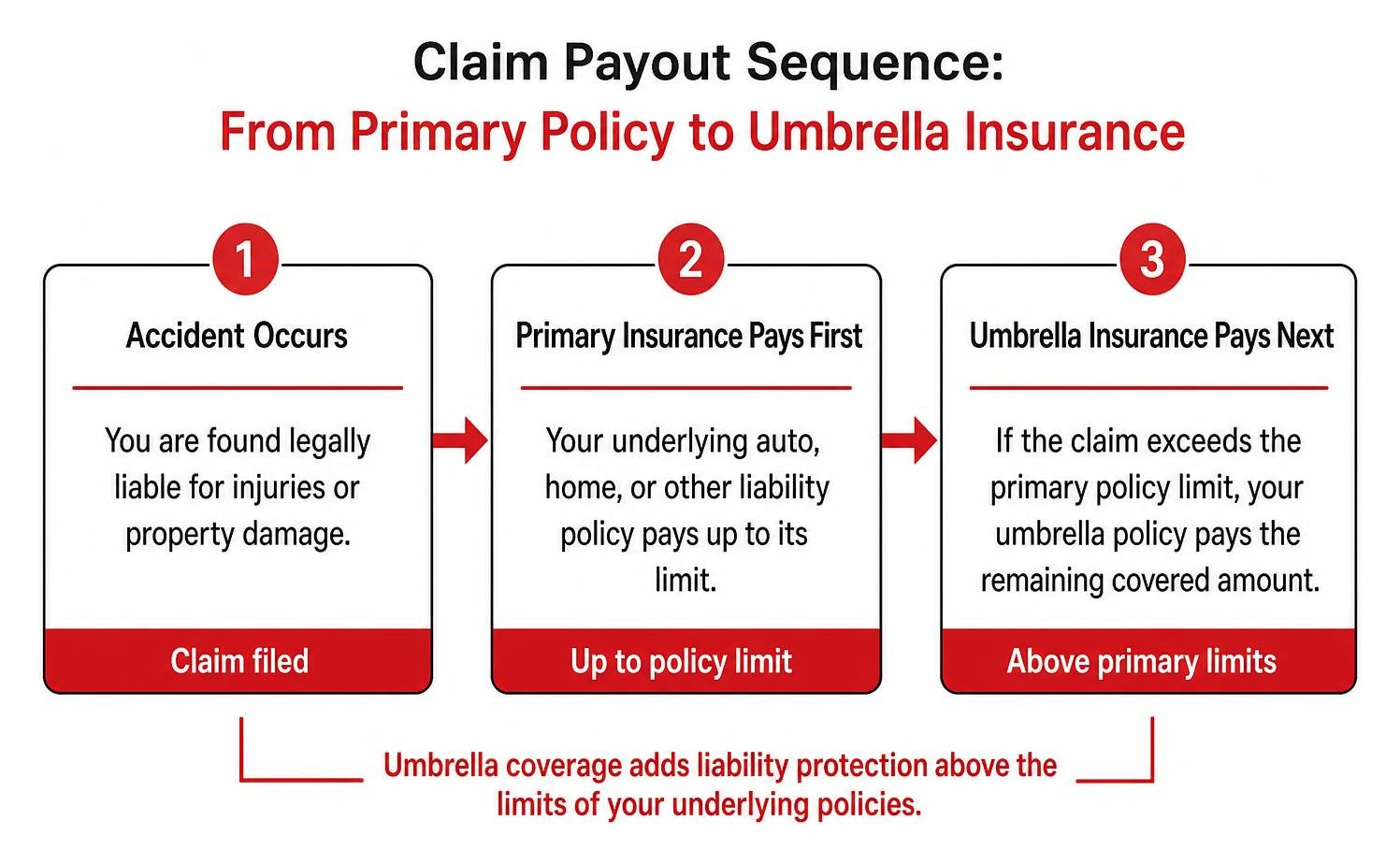
For instance, suppose you are involved in a major multi-vehicle collision on Highway 431. The injured parties accrue $1.2 million in medical expenses, rehabilitation costs, and lost wages. If your underlying auto policy has a bodily injury limit of $500,000, your auto carrier pays out that $500,000 limit and bows out. Without an umbrella policy, you would be personally responsible for the remaining $700,000. But with a $1 million or $2 million umbrella policy in place, your umbrella coverage picks up right where your auto policy stopped, paying the remaining $700,000 and protecting you from asset liquidation or wage garnishment.
Umbrella Coverage vs. Primary Liability Policies
While primary liability policies focus on specific risks tied to a vehicle or residence, personal umbrella coverage provides broader, overarching security.
| Feature | Primary Liability Policy (Home/Auto) | Personal Umbrella Insurance |
|---|---|---|
| Primary Purpose | First-dollar coverage for specific property or vehicle risks | Excess liability protection over multiple underlying policies |
| Typical Liability Limits | $100,000 to $500,000 | $1,000,000 to $5,000,000+ (up to $100M for specialized risks) |
| Legal Defense Costs | Covered up to or within primary policy terms | Covered in addition to policy limits, even for groundless lawsuits |
| Coverage Scope | Narrow (specifically bodily injury and property damage defined in contract) | Broader (includes personal injury claims like libel, slander, and false arrest) |
| Geographic Range | Often limited to the domestic territory or specific vehicle usage | Worldwide liability coverage for travel and vacations |
What Does an Umbrella Policy Cover and Exclude?

An umbrella policy is celebrated for its versatility, but it is not a blanket policy for every kind of financial loss. It focuses strictly on third-party liability—meaning claims brought against you by other people for injuries, property damage, or reputational harm.
According to policy analyses such as the Personal Umbrella Liability Policy DL 98 01 05 26 Contract Analysis Part 2 – Coverages & Exclusions, umbrella contracts expand upon standard homeowners forms by offering both excess monetary limits and broader definitions of covered personal injury.
Claims Covered Under Personal Umbrella Insurance Coverage
An umbrella policy steps in to handle a wide range of everyday scenarios that could otherwise trigger severe financial exposure:
- Bodily Injury Liability: Severe slip-and-fall injuries on your property, guest injuries from backyard trampolines or swimming pools, and major car accidents caused by you or family members living in your household.
- Property Damage Liability: Major damage caused to someone else’s vehicle, buildings, or landscape, such as your vehicle crashing through a storefront or a fire spreading from your grill to a neighbor’s outbuilding.
- Personal Injury Offenses: Lawsuits alleging non-physical harm, such as libel, slander, defamation of character, false arrest, invasion of privacy, or wrongful entry. These protections are rarely included in standard home policies without special endorsements.
- Recreational and Watercraft Incidents: Accidents involving recreational vehicles, jet skis, or boats when coordinated with qualifying watercraft insurance claims.
- Legal Defense Expenses: Attorney fees, court filing fees, and investigation costs, which are covered even if the lawsuit against you turns out to be entirely groundless or fraudulent.
Key Policy Exclusions and Gaps
Just as important as knowing what is covered is understanding what falls outside the scope of personal umbrella insurance:
- Intentional or Criminal Acts: Any bodily harm or property destruction you intentionally inflict is strictly excluded.
- Your Own Injuries or Belongings: Umbrella insurance never pays for damage to your own home or medical care for your own injuries; those belong under standard health, collision, or property coverage.
- Business and Professional Pursuits: Lawsuits arising from commercial ventures, freelancing, or professional services require dedicated commercial insurance or professional liability forms rather than a personal umbrella.
- Agricultural Operations: Incidents arising from commercial livestock production, custom farming, or agritourism must be handled under tailored farm insurance operations.
- Gig-Economy Driving: Delivering food or driving for rideshare platforms (like DoorDash, Uber, or Lyft) without commercial endorsements creates an exclusion on personal auto and personal umbrella forms.
- Contractual Liabilities: Obligations or indemnities you assume voluntarily through private contracts.
Who Needs Personal Liability Protection and How Much Coverage Is Required?

A common myth is that umbrella insurance is only for millionaires. In reality, anyone with tangible assets, regular income, or an active family lifestyle has exposure. If an adverse judgment exceeds your auto or homeowners policy, a court can order the liquidation of your non-exempt savings, place liens on your real estate, or garnish your future wages for years to come. Evaluating when umbrella insurance is worth it starts with looking at your daily liability profile.
Identifying Your Lawsuit Exposure and High-Risk Assets
Ask yourself if any of the following risk factors apply to your household:
- Young or Inexperienced Drivers: Households with teenage or young adult drivers face significantly higher odds of severe multi-vehicle collisions.
- Attractive Nuisances: Swimming pools, hot tubs, trampolines, and treehouses bring neighborhood fun, but they also bring substantial premises liability.
- Entertaining Guests Frequently: Hosting dinner parties, game nights, or cookouts increases the frequency of visitor slips, falls, or accidental injuries.
- Dog Ownership: Even friendly pets can get startled. Dog bites and knock-down injuries represent some of the most frequent liability claims nationwide.
- Rental Properties or Landlord Status: Owning tenant-occupied properties exposes you to tenant claims regarding maintenance, stairs, and property hazards.
- Social Inflation Trends: The modern legal landscape features rising jury awards and settlement figures across personal injury cases, meaning accidents that cost $200,000 a decade ago can easily reach seven figures today.
Calculating Required Limits and Minimum Underlying Requirements
To establish the right coverage limit, begin by adding up your total household net worth:
- Home equity and secondary real estate value
- Bank accounts, certificates of deposit, and non-retirement investment funds
- Estimated future earning capacity over the next 5 to 10 years
Most personal umbrella policies are sold in straightforward tiers starting at $1 million, scaling upward to $2 million, $5 million, or more. A baseline rule of thumb is to secure an umbrella limit that at least equals your total exposed assets plus your future earnings vulnerability.
To qualify for an umbrella policy, insurance carriers require you to maintain specific minimum limits on your primary policies:
- Auto Liability: Typically $250,000 per person and $500,000 per accident for bodily injury, plus $100,000 for property damage (or a $500,000 combined single limit).
- Homeowners Liability: Typically at least $100,000 to $300,000 in personal liability coverage.
- Watercraft Liability: Generally $300,000 in underlying liability if you own a boat.
Integrating these layers alongside your broader financial plan—including proper life insurance considerations—ensures your family’s overall financial security remains ironclad.
Costs, Discounts, and Securing Your Policy
One of the best aspects of personal umbrella insurance is its remarkable affordability. Because the umbrella policy only pays out after substantial underlying limits are exhausted, the likelihood of a payout is lower, allowing carriers to price this massive level of coverage very economically.
Policy Costs and Bundling Savings
A standard $1 million personal umbrella policy typically costs between $150 and $400 per year—or about $20 per month. Increasing coverage to $2 million or $3 million often adds only a modest percentage to the base premium, as the risk of penetrating higher limits drops even further.
Factors that influence your final premium include:
- The number of vehicles, homes, and watercraft on your policy
- The driving records and claims history of all household members
- The total amount of umbrella coverage selected ($1 million vs. $5 million)
Furthermore, bundling your umbrella coverage with your existing home and auto policies often unlocks multi-policy discounts ranging from 10% to 25% across your entire insurance package. In many instances, the savings generated on your auto and home policies largely offset the cost of adding the umbrella policy!
Steps to Qualify and Purchase Coverage
Securing personal umbrella protection is a streamlined process:
- Audit Your Underlying Policies: Check your current auto, home, and recreational vehicle declarations pages to confirm your existing liability limits meet carrier minimums.
- Review Household Risk Factors: Take inventory of newly licensed drivers, rental units, pool additions, or watercraft acquisitions.
- Adjust Base Limits if Needed: If your auto coverage is currently sitting at state minimums, bring those limits up to the required underlying threshold ($250k/$500k).
- Select Your Umbrella Limit: Choose your desired limit ($1M, $2M, etc.) based on your calculated asset exposure.
- Conduct Annual Reviews: As your net worth, investments, and home values increase over time, review your umbrella policy annually to ensure your coverage keeps pace.
Frequently Asked Questions About Personal Umbrella Coverage
Is personal umbrella insurance worth the cost for average homeowners?
Yes. A single catastrophic auto crash or severe premises accident can easily result in a judgment exceeding standard $100,000 or $300,000 home and auto limits. For roughly $20 a month, a $1 million umbrella policy protects your home equity, retirement savings, and future wages from being drained by legal judgments or settlement demands.
Does umbrella insurance cover legal defense fees if a lawsuit is groundless?
Yes. Your umbrella policy provides defense coverage for covered claim types, paying for legal representation, courtroom costs, and independent investigations. The carrier defends you even if the claims brought against you are groundless, exaggerated, or false, and these defense costs typically do not erode your total policy limit.
How do umbrella policies interact with international travel incidents?
Most personal umbrella policies offer true worldwide liability protection. If you are traveling abroad and accidentally injure someone or cause property damage while walking, operating certain rental equipment, or staying at a resort, your umbrella coverage travels with you, filling gaps left by domestic-only primary policies.
Conclusion: Safeguarding Your Financial Future
Building a stable financial foundation takes decades of hard work, disciplined saving, and careful planning. Leaving that foundation exposed to an unexpected legal judgment or a severe liability claim can jeopardize everything you have built in a matter of days. Proactive risk management is about preparing for the unexpected before it happens.
At The Hornbuckle Agency, we are dedicated to helping our neighbors protect their hard-earned assets through personalized education and straightforward coverage solutions. We proudly provide trusted guidance across multiple Alabama communities, including Albertville, Guntersville, Boaz, Arab, Geraldine, Crossville, Collinsville, Horton, and Douglas.
Take control of your family’s financial security today. Review your underlying limits and explore how comprehensive umbrella insurance coverage can provide complete peace of mind for you and your loved ones.
