
Why Business at Home Insurance Matters
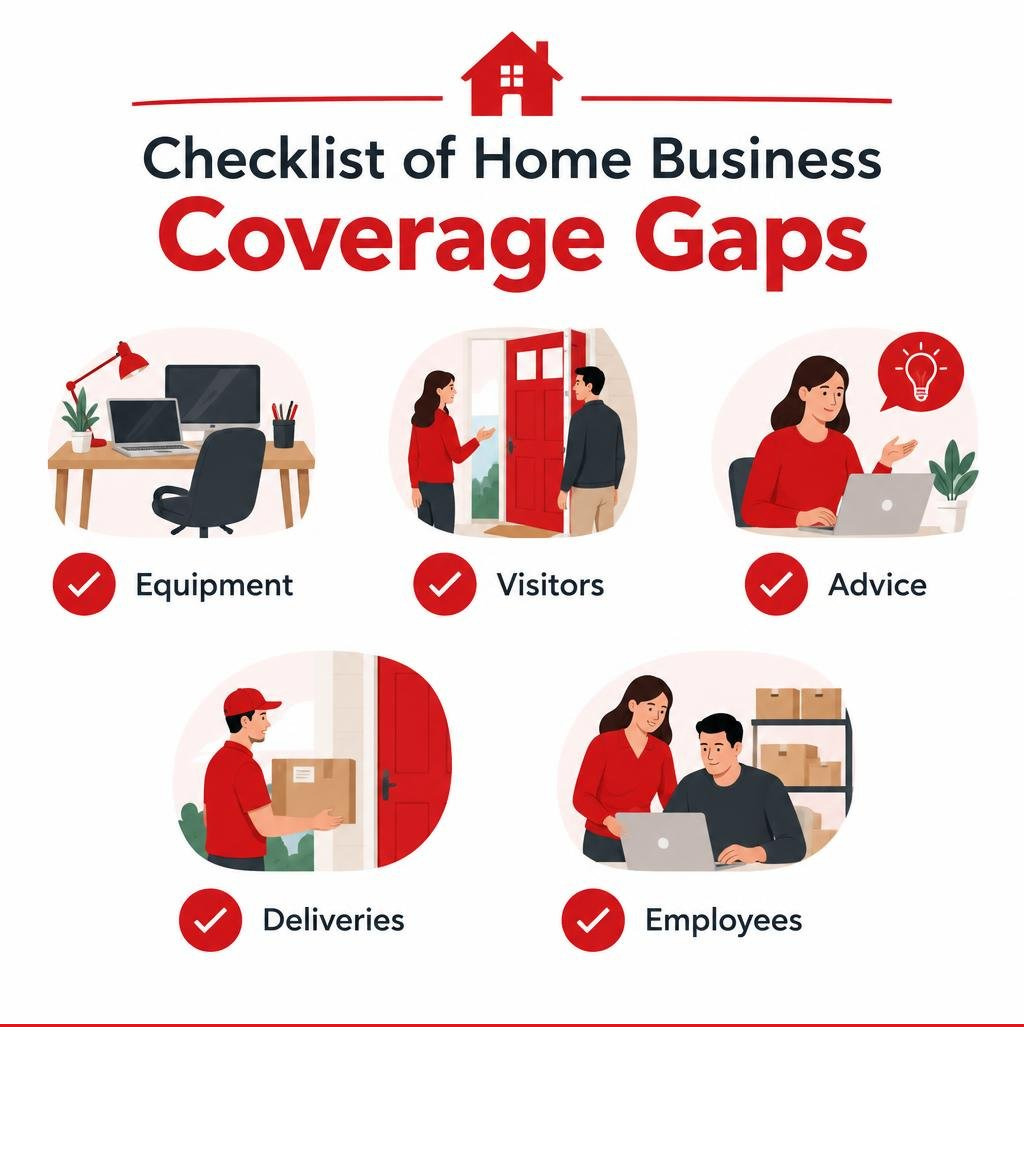
Business at home insurance protects against risks your homeowners or renters policy may not cover. A home policy may offer only limited coverage for business equipment and generally does not cover claims tied to your work. Start by adding up the value of your equipment and inventory, then consider whether customers visit, you give advice, or you make deliveries. A small operation may qualify for a home business endorsement. A growing business may need a Business Owner’s Policy (BOP) and other coverage based on its risks.
Discover more about business at home insurance:
- homeowners insurance
- homeowners insurance fire
- home rental insurance
Does Standard Homeowners or Renters Insurance Cover a Home Business?
A common assumption among home entrepreneurs is that because their business operates under their roof, their residential policy automatically protects their commercial assets. In reality, standard homeowners and renters policies are built strictly for personal residential risks, not commercial operations.
When you review a standard policy, you will find strict sublimits on business personal property. According to the Insurance Information Institute, most personal home policies cap business property coverage at approximately $2,500 on premises, and as low as $500 to $1,500 for items damaged or stolen while away from home. If a burst pipe destroys your specialized production equipment, high-end computer setup, or stored inventory, a standard policy leaves you paying the vast majority of the replacement costs out of pocket. For a foundational breakdown of these policy limits, review our beginners guide to homeowners insurance for a home-based business.
Even more critical is the total exclusion of commercial liability. If a customer, vendor, or delivery person trips on your porch steps while dropping off raw materials or picking up an order, your personal liability coverage will almost certainly deny the injury claim once commercial activity is discovered.
| Coverage Category | Standard Homeowners / Renters Policy | Dedicated Home Business Insurance |
|---|---|---|
| Business Equipment & Tools | Capped at low sublimits (typically $2,500) | Full replacement value based on scheduled limits |
| Product Inventory | Severely limited or excluded | Covered against fire, theft, water, and direct perils |
| Customer Slip-and-Fall Liability | Excluded for commercial activities | Covered under commercial general liability |
| Business Interruption / Lost Income | Not covered | Replaces lost net income during repairs from covered perils |
| Professional Errors / Bad Advice | Excluded | Covered via Professional Liability (E&O) |
| Client Data Breaches | Excluded | Covered via Cyber Liability endorsements |
Core Policy Options for Business at Home Insurance
Every home enterprise carries a distinct risk profile. A freelance graphic designer working from a spare bedroom faces different hazards than a home baker shipping goods across Marshall County or a craft woodworker operating heavy machinery in a converted garage. State insurance regulators frequently provide guidance on state insurance requirements for home businesses to help owners navigate these tiers.
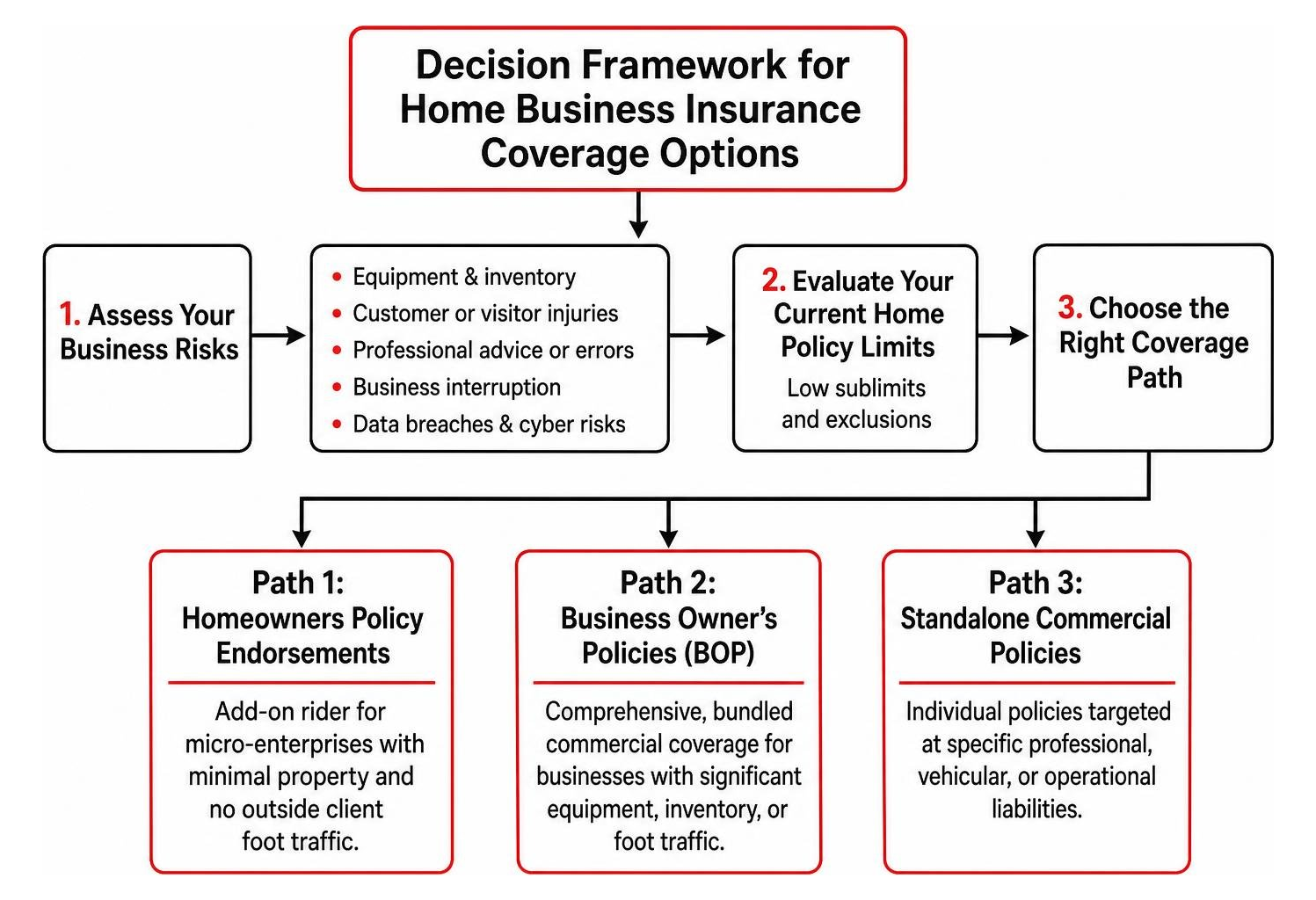
Selecting the right coverage involves evaluating three main paths:
- Homeowners Policy Endorsements: An add-on rider designed for micro-enterprises with minimal property and no outside client foot traffic.
- Business Owner’s Policies (BOP): Comprehensive, bundled commercial coverage designed for businesses with significant equipment, inventory, or foot traffic.
- Standalone Commercial Policies: Individual policies targeted at specific professional, vehicular, or operational liabilities.
Endorsement Riders vs. Business Owner’s Policies (BOP)
A home-based business endorsement is an add-on attached directly to your existing homeowners policy. It expands your business property limits (often up to $10,000 or $25,000) and adds basic liability protection for a limited number of business visitors. However, eligibility is strict: insurers typically require your business to have three or fewer employees and generate under $250,000 in gross annual receipts. Endorsements also generally exclude product manufacturing, food preparation, and high-liability services.
When your venture expands beyond these boundaries, a Business Owner’s Policy (BOP) becomes the gold standard. A BOP packages three vital protections into a single, cost-effective plan:
- Commercial General Liability: Protects against third-party bodily injury, property damage, and advertising injury claims.
- Commercial Property Coverage: Protects physical assets, including buildings, specialized tools, office furniture, and inventory.
- Business Interruption Insurance: Replaces lost business income and covers ongoing operating expenses if a fire, storm, or other covered physical loss forces you to temporarily pause operations.
If you are expanding your operations, explore our guide to insurance a new business owner needs before their first customer to ensure your assets are protected from day one.
Specialized Add-Ons for Comprehensive Business at Home Insurance

Modern enterprises often face risks that extend beyond physical property and basic slip-and-fall claims. You may need specialized endorsements to secure complete protection:
- Cyber Liability & Data Breach Coverage: If you store client records, handle credit card transactions, or manage sensitive files on home servers, this coverage pays for customer notification costs, credit monitoring, forensic investigations, and legal defense fees following a cyber attack.
- Product Liability Insurance: Essential for anyone creating and selling physical items, ranging from baked goods to custom furniture, protecting your business if a product causes bodily harm or property damage.
- Equipment Breakdown Coverage: Protects sensitive commercial hardware, computer networks, and manufacturing machinery against electrical surges, motor burnout, and mechanical failure—perils standard property policies typically exclude.
You can learn more about crafting tailored policies through our dedicated commercial insurance solutions.
Specialized Risk Management: Liability, Vehicles, and Employees
Risk management requires looking at how your operations interact with the outside world. Whether you manage visiting clients, rent external facilities, drive for work, or hire help, specialized coverages fill critical operational gaps. For example, if you rent external spaces for client consultations, our guide to small business insurance for suite rentals outlines off-premises liability protocols.
Securing Business at Home Insurance for Professional and Advisory Services
General liability policies cover physical injuries and property damage, but they will not protect you against financial damages resulting from professional mistakes, poor advice, or missed project deadlines.
If you work as a bookkeeper, tax preparer, marketing consultant, interior designer, or IT specialist, you need Professional Liability Insurance (also known as Errors and Omissions, or E&O).
E&O insurance shields your business by funding legal defense costs, settlements, and court judgments if a client alleges that:
- You provided negligent professional advice that caused them financial loss.
- Your design, code, or work contained an error or omission.
- You failed to deliver promised contractual milestones.
Commercial Auto and Workers’ Compensation Requirements
Using personal vehicles for business errands is standard for home entrepreneurs, but it carries a major coverage trap. Personal auto policies routinely deny claims for collisions that happen during commercial tasks, such as delivering products or driving to meet clients. To understand how personal and commercial vehicle protections differ, consult our guide on whether personal auto insurance covers driving for business tasks.
You have two primary vehicle options:
- Commercial Auto Insurance: Necessary for vehicles registered to a business entity or used primarily for deliveries, hauling inventory, or carrying specialized tools.
- Hired and Non-Owned Auto Insurance (HNOA): Covers liability if you or an employee drive personal vehicles for occasional business errands or rent vehicles for business travel.
When your team grows, employee protection is equally critical. Homeowners policies strictly exclude injuries sustained by employees working inside your residence. If you hire part-time or full-time staff, review the statutory business insurance rules in Alabama to ensure compliance with state-mandated workers’ compensation and employer liability regulations.
How to Estimate Costs and Secure Your Policy
Securing proper coverage for your home enterprise is surprisingly affordable. For basic general liability, a one-person business pays a median annual premium of approximately $333 per year. Adding property endorsements or transitioning to a comprehensive Business Owner’s Policy typically ranges from $500 to $1,200 annually, depending on your risk classification.
Key variables influencing your annual premium include:
- Industry & Operations: Low-risk office consulting costs less than product manufacturing or in-person service trades.
- Inventory & Property Value: The total replacement cost of tools, electronics, and stored materials.
- Gross Revenue & Foot Traffic: Higher client volumes and sales increase general liability exposure.
- Deductibles & Policy Limits: Adjusting deductibles allows you to balance monthly cash flow against out-of-pocket claims risk.
Once you purchase your policy, you will receive a Certificate of Insurance (COI), which serves as formal verification for clients, commercial landlords, and vendor contracts. When you are ready to explore specific pricing, review our practical guide to getting an insurance quote to streamline the process.
Frequently Asked Questions About Home-Based Business Coverage
Can I run a business from home without notifying my insurance company?
We strongly advise against concealing commercial operations from your residential insurer. Operating an undisclosed commercial enterprise can violate policy terms. If a fire starts due to business equipment, or a visiting client suffers an injury, your insurer can deny the claim entirely and cancel your personal homeowners coverage due to material misrepresentation of property risk.
Does personal auto insurance cover making business deliveries or picking up supplies?
No. Standard personal auto insurance policies include explicit commercial exclusions. If you cause an accident while delivering finished products, transporting commercial raw materials, or driving clients, your personal insurer will likely deny both collision and liability claims. You need a commercial auto policy or an HNOA endorsement to stay protected.
What is the annual revenue limit for a home business endorsement?
Most insurance carriers set eligibility caps for home business endorsements at three or fewer employees and $250,000 or less in gross annual receipts. If your enterprise surpasses either threshold, or if you manufacture consumable goods, you must transition to a standalone Business Owner’s Policy (BOP) or dedicated commercial liability policy.
Conclusion
Protecting your livelihood starts with identifying where residential coverage ends and commercial risk begins. By auditing your equipment values, evaluating client foot traffic, and securing the right endorsements or Business Owner’s Policy, you can protect both your household equity and your business assets.
At The Hornbuckle Agency, we believe in personalized risk education. We proudly serve multiple Alabama communities, including Albertville, Guntersville, Boaz, Arab, Geraldine, Crossville, Collinsville, Horton, and Douglas. Contact our team today to review your current policies and discover how tailored home insurance and commercial protection work together to safeguard your future.
