
New Vehicle Insurance: What to Know Before You Drive Home
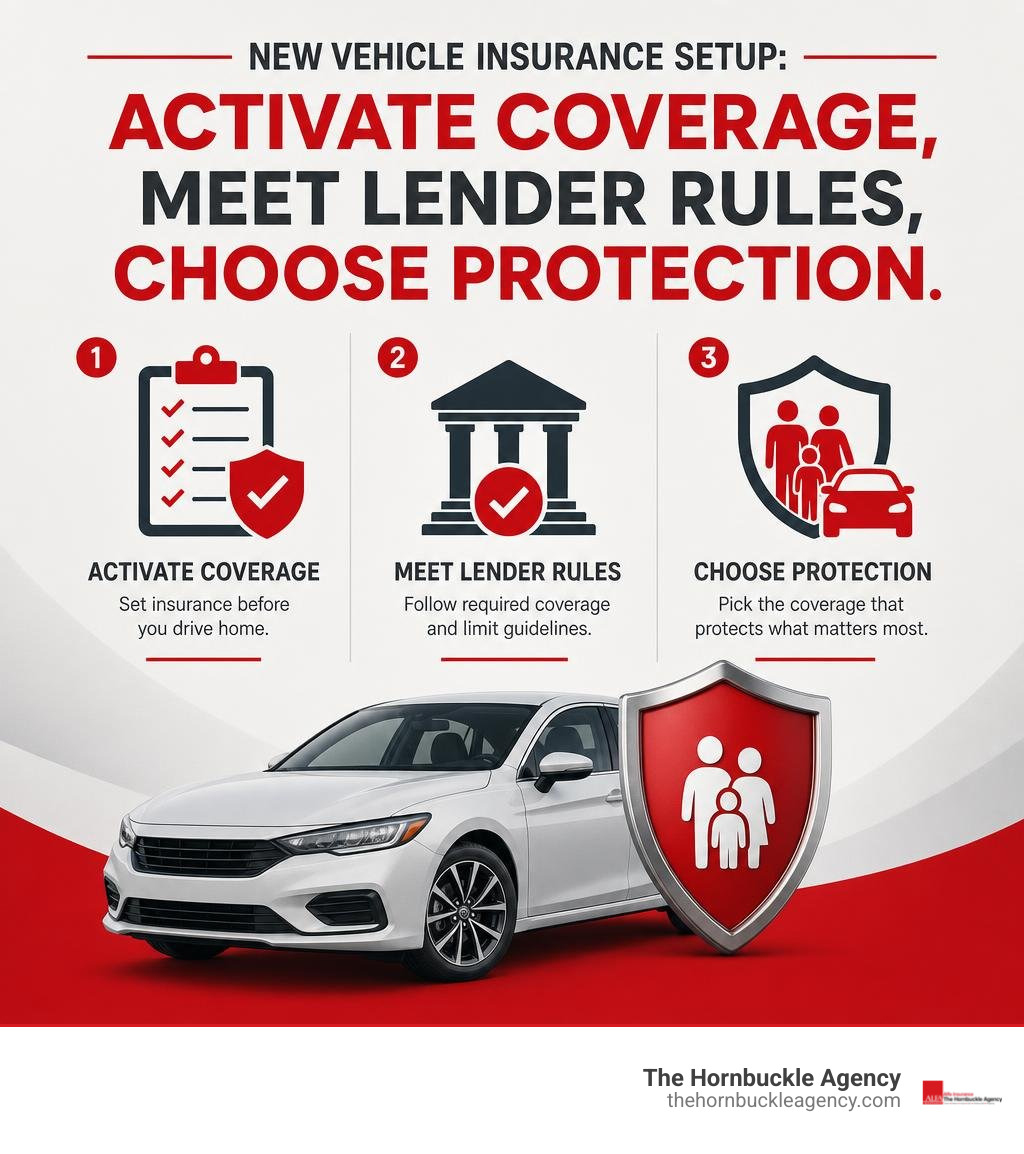
New vehicle insurance should be active before you drive a new car off the lot. If you already have an auto policy, it may extend temporary coverage to a replacement vehicle, but the rule and time limit depend on your insurer and policy. Do not assume a grace period applies when this is your first policy or when you are adding another vehicle.
For a quick answer:
- Financed and leased cars usually need liability, collision, and comprehensive coverage. The lender or leasing company may also require specific liability limits and a deductible of $1,000 or less.
- Owned cars with no loan or lease must meet Alabama’s liability insurance law, but collision and comprehensive are optional.
- New-car replacement and mechanical breakdown coverage can help protect against early depreciation, a total loss, or certain repair costs.
- New-car full coverage averages about $254 per month, or $3,048 per year, though your vehicle, driving history, location, coverage choices, and deductible can change that price sharply.
A new vehicle is often one of a family’s largest purchases. With average new-car prices nearing $50,000, a short insurance gap or the wrong coverage choice can create a serious financial setback after a crash, theft, or total loss.
Key Requirements and Rules for New Vehicle Insurance
Buying a new car is an exciting milestone, whether you are driving off a dealership lot in Marshall County or picking up a commercial vehicle for work. However, navigating auto coverage requirements can feel confusing if you do not know what your lender or state law demands.
When you purchase a vehicle, insurance rules vary based on whether you pay cash, take out an auto loan, or sign a lease. Understanding these mandates ensures you remain legal on the road while protecting your family budget from sudden out-of-pocket expenses.
| Vehicle Ownership Type | Required Coverage Types | Typical Deductible Caps | Special Policy Requirements |
|---|---|---|---|
| Financed Vehicle | State Liability + Comprehensive + Collision | $500 to $1,000 max | Lienholder listed on policy; proof before delivery |
| Leased Vehicle | State Liability + Comprehensive + Collision | $500 to $1,000 max | Higher liability limits (e.g., 100/300/100); proof before delivery |
| Owned Outright | State Minimum Liability | No limit (Optional) | Physical damage coverage optional, but recommended for new models |
Coverage Mandates for Financed and Leased Cars
If you finance your new ride, the bank or finance institution owns a financial stake in the car until your last payment clears. Because of this, lenders mandate full coverage—meaning both comprehensive and collision insurance—to protect their investment against physical damage.
- Collision Coverage: Covers repairs if your vehicle strikes another automobile, wall, guardrail, or experiences a rollover.
- Comprehensive Coverage: Handles non-collision losses such as hail damage, fallen trees, vandalism, animal strikes, or vehicle theft.
Lenders and leasing organizations almost always place restrictions on your policy. Most financial institutions cap allowable deductibles at $1,000 (and frequently prefer $500). Furthermore, leasing companies usually require significantly higher liability thresholds than state minimums—often demanding $100,000 per person in bodily injury coverage, $300,000 per accident, and $100,000 in property damage protection (100/300/100).
Before finalizing your contract, we always suggest reading through our breakdown on cruising sand mountain your guide to car insurance in albertville al to make sure your liability choices align with regional risks and contract requirements.
The Truth About Grace Periods
One of the most dangerous myths in car buying is the belief that every driver automatically gets a generous 30-day grace period to add a new car to their insurance. Relying on this assumption without verifying your policy terms can lead to denied claims, legal penalties, or severe out-of-pocket costs.
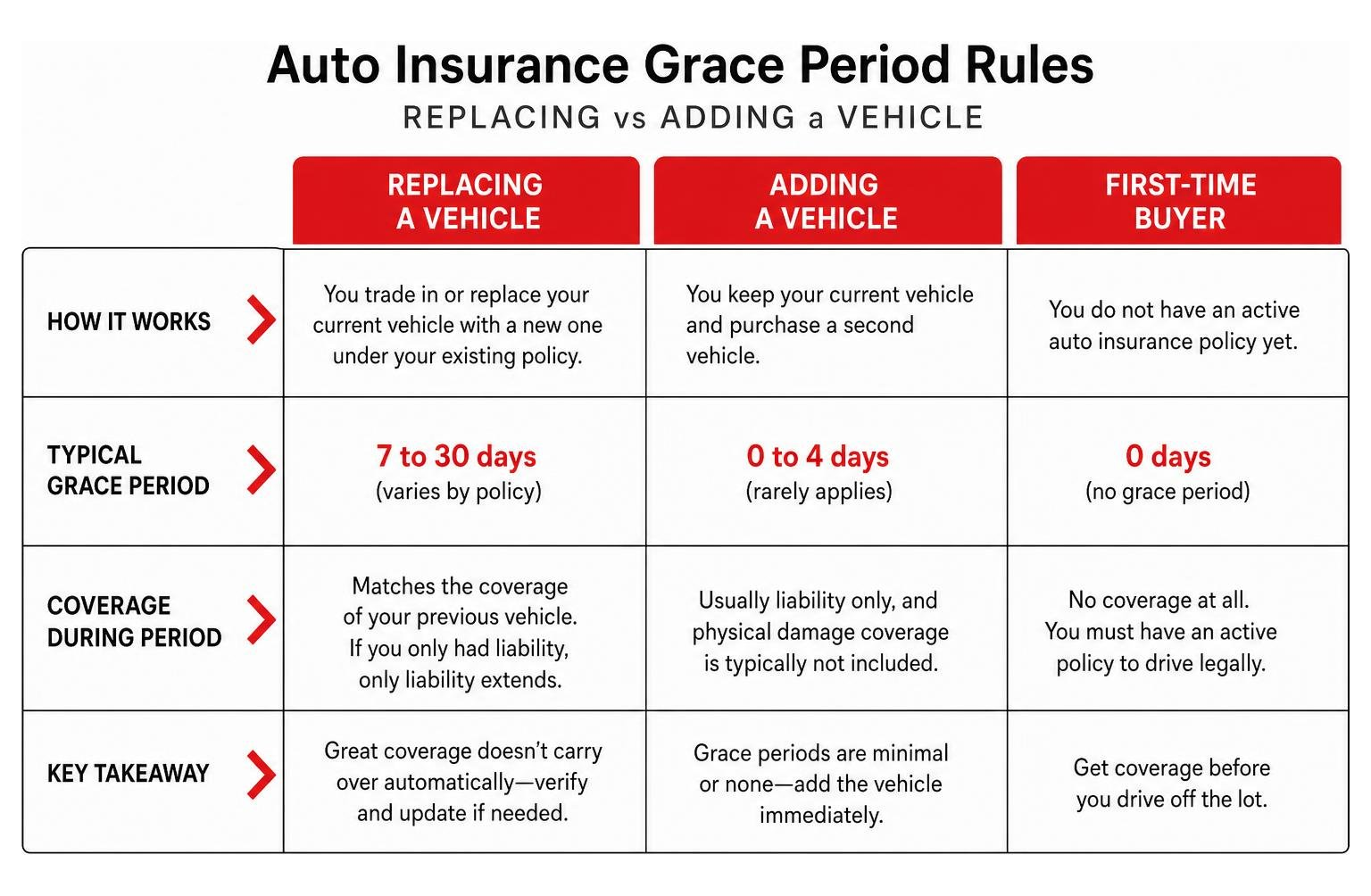
Here is how policy extensions actually work:
- Replacement Vehicles: If you trade in your old sedan for a new one, many standard insurance policies provide an automatic extension (typically 7 to 30 days) that matches the coverage of your former car. However, if your old car only carried standard liability protection, your brand-new $50,000 vehicle will not have collision or comprehensive protection during that window unless you explicitly add it!
- Additional Vehicles: If you keep your existing car and purchase a second vehicle, automatic grace periods rarely apply, or they may strictly limit physical damage coverage to 4 days or less.
- First-Time Buyers: If you do not currently hold an active auto policy, there is zero grace period. You cannot legally drive off the dealership lot without binder proof or an active policy declarations page.
Failing to report a newly acquired vehicle before the insurer’s strict deadline can leave you completely uninsured. To review local registration guidelines and vehicle safety standards across Marshall County, car buyers can reference Marshall County Online.
How to Set Up and Activate Policy Coverage

Activating new vehicle insurance does not have to be stressful or time-consuming. Dealerships will not release the keys until you present acceptable proof of active insurance that names the lender (if applicable) as a lienholder.
How to Activate New Vehicle Insurance Before Driving Off the Lot
The smoothest approach is arranging coverage before you set foot on the sales lot, or taking a brief break during the paperwork phase to call your agent. Here is the step-by-step procedure:
- Obtain the VIN: Ask your sales representative for the exact 17-character Vehicle Identification Number (VIN), along with the trim level and safety package details.
- Contact Your Insurance Agent: Phone your local provider or manage your account online. You can learn more about adding a vehicle before pickup to ensure seamless delivery.
- Select Limits and Deductibles: Specify your desired coverage levels, deductibles, and endorsement add-ons based on lender guidelines.
- Issue the Insurance Binder: Your insurance agent will generate a binder or updated declarations page listing the vehicle and lienholder, then email or fax it directly to the dealership’s finance manager.
If you are evaluating options across multiple providers or starting fresh, exploring our ultimate guide to auto insurance quotes will give you a clear roadmap for securing competitive, accurate pricing before entering negotiations.
Required Documents and Details
To eliminate administrative delays at the finance desk, prepare the following information in advance:
- Vehicle Identification Number (VIN): This single code gives your insurer details about engine size, safety features, and assembly specifications.
- Current Odometer Reading: Essential for policy setup and mileage-based discount verification.
- Financing Details: Complete legal name and billing address of your bank or leasing company, along with the loan/lease account number if established.
- Household Drivers: Full legal names, birth dates, and driver’s license numbers for all regular drivers in your home.
- Usage Purpose: Clearly state if the automobile will be used for personal commuting, pleasure, agricultural operations, or rideshare/business tasks.
Coverage Types and Policy Add-Ons

Standard minimum liability coverage pays for injuries and property damage you cause to other people in an accident. However, when you invest in a fresh, low-mileage automobile, basic state limits leave your personal balance sheet exposed.
Essential Coverage Options for New Vehicle Insurance
Building a balanced policy for a new vehicle requires layering physical damage protection over strong liability thresholds:
- Bodily Injury and Property Damage Liability: Covers third-party medical costs, lost income, legal fees, and vehicle repairs when an accident is your fault.
- Uninsured/Underinsured Motorist (UM/UIM): Protects you and your passengers if you are struck by a hit-and-run driver or a driver carrying inadequate liability limits.
- Collision Protection: Pays to repair structural, mechanical, and body damage following a crash, regardless of fault.
- Comprehensive Protection: Secures your automobile against theft, weather phenomena, strikes with deer or livestock, windshield damage, and falling objects.
Selecting optimal policy structures is easier when reviewing modern car insurance plans get covered without breaking the bank.
Replacement and Repair Protection
Because new automobiles suffer their largest depreciation drop during the first 12 to 36 months, traditional actual cash value (ACV) insurance claims can create major financial shortfalls. If a brand-new $45,000 SUV is written off in an accident three months after purchase, your insurer pays its current market value—which might only be $38,000. If your outstanding loan balance remains at $44,000, you may need additional planning to avoid an out-of-pocket shortfall.
Optional policy add-ons can help reduce financial surprises:
- New Car Replacement Coverage: If your automobile is totaled within its first 1 to 3 years (depending on insurer terms), this policy tier replaces it with a brand-new vehicle of the same make and model, rather than writing a check for depreciated cash value.
- Mechanical Breakdown Insurance (MBI): Covers unexpected mechanical failures and electronic component repairs outside of routine wear items, serving as an affordable alternative to extended dealer service contracts.
To dive deeper into standard coverage combinations, check out the ultimate auto insurance roundup finding the best coverage for your ride.
Cost Factors and Smart Ways to Save
Across the nation, full coverage insurance for new cars averages roughly $254 per month ($3,048 annually). However, pricing spans a wide spectrum depending on individual vehicle types, driver age, claims history, and geographic location.
Average Costs and Rate Drivers
Insurers calculate premium pricing using statistical loss risks. High-value cars require higher claim payouts after a total loss, and high-tech features like advanced driver-assistance sensors inside bumpers and windshields drive up routine body shop bills.
- Vehicle Make & Model: High-performance sports cars or luxury models carry significantly higher collision premiums than compact crossovers or midsize sedans. For instance, insuring a high-performance electric vehicle like a Tesla Model Y averages over $3,400 per year, whereas a standard Toyota Camry often runs closer to $1,800 to $1,900 annually.
- Age and Driver Experience: Young drivers under 25 face higher rates due to higher claim frequencies. Drivers under 25 starting their own policy often see full coverage rates ranging from $150 to $350 per month.
- Location: Population density, weather events, and regional accident statistics shape local base rates.
- Deductible Selection: Choosing a $1,000 collision deductible instead of $500 can lower annual premiums by 10% to 15%.
Proven Strategies to Lower Premiums
You do not have to settle for excessive annual premiums when protecting your vehicle. Smart strategic decisions can bring significant savings:
- Parental Policy Inclusion: Adding a young driver under 25 to a parent’s existing multi-car policy can save $100 to $200 per month compared to purchasing an individual standalone policy.
- Advanced Safety Features: Equipping your automobile with modern collision avoidance systems, lane departure warnings, factory security systems, and automatic emergency braking unlocks safety equipment discounts.
- Usage-Based Insurance (UBI): Enrolling in telematics programs that track safe driving habits, modest annual mileage, and gentle braking can trim rates significantly.
Before committing to a specific model at the showroom, use a quick start guide to insurance quote to calculate insurance costs in advance.
Frequently Asked Questions About Insuring New Vehicles
What happens if I drive off the lot without insurance?
Driving off a dealership lot without active insurance coverage is illegal in 49 states, including Alabama. If law enforcement stops you, penalties include stiff fine citations, mandatory license suspensions, and potential vehicle impoundment.
More importantly, if you cause a crash moments after leaving the lot without insurance, you assume total personal financial liability for all physical damage, legal fees, and bodily injury claims—exposing your bank accounts and assets to severe hardship.
How long is the grace period for adding a new car?
For replacement vehicles (trading in your existing car), standard insurance policies typically grant a window of 7 to 30 days to formally notify your insurance carrier. During this temporary span, the new car inherits the coverage levels of your previous automobile.
However, if you are purchasing an additional vehicle without trading one in, grace periods are often extremely short (sometimes only 4 days for physical damage) or completely nonexistent. Always speak directly with your agent before signing pickup paperwork.
Is new vehicle coverage more expensive than used car coverage?
In general, yes. Newer vehicles command higher market values and utilize complex materials, sensor technology, and computerized parts that cost significantly more to repair or replace than older models.
For example, upgrading from a 2010 model sedan to a 2018 model can increase monthly insurance costs by $30 to $80, and moving to a current-year model increases that gap further. However, new vehicles also feature advanced safety capabilities and anti-theft systems that help offset physical damage rates through modern safety discounts.
Protect Your Investment with Expert Guidance
Selecting the right new vehicle insurance policy comes down to matching comprehensive physical protection with strong liability limits that keep your financial future safe. Whether you are driving home a brand-new truck, a family SUV, or a commuter car, getting covered before key handover protects your investment from day one.
The Hornbuckle Agency serves multiple Alabama communities, including Albertville, Guntersville, Boaz, Arab, Geraldine, Crossville, Collinsville, Horton, and Douglas. As a local Alfa Insurance office rooted in Marshall County, our team provides personalized risk education, policy customization, and responsive service when you need it most.
Ready to compare coverage or finalize your new ride’s binder policy? Visit our auto insurance hub or call our Albertville office today to get customized quote guidance tailored to your family’s budget!
