
Why Is Agritourism Insurance Critical for Pumpkin Patches and Fall Festivals?
When autumn arrives across North Alabama, turning working cropland into a public fall destination can be one of the most profitable business moves a farm owner makes. However, inviting thousands of visitors onto agricultural land fundamental changes your legal exposure. Production agriculture revolves around soil, crops, livestock, and heavy equipment. Agritourism, on the other hand, operates squarely in hospitality, public entertainment, and consumer foot traffic.
The economic opportunity driving this shift is massive. According to the USDA Census of Agriculture, U.S. farms generated $1.26 billion in agritourism revenue in 2022, with over 28,600 farms participating nationwide. The average farm offering agritourism earns approximately $44,000 per year from seasonal public activities alone, while top-performing operations in high-traffic rural regions generate significantly more. The broader agritourism sector is projected to maintain an annual growth rate of 11.3% through 2030.
A standalone pumpkin patch or corn maze typically requires startup capital ranging from $5,000 to $30,000, but can yield between $35,000 and $120,000 in seasonal gross revenue in a 6-to-8-week window between September and November. Organizations like Sweet Grown Alabama highlight how local operations draw families from across North Alabama searching for pumpkin patches and corn mazes to celebrate the season.
However, welcoming public guests onto a working farm creates physical hazards that standard commercial operations rarely encounter:
- Uneven Terrain & Field Hazards: Muddy pumpkin patches, exposed roots, hidden irrigation lines, and unpaved walking trails lead to visitor slip-and-fall claims.
- Interactive Attractions: Multi-acre corn mazes can cause visitor disorientation or panic after dark, while farm slides, corn cannons, and pedal go-karts introduce physical injury risks.
- Tractor-Pulled Transport: Moving crowds across fields on open trailer hayrides exposes riders to fall risks, machinery entanglement, or trailer jackknifing.
- Animal Interactions: Petting zoos and pony rides create direct liability for animal bites, kicks, or zoonotic disease transmission.
When a paying guest steps onto your property, the legal standard of care required of you as a landowner increases dramatically. Protecting your farm’s land, equipment, and generational equity requires insurance coverage specifically structured for public interaction, not just crop production.
Why Do Standard Homeowners and Farm Policies Fall Short for Agritourism?
One of the most dangerous assumptions a farm owner can make is believing that a standard farm policy or personal homeowners insurance will cover a seasonal festival. Traditional farm policies were designed decades ago to cover crop production, outbuildings, personal liability, and farm equipment—not public entertainment or fee-based recreation.
The moment you charge admission, sell tickets for a corn maze, host food vendors, or charge for parking, your insurer considers your activity a commercial business enterprise.
Standard policy contracts contain explicit commercial exclusions. If a visitor breaks an ankle tripping over a pumpkin vine or suffers an injury near a display barn during a paid fall event, your standard insurer will likely deny the claim outright based on these exclusions:
- The Business Pursuits Exclusion: Standard home and farm policies exclude liabilities arising from income-generating commercial activities conducted on the premises.
- The Fee-for-Service Exclusion: Charging an entrance fee, parking fee, or ticket price invalidates personal premises liability coverage.
- High-Foot-Traffic Exclusions: Primary farm policies assume minimal non-employee foot traffic, whereas fall festivals draw hundreds or thousands of guests daily.
To keep your personal property and agricultural assets safe, it is vital to understand how standard coverage compares to dedicated commercial agritourism insurance:
| Coverage Feature | Standard Farm Policy | Commercial Agritourism Policy |
|---|---|---|
| Primary Focus | Production agriculture, personal liability, crops, and storage structures | Public safety, customer entertainment, commercial liability, and guest events |
| Paying Guests / Ticket Sales | Excluded under standard business pursuit terms | Fully Covered for fee-based events and public entry |
| Hayrides & Attractions | Excluded or restricted strictly to private personal use | Covered via specialized agritourism endorsements |
| Public Food & Merchandise | Excluded unless separate commercial rider is added | Included for farm stand items, cider sales, and baked goods |
| Premises Slip & Fall Defense | Covers invited private guests (family/friends) only | Covers high-volume public commercial visitors |
As highlighted in our guide on protecting your farm and home with alfa insurance in marshall county, bridging the gap between personal residential living and active business operations requires clear policy separation. Without dedicated commercial endorsements, an unexpected injury claim could directly expose your private bank accounts, land, and family home to financial loss.
The Commercial Activity Threshold
What transforms a traditional farm into a commercial agritourism business in the eyes of an underwriter? It often comes down to intentional public access and monetary transactions.
If your farm participates in any of the following, you have crossed the commercial activity threshold and require specialized coverage:
- Charging admission, parking fees, or activity ticket costs.
- Advertising public hours on social media, websites, or highway signage.
- Operating temporary food stands, apple cider operations, or gift shops.
- Constructing temporary attractions like corn mazes, haunted barns, or play zones.
- Hosting organized school field trips, church groups, or corporate fall retreats.
Once this threshold is crossed, your standard personal farm liability policy no longer provides a reliable defense against third-party bodily injury or property damage claims.
What Insurance Coverage Is Essential for Pumpkin Patches, Corn Mazes, and Fall Events?
Building an effective insurance portfolio for a seasonal fall attraction requires layering specific coverages to protect against medical claims, structural losses, lawsuits, and unexpected seasonal interruptions.
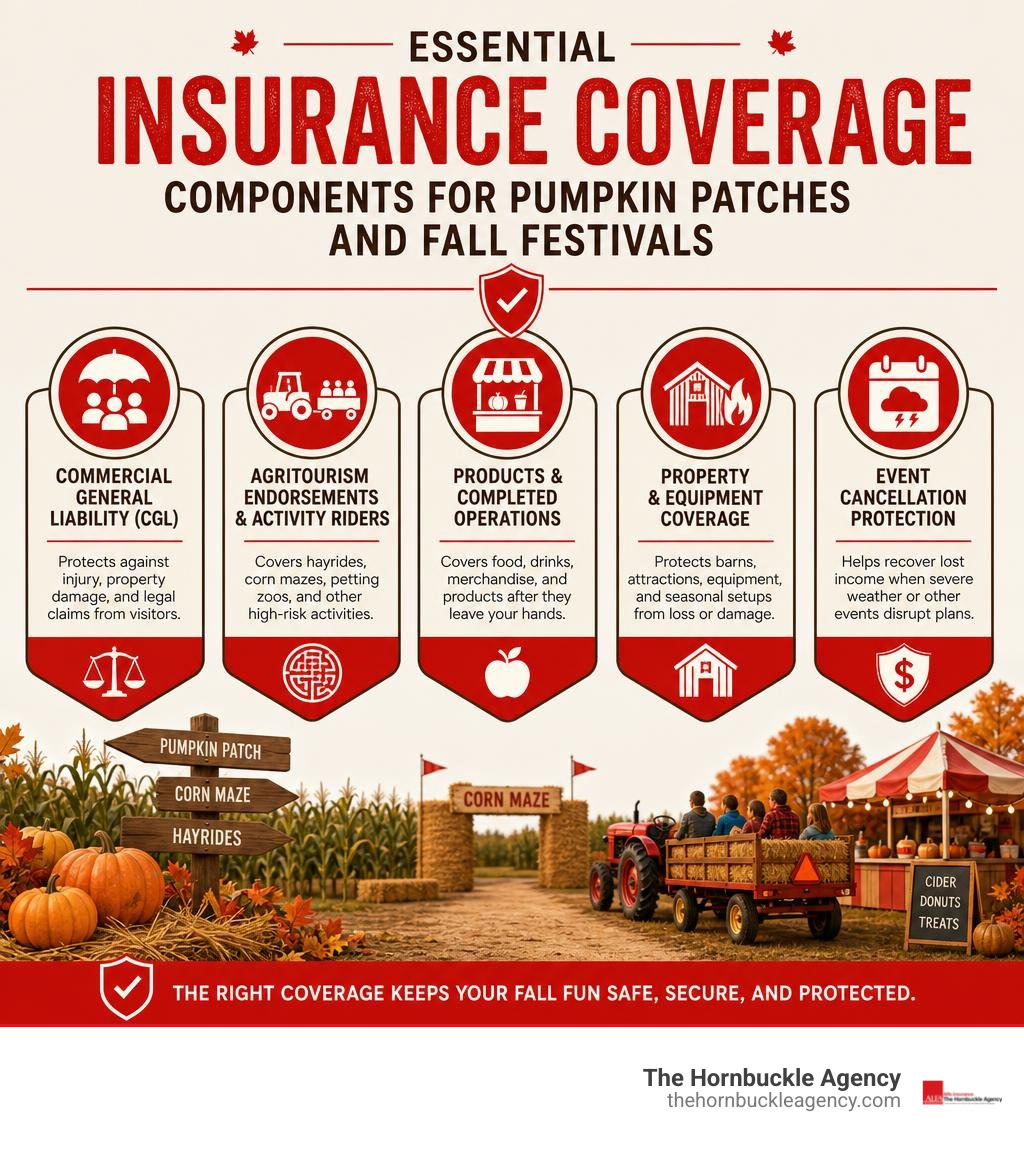
1. Commercial General Liability (CGL)
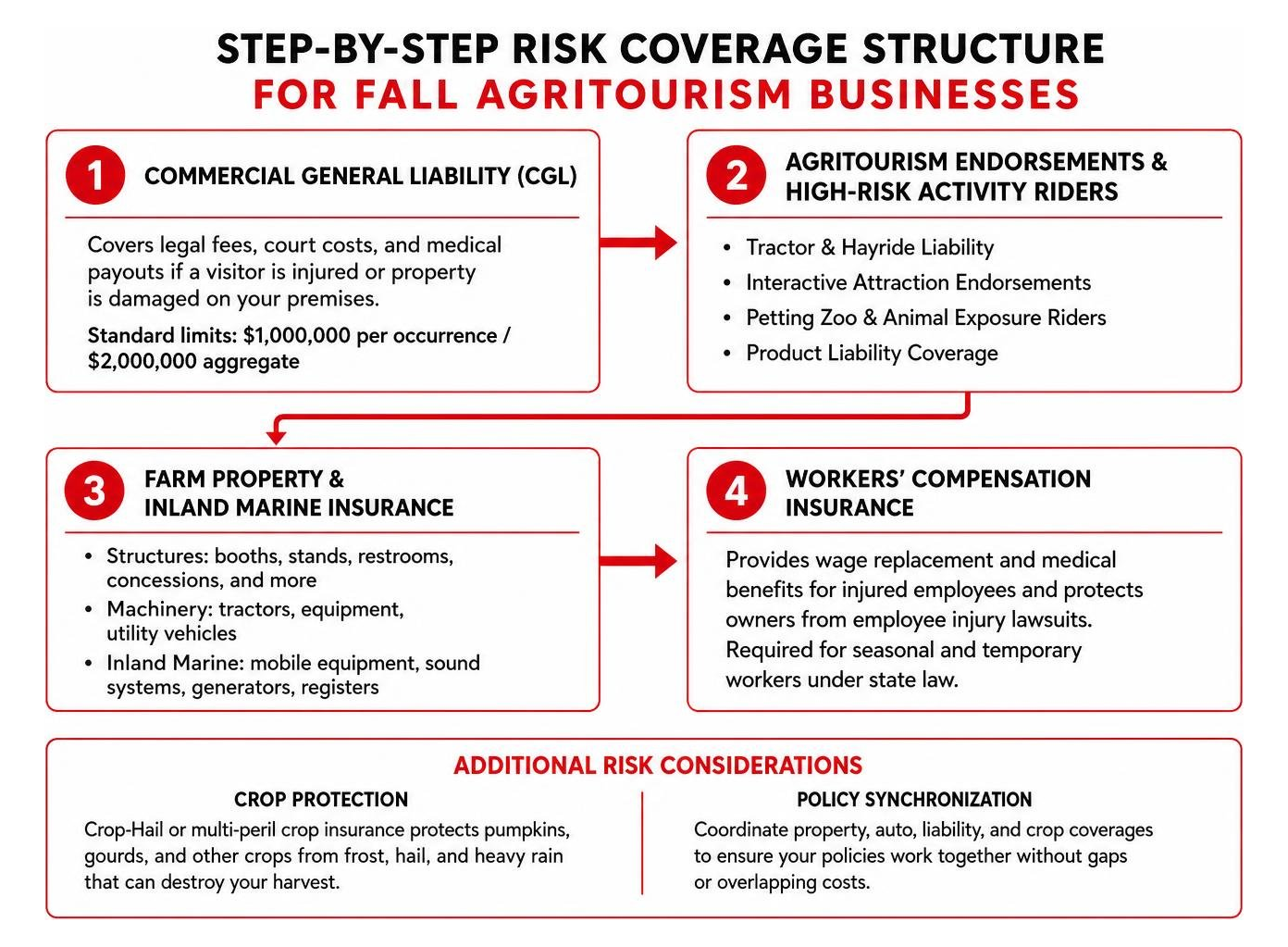
Commercial General Liability is the bedrock of any public event protection plan. CGL covers legal fees, court costs, and medical payouts if a visitor is injured on your property or suffers damage to their personal belongings. Standard CGL limits usually begin at $1,000,000 per occurrence / $2,000,000 aggregate, providing essential financial protection if a guest suffers a severe fall, property damage, or emergency medical incident.
2. Agritourism Endorsements & High-Risk Activity Riders
Because corn mazes, hayrides, and petting zoos present higher hazards than standard retail shops, insurers require specialized endorsements added to your primary policy. Essential riders include:
- Tractor & Hayride Liability: Protects against passenger falls, trailer collisions, or hitch failures during group rides.
- Interactive Attraction Endorsements: Covers corn mazes, zip lines, pedal karts, giant slides, and corn cannons.
- Petting Zoo & Animal Exposure Riders: Protects against animal bites, scratches, kicks, or illness transmissions.
- Product Liability Coverage: Essential if you sell farm-fresh food products, pumpkin pies, apple cider, jams, or canned items to festival visitors.
3. Farm Property & Inland Marine Insurance
While liability covers injuries to visitors, specialized farm insurance protects your physical structures, machinery, and equipment. This includes coverage for:
- Permanent and temporary structures, such as ticket booths, farm stands, restrooms, and concession structures.
- Specialized machinery, tractors, and utility vehicles used to operate festival activities.
- Inland Marine policies, which protect mobile equipment, portable sound systems, generator setups, and registers while moved across your property.
4. Mandatory Workers’ Compensation Insurance
Fall festivals rely heavily on temporary labor—students, seasonal workers, ticket takers, and parking attendants. If a seasonal worker gets injured lifting heavy pumpkins, operating equipment, or directing traffic, standard health insurance will not cover them.
Workers’ compensation provides wage replacement and medical benefits for injured employees while protecting farm owners from employee injury lawsuits. Even for short 6-week seasonal operations, maintaining workers’ compensation compliance is essential under state workplace laws.
Comparing Essential Agritourism Coverages
Navigating policy options requires matching specific seasonal activities with the correct insurance mechanism:
When reviewing your operational risks, work with your agent to ensure every activity is paired with appropriate coverage:
- Crop Protection vs. Crop-Hail Insurance: Specialty crops like pumpkins, ornamental gourds, and Indian corn are highly vulnerable to early frosts, hail, and torrential rainfall. Standard multi-peril crop insurance or standalone Crop-Hail coverage protects your initial financial investment in seed, fertilizer, and labor if weather destroys the patch before harvest.
- Policy Synchronization: To learn more about structuring core policies efficiently, read our guide on how to compare farm insurance options to ensure your property, auto, and liability coverages work together smoothly without costly overlaps or missed exposures.
How Does Hosting Fall Visitors Impact Commercial Umbrella Insurance Needs?
As fall festival attendance grows, your exposure to catastrophic legal claims increases exponentially. A rainy weekend can crowd hundreds of visitors onto covered wagons, around fire pits, or inside barn structures simultaneously. If a severe accident occurs, a baseline $1 million primary liability limit can be exhausted rapidly.
Catastrophic Exposure Scenarios
Consider how quickly legal costs and medical bills escalate during major property incidents:
- Hayride Rollover or Collision: A tractor pulling a high-capacity wagon overturns on an incline, resulting in multi-guest injuries, ambulance transports, and severe medical claims.
- Petting Zoo Incident: An escaped animal panics, trampling small children or causing serious injury to multiple guests.
- Haunted Barn or Structure Fire: An electrical fire inside a seasonal haunted structure leads to emergency evacuations, smoke inhalation claims, or panic-induced injuries.
- Severe Parking Lot Accident: A collision between farm machinery and guest vehicles in an unlit overflow lot results in severe injury or structural property claims.
How Commercial Umbrella Coverage Works
Commercial Umbrella Insurance sits directly on top of your underlying General Liability, Commercial Auto, and Employer’s Liability policies. It acts as a secondary safety shield, kicking in only after your primary policy limits are completely exhausted.
For example, if your farm carries a $1,000,000 CGL policy and incurs a $2,500,000 judgment following a major hayride accident, your primary policy covers the first $1,000,000. Without umbrella insurance, your farm is directly on the hook for the remaining $1,500,000—forcing liquidations of machinery, land, or personal assets.
With a $2,000,000 Commercial Umbrella policy, the excess coverage steps in to pay the remaining $1,500,000, fully shielding your family business from financial ruin.
At The Hornbuckle Agency, we work directly with farm families across North Alabama to structure umbrella policies that align perfectly with your seasonal traffic. The Hornbuckle Agency serves multiple Alabama communities, including Albertville, Guntersville, Boaz, Arab, Geraldine, Crossville, Collinsville, Horton, and Douglas, providing localized guidance that protects both your family heritage and your commercial growth.
What Factors Influence Insurance Costs and How Should You Prepare Your Patch?
Understanding policy pricing helps you budget effectively while building safety protocols that lower your annual premiums. Insurance underwriters evaluate several operational metrics when calculating premiums for seasonal agritourism operations:
Key Underwriting Cost Factors
- Annual Visitor Volume & Daily Capacity: Hosting 2,000 visitors over a season carries lower premiums than hosting 50,000 guests with peak weekend crowds of 5,000 per day.
- Gross Sales & Revenue: Higher gross revenues ($35,000 vs. $120,000+) reflect greater operational exposure and scale.
- Attraction Risk Profile: A basic pumpkin patch with walking paths costs significantly less to insure than an operation featuring zombie paintball, corn cannons, inflatables, or haunted barns.
- Food & Beverage Offerings: Selling pre-packaged items carries lower risk than preparing hot food, operating deep fryers, or serving alcoholic beverages like hard cider.
- Safety Infrastructure & Documentation: Written safety plans, employee training logs, clear directional signage, and perimeter fencing lower risk ratings.
Typical Agritourism Insurance Costs
- Base Commercial General Liability: $1,200 to $3,500 annually.
- Agritourism Activity Riders (Hayrides, Mazes, Animals): $800 to $2,500 annually.
- Commercial Umbrella Insurance ($1M–$5M limits): $500 to $1,800 annually.
- Total Expected Coverage Package: Typically ranges between $3,000 and $8,000 per season, depending on scale and high-risk activities.
To secure custom commercial coverage tailored to your fall events, explore our specialized solutions for commercial insurance.
Pre-Season Preparation & Risk Management Checklist
To lock in favorable rates and prepare your grounds for opening day, complete this operational safety audit 30 to 60 days before welcoming public guests:
Step 1: Physical Grounds Inspection
- Smooth out unpaved walking paths, fill hole hazards, and mark exposed tree roots or irrigation lines with bright safety flags.
- Secure all production farm machinery, chemical storage sheds, and working livestock quarters behind locked safety fencing.
- Inspect all tractors, trailers, wagon hitches, safety chains, and wood railings intended for hayrides.
Step 2: Post State Statutory Liability Signage
Under Alabama state agritourism laws, posting clear warning signs at farm entrances and activity zones provides important legal protections against inherent risks of agricultural activities. Ensure statutory warning notices are clearly visible near admission booths, corn maze entrances, and parking fields.
Step 3: Train Seasonal Staff & Establish Emergency Protocols
- Establish mandatory employee-to-guest ratios (aiming for at least 1 staff member per 40 guests in active zones).
- Train employees on emergency shut-off procedures for farm equipment, crowd management, and first-aid response.
- Implement daily pre-opening inspection logs for hayride wagons, corn maze paths, and customer restrooms.
To streamline policy reviews before your festival launches, follow our step-by-step guide to securing an accurate insurance quote.
What Are the Most Common Questions About Fall Festival Insurance?
Can a standard farm policy cover a seasonal pumpkin patch or corn maze?
No. Standard farm policies explicitly exclude commercial agritourism, fee-based public admission, and customer entertainment activities. Operating a public pumpkin patch or corn maze under a standard policy leaves your farm exposed to outright claim denials if a guest suffers an injury or property damage. You must add specialized agritourism liability endorsements or secure a standalone Commercial General Liability policy.
What happens if a visitor gets injured on a hayride or in a corn maze?
If a guest suffers an injury, immediate documentation is essential. First, provide immediate medical assistance and complete a written incident report detailing the date, time, weather conditions, guest contact info, witness statements, and photos of the scene. Next, report the incident immediately to your insurance carrier.
Your Commercial General Liability policy will cover approved medical bills, legal defense costs, and settlement claims. If total damages exceed your primary liability limit, your Commercial Umbrella policy steps in to cover excess costs up to your umbrella ceiling.
How early before opening should farm owners secure agritourism coverage?
Farm owners should initiate insurance reviews and risk audits 30 to 60 days before opening to the public. Underwriters require time to review your operational plan, inspect high-risk attractions (such as hayrides, corn cannons, or haunted barns), verify safety signage, and structure appropriate policy limits. Binding your policy well in advance ensures that setting up temporary structures, hiring seasonal labor, and hosting early media days are fully covered from day one.
How Can You Protect Your Agritourism Business Before Opening Day?
Hosting a fall festival, pumpkin patch, or corn maze is an exciting and profitable way to share your passion for agriculture with your local community. Generating seasonal revenues between $35,000 and $120,000+ offers significant financial growth, but opening your farm gates to public crowds introduces real operational risks that standard farm policies simply were not built to handle.
Protecting your farm’s legacy requires a proactive risk management plan:
- Identify Commercial Gaps: Recognize where production farm policies end and commercial public liability begins.
- Layer Your Protections: Combine Commercial General Liability, specialized activity riders, farm property coverage, workers’ compensation, and crop protection.
- Shield Against Catastrophes: Secure commercial umbrella coverage to protect your land, family assets, and equity against large unexpected claims.
- Audit Before Opening: Complete grounds audits, post state statutory warning signs, and train seasonal staff 30 to 60 days before your first guest arrives.
At The Hornbuckle Agency, we believe that personalized risk education is the key to protecting local businesses and farm families. We take the time to inspect your operation, identify hidden coverage gaps, and build custom policies that give you total confidence throughout the autumn season.
Whether you operate a small weekend u-pick patch or a multi-acre regional fall festival, our team is ready to stand behind your business. The Hornbuckle Agency serves multiple Alabama communities, including Albertville, Guntersville, Boaz, Arab, Geraldine, Crossville, Collinsville, Horton, and Douglas.
Ready to protect your seasonal business before opening day? Contact our experienced agricultural insurance team today at The Hornbuckle Agency to request your comprehensive policy audit and secure full protection for your farm this fall.
