
What Happens If Rebuilding Your Home Costs More Than Your Coverage Limit?
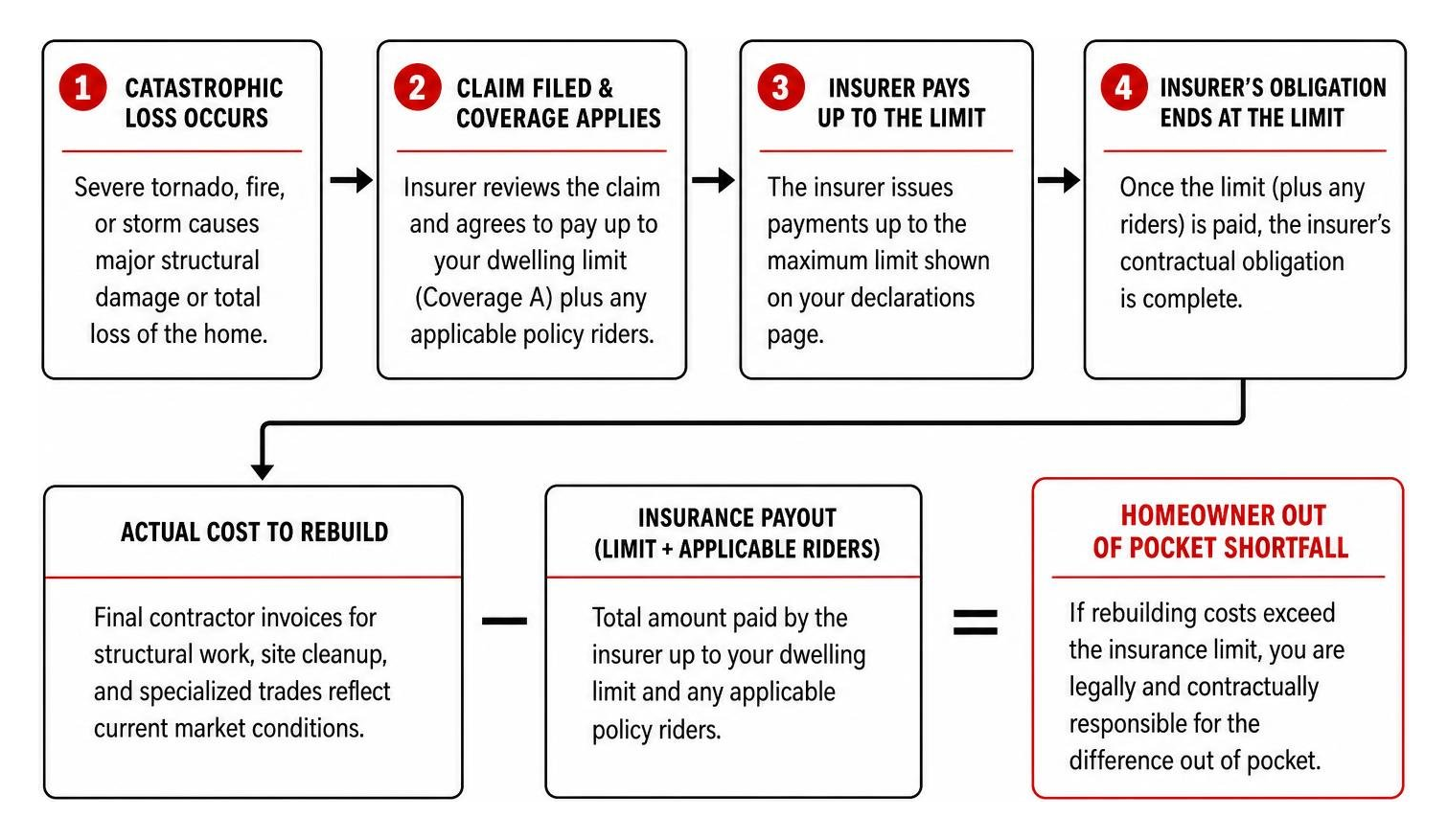
When a catastrophic event—such as a severe tornado, house fire, or severe storm—levels a property, the homeowner’s first instinct is to assume insurance will make them whole. However, if the final contractor invoices exceed your dwelling limit (Coverage A), you are legally and contractually responsible for the difference out of pocket.
Your insurance policy is a legally binding contract with explicit payout caps. Once your carrier disburses the maximum limit listed on your declarations page (plus any applicable policy riders), their contractual obligation ends. The financial burden of any remaining structural work, site cleanup, or specialized trade labor falls entirely on you.
In 2026, this underinsurance crisis has become more pronounced due to cumulative construction inflation, supply chain pressures, and widespread skilled trade shortages. When a localized catastrophe strikes, hundreds of property owners compete for the same limited pool of general contractors, drywallers, framers, and electricians. This hyper-competitive environment causes reconstruction costs to surge well beyond normal market rates.
The real-world consequences of this dynamic are severe:
- Following the 2021 Marshall Fire in Colorado, 74% of homeowners found themselves underinsured by an average of $139,000, leaving thousands struggling to finance their reconstruction.
- Underinsured policyholders were 25% less likely to apply for building permits within a year after the Marshall Fire, demonstrating how coverage shortfalls stall community recovery.
- During the January 2025 Los Angeles wildfires, estimated replacement costs soared to $955,000 in the Palisades area and $574,000 in the Eaton area, contributing to aggregate regional insured losses between $25.2 billion and $39.4 billion.
Navigating an underinsured property loss requires understanding policy mechanisms such as coinsurance penalties, optional replacement cost endorsements, mortgage escrow controls, and gap financing solutions.
Why Is Replacement Cost Different From Market Value, and How Does the 80% Rule Work?
A frequent point of confusion for property owners is the difference between real estate market value and insurance replacement cost. Market value represents what a willing buyer pays a willing seller for a home and the land beneath it. This price is heavily influenced by neighborhood school districts, lot views, curb appeal, and local supply and demand.
In contrast, replacement cost is the actual expense required to hire contractors, purchase raw materials, haul away debris, pull municipal permits, and rebuild an identical structure from the foundation up at current labor and material rates. Land does not burn, blow away, or get damaged by water, so insurance replacement cost calculations strictly exclude land value while accounting for the physical labor and raw supplies required for reconstruction.
In rural regions or communities with accessible land, rebuilding a home often costs significantly more than its resale price. Conversely, in dense urban markets, a property’s market value may be double its reconstruction cost due to the underlying land value. To ensure adequate protection, we always recommend consulting our homeowners insurance complete guide to establish accurate baseline coverage limits.
The Distinction Between Market Value and Reconstruction Cost
Because land value can distort property perceptions, relying on a real estate appraisal or a tax assessment to choose your dwelling coverage limit often leads to severe underinsurance. A standard home purchased for $250,000 on a family plot may cost $350,000 or more to reconstruct from scratch after factoring in modern architectural plans, framing lumber, electrical rewiring, roofing materials, and debris disposal.
When severe weather impacts a region, building supply bottlenecks and high labor demand drive reconstruction prices upward, making your initial home purchase price irrelevant to the actual cost of repair.
How the 80% Coinsurance Rule Reduces Partial Loss Claims
Most standard homeowners policies include an insurance-to-value clause, commonly known as the 80% coinsurance rule. This rule requires the policyholder to maintain a dwelling coverage limit equal to at least 80% of the home’s total replacement cost at the time of a loss.
If your Coverage A falls below that 80% threshold, your carrier will not pay the full cost of a partial repair. Instead, they apply a proportionate penalty to your claim payout using a standard formula:
$$\text{Claim Payout} = \left( \frac{\text{Carried Coverage A Limit}}{\text{Required 80\% Coverage Limit}} \right) \times \text{Total Loss Amount} – \text{Deductible}$$
To see how this works in practice, consider a home with a full reconstruction value of $400,000. Under the 80% rule, the homeowner must maintain at least $320,000 in Coverage A.
Because the dwelling limit was not maintained to meet the 80% threshold, the homeowner receives only $59,000 for an $80,000 repair, leaving an unexpected $21,000 out-of-pocket expense for a partial loss that was well beneath the policy’s total coverage face value. Unreported home additions, upgraded kitchens, and finished basements are frequent triggers for these coinsurance penalties.
How Do Extended Replacement Cost and Guaranteed Replacement Cost Endorsements Protect You?

A baseline Replacement Cost Value (RCV) policy pays to rebuild your property with materials of like kind and quality without deducting for depreciation—but it caps the payout strictly at the Coverage A limit stated on your declarations page. If regional reconstruction costs spike during a widespread disaster, that fixed dollar limit can be quickly exhausted.
To protect against these unexpected spikes, carriers offer specialized policy endorsements. Understanding extended replacement cost coverage rules and limits allows you to select the right buffer for your property.
- Extended Replacement Cost (ERC): This rider provides an additional percentage-based financial buffer—typically 10%, 25%, or 50%—above your stated Coverage A limit. For example, if your home is insured for $300,000 with a 25% ERC endorsement, your maximum available rebuilding fund expands to $375,000 if construction invoices exceed the initial limit.
- Guaranteed Replacement Cost (GRC): The most comprehensive dwelling protection available. A GRC endorsement commits the insurer to pay the full cost to reconstruct your damaged home back to its previous condition, regardless of how high labor and material costs rise, with no arbitrary cap.
| Coverage Type | Payout Ceiling | Premium Cost | Protection Level During Catastrophes |
|---|---|---|---|
| Standard Replacement Cost | Strictly capped at 100% of Coverage A | Baseline | Low; vulnerable to local labor and material price spikes |
| Extended Replacement Cost (25% Buffer) | Capped at 125% of Coverage A | Low to Moderate | Moderate; absorbs standard post-storm price surges |
| Extended Replacement Cost (50% Buffer) | Capped at 150% of Coverage A | Moderate | High; provides strong protection against major disaster costs |
| Guaranteed Replacement Cost | No maximum dollar cap (Full rebuild) | Highest | Maximum; completely eliminates personal rebuild cost overrun risk |
Extended Replacement Cost vs. Guaranteed Replacement Cost
While Guaranteed Replacement Cost provides total peace of mind, it is not offered by all carriers and often carries strict underwriting guidelines. Many insurers restrict GRC endorsements to newer homes or require rigorous home inspection reports. Extended Replacement Cost is widely available, cost-effective, and provides a dependable cushion when properly aligned with your baseline dwelling estimate.
The Reality of Post-Disaster Demand Surge
When a major catastrophe strikes a concentrated area, the local market experiences a phenomenon known as demand surge. When hundreds of structures are damaged simultaneously, regional supplies of framing lumber, roofing shingles, concrete, and certified tradespeople are instantly depleted.
As contractors bring in crews and materials from distant states, labor rates, travel per diems, and material prices rise sharply. Historical data reveals that demand surges frequently increase regional rebuilding costs by 20% to 30% or more.
However, an endorsement cannot compensate for an inaccurate baseline policy. After the 2021 Marshall Fire, 87% of studied policies included extended replacement cost coverage, yet nearly three-quarters of those policyholders still faced significant out-of-pocket shortfalls. Why? Their underlying Coverage A limits had been set far too low for years, meaning even a 25% or 50% policy extension was insufficient to bridge the gap created by post-disaster pricing.
How Do Mortgage Obligations, Recoverable Depreciation, and Building Codes Affect Your Payout?
Handling a total loss involves more than just calculating reconstruction estimates; it also requires navigating lender requirements, insurance accounting terms, and local construction codes.
Mortgage Lender Escrow Rules and Joint Payout Releases
If you carry a mortgage, your lender is named as a primary loss payee on your insurance policy. When a total loss claim is approved, the settlement checks are issued jointly to you and your lending institution. Under standard Fannie Mae, Freddie Mac, and private servicing guidelines, the lender deposits these insurance proceeds into an escrow account rather than releasing the full balance directly to you.
Funds are released in disbursements tied to specific construction milestones. Typically, the lender issues an initial draw (often around 33% or up to $40,000) to allow debris removal and foundation work to begin. Subsequent funds are released only after independent property inspectors verify that framing, mechanicals, and finishes are properly completed. If a borrower was delinquent on mortgage payments prior to the loss, lenders often enforce even stricter release schedules.
Understanding the legal considerations of whether you have to rebuild is critical if you are debating taking the insurance cash rather than reconstructing the home. If you choose not to rebuild, the mortgage lender retains the right to apply the insurance settlement proceeds directly against your remaining loan principal.
The 180-Day Notification Deadline and Forfeiting Depreciation
Replacement cost policies typically disburse claim funds in two separate phases:
- Actual Cash Value (ACV): The initial payout, calculated as the full replacement cost minus physical depreciation for age and wear.
- Recoverable Depreciation: The withheld depreciation balance, disbursed only after construction is completed and verified with final contractor invoices.
On an average total loss, recoverable depreciation balances often range between $80,000 and $150,000. Most standard property contracts enforce a strict 180-day notification deadline from the date of loss. Within this window, the homeowner must formally notify the carrier in writing of their intent to rebuild and claim replacement cost benefits. If you decide to walk away or fail to meet the policy timeline, you forfeit this recoverable depreciation holdback entirely, leaving you with only the depreciated ACV check.
Ordinance or Law Coverage for Mandatory Code Compliance
Building codes evolve over time to improve structural safety, energy efficiency, and disaster resistance. When rebuilding an older home, local building departments will require the new structure to comply with current municipal building codes—which may dictate upgraded electrical panels, hurricane tie-downs, impact-rated windows, fire-suppression systems, or reinforced foundation footings.
Standard homeowners insurance policies strictly exclude the cost of bringing undamaged or reconstructed property into compliance with updated municipal laws. To cover these mandatory updates, policyholders must attach an Ordinance or Law endorsement. Without this rider, code-mandated upgrades can add tens of thousands of dollars in uninsurable out-of-pocket costs to your reconstruction project.
For specialized perils and structural limitations, reviewing how standard policies address catastrophic damage helps avoid surprises during the claims process.
What Options Are Available If You Cannot Afford the Rebuilding Shortfall?
If your home is destroyed, your coverage limit is exhausted, and you face a significant financial shortfall between your insurance payout and contractor estimates, several practical strategies can help you move forward.
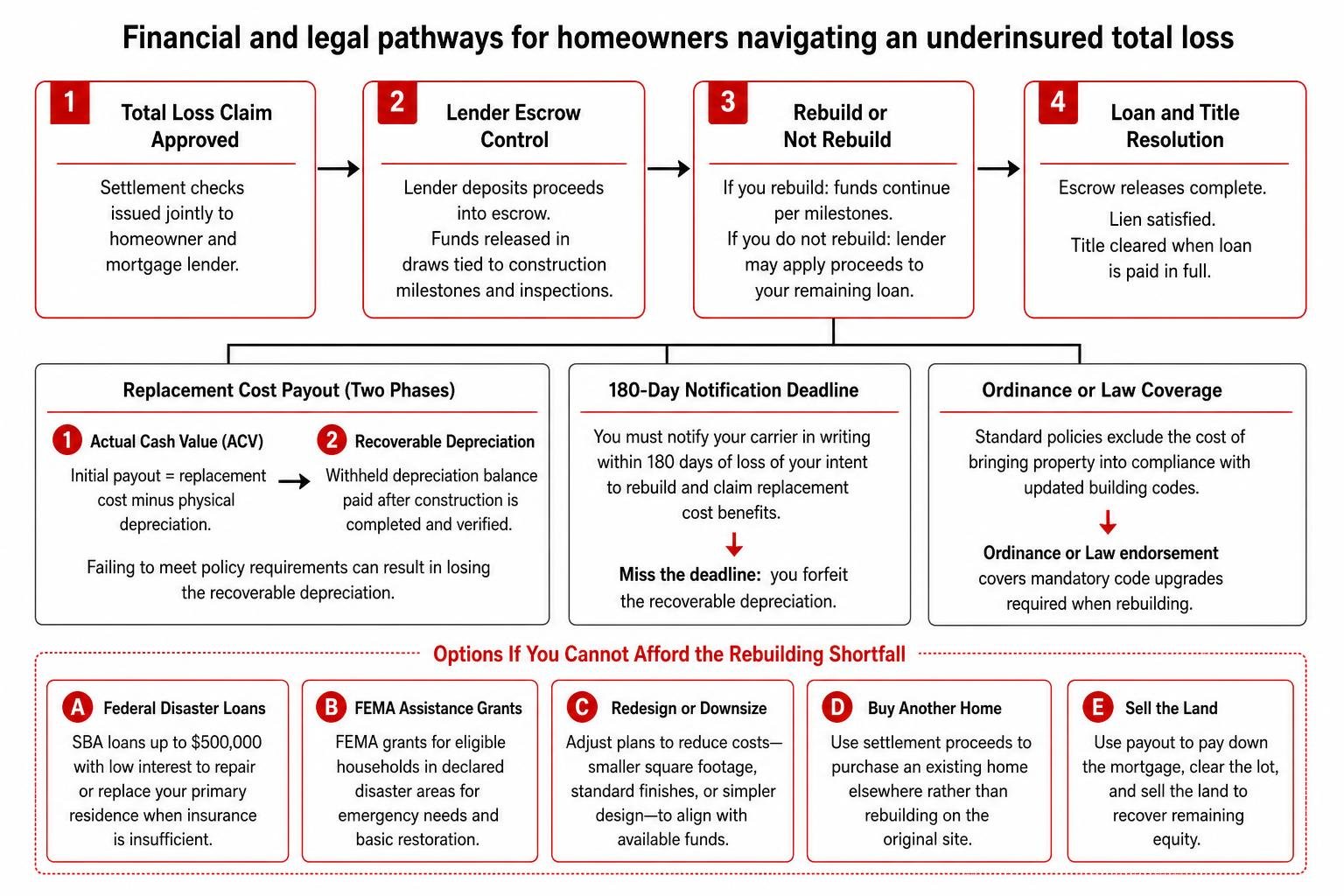
- Apply for Low-Interest Federal Disaster Loans: If your county is included in a federally declared disaster area, the U.S. Small Business Administration (SBA) offers physical disaster loans of up to $500,000 for homeowners. These loans provide long-term, low-interest financing designed specifically to repair or replace primary residences when insurance payouts are insufficient.
- Pursue FEMA Individual Assistance Grants: For qualifying households in declared disaster zones, FEMA provides emergency grants to address immediate safety, debris clearance, and basic structural restoration.
- Redesign or Downsize Construction Plans: You are not legally obligated to construct the exact floor plan that previously existed. If your settlement leaves a $60,000 shortfall on a custom layout, you can work with your architect or builder to adjust square footage, select standard interior finishes, or simplify the roofline to align construction costs with your available insurance funds.
- Purchase an Existing Home in a Different Location: In many jurisdictions and under standard insurance contracts, policyholders can use their total loss replacement cost settlement to purchase an existing home elsewhere rather than rebuilding on the original site. By establishing an agreed theoretical scope of loss with your adjuster, you can apply those proceeds toward a replacement property.
- Sell the Remaining Land to Settle Liens: If rebuilding proves financially impossible, you can use the initial insurance payout to pay down the mortgage, clear the damaged lot of debris, and sell the unimproved parcel to recover remaining equity.
When navigating complex claims, reviewing professional resources on settling insurance claims after a disaster provides valuable structure for negotiating with adjusters and contractors.
Frequently Asked Questions About Rebuilding Costs and Policy Limits
Can my insurance company cancel my policy if rebuilding costs more than my limit?
No. An insurance carrier cannot cancel or alter a policy retroactively during an active, valid claim to avoid paying covered damages up to the agreed policy limits. The insurer must fulfill its contractual obligations for the covered loss. However, once the policy term concludes or the claim is closed, the carrier may choose not to renew the policy or adjust underwriting guidelines and rates for the rebuilt property.
Will my homeowners insurance cover temporary housing if rebuilding is delayed?
Yes, under your policy’s Additional Living Expenses (ALE) or Loss of Use coverage (Coverage D). This section reimburses you for reasonable increases in living costs—including apartment rent, extended-stay hotels, storage units, and utility differentials—while your primary residence is uninhabitable.
Standard policies typically cap Loss of Use coverage at a specific percentage of Coverage A (often 10% to 30%) or apply a 12-to-24-month time limit. When extensive post-disaster supply chain bottlenecks or permitting delays extend reconstruction past two years, policyholders risk exhausting their temporary housing funds before their new home is finished.
How often should I update my dwelling coverage to avoid an underinsurance shortfall?
You should review your dwelling coverage limit with an insurance professional every 1 to 2 years, as well as immediately following any significant home renovation, finished basement, room addition, or high-end roof upgrade. While many policies include an automatic annual “inflation guard” endorsement that increases Coverage A by a standard 2% to 5%, this adjustment may lag behind localized construction cost spikes during periods of high inflation.
How Can You Ensure Your Home Has Adequate Replacement Cost Coverage?
Facing a total structural loss is emotionally challenging; discovering that your insurance policy falls tens of thousands of dollars short of actual reconstruction expenses is financially devastating. Underinsurance gaps, coinsurance penalties on partial claims, and uncovered building code mandates are risks that can be avoided with proactive policy planning.
Taking the time to evaluate your policy details using the ultimate guide to compare home insurance quotes in alabama gives you the tools needed to spot coverage shortfalls before severe weather strikes.
At The Hornbuckle Agency, as a dedicated Alfa Insurance provider located in Albertville, AL, we specialize in personalized risk education to help families protect their most valuable physical assets. We work closely with homeowners across North Alabama to calculate precise, localized reconstruction valuations and design customized coverage packages that stand up to real-world construction costs.
Whether you need to add an Extended Replacement Cost rider, secure Ordinance or Law coverage, or update your baseline home insurance, our team serves families across multiple Alabama communities, including Albertville, Guntersville, Boaz, Arab, Geraldine, Crossville, Collinsville, Horton, and Douglas.
Do not wait for a major storm or unexpected fire to find out if your policy limits are sufficient. Use our a quick start guide to insurance quote or reach out to our office directly to schedule a personalized replacement-cost assessment for your home today.
