
Does a Landlord’s Master Policy Cover Your Suite, Assets, and Operations?
A common assumption among first-time commercial tenants is that the building owner’s master policy extends protection to everyone operating under the roof. In commercial real estate, this assumption is not only incorrect—it is dangerous.
A commercial landlord maintains property and casualty insurance designed exclusively to protect the landlord’s financial and physical interests. Specifically, a landlord’s master policy covers:
- The exterior physical building structure (brick, mortar, structural framing, foundation, and roof).
- Shared common areas (main entryways, common hallways, public restrooms, elevators, and parking lots).
- Central heating, ventilation, and air conditioning (HVAC) systems and shared utility infrastructure.
- The landlord’s own premises liability for accidents occurring within shared common areas.
The master policy explicitly excludes your commercial operations. If a client visits your private executive suite, trips over a rug inside your office door, and breaks a wrist, the landlord’s insurer will deny the claim immediately. The landlord’s insurer will point out that the injury occurred inside your demised premises—the specific square footage under your exclusive control.
Why Personal Renters Insurance Fails to Protect Commercial Spaces
Some solo practitioners or home-based business owners transitioning into their first suite wonder if an existing personal renters insurance policy will suffice.
Personal renters insurance is written under standard residential forms that contain strict commercial exclusions. These policies do not extend liability coverage to commercial enterprise activities, client foot traffic, or professional services.
Furthermore, personal renters policies severely restrict business equipment coverage. Most standard personal renters policies cap business property at $2,500 while on your residential premises, and restrict off-premises business property to as little as $250. Relying on a personal renters policy for commercial operations leaves your business completely uncovered against liability claims and asset loss. To properly safeguard commercial equipment and professional operations, you must follow standard renters insurance for a business requirements and carry dedicated commercial lines.
Alabama Premises Liability and the “Demised Premises”
Under Alabama premises liability law, duty of care is tied directly to possession and control of the real property. When you sign a commercial lease for a private suite, that suite becomes your “demised premises.”
As the legal tenant in possession, Alabama law assigns you the legal duty to maintain a reasonably safe environment for invitees (clients, vendors, and customers) who enter your private suite. If an unsafe condition inside your private suite leads to personal injury or property damage, the legal liability rests on your business, not the building owner. Without dedicated commercial liability protection, your business entity and personal assets are exposed to litigation, defense costs, and settlement judgments.
What Types of Insurance Coverage Does a Private Suite Tenant Actually Need?
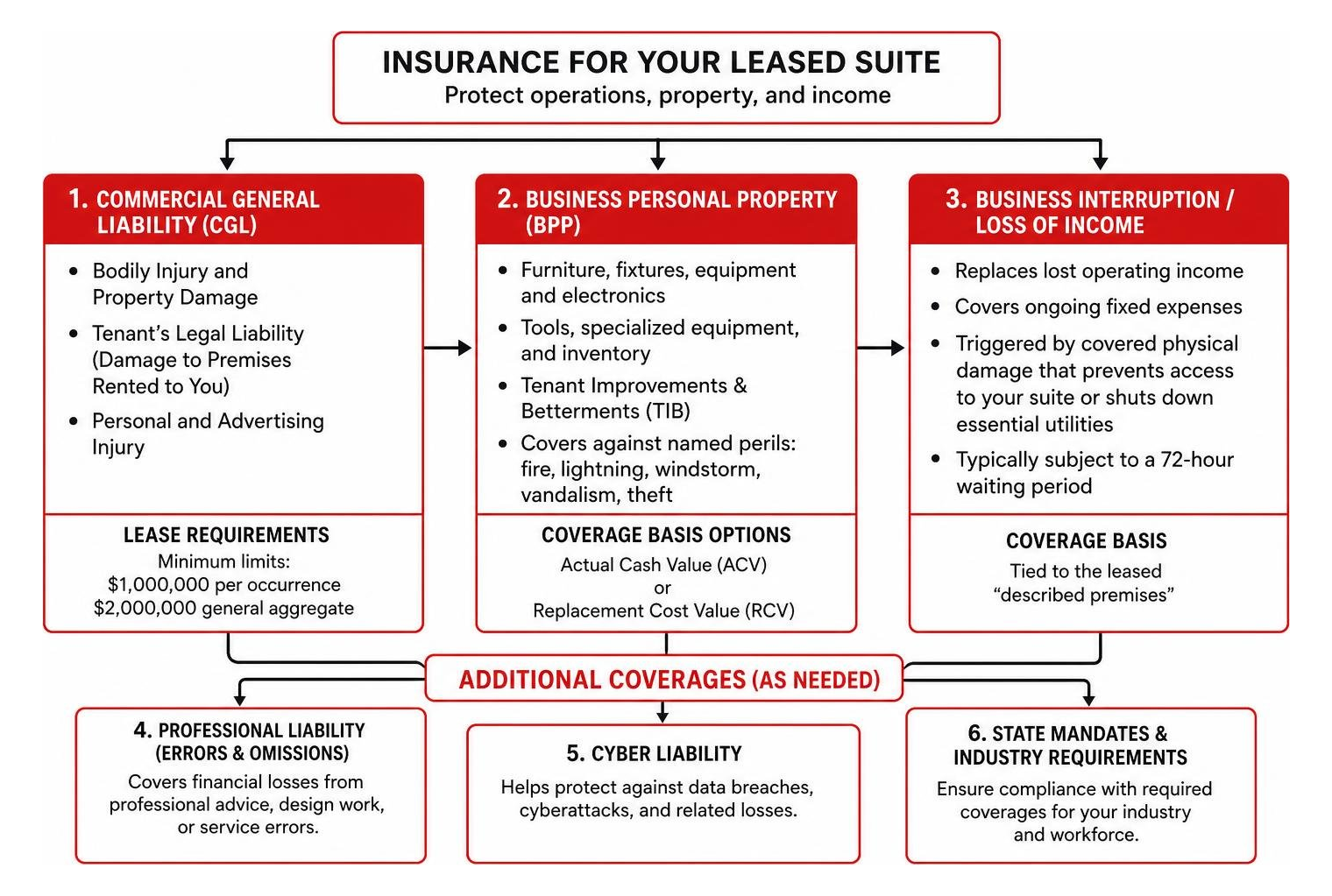
Protecting your operations inside a leased suite requires a balanced combination of liability, property, and income protection. Let’s look at the core coverage areas every suite tenant needs to evaluate.
Commercial General Liability (CGL)
Commercial General Liability is the foundation of every commercial insurance program. CGL protects your business if a third party (such as a client, delivery courier, or vendor) suffers bodily injury or property damage arising out of your day-to-day operations.
- Bodily Injury and Property Damage: Covers legal defense costs, medical expenses, and court settlements if a visitor slips and falls in your suite or if an accident causes damage to a client’s property.
- Tenant’s Legal Liability (Damage to Premises Rented to You): Provides coverage if your operations accidentally cause damage to the rented suite itself—such as an accidental fire started by an unattended space heater or an overflowing sink that damages drywall.
- Personal and Advertising Injury: Shields your company against claims of libel, slander, copyright infringement in marketing materials, or invasion of privacy.
In commercial leasing, standard contracts mandate minimum CGL policy limits of $1,000,000 per occurrence and $2,000,000 general aggregate.
Business Personal Property (BPP)
While the landlord insures the structural walls of your building, everything you bring through the doorway is your responsibility. Business Personal Property (BPP) insurance covers your physical business assets against named perils, including fire, lightning, windstorm, vandalism, and theft.
Key items covered under BPP include:
- Office furniture, desks, ergonomic chairs, and treatment tables.
- Computers, laptops, servers, monitors, point-of-sale terminals, and printers.
- Specialized trade tools (e.g., salon styling stations, diagnostic medical equipment, photographic gear).
- Retail inventory, raw materials, and packaged client merchandise.
- Tenant Improvements and Betterments (TIB): Permanent fixtures, custom cabinetry, upgraded flooring, or specialized lighting installed inside the suite at your expense.
When structuring BPP coverage, policies can be written on an Actual Cash Value (ACV) basis (which subtracts depreciation) or a Replacement Cost Value (RCV) basis (which pays the full cost to replace old items with new ones of comparable quality). In almost all suite leasing situations, securing Replacement Cost coverage prevents significant out-of-pocket gaps following a total property loss.
Business Interruption / Loss of Income
What happens if a fire breaks out in a neighboring suite, or a major water pipe bursts in the main commercial building, forcing the property manager to shut down the building for three months of repairs?
Even if none of your physical assets are damaged, your private suite may be inaccessible, halting your daily revenue while your ongoing overhead expenses—including payroll, vendor contracts, software subscriptions, and tax obligations—continue to accumulate.
Business Interruption insurance (also known as Business Income coverage) replaces lost operating income and covers ongoing fixed expenses while the premises undergo restoration. Tenants can secure business income coverage without building property ownership by tying coverage directly to the leased “described premises.” Under this arrangement, if physical damage to any part of the shared commercial structure prevents access to your suite or shuts down essential utility feeds, your loss of income is covered during the restoration period (typically subject to a 72-hour waiting period).
Professional Liability, Cyber, and State Mandates
Depending on your industry and workforce structure, several additional coverages may be required:
- Professional Liability (Errors & Omissions / E&O): General liability covers physical slip-and-falls; it does not cover financial losses caused by professional advice, design work, or medical/aesthetic services. Accountants, attorneys, consultants, therapists, medical practitioners, and cosmetologists operating out of private suites need E&O insurance to defend against claims of negligence, inaccurate advice, or service errors.
- Cyber Liability Insurance: If your suite operations process digital credit card transactions, collect confidential client intake records, or store customer data on local network drives, a data breach or ransomware attack can lead to steep notification costs and regulatory penalties. A cyber liability endorsement provides essential incident response and forensic remediation.
- Alabama Workers’ Compensation: Under Alabama state law (Code of Alabama § 25-5-1 et seq.), any business that regularly employs five or more employees (including full-time staff, part-time workers, and corporate officers) must carry statutory Workers’ Compensation insurance. Even if your commercial suite operates with fewer than five workers, carrying voluntary workers’ compensation protects you from expensive workplace injury lawsuits.
Working with an independent agency allows you to bundle these components into cohesive commercial insurance plans tailored precisely to your suite’s risk profile.
Why Is a Business Owners Policy (BOP) Often the Best Choice for Suite Renters?
For most small businesses leasing a private office, studio, or retail suite, purchasing individual monoline policies for general liability, personal property, and business interruption is inefficient and costly.
A Business Owners Policy (BOP) solves this problem by packaging the three fundamental small business protections into one integrated contract:
- Commercial General Liability
- Business Personal Property Coverage
- Business Interruption / Extra Expense Insurance
Advantages of a BOP for Commercial Suite Tenants
- Substantial Premium Savings: Insurers discount bundled coverage within a BOP, making it significantly less expensive than buying standalone CGL and commercial property policies. While standalone policies might total $2,000+ annually, a BOP for a low-hazard suite averages roughly $57 per month ($684/year) to $1,700 per year depending on total property values.
- Streamlined Underwriting: BOP policies use simplified underwriting criteria designed for small-to-midsize businesses occupying spaces under 25,000 to 35,000 square feet.
- Built-in Lease Compliance: A BOP automatically provides the standard liability limits ($1M/$2M) and property terms required by commercial landlords.
Standalone CGL vs. Bundled Business Owners Policy (BOP)
| Feature / Coverage Line | Standalone General Liability | Bundled Business Owners Policy (BOP) |
|---|---|---|
| Third-Party Bodily Injury | Included ($1M/$2M Limits) | Included ($1M/$2M Limits) |
| Tenant Legal Liability (Fire Damage) | Included | Included |
| Furniture, Equipment & Inventory (BPP) | Excluded (Requires Separate Policy) | Included (Customizable Limits) |
| Tenant Betterments & Improvements | Excluded | Included Under BPP |
| Loss of Business Income | Excluded (Requires Separate Policy) | Included (Up to 12 Months Actual Loss) |
| Average Cost Profile | $30 – $100 / month | $50 – $140 / month |
| Lease Requirement Fit | Partial (Satisfies Liability Only) | Complete (Satisfies Liability + Property) |
Common BOP Exclusions Every Tenant Must Note
While a BOP is comprehensive, standard policies contain specific exclusions that require separate endorsements or standalone policies:
- Professional Negligence / Malpractice: Excluded; requires an E&O or Professional Liability endorsement.
- Flooding and Earth Movement: Surface water flooding and earthquakes are excluded under standard commercial property forms and require specialized policies.
- Cyber Attacks and Data Breaches: Basic BOPs include little to no cyber coverage without a dedicated endorsement.
- Commercial Auto Incidents: Vehicles used for business deliveries or client transport require commercial auto coverage.
- Employment Practices Liability (EPLI): Claims regarding wrongful termination, harassment, or discrimination require an EPLI policy.
What Commercial Lease Insurance Clauses Must Alabama Tenants Satisfy?
When reviewing your commercial lease agreement, the section titled “Insurance,” “Indemnification,” or “Tenant Obligations” will detail explicit requirements you must satisfy before getting your keys. Standard lease agreements—including widely used forms adhering to standard commercial lease insurance terms—contain several mandatory provisions.

Additional Insured Endorsements and Subrogation Waivers
Landlords protect their legal position by transferring operational risk onto the tenant through specific contractual endorsements:
1. Additional Insured Endorsement
Commercial leases universally mandate that the tenant name the landlord, property management company, and sometimes the building lender as an Additional Insured on the tenant’s General Liability policy.
This is accomplished using standard insurance forms such as the ISO CG 20 11 (Additional Insured — Managers or Lessors of Premises) endorsement. This endorsement ensures that if a third party sues both you and the landlord over an incident arising out of your suite’s operations, your insurance policy provides legal defense and indemnification for the landlord.
Crucial Note: Handing your landlord a standard Certificate of Insurance (COI) that merely lists their name in the “Certificate Holder” box is often legally insufficient. Leases frequently state that the physical Additional Insured Endorsement page must be attached to the COI to verify coverage.
2. Waiver of Subrogation
Subrogation is the legal process by which an insurance company pays a claim to its policyholder and then sues the at-fault third party to recover its funds. Commercial leases almost always include a mutual Waiver of Subrogation.
Under this clause, you and your landlord agree that neither party’s insurer can sue the other party to recover damages covered by property insurance. When your insurer issues your policy with a Waiver of Subrogation endorsement, it agrees not to pursue the landlord even if the landlord’s minor negligence contributed to a covered property loss.
Consequences of Policy Lapses and Default
Failing to secure required coverage or letting a policy lapse due to missed payments carries immediate legal and operational consequences under Alabama contract law. Standard commercial leases outline clear remedies for landlords when reviewing guidelines for when a landlord requires insurance:
- Immediate Notice of Default: An insurance lapse constitutes a material breach of the lease agreement. Commercial leases typically provide a short cure period (often 3 to 10 days) to rectify the deficiency.
- Force-Placed Insurance Surcharges: If you fail to provide an updated Certificate of Insurance, many leases grant the landlord the right to purchase coverage on your behalf and bill the premium back to you, often adding administrative fees or automatic rent penalties (such as a 10% rent surcharge).
- Eviction and Lease Termination: Under Alabama commercial leasing law, failure to cure a material breach gives the property owner legal standing to terminate the lease, re-enter the suite, accelerate the remaining lease payments, and initiate eviction proceedings.
To avoid costly compliance oversights, businesses can review our quick start guide to securing an insurance quote to establish continuous coverage and automated renewal filings.
How Much Does Business Insurance for a Rented Commercial Suite Cost?
Business insurance for a commercial suite rental is generally very affordable. For most small businesses operating out of a private suite in 2026, baseline commercial liability premiums range from $30 to $100 per month.
Typical Cost Benchmarks by Industry and Policy Type
- Professional Office / Consulting Suite: An office-only suite (accountants, software consultants, copywriters, graphic designers) with minimal foot traffic averages $35 per month ($420/year) for a $1M/$2M General Liability policy.
- Retail Boutique or Studio: A private boutique suite with regular customer foot traffic averages $66 per month ($792/year) for standalone CGL.
- Personal Care or Specialty Service Suite: Salons, estheticians, massage therapists, and personal trainers with hands-on client interactions average $91 per month ($1,092/year) for commercial liability.
- Comprehensive Business Owners Policy (BOP): Bundling General Liability, Business Personal Property ($25,000–$100,000 in equipment/inventory), and Business Interruption typically costs between $1,200 and $2,500 annually, with the median falling right around $1,700 per year (~$140/month). Low-hazard micro-suites with minimal property often pay as little as $57 per month.
Key Factors Determining Your Premium Rates
- Industry Classification & Risk Profile: An aesthetician using chemical peels or heat tools faces higher operational liability than an executive consultant working solely on a laptop.
- Suite Square Footage and Foot Traffic: Larger suites accommodating higher daily client volume carry higher liability exposure.
- Total Insurable Property Value: The total replacement cost of your trade equipment, specialized tools, furnishings, and inventory directly dictates your BPP premium.
- Building Location and Construction Quality: Factors like building fire suppression systems, local fire protection class ratings, and regional storm exposures impact commercial property rates.
- Deductible Selection: Choosing a $1,000 or $2,500 property deductible instead of a $500 deductible lowers your annual BOP premium.
What Are the Most Common Questions About Renting a Commercial Suite?
Does my personal renters insurance cover my equipment inside a rented office suite?
No. Standard personal renters insurance policies explicitly exclude coverage for commercial liability, business operations, and off-premises business activities.
Personal policies typically cap business equipment coverage at $2,500 while inside your primary residence and reduce that limit to as little as $250 when the property is kept at an off-premises commercial suite. Furthermore, personal policies provide zero liability defense if a client slips and falls inside your rented suite.
What is the difference between a Certificate of Insurance (COI) and an Additional Insured endorsement?
A Certificate of Insurance (COI) is an informational document summarizing your active policy limits, effective dates, and policy numbers.
An Additional Insured endorsement is a legally binding amendment attached to the underlying insurance contract that officially extends your policy’s liability defense and indemnification rights to the named landlord. While a COI alerts the landlord that coverage exists, the endorsement gives the landlord actual legal standing under your policy.
Can my commercial landlord evict my business if my liability insurance lapses?
Yes. Maintaining the insurance limits specified in your lease agreement is a contractual covenant.
Allowing your policy to lapse constitutes a material breach of contract. Under Alabama commercial lease law, once an official notice of default is served and the specified cure window expires without proof of reinstatement, the landlord has the legal right to lock out the tenant, terminate the lease agreement, and file for commercial eviction.
How Can Local Businesses Secure the Right Commercial Suite Coverage?
Renting a private commercial suite is an exciting milestone for any growing business. Whether you are opening a salon suite, launching a therapy practice, expanding a professional consultancy, or setting up a retail showroom, having dedicated insurance ensures that unexpected accidents or structural disruptions do not derail your business.
Carrying your own commercial insurance protects your inventory and equipment, satisfies your lease obligations, shields you from third-party slip-and-fall claims, and guarantees that your income continues if an unexpected disaster strikes the building.
We believe that personalized risk education is the best way to safeguard small business owners from unexpected liability gaps. The Hornbuckle Agency serves multiple Alabama communities, including Albertville, Guntersville, Boaz, Arab, Geraldine, Crossville, Collinsville, Horton, and Douglas.
Take a moment to learn more about our agency and our commitment to local business owners across Marshall County and North Alabama. If you are reviewing a new commercial lease or need to verify that your active coverage meets your landlord’s requirements, contact our local team today for a comprehensive lease insurance review and a tailored commercial quote.
