
Does Homeowners Insurance Cover Roof Replacement in Alabama?
When severe weather tears through Alabama, your roof takes the brunt of the impact. The direct answer to whether homeowners insurance covers a complete roof replacement comes down to what caused the damage. Under standard property policies across the state, roof replacement is covered when damage results from sudden, accidental, and direct physical loss caused by an insured peril.
Covered Perils vs. Excluded Maintenance
Alabama weather is notoriously volatile. In Marshall County and across North Alabama, severe spring and fall storm fronts frequently bring straight-line winds, supercell tornadoes, and golf-ball-sized hail. Further south, tropical systems and hurricane-force gusts push northward from the Gulf of Mexico.
Standard homeowners policies (typically written on an HO-3 special form) cover your roof against a specific list of sudden weather and accidental events, including:
- Windstorms and Tornadoes: High winds that lift, crease, or rip away shingles, exposing the underlying decking.
- Hailstorms: Hail impacts that bruise asphalt shingles, crack tile or slate, fracture fiberglass mats, and dent metal flashing or gutters.
- Falling Objects: Limbs, branches, or entire trees brought down onto the roof during a storm.
- Fire and Lightning: Direct lightning strikes or house fires that destroy the roof structure.
- Weight of Ice or Sleet: Heavy winter precipitation causing structural stress or collapse.
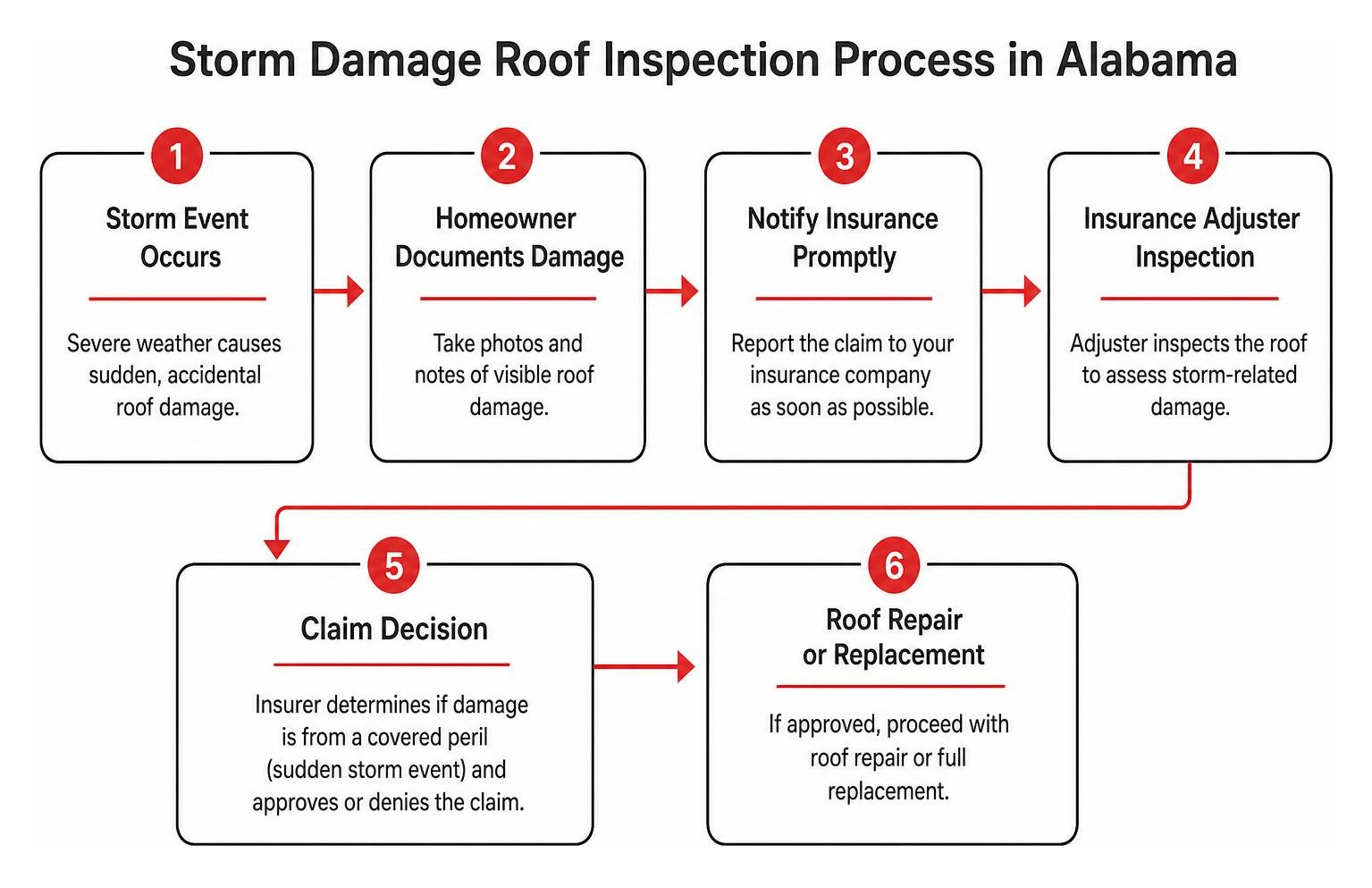
Where homeowners run into unexpected claim denials is the distinction between sudden storm events and ongoing maintenance issues. Your insurance policy is a financial safety net designed for unexpected catastrophic damage, not a roof maintenance warranty.
Insurers in Alabama explicitly exclude:
- Gradual Wear and Tear: Granule loss occurring naturally over 15 to 20 years of sun exposure and heat cycles.
- Lack of Maintenance: Rotting roof decking caused by clogged gutters or unattended minor leaks.
- Rot, Mold, and Dry Rot: Damage stemming from long-term moisture intrusion that went unaddressed.
- Manufacturer Defects or Faulty Installation: Improper nailing patterns or defective shingles that fail prematurely.
- Cosmetic Marring: Minor cosmetic blemishes (such as light hail dents on metal roofing) that do not compromise the water-shedding integrity of the roof, unless specific cosmetic damage endorsements are purchased.
The Role of Dwelling Coverage (Coverage A)
Your roof is protected under Coverage A (Dwelling Coverage) of your homeowners policy. This section of your contract establishes the maximum payout available to repair or rebuild the physical structure of your house, including attached elements like rafters, decking, underlayment, flashing, and shingles.
In Alabama, the cost of property coverage reflects our state’s severe weather patterns. The average annual premium for an HO-3 policy in Alabama was $1,906 in 2023, while the average across all owner-occupied dwelling forms reached $1,862. Because roof claims represent one of the single largest expense categories for carriers, underwriters scrutinize roof age, material, and maintenance history closely when issuing or renewing policies.
How Do Policy Terms, Deductibles, and the 80 Percent Rule Affect Your Payout?
Even when a storm causes undeniable damage, the amount your insurer pays out depends on three critical elements in your contract: your loss settlement type (RCV vs. ACV), your deductible structure, and your dwelling limit compliance.
Replacement Cost Value (RCV) vs. Actual Cash Value (ACV)
How your policy values your roof determines whether an approved claim pays for a brand-new roof or leaves you with thousands of dollars in uncovered expenses.
- Replacement Cost Value (RCV): Under an RCV policy, the insurer covers the current cost to replace your damaged roof with new materials of like kind and quality, without subtracting a deduction for physical depreciation or age.
- Actual Cash Value (ACV): Under an ACV policy, the insurer calculates what it costs to replace the roof today and then deducts depreciation based on how old and worn the roof was at the time of loss. If your 15-year-old architectural shingle roof has an expected lifespan of 20 years, the carrier may deduct up to 75% of the total material and labor payout.
| Feature | Replacement Cost Value (RCV) | Actual Cash Value (ACV) |
|---|---|---|
| Depreciation Applied? | No (depreciation is withheld upfront, then released after work is finished) | Yes (depreciation is permanently deducted from payout) |
| Upfront Out-of-Pocket Cost | Deductible only (once recoverable depreciation is claimed) | Deductible + all accumulated depreciation |
| Payment Structure | Two checks (Initial ACV check + Depreciation release check) | One check (Depreciated value minus deductible) |
| Material Coverage | Reimburses full price of modern materials | Reimburses discounted value based on remaining lifespan |
| Premium Cost | Slightly higher annual premium | Lower annual premium |
How Alabama Wind and Hail Deductibles Work
Unlike many parts of the country where a flat $1,000 or $1,500 deductible applies to all claims, Alabama policies frequently include a separate percentage-based wind/hail deductible.
This percentage is not calculated from the cost of the roof repair. It is calculated as a percentage of your Coverage A Dwelling Limit.
For example, if your home has a $300,000 dwelling limit and your policy carries a 2% wind/hail deductible:
- Dwelling Limit: $300,000
- Wind/Hail Deductible (2%): $6,000
If a severe hailstorm hits and a full roof replacement costs $14,000, you are responsible for paying the first $6,000 out of pocket. The insurance company pays the remaining $8,000. If total repair costs come out to $5,200, the claim falls entirely below your deductible, meaning the insurer pays nothing.
Repair Costs and the 80 Percent Coinsurance Rule
Over the past five years, repair and rebuilding expenses across Alabama have surged nearly 30%, driven by inflation, supply-chain constraints, material price increases, and skilled labor shortages. When rebuilding costs climb faster than your policy limits, you risk falling below the 80 percent coinsurance threshold.
Under the standard 80 percent rule, insurance carriers require you to maintain a dwelling coverage limit equal to at least 80% of your home’s total replacement cost. If your coverage drops below this mark, the insurer applies a proportional penalty to partial loss claims—including roof replacements.
Consider this mathematical breakdown:
- Full Replacement Cost of Home: $50,000 (for illustration)
- Required 80% Coverage: $40,000
- Actual Coverage Carried: $30,000 (only 75% of the required $40,000 limit)
- Covered Roof Loss: $25,000
Because the home was only insured for 75% of the required amount ($30,000 / $40,000 = 0.75), the insurer pays only 75% of the $25,000 loss, which equals $18,750. The homeowner is left responsible for the remaining $6,250 balance, on top of any applicable deductible.
To ensure your policy stays aligned with rising construction rates, we recommend reviewing your coverage limits regularly and evaluating rebuilding costs exceeding your homeowners insurance limit so you never encounter unexpected coinsurance penalties.
What Is Recoverable Depreciation and How Do You Collect It?
If you carry an RCV policy, your insurance payout is almost always distributed in two separate checks. The initial payment covers the Actual Cash Value of the damage (the total estimated replacement cost minus your deductible and minus calculated depreciation).
The withheld amount is called recoverable depreciation.
To collect that withheld money, you must prove that the repairs were completed by a licensed contractor according to the adjuster’s scope of work.
To collect recoverable depreciation:
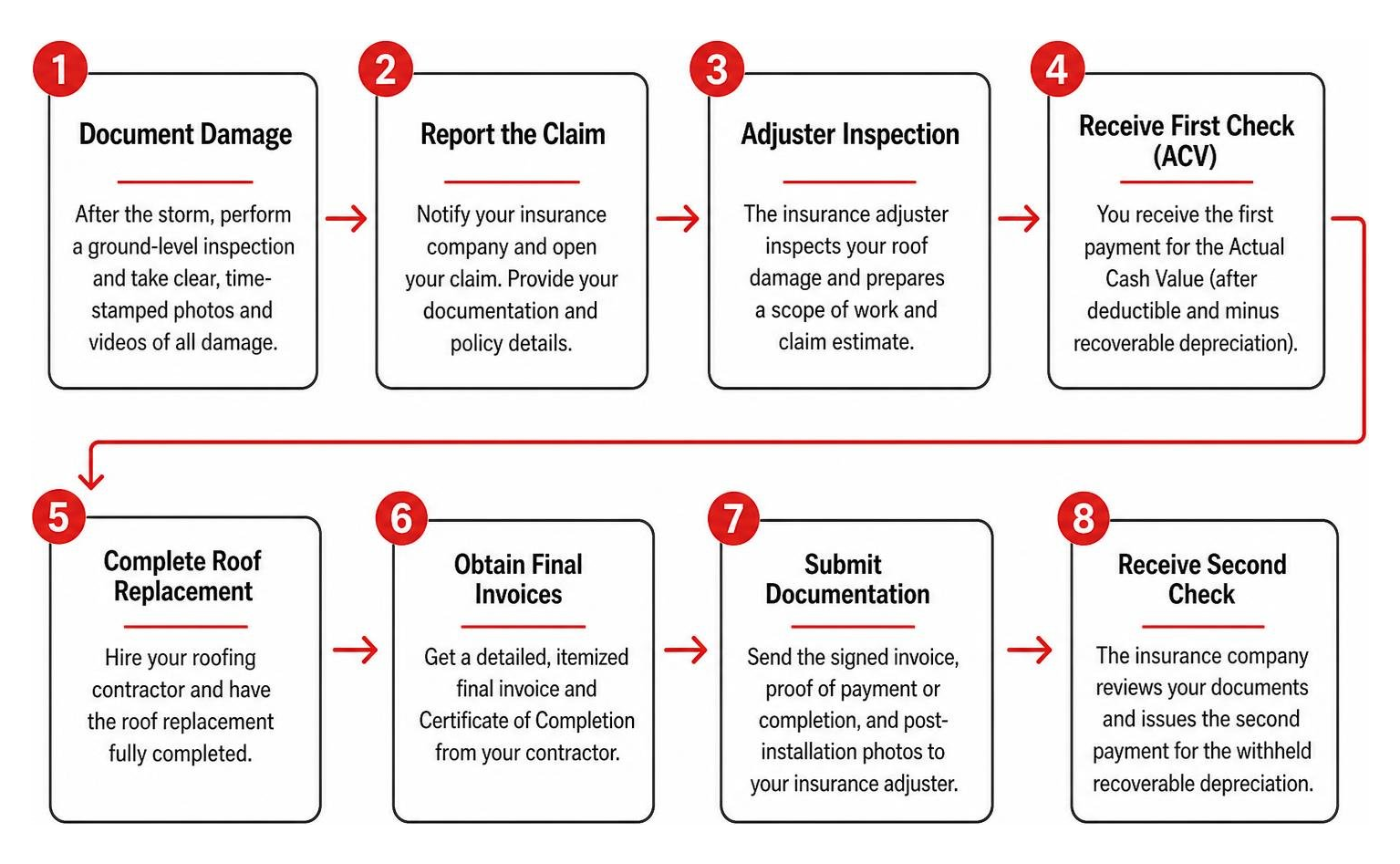
- Complete the Roof Replacement: Hire your roofing contractor and have the installation fully completed.
- Obtain the Final Invoices: Secure a detailed, itemized final bill and Certificate of Completion from your contractor showing the total job cost.
- Submit Documentation: Send the contractor’s signed invoice, proof of payment or completion, and post-installation photos directly to your insurance adjuster or claims representative.
- Receive the Second Check: The insurance company reviews the invoice and issues a second payment reimbursing the withheld recoverable depreciation up to the actual amount spent.
Be mindful of policy deadlines: standard Alabama policies generally give policyholders between 180 and 365 days from the date of loss to complete the repairs and request the release of recoverable depreciation funds.
How Does the Roof Insurance Claim Process Work in Alabama from Start to Finish?
Navigating a roof insurance claim after a storm requires careful documentation and structured communication with your carrier. Following a methodical process ensures your claim is processed fairly and promptly.
Step 1: Document Damage Immediately After the Storm
As soon as weather conditions are safe, perform a preliminary ground-level inspection of your property.
- Take clear, high-resolution, time-stamped photos and videos of fallen shingles, torn ridge caps, dented gutters, damaged window screens, and dented outdoor HVAC units.
- Inspect your attic and ceilings for active water leaks, damp insulation, or daylight showing through roof decking.
- Log the exact date and approximate time the severe weather hit your neighborhood.
Step 2: Mitigate Further Loss
Every insurance policy requires the homeowner to take reasonable steps to protect the property from secondary damage. If you have active water intrusion, install emergency tarps or hire a contractor to secure the roof. Keep every receipt for tarping materials or professional emergency services; these reasonable costs are reimbursable under the property protection provisions of your policy.
Step 3: Get an Independent Inspection Before Calling the Adjuster
Before opening an insurance claim, have a reputable, licensed local roofing contractor perform a thorough inspection. An experienced professional will get on the roof to evaluate wind creasing, hail splatter patterns, and flashing integrity. They can provide an honest assessment of whether the damage exceeds your wind/hail deductible, saving you from filing an unnecessary claim for minor repairs.
Step 4: File the Claim Promptly
Contact your insurance agency or carrier’s claims department to initiate the claim. Provide:
- Your policy number.
- The exact date of loss.
- A concise description of the storm event (e.g., severe thunderstorm with hail).
- Any supporting weather verification, such as local radar data or storm reports from the National Weather Service.
Step 5: Coordinate the Adjuster Meeting
The carrier will assign an insurance adjuster to inspect your roof and prepare an estimate. Request that your independent roofing contractor attend this inspection. Having your contractor on-site ensures both professionals walk the roof together, mark damaged slopes, and agree on the scope of work—including code-required items like drip edges, ice and water shield, and ventilation.
Step 6: Review the Estimate and Supplement If Necessary
When you receive the adjuster’s initial loss report, compare it line-by-line with your contractor’s estimate. If the insurance adjuster missed damaged flashing, overlooked rotted decking hidden under shingles, or failed to account for local building codes, your contractor can submit a supplement request with supplemental photos and documentation directly to the carrier before completing the work.
Step 7: Complete Repairs and Close Out the Claim
Once the initial ACV check arrives and the scope is finalized, schedule the replacement. After the roof is installed, forward the final invoice to your insurer to collect your recoverable depreciation check.
In Alabama, standard roof claims typically take between 2 to 6 weeks from filing to final payment. Following major regional disasters like widespread tornado outbreaks or hurricanes, processing timelines can extend as adjusters manage high claim volumes.
What to Do If Your Claim Is Denied or Undervalued
If your claim is denied or the settlement offer is insufficient:
- Request a Written Explanation: Insurers must provide a specific written denial citing the exact policy language, exclusions, or findings used to make their decision.
- Request a Re-Inspection: If you have contractor photos proving storm damage that the initial adjuster overlooked, request that the insurer send a different adjuster for a secondary review.
- Invoke the Policy Appraisal Clause: If you and the carrier agree that damage is covered but cannot agree on the cost of repairs, most standard policies permit either party to invoke the appraisal clause, bringing in independent appraisers and an umpire to settle the dispute.
- Contact State Regulators: If you believe your carrier is acting in bad faith or violating state claims standards, you can seek guidance from the Alabama Department of Insurance.
What Unique Alabama Programs and Coastal Rules Impact Your Roof Coverage?
Alabama’s geographic layout creates diverse risk profiles across the state. In North and Central Alabama, convective wind and tornado exposure accounts for roughly 40% to 60% of property insurance costs. In coastal regions, hurricane and tropical wind risk accounts for 70% to 80% of total premium expenses. These variations heavily influence market conditions, as detailed in recent Alabama Homeowners Insurance Analysis data.
The Alabama Insurance Underwriting Association (AIUA)
In coastal areas—specifically properties located south of the 31st parallel in Baldwin and Mobile counties—many standard private carriers exclude wind and hail coverage entirely from their policies. Homeowners in these designated coastal zones must purchase a separate windstorm policy through the Alabama Insurance Underwriting Association (AIUA), commonly known as the state’s wind pool of last resort. For homeowners living in inland areas such as Albertville, Marshall County, and surrounding North Alabama communities, wind and hail coverage remains integrated into standard homeowners policies.
Strengthen Alabama Homes (SAH) Program
To combat rising property insurance costs and build regional structural resilience, the State of Alabama created the Strengthen Alabama Homes (SAH) program. Managed by the Alabama Department of Insurance, this initiative provides financial grants of up to $10,000 to eligible homeowners to upgrade their roofs to the FORTIFIED Roof™ standard established by the Insurance Institute for Business & Home Safety (IBHS).
A FORTIFIED Roof installation incorporates specialized construction standards:
- Using ring-shank nails in a denser nailing pattern to double roof deck uplift resistance.
- Sealing the roof deck with specialized tape or fully adhered membrane to prevent water intrusion even if shingles are blown off.
- Installing enhanced metal drip edges and starter shingles locked down with high-wind adhesives.
These grants are awarded on a non-repayable basis and are paid directly to certified FORTIFIED contractors upon completion and independent verification.
Mandatory Insurance Premium Discounts
Investing in wind mitigation delivers substantial, ongoing financial returns in Alabama. State law mandates that all admitted insurance carriers provide meaningful premium discounts to homeowners who secure an official IBHS FORTIFIED designation:
- FORTIFIED Roof: Up to a 20% discount on the wind portion of your premium.
- FORTIFIED Silver: Up to a 35% discount (incorporates roof upgrades plus reinforced gable ends and window protection).
- FORTIFIED Gold: Up to a 40% discount (incorporates full engineered tie-down paths from roof to foundation).
Securing comprehensive home insurance backed by local risk advisors ensures you capture all state-mandated discounts when upgrading your roof.
What Are the Most Common Mistakes Homeowners Make During a Roof Claim?

Filing a roof claim without preparation can lead to unexpected out-of-pocket expenses, claim delays, or unnecessary claim records on your Comprehensive Loss Underwriting Exchange (C.L.U.E.) report. Avoid these five critical mistakes:
1. Filing Claims for Damage Below Your Deductible
Always run the numbers before calling your carrier. If your percentage-based wind/hail deductible is $5,000 and the total cost to fix several blown-off shingles is $1,200, filing a claim yields zero financial recovery while recording a claim entry on your insurance loss history.
2. Delaying Storm Reporting
Most policies contain explicit clauses requiring “prompt notice” of a loss. Waiting six to twelve months after a hailstorm makes it difficult for adjusters to distinguish between original storm damage and subsequent natural weathering, increasing the likelihood of a denial.
3. Signing Assignment of Benefits (AOB) Agreements
After severe storms, out-of-town contractors often canvas neighborhoods offering “free roofs.” Never sign an Assignment of Benefits (AOB) form or any contract containing blank fields. An AOB transfers your insurance claim rights directly to the contractor, taking control of the settlement out of your hands. Work only with established, local, licensed roofing specialists.
4. Neglecting Routine Maintenance Documentation
If an insurer discovers moss growth, rotted fascia boards, or rusted valleys during an inspection, they may attribute internal water damage to maintenance neglect rather than wind impact. Keep annual roof inspection records, gutter cleaning receipts, and maintenance invoices stored securely.
For additional practical tips on managing regional coverage decisions, explore our cheat sheet to common insurance questions for North Alabama homeowners.
Essential Claim Documentation Checklist
Keep these essential records organized before and during a claim:
- Current Policy Declarations Page with dwelling and deductible endorsements.
- Clear before-and-after photos of the roof, siding, and attic.
- Detailed written estimate and scope of work from a licensed local roofing contractor.
- Itemized receipts for emergency mitigation (tarps, plywood, sealants).
- National Weather Service storm report confirmation or local weather alerts.
- Written log containing adjuster contact details, claim reference numbers, and inspection notes.
Frequently Asked Questions About Alabama Roof Replacement Coverage
Will insurance cover a roof replacement if my roof is over 15 years old?
Insurance can still cover storm damage on an older roof, but your policy terms may restrict the payout. Many carriers in Alabama transition roofs older than 10 or 15 years from Replacement Cost Value (RCV) to an Actual Cash Value (ACV) schedule or Roof Payment Schedule endorsement. Under these endorsements, the insurer deducts substantial depreciation based on age. Additionally, aging roofs with severe pre-existing granule loss or brittle shingles may prompt underwriting inspections resulting in non-renewal notices unless replaced.
Can I choose my own roofing contractor for an insurance claim in Alabama?
Yes. Under Alabama law, you have the right to select any licensed, insured contractor of your choice to repair or replace your roof. Your insurance carrier cannot force you to use their preferred vendor network. The only exception involves specialized state-administered grant programs, such as the Strengthen Alabama Homes program, which requires you to select from an approved directory of certified FORTIFIED contractors to ensure compliance with grant engineering standards.
Does homeowners insurance cover roof damage from fallen trees?
Yes, provided the tree fell due to a covered peril such as wind, severe lightning, or ice accumulation. If a healthy tree blows over onto your roof during a storm, your dwelling coverage pays to repair the structural roof damage and covers tree removal from the structure (typically up to policy sub-limits).
If a dead or rotted tree falls onto your roof, the insurer may investigate whether homeowner neglect contributed to the loss. If your neighbor’s healthy tree falls onto your house during a windstorm, your own homeowners policy handles the damage under Coverage A, as wind is deemed the primary cause of loss.
How Can The Hornbuckle Agency Help Protect Your Alabama Home and Roof?
Your roof protects your family and your single largest investment. Ensuring your policy has proper coverage limits, manageable storm deductibles, and complete replacement cost protection should happen before severe weather threatens our area.
At The Hornbuckle Agency, we believe in proactive risk education. As a local Alfa Insurance provider rooted in Albertville, we work directly with families to review their policy declarations, calculate accurate rebuilding limits, and structure wind/hail coverage that prevents costly surprises.
We serve policyholders across multiple North Alabama communities, including:
- Albertville
- Guntersville
- Boaz
- Arab
- Geraldine
- Crossville
- Collinsville
- Horton
- Douglas
Whether you want to ensure your home meets the 80% coinsurance requirement, verify whether your roof is covered under RCV or ACV, or evaluate your mitigation discounts, our team is here to guide you. For an in-depth look at structuring property policies across our region, read the ultimate guide to compare home insurance quotes in Alabama.
Ready to ensure your roof is fully protected against Alabama weather? Contact The Hornbuckle Agency in Albertville today for a comprehensive, personalized home insurance review.
