
What Should You Understand First About House Fire Insurance Coverage?
When a house fire occurs, the damage extends far beyond charred walls and scorched rafters. Fire creates a destructive chain reaction involving extreme heat, caustic smoke, pervasive soot, and hundreds or thousands of gallons of water pumped by local fire departments to suppress the flames. A standard homeowners insurance policy (most commonly written on an HO-3 Special Form) is specifically structured to handle these overlapping layers of destruction.
In standard property insurance, fire and lightning are classified as open perils for the structure and named perils for personal belongings. This means that accidental fires are covered by default unless a specific policy exclusion applies.
However, navigating a fire claim in 2026 requires understanding the modern economic environment of home rebuilding. Over the past five years, construction costs have shifted dramatically. Building materials, specialized trade labor, and supply chain adjustments have driven the average cost per square foot to rebuild up by 30% to 50% across many regional housing markets. Additionally, overall fire-related property damage expenses across the nation have risen by roughly 15%, driven in large part by higher labor wages.
When homeowners experience a total loss fire today, they frequently encounter an unsettling reality: policy limits calculated several years ago often fall short of the true, modern cost of reconstruction. Understanding how each tier of your policy functions—and where potential coverage gaps lie—is the single most important step in protecting your financial foundation.
What Are the Four Primary Coverage Components After a House Fire?

A comprehensive homeowners insurance policy breaks fire protection down into four distinct buckets, labeled Coverages A through D. Each coverage component has its own dedicated limit, valuation rules, and specific terms.
Coverage A: Dwelling Protection and Rebuilding Costs
Dwelling coverage forms the cornerstone of your property policy. It pays to repair or fully rebuild the physical structure of your primary residence if it is damaged or destroyed by fire. This includes:
- The foundation, framing, load-bearing walls, and roof
- Built-in appliances (cooktops, built-in ovens, range hoods)
- Plumbing, electrical wiring, HVAC units, and ductwork
- Permanently installed flooring, cabinetry, countertops, and drywall
- Attached structures, such as attached garages, porches, and decks
It is critical to distinguish between your home’s market value (what someone would pay to purchase your house and the land it sits on) and its replacement cost (the actual price to purchase materials and hire contractors to rebuild the structure from the ground up).
Real estate market prices fluctuate based on school districts, land value, and neighborhood demand, whereas replacement cost is strictly determined by local construction labor rates, architectural complexity, square footage, and building material prices. Understanding the intricacies of dwelling coverage in home insurance helps ensure that your dwelling limit reflects current per-square-foot rebuilding costs rather than an outdated purchase price.
Coverage B: Other Detached Structures
Most properties feature improvements located outside the primary dwelling’s footprint. Coverage B protects unattached structures on your land that are separated from the main house by clear space or connected only by a fence or utility line.
Standard items covered under Coverage B include:
- Detached garages and carports
- Storage sheds, barns, and detached workshops
- Fences, privacy walls, and perimeter gates
- Gazebos, pergolas, and outdoor kitchens
- Driveways, walkways, and retaining walls damaged by fire
By default, insurers typically set Coverage B at 10% of your Coverage A limit. For instance, if your primary dwelling is insured for $400,000, you will automatically have $40,000 in baseline detached structure coverage.
For properties with customized workshops, pool houses, or extensive agricultural outbuildings, this default 10% allocation may prove insufficient. In those situations, exploring customized endorsements or specialized protections, such as protecting your farm and home with Alfa Insurance in Marshall County, ensures that every detached outbuilding maintains adequate structural protection limits.
Coverage C: Personal Property and Contents
Coverage C reimburses you for the loss of personal belongings inside the home that are ruined by fire, smoke, soot, or water. If you were to pick up your house, turn it upside down, and shake it, everything that falls out generally falls under personal property:
- Furniture, mattresses, rugs, and window treatments
- Clothing, shoes, and personal accessories
- Free-standing appliances (refrigerators, washers, dryers)
- Electronics, televisions, computers, and home entertainment setups
- Kitchenware, cookware, small countertop appliances, and pantry goods
- Tools, sporting goods, books, and musical instruments
Personal property limits are usually established at 50% to 70% of Coverage A. If your home is insured for $400,000, your personal property coverage typically ranges between $200,000 and $280,000.
Category Sub-Limits to Keep in Mind
While your overall contents limit might seem large, standard policies enforce strict internal dollar limits on specific high-risk or high-value item categories:
- Jewelry, watches, and precious stones: Often capped at $1,500 to $2,500 total
- Firearms and accessories: Commonly capped at $2,000 to $2,500
- Fine silverware, goldware, and pewterware: Typically limited to $2,500
- Cash, bullion, and bank notes: Often capped at $200
- Business personal property kept at home: Commonly limited to $2,500
To ensure total reimbursement for heirlooms, high-end jewelry collections, or specialized sporting equipment, reviewing our homeowners insurance complete guide provides actionable advice on scheduling individual high-value items through scheduled personal property floaters.
Coverage D: Additional Living Expenses (ALE)
When a severe fire leaves a residence uninhabitable, the financial strain of displacement begins immediately. Coverage D, also known as Loss of Use or Additional Living Expenses (ALE), steps in to maintain your family’s normal standard of living while your home is undergoing remediation and reconstruction.
ALE operates on an incremental cost principle: it reimburses the difference between what it normally costs you to live and the extra expenses incurred due to your displacement. Covered expenses include:
- Extended-stay hotel bills, apartment leases, or comparable single-family rental homes
- Reasonable restaurant meals and grocery cost increases if your temporary residence lacks full kitchen facilities
- Utility connection fees and setup charges at a temporary rental property
- Storage unit fees for salvaged personal belongings
- Pet boarding costs if your temporary rental prohibits animals
- Increased commuting mileage if your temporary home is farther from work or school
- Emergency laundry and dry cleaning services
Coverage D limits are commonly set at 20% to 30% of Coverage A, though some policies provide actual loss sustained coverage up to a specified time limit.
Critically, policies impose a strict duration restriction—typically 12 to 24 months. Because complex total-loss rebuilds often take 12 to 18 months from initial debris cleanup to final certificate of occupancy, managing your ALE budget carefully from day one is essential to avoid running out of temporary housing funds before reconstruction finishes.
How Do Replacement Cost and Actual Cash Value Impact Your Fire Settlement?
The single largest factor dictating how much money you receive after a fire claim is whether your policy calculates payouts using Replacement Cost Value (RCV) or Actual Cash Value (ACV).
| Policy Feature | Actual Cash Value (ACV) | Replacement Cost Value (RCV) |
|---|---|---|
| Depreciation Deduction | Yes (deducts for age, wear, and obsolescence) | No (pays full modern retail price) |
| Initial Claim Payout | Depreciated market value only | ACV paid first; depreciation released after purchase |
| Out-of-Pocket Expense | High (homeowner pays the depreciation gap) | Low (limited primarily to policy deductible) |
| Dwelling Rebuild Impact | May leave tens of thousands in unpaid repair costs | Covers full contractor invoices up to policy limit |
| Contents Replacement | Pays garage-sale/used item value | Pays price to buy brand-new equivalent items |
Actual Cash Value (ACV) vs. Replacement Cost Value (RCV)
Actual Cash Value (ACV) calculates compensation based on the current depreciated value of your property immediately prior to the loss. The formula is straightforward:
$$\text{ACV} = \text{Replacement Cost} – \text{Depreciation}$$
For example, if a 6-year-old television that originally cost $1,200 is destroyed, and its useful lifespan was estimated at 8 years, an ACV settlement would deduct 75% for depreciation, resulting in a payout of just $300. You would be responsible for paying the remaining $900 out of pocket to purchase a new television of similar quality.
Replacement Cost Value (RCV), by contrast, reimburses the actual cost to repair or replace the damaged item or structural element with new materials of like kind and quality, without subtracting a deduction for physical depreciation or age. Under an RCV policy, that same destroyed television would be reimbursed for the full $1,200 required to buy a modern equivalent.
Recoverable Depreciation and Holdback Processes
If you hold an RCV policy, insurance carriers do not simply hand over a single lump-sum check for the full replacement cost on day one. Instead, they utilize a two-stage settlement framework known as recoverable depreciation:
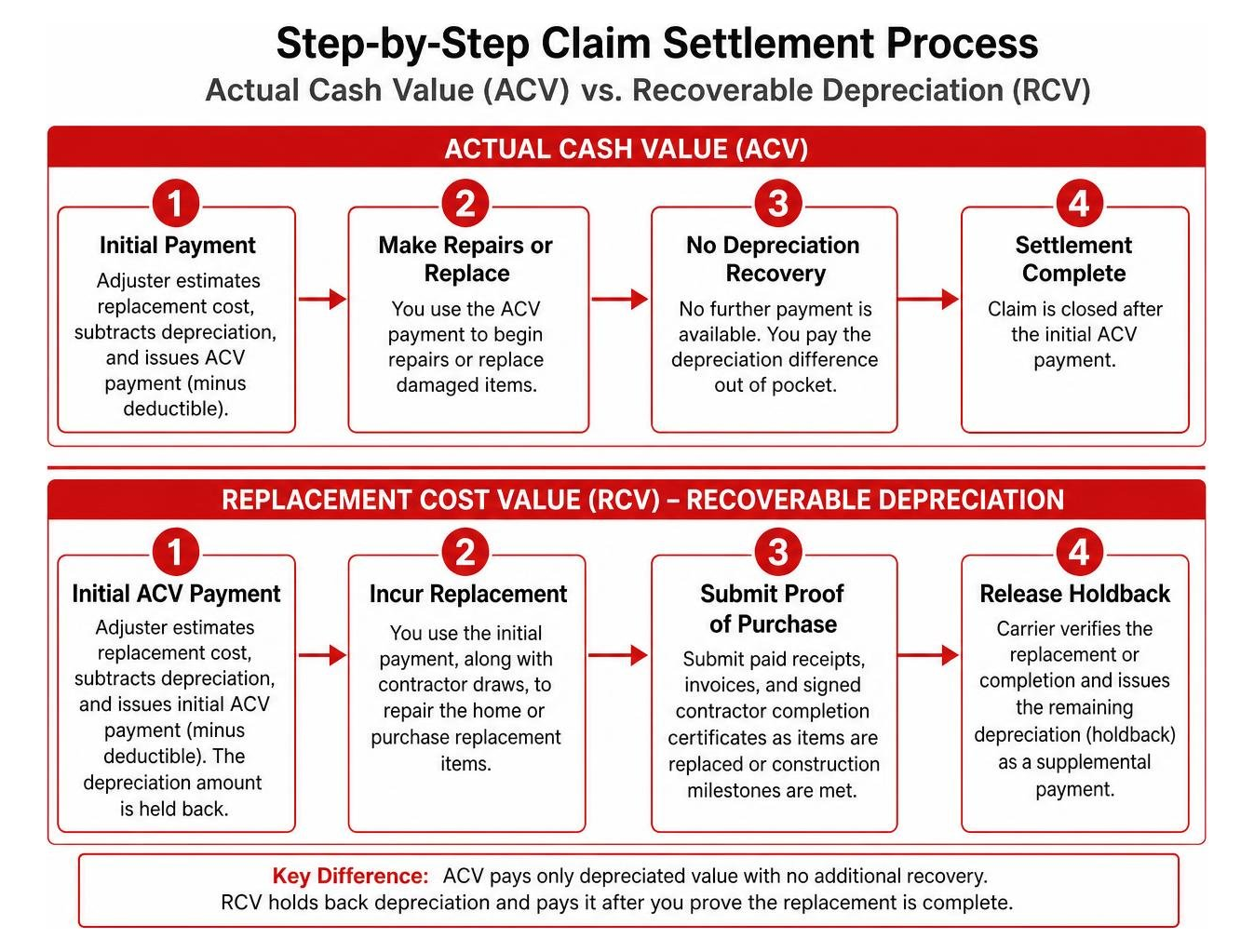
- The Initial ACV Payment: The insurance adjuster inspects the loss and estimates the total replacement cost, subtracts depreciation, and issues an initial check for the Actual Cash Value (minus your deductible).
- The Incurred Replacement: You use those initial funds, along with contractor draws, to begin rebuilding the home or purchasing replacement contents.
- Submitting Proof of Purchase: As you replace items or complete construction milestones, you submit paid receipts, invoices, and signed contractor completion certificates to the claims adjuster.
- Releasing the Holdback: Once the carrier verifies that the item was actually replaced or the repair was finished, they issue a secondary check releasing the withheld depreciation.
Most policies give homeowners 180 to 365 days from the date of loss to replace items and claim this recoverable depreciation. Failing to submit receipts within this window can forfeit your right to the remaining funds, effectively turning an RCV policy into an ACV settlement.
Extended and Guaranteed Replacement Cost Endorsements
A standard RCV dwelling limit establishes a fixed maximum dollar cap. However, widespread structural fires or severe regional disasters frequently create localized spikes in material costs and contractor shortages—known in the insurance industry as demand surge.
Industry data shows that 65% of U.S. homes are underinsured for full replacement cost, with an average shortfall exceeding $40,000 between policy limits and actual reconstruction bills.
To safeguard against sudden construction inflation, homeowners can attach specialized endorsements:
- Extended Replacement Cost: Increases your dwelling coverage limit by an additional 10% to 50% above your base Coverage A amount if rebuilding costs exceed your limit. For example, a $400,000 policy with a 25% extended replacement endorsement provides up to $500,000 in total rebuilding funds.
- Guaranteed Replacement Cost: The most comprehensive coverage available, which pays the full cost to rebuild your home back to its pre-loss condition, regardless of whether the final construction bill exceeds the policy limit.
- Inflation Guard: An automatic policy endorsement that periodically adjusts your Coverage A limit at annual renewals to keep pace with prevailing building cost indices.
Evaluating your policy structure and choosing appropriate homeowners insurance fire coverage limits ensures your family will not be forced to absorb massive construction shortfalls after a disaster. You can also explore independent guidance in resources like this 2026 fire damage insurance analysis to see how different endorsements function during real-world total losses.
What Types of Fire Damage and Expenses Are Typically Excluded?
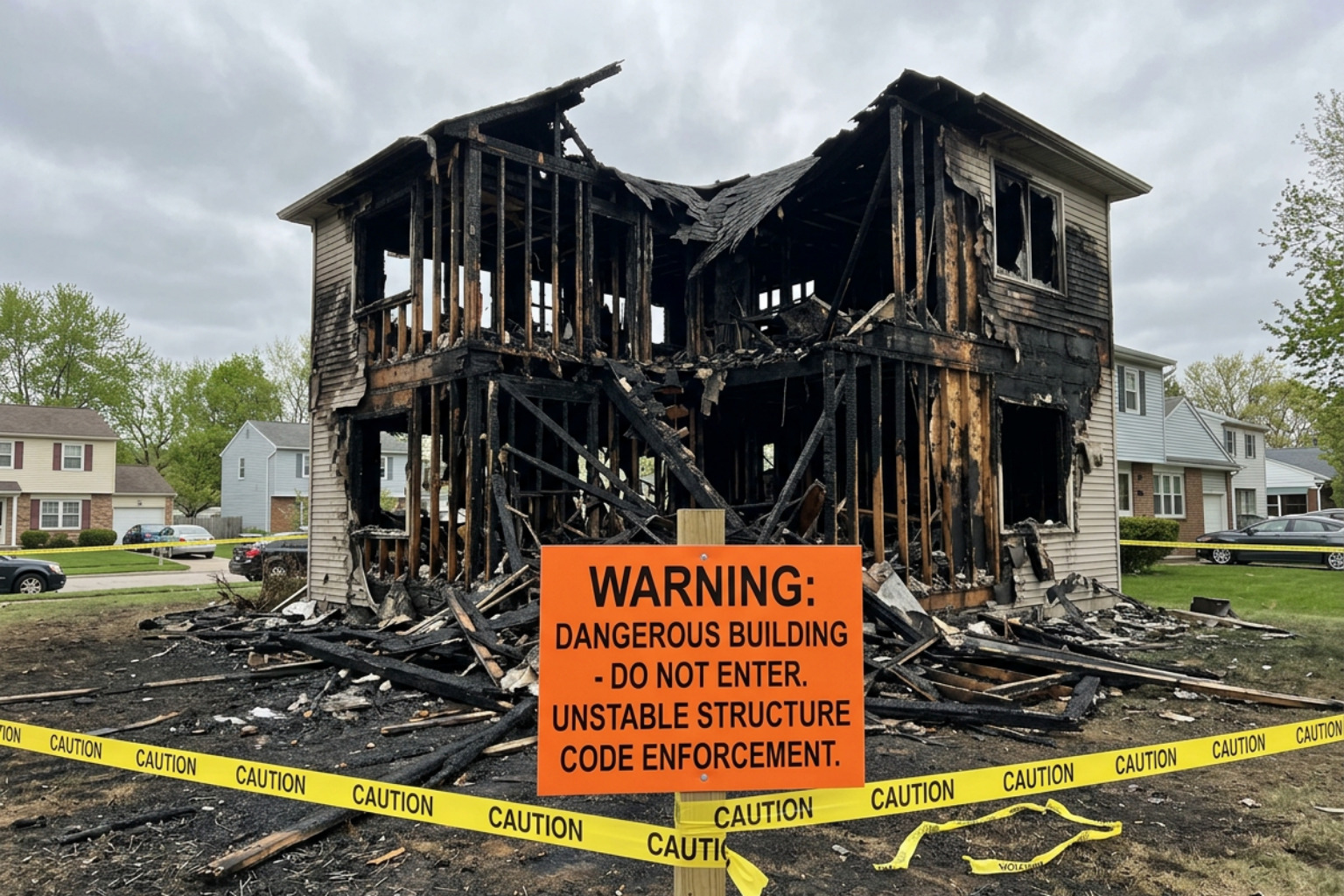
While fire is universally recognized as a primary covered peril, standard homeowners insurance policies contain clear boundaries, exclusions, and financial ceilings that every property owner should understand.
Intentional Acts, Arson, and Vacancy Clauses
Coverage is designed exclusively for sudden, unexpected, and accidental losses. Homeowners policies explicitly exclude:
- Arson and Intentional Acts: If the insurer proves through forensic fire investigation that the policyholder or an insured family member intentionally set the fire or conspired to cause the damage to collect insurance proceeds, the entire claim will be denied and referred for criminal fraud prosecution.
- Vacancy Clauses: If a home remains unoccupied and largely unfurnished for a prolonged period (typically 30 to 60 consecutive days depending on policy terms) before a fire breaks out, coverage may be suspended or denied entirely. Vacant homes carry elevated risks of undetected electrical faults, vandalism, and delayed emergency response times. If a home is undergoing long-term renovations or sitting vacant during an estate transition, a specialized vacant home insurance rider is required.
Ordinance or Law Upgrades and Building Code Compliance
When rebuilding a home after a fire, municipal building departments require the new construction to comply with current building codes and zoning ordinances. If your home was built 20, 30, or 50 years ago, modern building codes may mandate significant structural and mechanical upgrades:
- Installing residential fire sprinkler systems
- Upgrading to arc-fault electrical breakers and modern wiring standards
- Adding high-efficiency insulation, energy-efficient windows, and solar provisions
- Implementing enhanced hurricane straps, earthquake ties, or roof-to-foundation anchoring
- Upgrading plumbing and septic systems to modern environmental requirements
A baseline homeowners policy pays only to rebuild the house to its original pre-loss specifications. Standard policies exclude the additional costs required to bring undamaged or rebuilt sections into compliance with new laws.
In 2026, building code compliance mandates can easily add $50,000 to $100,000 to the total cost of rebuilding an older home. Protecting yourself against this exposure requires adding an Ordinance or Law endorsement, which typically allocates an extra 10%, 25%, or 50% of Coverage A specifically for mandated code upgrades.
Secondary Damage Exclusions and Personal Property Caps
Certain physical items and ancillary costs associated with a fire are subject to distinct policy treatment:
- Motor Vehicles: Any cars, trucks, motorcycles, or ATVs parked in your garage or driveway that burn during a house fire are completely excluded from your homeowners policy. Vehicle damage must be claimed under the comprehensive coverage of your separate auto insurance policy.
- Landscaping and Mature Trees: Policies typically place a strict sub-limit on outdoor trees, shrubs, and lawns damaged by fire—often capping reimbursement at $500 to $1,000 per tree and a total ceiling of 5% of Coverage A.
- Debris Removal Expenses: Clearing away charred structural debris, hauling away toxic ash, and scraping foundations is labor-intensive and environmentally regulated. Debris removal after a total loss fire regularly costs between $20,000 and $40,000. Most policies cap debris removal at 5% of Coverage A unless an additional debris removal endorsement is in place.
Reviewing the fundamental principles outlined in the Insurance Information Institute’s Homeowners Insurance Handbook can help you verify how ancillary coverages and limits are structured across standard policies.
How Do You Successfully Navigate the Fire Insurance Claims Process?
Recovering from a residential fire is a detailed process that typically spans 12 to 18 months for major or total losses. Maintaining organization and understanding the proper sequence of steps dramatically improves settlement outcomes.
Immediate Steps and Initial Claim Filing
The actions you take in the first 48 to 72 hours after a fire establish the trajectory of your entire claim:
- Notify Your Insurance Carrier or Local Agent: Report the loss immediately. Provide the date, approximate time, responding fire department jurisdiction, and the current location of all family members.
- Request an Emergency ALE Advance: Ask your adjuster for an immediate advance check against your Coverage D (Additional Living Expenses) to pay for emergency clothing, toiletries, prescription replacements, and short-term hotel lodging.
- Secure the Property: Homeowners have a legal duty under policy conditions to mitigate further damage. Once the fire marshal grants permission to enter the site, arrange to board up broken windows, tarp exposed roof sections, and install temporary fencing to prevent weather intrusion, vandalism, or liability hazards. Keep every receipt for emergency mitigation work.
- Establish Parallel Claims Tracks: Treat your claim as three separate files operating simultaneously:
- Track 1: Structural Dwelling & Debris Removal (Coverage A & B)
- Track 2: Personal Property & Contents (Coverage C)
- Track 3: Additional Living Expenses (Coverage D)
Assembling a Bulletproof Home Inventory and Proof of Loss
To receive maximum reimbursement for your belongings under Coverage C, you must establish an itemized proof of loss. Insurance carriers require a detailed spreadsheet listing every damaged or destroyed possession.
When building your post-fire inventory:
- List Item Specifics: Record the brand name, exact model number, approximate purchase date, estimated original retail cost, and current replacement price for every item. Instead of writing “toaster,” list “Breville 4-Slice Smart Toaster, Model BTA840XL.”
- Leverage Digital Trails: Search your online shopping order histories, credit card statements, bank records, and email receipts to substantiate ownership and cost.
- Retrieve Pre-Loss Media: Gather family photographs, holiday videos, and smartphone cloud backups that show furniture, art, electronics, and clothing inside the home prior to the fire.
- Account for Invisible Smoke and Acidic Soot Damage: Fire produces acidic soot particles that corrode circuit boards, pit metal fixtures, and deeply penetrate porous upholstery. Do not allow adjusters to classify items as undamaged without certified restoration testing.
- Document Water Suppression Losses: Include items soaked, warped, or mold-damaged due to high-pressure fire hoses and municipal water suppression efforts.
Working with Insurance Adjusters and Public Adjusters
Throughout the recovery process, you will interact with different types of adjusters who play distinct roles in determining your settlement:
- Staff Adjuster: A direct, salaried employee of your insurance company assigned to manage your claim, evaluate damage estimates, and issue payments.
- Independent Adjuster (IA): A third-party contractor hired by your insurance carrier to handle field inspections, adjust losses, and compile repair estimates during high-volume periods or regional disasters.
- Public Adjuster (PA): An independent, licensed claims professional hired directly by you—the policyholder—to advocate on your behalf, calculate scope of loss, and negotiate settlements directly with the insurance carrier.
Public adjusters typically charge a contingency fee ranging between 10% and 15% of the gross insurance settlement. For minor kitchen fires or clear-cut structural claims, hiring a public adjuster is rarely necessary.
However, if you face a catastrophic total loss, an ongoing dispute over structural repair scopes, or severe lowball estimates from the insurer’s adjusters, engaging a qualified public adjuster can help level the playing field. For further details on dispute resolution and loss negotiation, refer to the industry guidance on settling insurance claims after a disaster.
Frequently Asked Questions About Homeowners Insurance Fire Coverage
Does homeowners insurance cover a fire accidentally started by the homeowner?
Yes. Standard homeowners insurance policies cover accidental fires caused by homeowner negligence or everyday household mishaps. This includes fires resulting from:
- Unattended cooking, grease fires, and kitchen flare-ups
- Overloaded electrical outlets, faulty power strips, or DIY wiring mistakes
- Burning candles knocked over by children or pets
- Fireplace sparks escaping past a hearth screen
- Discarded smoking materials or barbecue grill flare-ups
The only scenario where an accidental or self-caused fire is denied is if the insurer proves deliberate, intentional arson or fraudulent destruction committed by the policyholder.
How are smoke, soot, and water damage from firefighting efforts covered?
Smoke, soot, and water used during emergency firefighting operations are fully covered as direct extensions of the fire peril. Under insurance law, fire is recognized as the proximate cause of the loss:
- Smoke Damage: Lingering smoke odors embedded in framing, insulation, ductwork, and clothing are covered for professional ozone treatment, thermal fogging, or full replacement.
- Acidic Soot: Fine carbon particles that settle on appliances, HVAC coils, and structural surfaces are covered for specialized chemical sponge cleaning or total replacement.
- Water Damage: Saturated subfloors, ruined drywall, and warped hardwood floors resulting from fire hoses or residential sprinkler activations are covered as fire-related structural damages.
Can you rebuild your home in a different location after a total loss fire?
Yes. In the event of a total loss, policyholders are generally not legally obligated to rebuild the exact same house on the exact same plot of land. You have the right to take your insurance settlement and:
- Rebuild a different style of home on your existing property
- Purchase a replacement home in another neighborhood or community
- Build a new home on a different parcel of land
However, the insurer’s financial obligation is capped at what it would have cost to rebuild the original structure on the original lot, up to your policy limit. Any additional costs associated with purchasing more expensive land or building larger square footage remain your personal responsibility.
How Can You Ensure Your Home Is Adequately Protected Before Disaster Strikes?
Recovering from a house fire is one of the most emotionally and financially challenging experiences a family can endure. The difference between a smooth recovery and an agonizing financial shortfall comes down to the quality and accuracy of your property coverage before the flames start.
Because construction, labor, and material costs change over time, holding an unexamined policy from years ago creates substantial risk. We strongly recommend completing an annual coverage review to ensure:
- Your Coverage A dwelling limit matches current per-square-foot reconstruction rates.
- You have attached an Extended or Guaranteed Replacement Cost endorsement.
- Your policy includes adequate Ordinance or Law coverage to absorb building code upgrades.
- High-value personal belongings are scheduled through tailored policy floaters.
- You maintain an off-site, cloud-backed digital video inventory of your household possessions.
At The Hornbuckle Agency, we believe in providing personalized risk education and comprehensive Alfa Insurance solutions to protect your home, your family, and your financial future. We proudly serve multiple Alabama communities, including Albertville, Guntersville, Boaz, Arab, Geraldine, Crossville, Collinsville, Horton, and Douglas.
Whether you need to review your current policy limits, update your personal property schedules, or explore tailored coverage for your family, our local team is here to help you navigate every detail.
To evaluate your existing protections or compare local options, explore our comprehensive guide on home insurance and discover how to optimize your coverage through the ultimate guide to compare home insurance quotes in Alabama.
Ready to make sure your home is fully protected against the unexpected? Contact our local team at The Hornbuckle Agency today to schedule your comprehensive coverage review.
