
How to Choose Alabama Farm Insurance
Alabama farm insurance can cover your home, farm buildings, equipment, livestock, and liability. Crop losses may need separate multi-peril crop insurance. To find affordable protection, list your property and farm activities, ask about discounts and deductible choices, and check how a damaged poultry house would be valued.
Core Coverages in Alabama Farm Insurance Policies
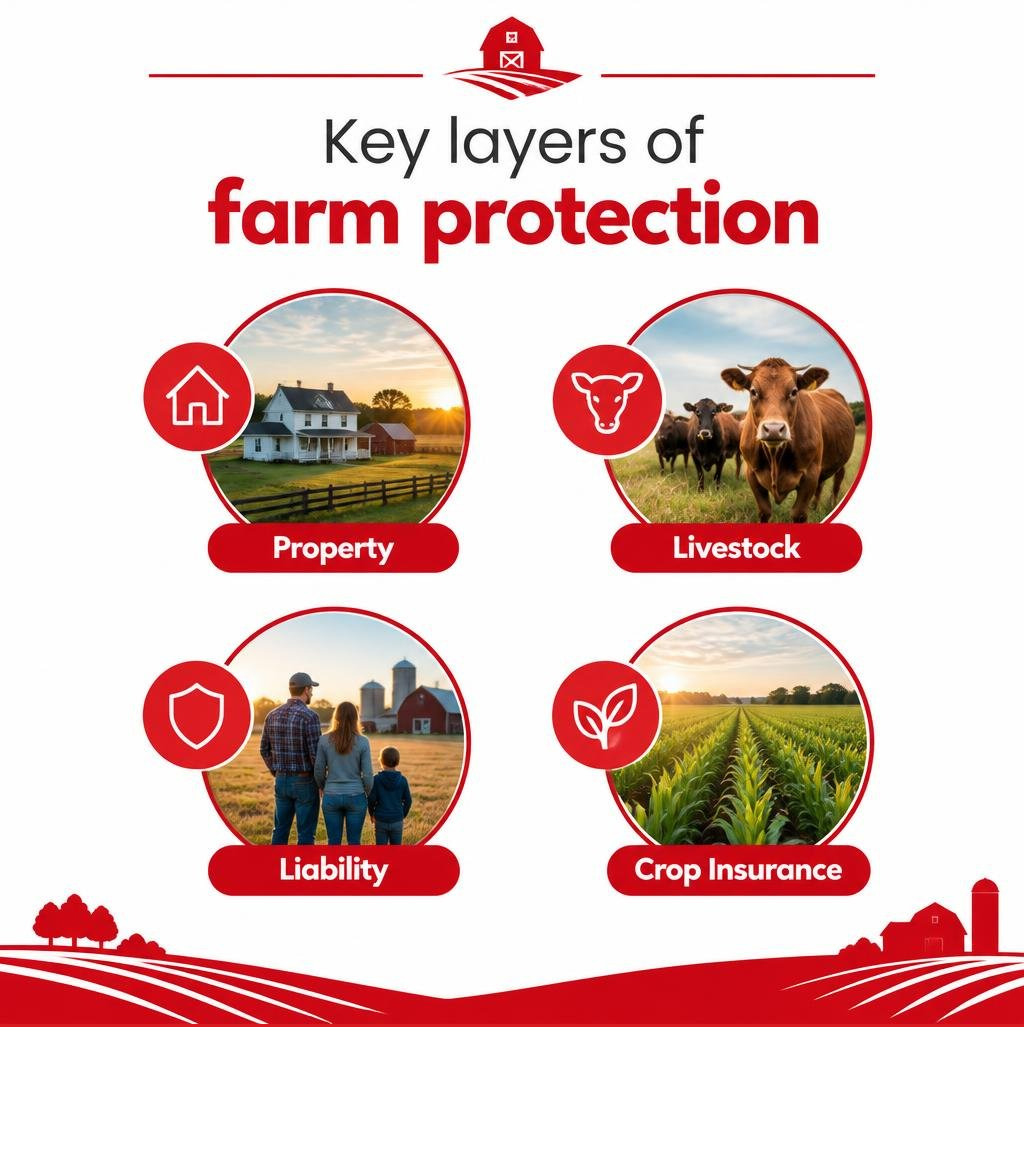
Operating an agricultural business in Alabama requires managing severe weather, shifting commodity markets, and complex liability risks. Standard policies protect your foundational assets by blending residential protection with commercial agricultural coverage into a cohesive policy. These packages safeguard farm dwellings, barns, grain bins, mechanical equipment, and livestock against covered perils such as fire, lightning, windstorms, hail, and vandalism.
Beyond direct property loss, specialized agricultural endorsements address livestock mortality, accidental shooting, attacks by wild animals, and loading accidents. Because local farming traditions are deeply rooted in community collaboration, policyholders benefit from statewide industry resources like the Alabama Farmers Federation network, representing over 350,000 members who advocate for sustainable agricultural interests and rural growth across our state.
Multi-Peril Crop Protection vs Private Alabama Farm Insurance
Private property policies protect your harvested grain in storage and mobile machinery, but field crops require a different approach. Standard farm policies do not cover standing crops damaged by drought, excessive moisture, insect infestations, disease, or widespread freezes. Managing these risks requires federally backed multi-peril crop insurance (MPCI).
The USDA Risk Management Agency (RMA) administers these programs, establishing coverage terms for policies ranging from basic Catastrophic Risk Protection (CAT) to higher-tier revenue protection. These federal policies are purchased through licensed private crop insurance agents rather than directly from government offices. Proper risk management requires evaluating harvest season protections early in the production cycle so field operations remain solvent through unexpected seasonal disruptions.
Farm Liability and Umbrella Extensions
Farm liability insurance protects your operation against third-party bodily injury and property damage claims arising from everyday farming practices. Common exposures include:
- Escaped livestock wandering onto county roads and causing vehicular collisions
- Chemical drift from pesticide or herbicide applications reaching neighboring properties
- Delivery drivers or grain haulers sustaining injuries on slick barn ramps or unpaved driveways
- Contamination claims connected to sold agricultural commodities
When catastrophic events produce liabilities exceeding standard limits, farm umbrella insurance extends coverage beyond your base policies. An umbrella endorsement provides critical legal defense resources and excess liability limits, safeguarding your land, savings, and multigenerational equity against devastating judgments. Exploring comprehensive farm insurance options ensures your liability thresholds match your actual operational scale.
Property Valuation: Replacement Cost vs Actual Cash Value

How an insurer calculates the payout on damaged structures fundamentally dictates your financial recovery after a disaster. Agricultural property claims settle under one of two valuation standards: Replacement Cost (RC) or Actual Cash Value (ACV).
Under Actual Cash Value, your settlement equals the cost to repair or replace the damaged asset minus physical depreciation accumulated over its lifespan. For older outbuildings, barns, and machinery, this deduction can significantly diminish your payout. Replacement cost coverage, by contrast, reimburses the actual expense required to repair or rebuild structures with materials of like kind and quality at current market prices, without factoring in depreciation.
| Valuation Feature | Replacement Cost (RC) | Actual Cash Value (ACV) |
|---|---|---|
| Depreciation Deduction | None applied to covered structural claims | Deducted based on age, wear, and obsolescence |
| Out-of-Pocket Expense | Limited primarily to your policy deductible | Policy deductible plus accumulated depreciation |
| Rebuilding Practicality | Provides modern capital to reconstruct immediately | Payout may fall short of current construction costs |
| Premium Impact | Slightly higher base rate for complete protection | Lower ongoing premium with higher risk retention |
Poultry House Settlement Provisions
Poultry farming is a cornerstone of North Alabama agriculture, but modern commercial poultry houses represent significant capital investments with high vulnerability to severe winds, heavy snow loads, equipment breakdown, and catastrophic fires.
Standard agricultural policies often settle poultry house losses on an Actual Cash Value basis. Because truss wear, insulation age, and equipment depreciation accumulate quickly, an ACV payout can leave a grower hundreds of thousands of dollars short when attempting to reconstruct a modern, computer-automated tunnel house. Adding a dedicated replacement cost endorsement ensures damaged houses are rebuilt to modern integrator standards without deducting for structural age. Combining this with clear provisions for protecting farm structures and rural homes provides complete stability across residential and commercial farm buildings.
Outbuildings and Out-of-Area Machinery Protection
Agricultural operations rely heavily on off-premises equipment mobility. Tractors, combines, sprayers, and implements frequently travel public roads between detached fields, leasehold pastures, and cooperative facilities.
Standard on-premises coverage ceases when machinery leaves your property boundaries. Securing scheduled farm personal property or blanket mobile machinery endorsements protects expensive tractors against overturns, roadway collisions, and off-site fires. Reviewing your off-premises equipment coverage ensures tools and mobile implements remain fully insured wherever production demands take them.
Practical Ways to Lower Agricultural Premiums
Managing farm overhead in 2026 demands practical balance between comprehensive asset protection and cost efficiency. Agricultural producers across the Marshall County agricultural community can utilize several strategic options to reduce their annual premium expenses without introducing dangerous gaps into their foundational coverage plans.
How Deductible Choices Impact Alabama Farm Insurance Rates
Adjusting your property deductible is one of the most direct levers for controlling premium expenses. Higher deductibles reduce an insurer’s exposure to small, frequent maintenance claims, allowing them to lower your ongoing rate.
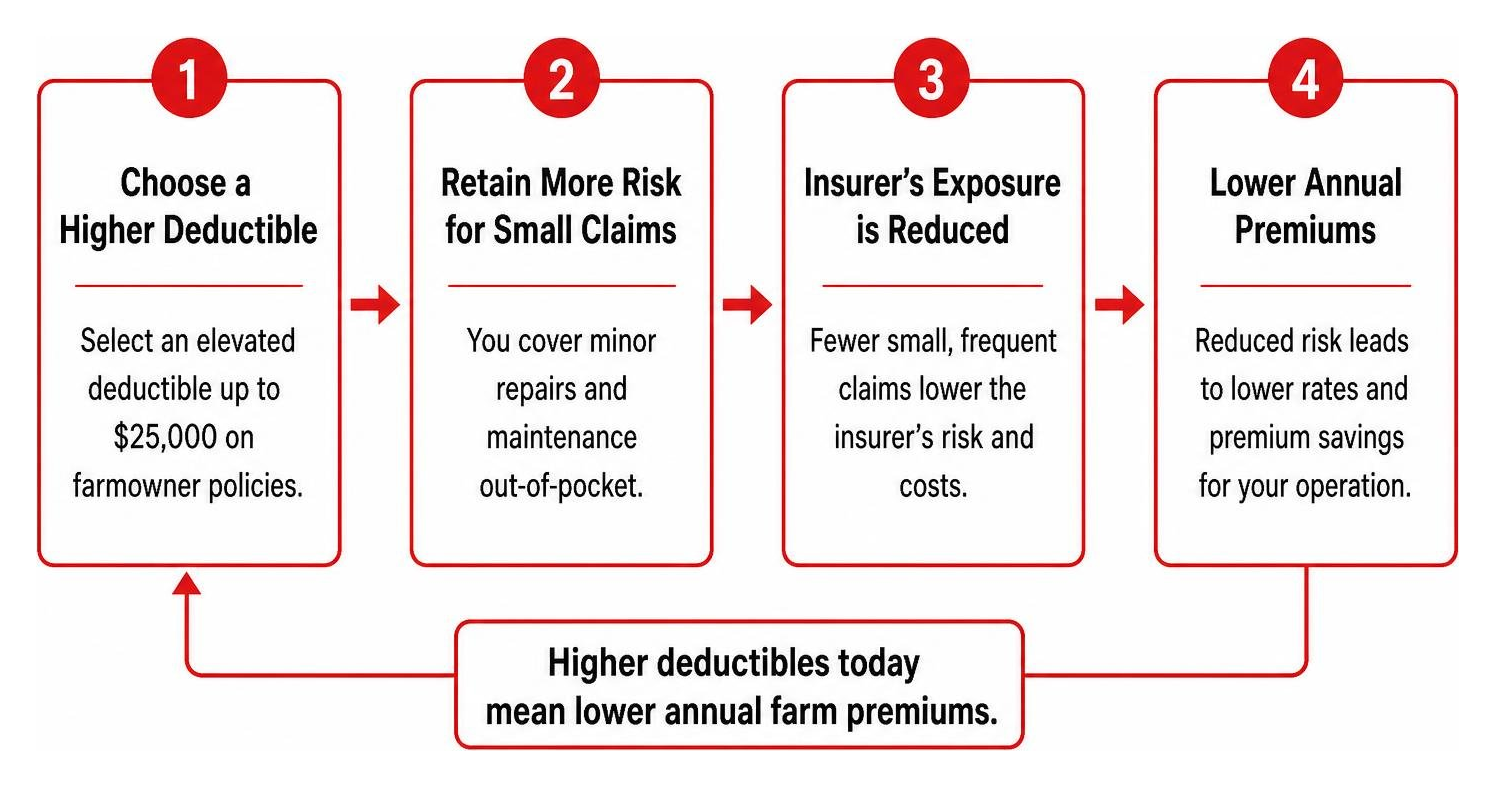
Alfa Insurance offers deductible choices scaling up to $25,000 on farmowner policies. Selecting an elevated deductible structure makes sense for operations with adequate liquid cash reserves. By retaining risk for minor property repairs, you can secure substantial reductions on baseline premium costs, preserving capital for primary inputs like seed, feed, and fuel.
Safety Features and Risk Mitigation Credits
Insurance underwriters reward proactive risk management. Installing protective systems and maintaining clean production facilities earns valuable policy discounts:
- Fire Suppression Systems: Installing verified fire extinguishers, automatic sprinkler networks, or dry chemical systems in shops, processing facilities, and generator sheds.
- Security Monitoring: Equipping residences, tack rooms, and chemical storage buildings with central station burglar and smoke alarms.
- Electrical Maintenance: Upgrading historical barn wiring to modern code standards in conduit to mitigate arc-fault fire risks.
- Deadbolt and Gated Security: Securing farm entryways, equipment compounds, and fuel storage tanks with approved physical security hardware.
Adapting Insurance for Operational Growth and Land Use Changes
Farms are dynamic operations that evolve continuously. Adding poultry capacity, clearing timber for pasture, constructing hay barns, or purchasing specialized harvesting machinery alters your operational risk profile. Whenever you modify acreage or operational scope, notify your insurance agent to schedule an on-site property inspection, ensuring new structures and equipment are added to your schedule of values before an unexpected loss occurs.
Introducing New Agricultural Activities
Transitioning from a family garden to a market crop producer, or adding a commercial beef herd to rural acreage, moves an operation beyond the scope of personal residential coverage. Reviewing hobby farm coverage requirements helps identify when growing sideline activities outgrow conventional homeowners limits and require a commercial agricultural policy.
Managing Agritourism and Specialized Land Leases
Diversifying your revenue through agritourism, corn mazes, pumpkin patches, or recreational leasing brings unique liability exposures. Inviting public visitors or recreational hunters onto working farmland increases third-party injury risks from uneven ground, farm machinery, or accidental discharges. Addressing these exposures requires understanding hunting lease liability considerations and securing dedicated endorsements designed for public land use.
Frequently Asked Questions About Agricultural Protection
How does the USDA RMA support Alabama crop producers?
The USDA Risk Management Agency develops actuarial tables, establishes baseline premium support, and sets product guidelines for multi-peril crop insurance across Alabama. Because federal agencies do not sell policies directly to farmers, producers access this protection through licensed private crop insurance agents found using the online RMA Agent Locator tool.
What is the advantage of a replacement cost endorsement for poultry growers?
A replacement cost endorsement guarantees that damaged poultry houses and integrated feeding, watering, and ventilation equipment are rebuilt or replaced without physical depreciation deductions. This prevents producers from absorbing massive construction shortfalls after catastrophic wind, hail, or fire losses.
What should producers do when expanding their agricultural operations?
When acquiring land, adding livestock species, or building outbuildings, immediately contact your local agent. They will conduct an operational review, verify equipment values, and adjust policy liability limits to prevent underinsurance.
Conclusion
Securing dependable, cost-effective agricultural coverage requires thoughtful planning, accurate property valuation, and tailored liability thresholds. Our team at The Hornbuckle Agency serves multiple Alabama communities, including Albertville, Guntersville, Boaz, Arab, Geraldine, Crossville, Collinsville, Horton, and Douglas. We provide the personalized risk guidance necessary to safeguard your agricultural heritage. Contact us today to build your customized farm insurance policies and protect your operation for generations to come.
