
Why Is Insuring Rural Acreage, Farmland, and Hunting Land Different in Alabama?
To insure hunting land, farm property, and rural acreage in Alabama, you need a layered insurance structure that combines residential dwelling coverage, farm property and liability protection, and specialized hunting lease liability. Start by scheduling every dwelling, barn, equipment shed, and fence line under a dedicated farm or rural property policy, then add liability coverage for agricultural operations, livestock, and any paid hunting or recreational use. Standard homeowners policies are not designed for these exposures.
Insuring rural land in Alabama is fundamentally different from purchasing a standard suburban homeowners policy. When you own a quarter-acre lot in a subdivision, your primary concern is the structure of your house and standard premises liability for everyday visitors. However, when you own 20, 100, or 1,000 acres in rural Alabama, your property encompasses multiple distinct land uses—each carrying its own set of exposures, legal liabilities, and property risks.
As of 2026, Alabama land values average around $3,645 per acre, with rural parcels and timberland often ranging between $2,500 and $5,000 per acre depending on location, topography, and timber stand maturity. With statewide land sales surging nearly 18% year-over-year, more individuals and families are investing in acreage for weekend hunting, timber investment, livestock farming, or private homesteads.
Yet many landowners assume their primary personal homeowners policy automatically extends liability and property protection across their entire rural perimeter. In reality, standard homeowners policies contain strict exclusions for:
- Activities generating income, such as leasing land to hunters or harvesting timber
- Unscheduled outbuildings, large equipment barns, hay sheds, and livestock shelters
- Heavy agricultural machinery, tractors, implements, and utility vehicles
- Livestock-related liabilities, including animals escaping onto public roads
- Environmental hazards, open water impoundments, and extended boundary exposures
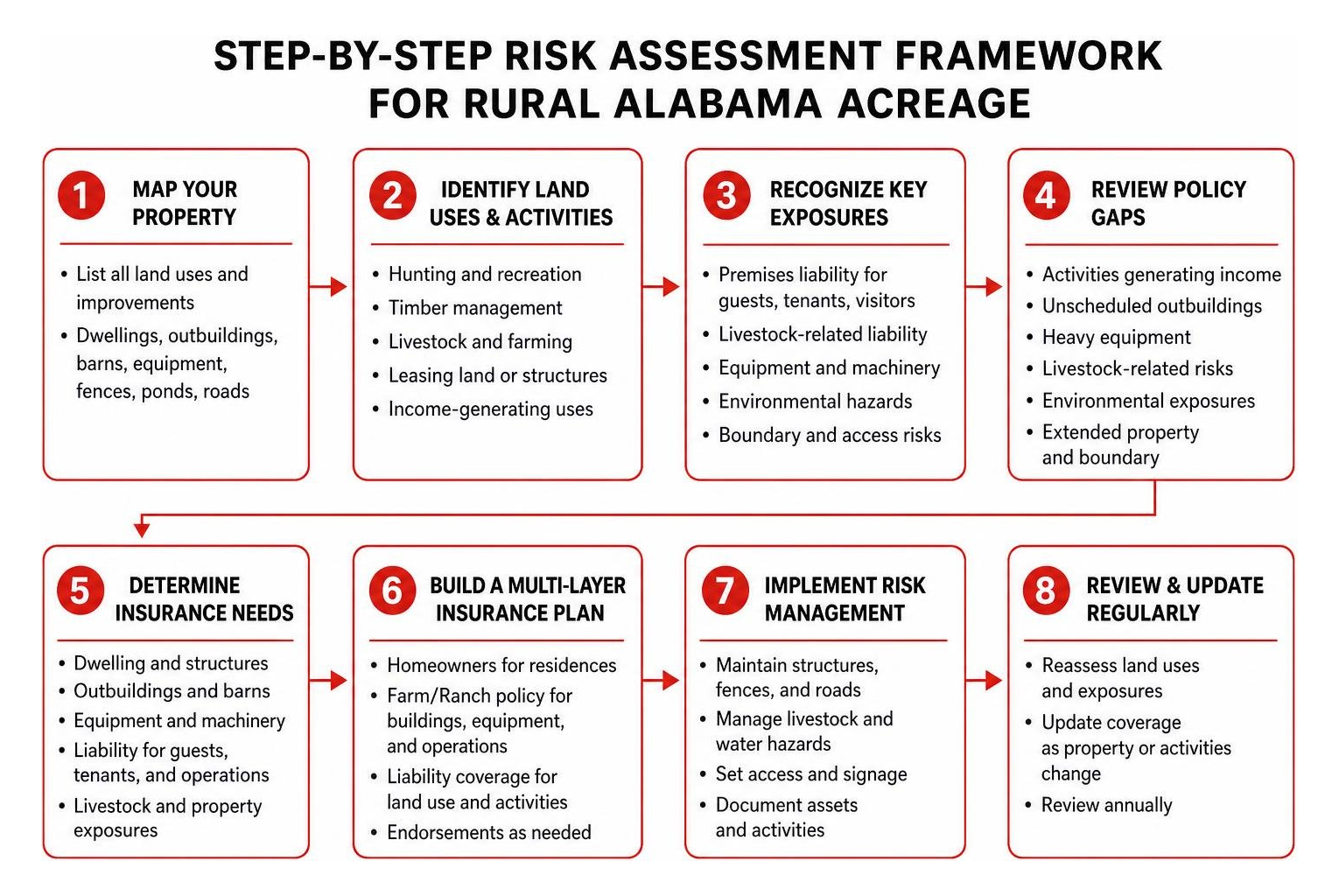
To protect rural holdings properly, landowners must build a multi-layered insurance structure that accounts for residential dwellings, active agricultural operations, guest or tenant recreational activities, and physical infrastructure.
How Do You Insure Hunting Land and Manage Lease Liability in Alabama?

Hunting is an integral part of Alabama’s outdoor heritage and rural economy. Many landowners maintain acreage strictly for personal hunting with family and friends, while others lease rights to local hunting clubs or individual hunters to generate supplemental income. Hunting lease rates across Alabama generally command $10 to $20 per acre annually, providing consistent cash flow that helps offset annual property taxes and land management costs.
However, the moment money changes hands—or members of the public enter your property to discharge firearms, build tree stands, and operate all-terrain vehicles (ATVs)—your exposure shifts dramatically. Personal homeowners liability policies routinely exclude any claims arising from commercial activities or leased recreational land. If an invited hunter falls from a poorly secured stand or suffers an accidental gunshot wound on your leased acreage, you could face devastating out-of-pocket legal defense costs and settlement judgments without specialized liability coverage.
Alabama Hunting Lease Liability Group Insurance Policy Details
For private landowners leasing acreage for recreational purposes, securing specialized hunting lease liability insurance is essential. Landowners can obtain coverage through individual commercial policies or by participating in group liability programs such as those coordinated through organizations like the Alabama Forest Owners’ Association (AFOA).
These group liability programs are specifically tailored to the legal and operational landscape of Alabama timber and hunting acreage:
- Commercial General Liability (CGL): Typically provides $1,000,000 per occurrence with aggregate limits of $2,000,000, defending you against bodily injury and property damage lawsuits.
- Property Damage Liability to Leased Property: Covers accidental fire damage caused by hunters to timber stands, pastures, and designated structures.
- Guest Medical Payments: Provides direct medical expense reimbursement (often $5,000 per person) for minor injuries sustained on the premises, helping resolve incidents without protracted litigation.
To qualify for these group programs, applicants must hold clear title to the property and maintain active membership in the sponsoring association. When completing application forms, ensure that legal tract descriptions, total acreage figures, and hunting club details match your formal written lease agreements exactly. Submitting inaccurate acreage or omitting named club leaders can delay coverage activation or leave specific tracts uninsured during hunting season.
Protecting Landowners and Hunting Clubs Through Endorsements and Waivers
Securing an insurance policy is only the first line of defense; legal risk management must support your financial protection. When leasing land, we recommend implementing a three-point protection protocol:
- Draft a Formal Written Lease: Never rely on verbal handshakes. A comprehensive lease agreement must outline explicit safety rules, authorized hunting zones, firearm restrictions, and ATV speed limits.
- Require Mandatory Indemnification and Hold Harmless Clauses: Contracts must clearly state that the hunting club or tenant will defend, indemnify, and hold the landowner harmless from any claims arising from their use of the property.
- Name Landowner as an “Additional Insured”: Require the hunting club to purchase their own liability policy and list you (the landowner) as an Additional Insured on the certificate of insurance. This ensures the club’s insurance pays first in the event of an incident on the leased acreage.
Landowners should also consult established resources such as landowner liability research and natural resource enterprise guidance to understand how recreational use statutes apply to their property. While Alabama law offers recreational use immunity when private land is opened to the public for outdoor recreation without a fee, that statutory immunity is generally forfeited when you collect lease fees or charge per-gun access. Managing physical hazards—such as capping open abandoned wells, posting marked boundaries, inspecting bridges or culverts, and regulating tree stands—remains a fundamental duty of rural landownership.
How Does Farm Insurance Differ from Standard Homeowners Insurance on Alabama Acreage?
Many owners of small acreages operate in a grey area between a traditional rural residence and a working commercial farm. A personal homeowners policy is designed exclusively to protect private residential property and personal non-business liability. Once your acreage involves tractors, livestock, harvested crops, or barns housing specialized equipment, a standard policy leaves vast protection deficits.
Learning how to compare rural property insurance options enables you to choose policies that blend residential comfort with robust commercial agricultural endorsements.
Core Distinctions Between Homeowners and Farm Property Policies
Standard homeowners insurance (such as an HO-3 policy) caps outbuilding coverage (Coverage B – Other Structures) at a flat 10% of the dwelling’s insured value. For example, if your rural home is insured for $350,000, your policy provides a maximum of $35,000 to cover all external structures combined. On rural Alabama land, a modern equipment barn, a detached workshop, and perimeter fencing can easily exceed $100,000 to replace. Furthermore, homeowners policies routinely exclude any structure used in whole or in part for farming or business storage.
Dedicated farm property coverage solves this limitation by scheduling each outbuilding separately under Agreed Value or Replacement Cost terms, utilizing Special Form coverage to safeguard against broad perils including windstorms, collapse, fire, and vandalism. Structuring proper farm house insurance coverage ensures your home, garage, and dedicated agricultural outbuildings are protected under a unified, tailored policy.
Coverage for Hobby Farms, Livestock, and Working Structures
A common question among rural property buyers is when a hobby farm needs farm insurance instead of homeowners. If you keep a few chickens, maintain a vegetable garden for family consumption, and own a small utility tractor solely for lawn maintenance, an extended homeowners endorsement may suffice. However, if you sell eggs or produce at a local market, board horses, raise cattle for sale, or maintain more than a nominal number of livestock, insurers classify the property as an agricultural operation.
Farm liability policies protect you against several critical farm-specific risks:
- Livestock Escape Liability: If a cow or horse breaks through a pasture fence and wanders onto a county highway or state route, causing a severe motor vehicle collision, standard personal liability may reject the claim. Farm liability explicitly covers bodily injury and property damage resulting from escaped livestock.
- Livestock Mortality and Theft: Coverage options protect against the loss of valuable cattle, horses, or specialty livestock due to lightning strikes, fire, drowning, or theft.
- Custom Farming and Agritourism: Endorsements can protect you if you perform contract hay baling for neighbors or host seasonal farm visitors.
| Policy Feature | Standard Homeowners Policy | Farm Property & Liability Policy |
|---|---|---|
| Outbuilding Limits | Restricted to ~10% of dwelling value | Scheduled individually at full replacement value |
| Agricultural Liability | Excluded (strictly personal liability) | Included for farm operations, livestock, and sales |
| Tractors & Implements | Very limited; excluded if used commercially | Covered on and off-premises against damage and collision |
| Livestock Coverage | No coverage for injury, loss, or road escape | Covered for mortality perils and third-party liability |
| Fencing & Corrals | Minimal coverage; often depreciated heavily | Scheduled per linear foot or total replacement valuation |
Farm Equipment, Off-Premises Machinery, and Harvest Protection
Modern tractors, front-end loaders, balers, and implements represent substantial capital investments. Farm equipment insurance protects these valuable assets against physical damage caused by collision, overturning, fire, lightning, theft, and vandalism.
Additionally, because farmers frequently move equipment along public corridors between separated fields, securing specialized coverage for off-premises equipment is critical. Standard auto insurance will not cover an unhitched implement or tractor operating on a roadway, and standard property insurance terminates coverage once machinery leaves your parcel boundaries. Farm equipment endorsements bridge this gap, ensuring continuous protection whether your machinery is parked in a machine shed, operating in an open field, or traversing rural highways.
What Unique Risks and Property Factors Impact Rural Alabama Acreage?

Insuring rural acreage in Alabama requires an understanding of distinct environmental, structural, and legal factors that underwriters evaluate when calculating premiums and establishing coverage terms.
Emergency Response Distance and Fire Protection Class
One of the largest cost drivers for rural property insurance is the ISO (Insurance Services Office) Public Protection Classification (PPC) rating. In rural Alabama, many properties are located more than five road miles from the nearest responding volunteer fire department and lack access to pressurized municipal fire hydrants within 1,000 feet.
When a property falls into a Class 9 or Class 10 rating due to extended response times and limited water access, base property insurance rates can increase considerably. Understanding the specific fire coverage limits for rural homes is vital when structural replacement takes longer and emergency resources are distant.
Furthermore, rural infrastructure such as private water wells and septic tank systems—which cost between $5,000 and $15,000 to install or replace—require dedicated equipment breakdown and utility service line endorsements to cover pump failures, electrical surges, or subterranean pipe collapses.
Climate Hazards, Timber Risks, and Severed Mineral Rights
Alabama receives an average of 55+ inches of annual rainfall, providing exceptional growing conditions for commercial timber stands of loblolly pine and southern hardwoods. However, our climate also exposes rural acreage to severe thunderstorms, straight-line winds, hail, and tornadoes.
When purchasing rural acreage, review county flood maps and deed restrictions carefully. As highlighted in the Alabama land buying and due diligence guide, mineral rights are frequently severed from surface rights across Alabama. If a third party owns subterranean mineral or timber rights, their right of ingress and egress can create distinct liability and property complications that must be reviewed during title examination and insurance structuring.
Diverse Residential Dwellings on Rural Acreage
Rural landowners often build non-traditional dwellings, including custom barndominiums (steel-frame barn homes), log cabins, and modular structures. Additionally, private parcels often include secondary manufactured homes used as hunting cabins or tenant housing. Securing proper insurance for a manufactured home on private land requires matching the carrier to the home’s specific foundation type, tie-down anchoring, and age classification.
What Factors Determine Rural and Farm Insurance Costs in Alabama?
Insurance premiums for rural property and farms in Alabama are determined by a combination of physical property attributes, operational scale, and liability exposure levels.
Cost Ranges by Acreage and Operation Scale
While premiums vary based on specific building values and coverage selections, typical rural insurance costs across Alabama reflect predictable ranges:
| Property Classification | Typical Size | Common Coverage Inclusions | Estimated Annual Premium |
|---|---|---|---|
| Small Hobby Farm / Homestead | 5 – 25 Acres | Dwelling, small barn, basic hobby farm liability, utility tractor | $600 – $1,200 ($50–$100/mo) |
| Mid-Size Family Farm / Pasture | 50 – 150 Acres | Main home, 2–3 outbuildings, livestock liability, equipment schedule | $2,000 – $3,000 |
| Timber & Hunting Lease Tract | 100 – 500 Acres | Vacant land liability, hunting lease rider, fire damage to timber | $350 – $1,000 |
| Large Commercial Ag Operation | 1,500+ Acres | Multiple dwellings, extensive machinery fleet, commercial liability, grain storage | $5,000+ |
Underwriting Criteria and Premium Discounts
Insurers evaluate several risk mitigation factors when pricing rural policies:
- Controlled Access: Installing gated entries, maintained perimeter fencing, and clearly posted “No Trespassing” boundary signs reduces unauthorized access and premises liability exposure.
- Defensible Space and Fire Protection: Clearing dead brush and overhanging timber within 100 feet of all dwellings and barns significantly reduces wildfire vulnerability. Maintaining operational, inspected fire extinguishers in all machine sheds and workshops can earn policy credits.
- Property Maintenance & Loss History: Demonstrating clean loss records and regular maintenance on electrical wiring, roofs, and heating systems in older barns helps secure preferred underwriting tiers.
- Deductible Structure: Choosing higher property deductibles (such as $2,500 or $5,000) on outbuildings and machinery allows you to keep annual premiums low while reserving insurance payouts for catastrophic losses.
How Can Alabama Landowners Bundle Coverage for Complete Protection?
Rural landowners benefit from coverage that treats the home, farm property, equipment, and recreational liability as one connected risk picture rather than isolated policies. The Hornbuckle Agency helps Alabama families make confident coverage decisions through personalized risk education, clear explanations, and coordinated protection built around the way their land is actually used.
Combining Dwellings, Operations, and Hunting Leases
When you package your personal dwelling, farm buildings, equipment, and hunting lease riders together, you eliminate common jurisdictional disputes between carriers regarding which policy responds during a multi-faceted loss.
Furthermore, landowners with significant assets or public-facing operations should incorporate umbrella insurance over their underlying farm and recreational liability policies. An umbrella policy provides an additional $1,000,000 to $5,000,000 in liability protection, activating if a major catastrophic lawsuit—such as a multi-vehicle highway accident caused by escaped cattle or a severe hunting mishap—exceeds your base policy limits. Exploring specialized farm insurance solutions ensures your operations remain fully resilient against unforeseen liabilities.
Working with a Local Alabama Specialist Agent
For Alabama acreage owners, the right insurance conversation starts with an agency that can translate a complex property into clear coverage priorities. The Hornbuckle Agency brings practical local perspective and one-on-one guidance to families in Albertville, Guntersville, Boaz, Arab, Geraldine, Crossville, Collinsville, Horton, Douglas, and surrounding communities.
A personalized insurance review can turn the details of a rural property, from buildings and equipment to leases and livestock, into a more coordinated protection plan. Protecting your farm and home with ALFA insurance offers a useful next step for discussing the coverage priorities most relevant to a landowner’s situation.
Frequently Asked Questions About Insuring Alabama Rural Property
Does standard homeowners insurance cover hunting accidents on my land?
Generally, no. Standard homeowners policies cover limited personal liability for casual, non-paying social guests on your immediate residential premises. However, if you collect lease fees, charge hunting club dues, or permit regular shooting activities across raw acreage away from your primary dwelling, homeowners policies routinely exclude those claims under business pursuits or recreational property exclusions. A dedicated hunting lease liability policy or specialized acreage endorsement is required.
Do I need a separate policy if I lease my land to an Alabama hunting club?
Yes. Once you lease land for hunting, the property is classified as an income-generating recreational property. You can either purchase a standalone hunting lease liability policy, enroll in a landowner group liability program through an association, or require the hunting club to purchase an approved club liability policy that names you as an Additional Insured on the certificate of insurance.
How does distance from a fire department affect my rural insurance premium?
Insurance carriers utilize ISO ratings from 1 to 10 to evaluate local fire suppression capabilities. If your rural property is located more than five miles from the nearest responding station or lacks a municipal fire hydrant nearby, it is typically rated Class 9 or 10. This higher rating increases base property insurance rates. You can offset these costs by maintaining defensible brush clearings, keeping functional fire extinguishers in all barns, and installing monitored smoke and security alarms.
How Should You Begin Documenting and Protecting Your Rural Alabama Land?
Protecting your investment in rural Alabama acreage begins with proactive documentation and a structured insurance review:
- Conduct a Comprehensive Asset Inventory: Walk your acreage and document every dwelling, barn, pole shed, workshop, and wellhouse with date-stamped photographs and video. Record serial numbers, makes, models, and purchase receipts for all tractors, implements, and utility vehicles.
- Audit Boundary Lines and Signage: Verify your physical property boundaries against your legal deed survey. Ensure that perimeter gates are secured and that visible, weather-resistant boundary markers and “No Trespassing” signs are posted along public road frontages.
- Review Written Agreements: Check all current hunting leases, timber contracts, or pasture rental agreements to ensure they contain up-to-date hold harmless clauses and proof of active liability insurance naming you as an Additional Insured.
- Schedule an On-Farm Insurance Review: Meet with a local specialist to review your existing property declarations, verify outbuilding replacement valuations, and eliminate any gaps between your residential and operational liability limits.
Whether you manage timber acreage, run a working family farm, or lease land to a local hunting club, a personalized review can help align coverage with the risks that matter most to your property, operations, and long-term plans.
