
How to Compare Small Business Insurance Options
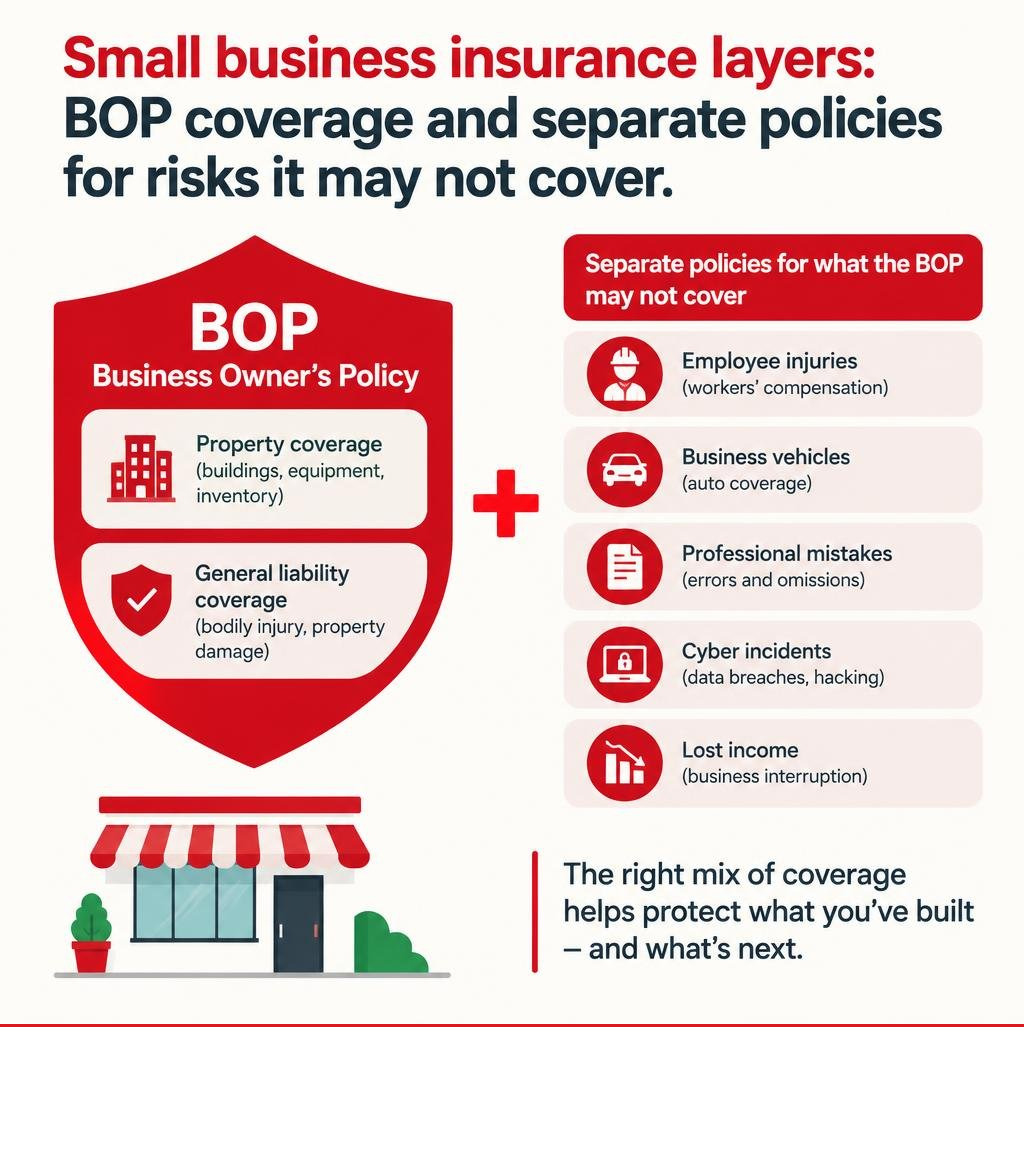
Start with the risks your business faces. A business owner’s policy (BOP) usually combines property and general liability coverage, making it a useful starting point for many small businesses. Then check what it leaves out. You may need separate coverage for employee injuries, business vehicles, professional mistakes, cyber incidents, or lost income after a covered property loss. Compare each option’s limits, deductibles, and exclusions, not just its price.
Why Commercial Coverage Matters for Small Enterprises
Running a business takes vision, grit, and significant capital. Yet, unexpected events—a customer slip-and-fall, an unexpected kitchen fire, or severe wind damage—can disrupt operations in seconds. Commercial protection serves as a financial safeguard, ensuring that a single covered loss does not wipe out your hard-earned progress.
Beyond shielding physical property and cash reserves, coverage plays a pivotal operational role. Many commercial lenders require comprehensive asset and liability policies before approving loans or lines of credit. Commercial leases frequently mandate minimum general liability limits before landlords hand over the keys.
Maintaining the right policies builds instant credibility with clients, vendors, and regulatory bodies. As emphasized by rural development advocates, protecting your small business: the importance of insurance extends beyond basic survival—it establishes a stable foundation for long-term growth. When you are just launching, securing essential business insurance before serving your first customer prevents immediate operational disruptions.
Understanding Property Coverage: Basic, Broad, and Special Forms
Commercial property insurance protects physical assets—such as your building, office furnishings, inventory, and specialized equipment. When evaluating commercial property policies, the specific form determines which perils are included.
- Basic Form: Covers specific “named perils” explicitly listed in the policy document, such as fire, lightning, windstorm, hail, smoke, explosion, vandalism, and civil commotion. If a peril is not listed, the resulting loss is not covered.
- Broad Form: Includes all basic causes of loss while adding protections for falling objects, the weight of ice and snow, accidental water discharge from plumbing systems, and structural collapse caused by specified hazards.
- Special Form: Delivers the widest protection by operating on an “open perils” basis. It covers direct physical loss from any cause except those specifically excluded (such as standard exclusions for war, nuclear hazard, government seizure, or routine wear and tear).
| Coverage Feature | Basic Form | Broad Form | Special Form |
|---|---|---|---|
| Form Type | Named Perils | Named Perils | Open Perils |
| Standard Perils (Fire, Wind, Hail) | Yes | Yes | Yes |
| Vandalism & Smoke | Yes | Yes | Yes |
| Water Damage (Plumbing System) | No | Yes | Yes |
| Weight of Ice/Snow & Falling Objects | No | Yes | Yes |
| Burglary/Theft of Inventory | Limited | Limited | Comprehensive (unless excluded) |
| Unlisted Accidental Losses | Not Covered | Not Covered | Covered |
Replacement Cost vs. Actual Cash Value
When setting up your commercial property policy, how a claim is settled matters just as much as the perils listed. Insurers settle property claims using one of two primary valuation methods:
- Actual Cash Value (ACV): Calculates the cost to repair or replace damaged property minus accumulated depreciation from age, wear, and market obsolescence. While ACV policies feature lower monthly premiums, your settlement payout could fall short of purchasing brand-new replacement equipment.
- Replacement Cost Value (RCV): Reimburses the actual cost to repair or replace damaged items with new materials of comparable quality, without any deduction for physical depreciation.
As detailed in state regulatory resources like the Consumer’s Guide to Insurance for Small Business Owners, selecting replacement cost coverage ensures your enterprise can buy new equipment and rebuild facilities without draining operating capital.
Core Types of Small Business Insurance Policies to Consider
Every company has unique operational risks, but several foundational coverages form the backbone of a strong risk management plan.
Business Owner’s Policies: The All-in-One Small Business Insurance Option
A Business Owner’s Policy (BOP) combines essential property insurance and general liability protection into one policy that covers common property and liability exposures. Instead of purchasing separate policies for every individual risk, a BOP can simplify the coverage process.
A standard BOP typically covers:
- Commercial Property: Structures, office furniture, point-of-sale systems, and stored inventory.
- General Liability: Defense costs and damages for third-party bodily injury, slip-and-falls on the premises, property damage, and advertising injury.
- Business Income Insurance: Replaces lost revenue and covers ongoing payroll if a direct covered property loss halts operations.
While a BOP is convenient and cost-effective, it does not cover everything. Professional mistakes, commercial auto claims, and employee workplace injuries require specialized endorsements or separate policies.
Key Liability Protections: Professional, Product, and Excess Umbrella
General liability covers physical accidents on your property, but modern business exposures often involve professional advice, manufactured products, or catastrophic legal judgments.
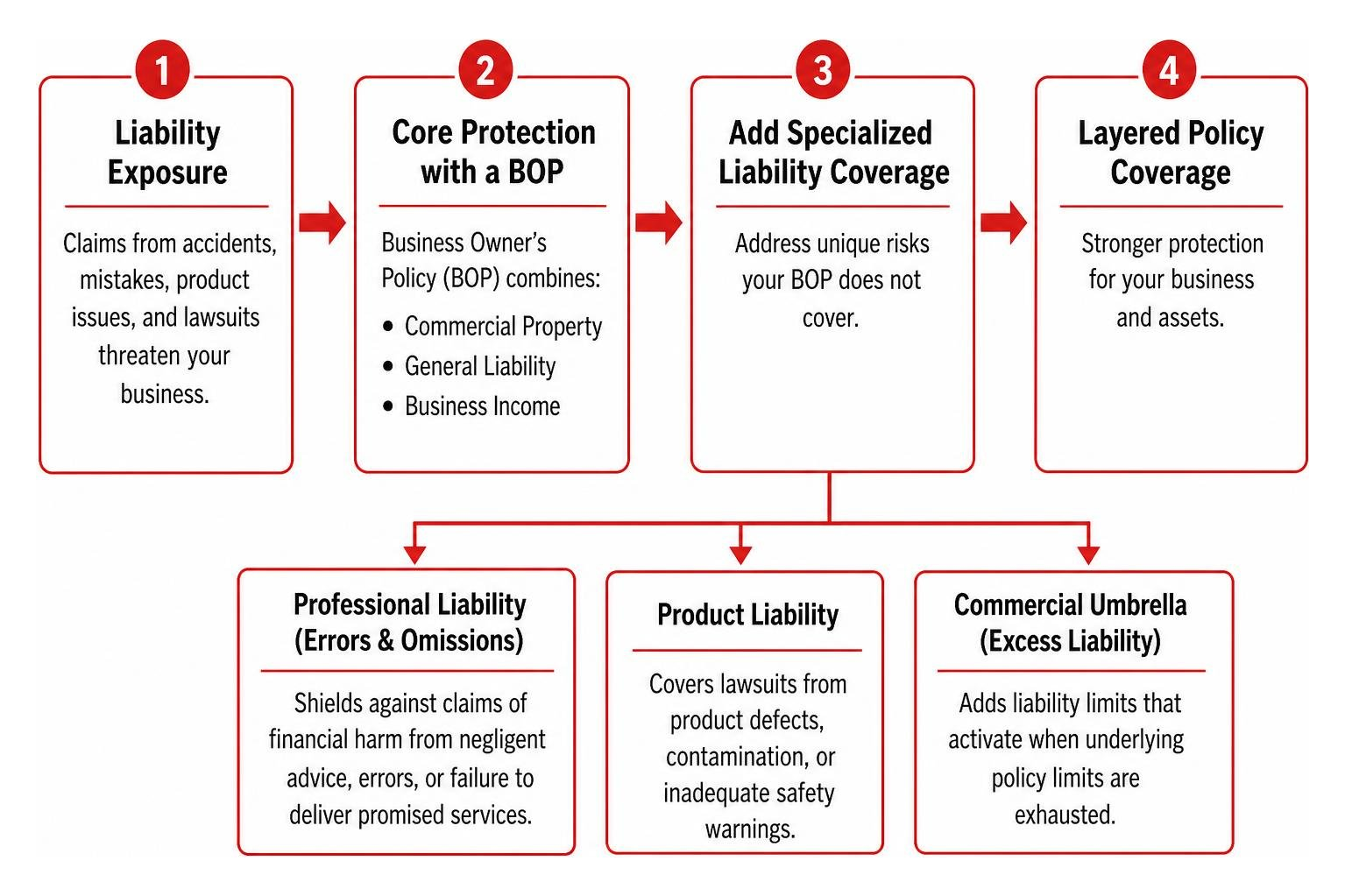
- Professional Liability (Errors & Omissions): Essential for consultants, accountants, counselors, and designers. It shields against claims of financial harm resulting from negligent advice, administrative errors, or failure to deliver promised services.
- Product Liability: Covers manufacturers, wholesalers, and retail shops against lawsuits arising from product defects, contamination, or inadequate safety warnings.
- Commercial Umbrella (Excess Liability): Provides additional liability limits that activate when your underlying general liability, employer’s liability, or commercial auto coverage limits are exhausted.
Understanding these liability structures is critical; as highlighted in analyses of LLC business insurance structures, creating an LLC provides a personal liability veil, but it does not shield the company’s own assets from commercial lawsuits.
Business Interruption and Extra Expense Protection
Physical repairs after a fire, storm, or burst pipe take time. Business interruption insurance steps in during the reconstruction period by replacing lost operational profits, covering essential employee payroll, and handling recurring debt obligations.
Additionally, extra expense coverage reimburses the temporary costs required to keep your business operating from an alternate location, such as leasing temporary office space, renting mobile equipment, or installing emergency utility connections.
Mandatory Policies and Legal Requirements for Employers
Beyond voluntary property and liability insurance, certain policies are mandated by state and federal laws. Complying with these statutes ensures you avoid heavy regulatory fines, business license suspensions, and stop-work orders.
For a detailed review of regional compliance standards, consult our comprehensive guide on required commercial business insurance in Alabama.
Workers’ Compensation and Commercial Auto Mandates
State laws establish specific triggers for compulsory employer coverage:
- Workers’ Compensation: Covers medical bills, vocational rehabilitation, and partial wage replacement for employees who suffer job-related injuries or illnesses. In Alabama, employers who regularly employ five or more employees (including full-time, part-time, and corporate officers) must carry workers’ compensation coverage. Operating without required coverage leaves business owners exposed to personal liability for workplace injuries alongside state civil penalties.
- Commercial Auto Insurance: Vehicles titled to a business or used for daily commercial operations—such as transporting equipment, hauling materials, or delivering goods—require commercial auto policies. Personal auto policies almost always exclude losses incurred during commercial work. If staff members use their personal cars to complete company errands, adding hired and non-owned auto coverage is essential. For further details, see our guide on whether personal auto insurance covers driving for your business.
Affordable Care Act and Small Business Health Coverage
Under the Affordable Care Act (ACA), the Small Business Health Options Program (SHOP) helps small enterprises offer high-quality health and dental plans to their staff:
- The 50 FTE Threshold: Employers with fewer than 50 full-time equivalent (FTE) employees are not subject to the ACA Employer Shared Responsibility provisions and do not face penalties if they choose not to offer group health insurance.
- Small Business Health Care Tax Credit: Qualified small businesses with fewer than 25 full-time equivalent employees, paying average annual wages below indexed federal thresholds, and contributing at least 50% toward employee premium costs can claim tax credits worth up to 50% of their premium contributions.
Specialized Coverage Needs: Home-Based and Non-Standard Risks
Many modern businesses operate outside traditional storefronts and commercial office parks. Remote setups, private suites, and seasonal ventures present unique insurance challenges.

Protecting Home-Based Ventures and Studio Rentals
A standard homeowners insurance policy provides very limited protection for business-related property (often capped at $2,500 on-premises) and explicitly excludes third-party commercial liability. If a delivery courier slips on your front porch while dropping off business inventory, your homeowners policy may deny the claim.
To address these gaps, home-based entrepreneurs have several options:
- Homeowners Business Endorsement: Adds higher coverage limits for business equipment and basic on-site client liability to an existing home policy.
- In-Home Business Policy: A standalone package tailored for home operations, offering broader liability protection and coverage for off-premises business property.
- Commercial Business Owner’s Policy: Provides complete property and liability coverage for home-based enterprises with high asset values or frequent client visits.
Review our ultimate checklist for business-at-home insurance coverage and our beginner’s guide to homeowners insurance for a home-based business to ensure your home workspace is properly secured.
If you rent a specialized workspace, such as a salon booth or health studio, see our practical guide to insurance for private suite rentals. For unique agritourism or seasonal events, review our comparative guide for fall festival insurance.
Options When Standard Insurance Is Denied
Certain businesses struggle to secure coverage in the standard commercial market due to prior loss history, hazardous operations, or unique liability profiles (such as demolition contracting or specialized manufacturing).
When standard admitted carriers decline a policy, business owners can access the Excess and Surplus (E&S) lines market. Surplus lines carriers take on non-standard, higher-hazard risks that traditional insurers decline, providing crucial operational protection when standard avenues are unavailable.
How to Shop for Insurance and Manage Long-Term Risk
Securing appropriate commercial insurance requires balancing comprehensive protection with budget constraints. Taking a structured approach helps you obtain strong coverage at competitive premium rates.
- Conduct a Thorough Risk Assessment: Identify your physical assets, revenue exposure, daily operational hazards, and contractual requirements.
- Work with an Experienced Local Agent: Dedicated local agents provide personalized risk education, helping you select coverage tailored to your industry rather than relying on generic online algorithms.
- Verify Carrier Financial Strength: Review financial stability ratings from independent rating agencies like A.M. Best or Standard & Poor’s to ensure your carrier has the capital reserves to pay claims during catastrophic events.
- Choose Appropriate Deductibles: Selecting higher deductibles can lower annual premiums. However, ensure your business maintains sufficient liquid cash reserves to cover that deductible comfortably if a loss occurs.
Avoiding Common Small Business Insurance Pitfalls
Small enterprise owners frequently encounter several common coverage pitfalls:
- Underinsuring Assets: Failing to increase property limits after purchasing new equipment or upgrading facilities leaves you exposed to coinsurance penalties and out-of-pocket replacement costs.
- Misclassifying Workers: Labeling employees as independent contractors to avoid workers’ compensation premiums can trigger severe state penalties, back-tax assessments, and unpaid injury claims.
- Overlooking Cyber and Data Breach Risks: Relying solely on basic property and liability coverage leaves you vulnerable to ransomware attacks, customer data theft, and electronic wire fraud.
- Assuming LLC Registration Replaces Insurance: An LLC structure shields personal assets from some business debts, but it does not protect commercial equipment from storm damage or defend the company in court against a third-party injury lawsuit.
Proactive Risk Management Strategies to Lower Premiums
Insurers reward proactive loss prevention. Implementing basic risk management protocols reduces claim frequency and keeps your commercial premiums affordable:
- Fire Suppression & Security Systems: Install monitored commercial fire alarms, automatic sprinkler networks, and video surveillance to qualify for underwriting credits.
- Safety Programs & Employee Training: Maintain clear workplace safety guidelines, conduct regular hazard inspections, and enforce equipment protocols to lower workers’ compensation claim rates.
- Rigorous Contractual Risk Transfer: Require subcontractors and service vendors to supply Certificates of Insurance naming your enterprise as an Additional Insured before starting work on your job site.
Frequently Asked Questions About Small Business Coverage
How much coverage does an LLC typically need?
Most small LLCs begin with a foundational General Liability policy featuring limits of $1 million per occurrence and $2 million aggregate. However, the ideal coverage level depends directly on your industry risk, physical asset values, payroll size, and lease requirements. Service firms also require professional liability, while LLCs with staff need state-mandated workers’ compensation.
Can a homeowner’s policy cover a home-based business?
No. Standard homeowner policies explicitly exclude commercial liability claims and provide very low sub-limits (typically $2,500) for business personal property. Home-based owners need a dedicated business endorsement, an in-home commercial policy, or a standalone Business Owner’s Policy.
When is an umbrella liability policy necessary?
An umbrella policy is recommended whenever your business faces catastrophic loss scenarios that could exceed standard primary limits ($1 million). It is especially valuable for businesses that operate commercial vehicles, manage high foot traffic, handle large commercial contracts, or oversee high-hazard operations.
Conclusion
Securing the right commercial insurance is an ongoing business practice, not a one-time transaction. As your revenue grows, equipment expands, and staffing levels change, your insurance coverage must adapt to match your evolving exposures. Scheduling annual policy reviews with a knowledgeable local professional ensures your company remains fully protected against unexpected setbacks.
The Hornbuckle Agency provides personalized risk education and tailored commercial coverage for enterprises throughout Marshall County and surrounding areas. We proudly serve business owners across Albertville, Guntersville, Boaz, Arab, Geraldine, Crossville, Collinsville, Horton, and Douglas.
Explore our custom commercial insurance solutions today to build a comprehensive protection plan tailored to your business goals.
