
How to Choose Breakdown Cover for Older Motorhomes
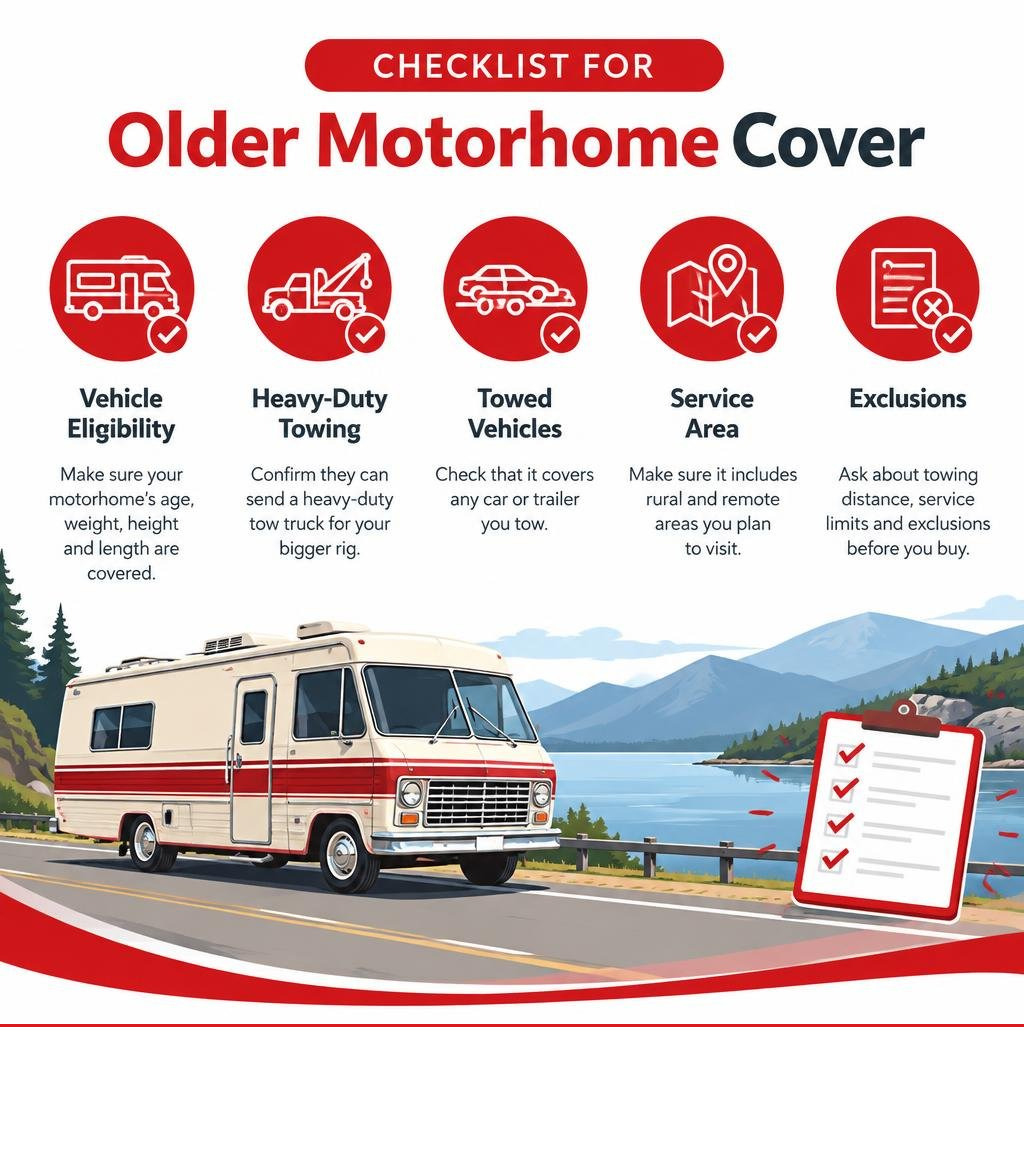
Start with a roadside plan that explicitly accepts your motorhome’s age, weight, height, and length. Then confirm it can send a heavy-duty tow truck, help in the rural areas you travel, and transport any car or trailer you tow. Standard auto roadside assistance may not cover the whole rig. Ask about towing distance, service limits, and exclusions before you buy.
An older motorhome can be harder to move and repair than a car, especially when parts are scarce. Keep service records, and check whether your RV insurance already includes roadside help so you do not pay twice for limited coverage.
Basic breakdown cover for older motorhomes vocab:
- mobile home insurance
- mobile home insurance cover
Understanding Breakdown Cover for Older Motorhomes and Vintage RVs
Owning a vintage rig or an aging coach brings a unique sense of freedom. Whether you are driving a 1990s diesel pusher or a classic campervan from the 1980s, these vehicles have character that modern RVs rarely match. However, seasoned mechanical systems encounter unique stresses on modern U.S. highways. As of October 2026, finding specialized emergency dispatch for aging coaches requires understanding modern towing networks and fleet capabilities.
Older motorhomes carry substantial weight over complex suspension setups, carbureted or early fuel-injected engines, aging cooling packages, and older wiring harnesses. When a component fails on an interstate shoulder or a rural highway, standard passenger-car roadside programs rarely have the operational framework to help. Understanding how emergency assistance works for heavy leisure vehicles is the first step toward safeguarding your travel budget.
Unique Challenges of Breakdown Cover for Older Motorhomes
Securing reliable protection for an older RV involves distinct mechanical and logistical hurdles. As vehicles age, finding qualified mechanics who understand older carburetion systems, vintage air brake setups, or obsolete electrical layouts becomes difficult. When a breakdown occurs, a standard neighborhood garage often lacks the bay height, heavy lifts, or diagnostic tools needed to service a Class A or Class C motorhome.
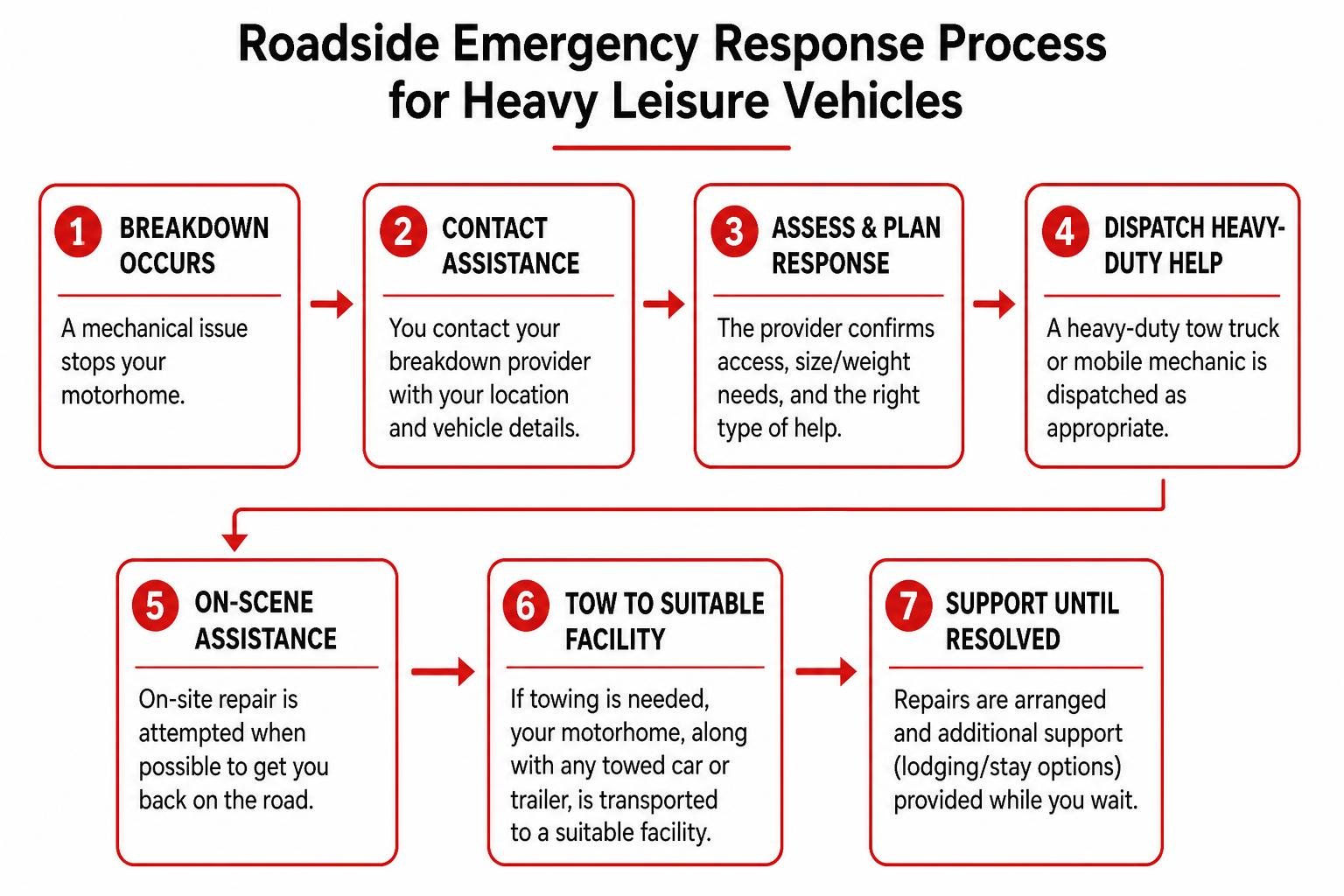
Furthermore, sourcing replacement parts for an engine or chassis built decades ago can cause significant delays. If an alternator, water pump, or steering component fails, regional warehouses might need days to locate and ship a compatible part. When you are far from home, connecting with network partners such as Mobile RV Repair in Birmingham, AL can resolve on-site mechanical faults without the added expense of an immediate long-distance tow. Specialized roadside protection accounts for these delays by providing lodging stipends, dispatching mobile mechanics, and coordinating with facilities capable of handling larger recreational vehicles.
Weight, Height, and Length Restrictions to Watch For
The most common pitfall for vintage RV owners is purchasing roadside assistance with restrictive vehicle dimension caps. Standard personal vehicle roadside programs typically impose a Gross Vehicle Weight Rating (GVWR) limit of 10,000 lbs (standard Class 1 and Class 2 passenger vehicles). A fully loaded Class A or large Class C motorhome frequently weighs between 14,000 and 30,000 lbs or more, instantly invalidating basic auto club plans during a breakdown.
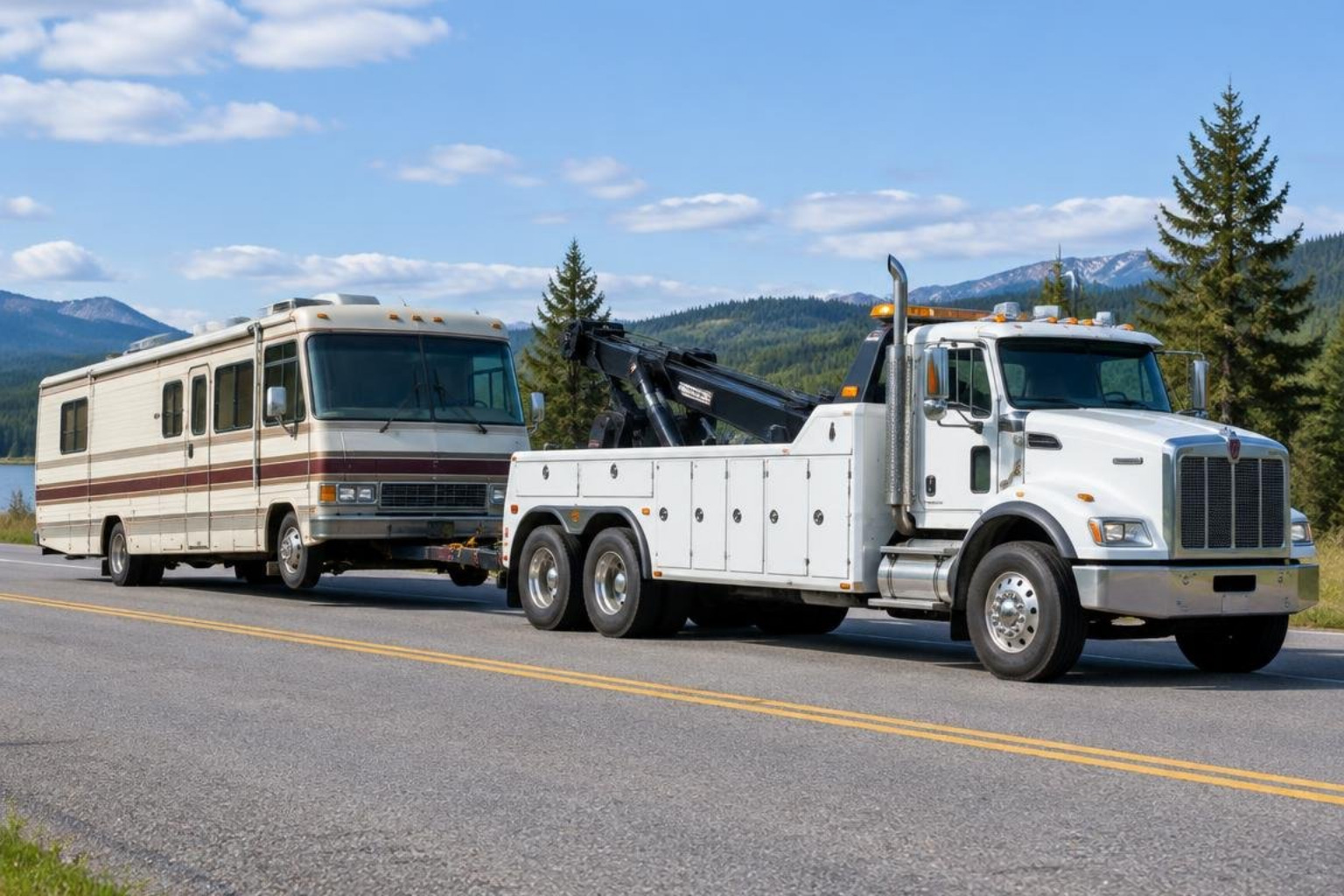
Height and length dimensions also dictate the type of recovery equipment required. A 36-foot motorhome with rooftop air conditioners standing 12 to 13.5 feet high cannot be pulled onto an ordinary flatbed tow truck. It requires a specialized low-boy heavy wrecker or wheel-lift configuration with auxiliary air-line hookups to release the rig’s air brakes safely. Dedicated RV programs (such as Coach-Net and Good Sam) and specialized insurer endorsements are structured specifically to deploy commercial Class 7 and Class 8 recovery units capable of transporting heavy platforms without undercarriage or roof damage.
| Coverage Feature | Standard Auto Roadside Plan | Dedicated Motorhome Breakdown Cover |
|---|---|---|
| Gross Vehicle Weight (GVWR) | Typically capped at 10,000 lbs (Class 1–2 passenger vehicles) | Accommodates 14,000 to 30,000+ lbs, with leading RV plans offering uncapped weight for listed rigs |
| Vehicle Dimensions | Standard passenger car widths and heights (under 8 ft wide) | Accommodates heights over 10 to 13.5 ft and lengths up to 45 ft |
| Recovery Equipment | Standard light-duty flatbeds or wheel lifts | Heavy-duty commercial wreckers, low-angle flatbeds, air supply hookups |
| Towed Equipment / Trailers | Excluded or requires separate, extra-fee policy | Covers both motorhome and towed vehicle/trailer simultaneously |
| Habitational Components | No coverage for onboard domestic systems | Support for auxiliary leisure batteries, lockouts, and water connections |
Key Differences Between Motorhome and Standard Auto Roadside Plans
Motorhome roadside assistance differs fundamentally from personal passenger car coverage. While a standard vehicle breakdown policy focuses on changing a light spare tire or jumpstarting an ordinary starter battery, an RV policy must address both mechanical propulsion and living quarter support.
When you configure your overall auto insurance portfolio, integrating specialized breakdown options ensures that heavy equipment operators respond when trouble arises.
Vehicle-Based vs. Driver-Based Emergency Cover
When shopping for emergency assistance, you will encounter two primary coverage structures:
- Vehicle-Based Cover: This policy attaches directly to your specific motorhome chassis Identification Number (VIN). Regardless of who is driving—whether it is you, a family member, or a designated relief driver—the motorhome is covered. This structure is ideal for families who share driving duties on long vacations.
- Driver-Based (Personal) Cover: This follows the individual member. You receive emergency dispatch services in any vehicle you operate or ride in as a passenger. However, driver-based policies often contain strict small-vehicle exclusions that disqualify heavy motorhomes unless you explicitly buy a specialized leisure-vehicle endorsement.
For owners of vintage coaches, vehicle-based coverage offers predictable protection. It guarantees that the unique weight, length, and heavy-duty towing requirements of the specific rig are permanently noted in your dispatch profile.
Towing Capacity for Motorhomes and Attached Trailers
Many motorhome owners tow a secondary vehicle—often called a “toad” or dinghy vehicle—or pull a utility trailer carrying supplies, golf carts, or motorcycles. A major vulnerability in generic motor club coverage is the treatment of attached trailers.
If your motorhome suffers an engine failure on an isolated route while cruising Sand Mountain with dependable vehicle protection, a standard wrecker might disconnect and leave your towed vehicle on the roadside while transporting only the motorhome. Dedicated RV programs manage dual-vehicle recovery, dispatching secondary wreckers or multi-vehicle flatbeds to transport your entire setup safely to the same repair facility.
Essential Policy Options and Coverage Considerations
Older motorhomes require more than a basic hook-and-tow policy. As repair costs and heavy-wrecker fees rise, comparing comprehensive plan structures helps you avoid massive out-of-pocket expenses during a mechanical failure. Reviewing finding the best coverage for your ride provides helpful perspective on structuring financial safeguards for valuable family vehicles.
Selecting Breakdown Cover for Older Motorhomes with Specialized Needs

When reviewing terms for an older RV, make sure your emergency service includes assistance with specialized components:
- Auxiliary & Leisure Battery Support: Older motorhomes utilize complex dual-battery banks: one for starting the engine and deep-cycle banks for habitational electronics. Specialized providers offer testing and jumpstart support tailored to high-amperage 12-volt leisure systems.
- Fuel Delivery and Misfueling Remediation: Accidentally putting gasoline into an older diesel engine (or vice versa) can cause catastrophic mechanical damage. Quality leisure vehicle plans cover draining, flushing, and refilling the system with correct fuel.
- Heavy-Duty Wheel and Tire Changes: Unseating and torquing a 19.5-inch or 22.5-inch commercial truck tire mounted on a dual rear-axle motorhome requires commercial-grade pneumatic jacks and high-torque impact tools. Providers should send mobile technicians serving Albertville, AL who carry specialized truck tire gear.
Long-Distance Road Trips and Interstate Travel Assistance
If you travel across state lines or take month-long camping journeys, evaluating how providers structure long-distance coverage is vital:
- Towing Distance and Dispatch Rules: Basic auto plans often cap towing distance at 3 to 5 miles. Dedicated RV programs manage towing differently based on provider policy: Coach-Net and Good Sam typically authorize unlimited towing mileage to the nearest qualified repair facility equipped to handle heavy RV chassis, whereas club-based options like AAA Premier RV provide towing up to a fixed cap (e.g., one 200-mile tow and up to three 100-mile tows per membership year). Always verify whether your plan tows to the nearest shop or allows destination choice.
- Trip Interruption and Lodging Reimbursement: If an unexpected mechanical failure leaves your motorhome inoperable while you are more than 100 miles from home, trip interruption benefits reimburse hotel lodging, meals, and alternative transportation expenses (typically ranging from $500 up to $2,000 depending on policy tiers) while awaiting repairs.
- Replacement Driver Services: If an unexpected medical emergency prevents the primary driver from safely piloting the motorhome home, premium policies dispatch a professional commercial driver to return the vehicle safely to your residence.
Common Exclusions and Maintenance Requirements for Aging RVs
Every breakdown policy comes with clear conditions. Understanding these limitations prevents claim denials and unexpected roadside expenses. When evaluating overall vehicle protection, comparing vehicle insurance options ensures your collision, liability, and emergency provisions work together seamlessly.
Pre-Existing Faults and Aftermarket Modifications
Roadside assistance is designed for sudden, unforeseen mechanical failures—not deferred maintenance. Common exclusions include:
- Pre-Existing Conditions: If a vehicle was already inoperable before the policy took effect, initial service requests will be denied. Most providers enforce a 24- to 48-hour waiting period before benefits begin.
- Uncertified Electrical Modifications: Older RVs frequently undergo DIY upgrades, such as high-output inverters, lithium battery banks, or aftermarket solar controllers. If an uncertified electrical alteration causes a failure, recovery technicians may decline roadside habitational repairs.
- Unsafe Recovery Locations: If an older motorhome is parked in an off-road area, on unimproved dirt tracks, or bogged down in deep sand or mud off public roads, standard recovery terms may exclude service or require additional fees for heavy winching.
Roadworthiness Standards and Inspection Records
To keep your coverage valid, you must maintain your motorhome in a roadworthy condition under U.S. Department of Transportation standards:
- Tire Age and Safety Limits: Authoritative NHTSA tire safety guidance and recommendations from commercial tire manufacturers (including Michelin and Goodyear) emphasize that RV tires experience internal rubber degradation from UV radiation, heat cycling, and prolonged static storage. Industry standards advise annual professional inspections after year 5 and mandatory replacement between 6 and 10 years of service, regardless of tread depth. Commercial roadside dispatchers may decline tire-change assistance or liability for tire service if the casing exhibits severe dry rot, deep sidewall ozone cracking, or structural tread separation.
- Fluid and Brake Maintenance: Keep comprehensive records showing that oil changes, transmission flushes, coolant replacements, and air/hydraulic brake system services have been performed at regular intervals.
- Annual Mechanical Inspections: Documenting an annual bumper-to-bumper mechanical and chassis inspection provides concrete proof of roadworthiness if a complex roadside claim is questioned.
Frequently Asked Questions About RV Roadside Assistance
Is it better to buy standalone roadside assistance or add an endorsement to an auto policy?
Adding an endorsement to your existing specialty RV insurance policy (through carriers such as Foremost or Progressive) is frequently more economical, often adding modest annual fees to your premium. However, you must verify that the endorsement explicitly covers heavy-duty commercial wrecker dispatch, long-distance towing, and attached trailer recovery. Dedicated standalone RV motor clubs (like Coach-Net or Good Sam) focus exclusively on recreational vehicle networks with technical RV dispatch hotlines, but an insurer-backed roadside endorsement that accommodates your coach’s full weight and dimensions offers dependable coverage with convenient single-bill management.
Are older motorhomes over 15 or 20 years old eligible for full recovery?
Yes. While mechanical warranty and extended service contracts frequently enforce strict age caps (often excluding rigs over 10 to 15 years old), standard U.S. roadside breakdown assistance programs generally accept older coaches provided they are roadworthy, legally registered, and properly insured. Always confirm whether the provider sets specific age cutoffs for specialized habitational system coverage or replacement part location.
How much does reliable breakdown cover cost annually for older rigs?
As of current U.S. pricing benchmarks, roadside assistance costs vary by coverage structure:
- Specialty Insurer Endorsements: Adding roadside dispatch directly to an RV insurance policy typically ranges from $30 to $100 per year.
- Dedicated RV Motor Clubs: Comprehensive standalone plans generally range from $90 to $180 for introductory first-year terms and $150 to $350 annually for standard renewal motorized coach plans (such as Coach-Net RV or Good Sam Premier, or AAA Plus/Premier RV tiers where available through regional auto clubs).
Considering that an out-of-pocket heavy-duty commercial wrecker call easily costs $500 to $1,500+ for hookup, winching, and per-mile towing, dedicated breakdown coverage delivers substantial financial protection.
Conclusion
A well-maintained vintage motorhome can provide years of unforgettable adventures. Ensuring you have the right breakdown protection lets you focus on the open road with complete confidence.
Before your next road trip, review your vehicle weight ratings, inspect your tires and fluid systems, and verify that your emergency assistance program is ready to handle your specific motorhome. The Hornbuckle Agency serves multiple Alabama communities, including Albertville, Guntersville, Boaz, Arab, Geraldine, Crossville, Collinsville, Horton, and Douglas. Contact our team today to explore specialized manufactured home and recreational vehicle insurance solutions that protect your travels wherever the road leads.
